
Mold in Air Ducts: How to Tell and What to Do Next
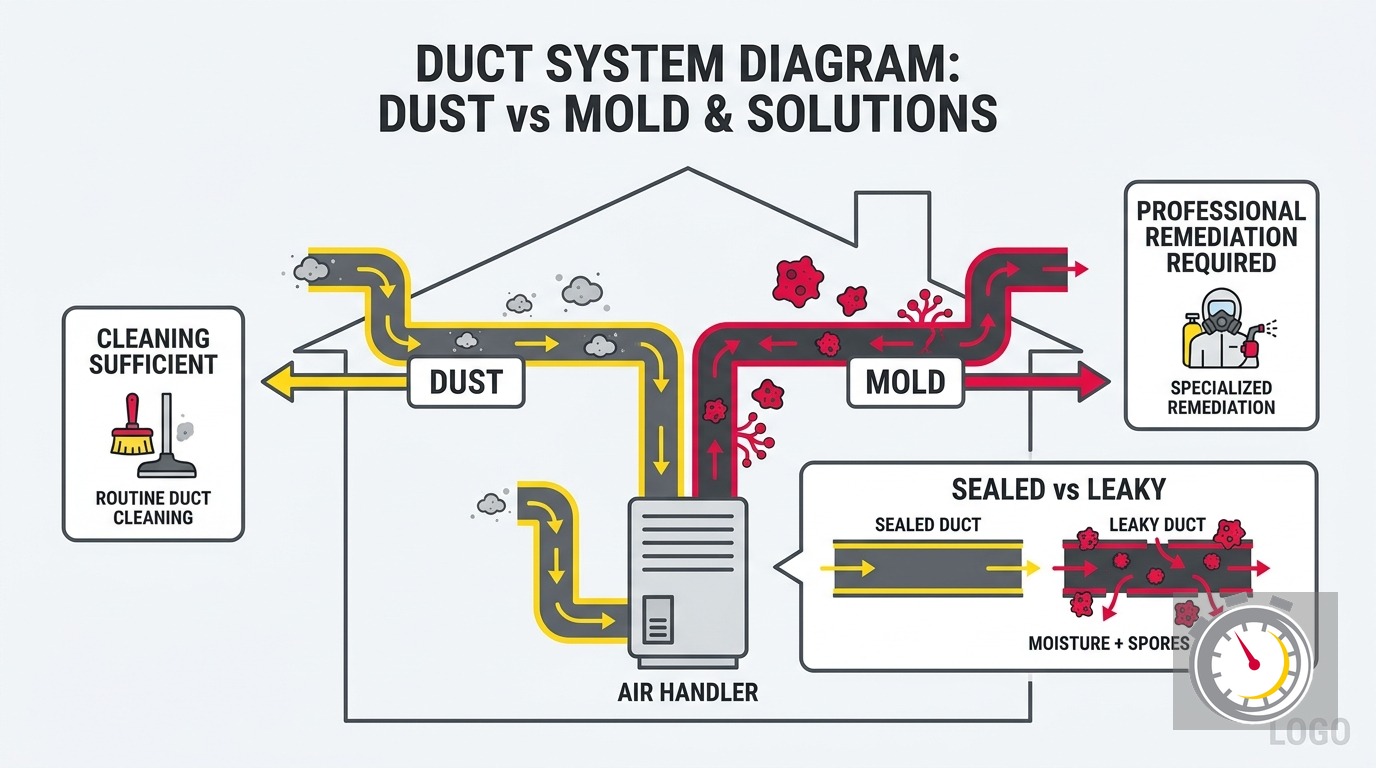
Key Takeaways
- Mold in air ducts looks fuzzy and circular, appears in black, green, or white, and clusters near moisture zones - not spread evenly like dust.
- Duct material is the decision hinge: sheet metal can be cleaned; fiberglass-lined and flex ducts with mold must be replaced.
- The EPA classifies HVAC-system mold as requiring professional remediation - containment, negative air pressure, and HEPA filtration.
- Turn your HVAC off the moment you suspect mold. Running it spreads spores to every room in the house.
- Biocide sprays kill the organism but do not remove mold compounds. Dead mold still triggers reactions.
- Fixing the moisture source is not optional. Skip it and the mold comes back.
Is That Black Stuff Mold in Your Air Ducts?
Short answer: Probably not if it is gray, even buildup throughout the duct. More likely yes if you see fuzzy, circular patches in black, green, or white near the evaporator coil, the drain pan, or the first boot connections off the air handler. A musty smell when the system runs is the clearest homeowner signal.
Here is the distinction every competitor article gestures at but never actually resolves. Dust is gray or brown. It settles uniformly along duct walls, the same way it coats a bookshelf. It does not prefer one section of the duct over another. Mold is different. It forms fuzzy, often circular patches. It appears where moisture concentrates, not randomly through a dry stretch of duct run.
In a Minnesota home, those moisture zones have a predictable address: the evaporator coil, the condensate drain pan below it, and the first several feet of supply duct connected to the air handler cabinet. Those are the spots to check first, not the register covers in the bedrooms.
A visual inspection tells you whether something is there. Only air sampling and lab analysis can confirm the mold species. If you need certainty before spending money on remediation, a certified inspector with lab sampling is the right first call.
Warning signs worth taking seriously:
- A persistent musty or earthy odor when the system runs, even after you change the filter
- Dark spots or discoloration on or around supply register covers that return after cleaning
- Family members with new or worsening allergy or respiratory symptoms that ease up when they leave the house
- Any history of water near the HVAC system in the past two years: a leaky condensate pan, a backed-up drain line, or any flooding that reached the mechanical space
That last item is the one homeowners most often overlook. Any water event near the air handler significantly raises the risk of mold in the duct system. A clogged AC condensate drain line is one of the most common moisture sources in Twin Cities systems and one of the easiest to miss until damage is already done.
Why Twin Cities Homes Are More Vulnerable to Duct Mold
Minnesota’s climate creates the exact conditions mold needs. The Twin Cities average outdoor relative humidity in July sits near 70%. Your air conditioner runs hard to keep the house comfortable. As warm, humid air passes over the cold evaporator coil, moisture drops out of the air as condensation. That water collects on the coil and in the drain pan below it.
If drainage is slow or partially blocked, that moisture stays longer than it should. If the system is oversized for the house and short-cycles, it never runs long enough to dry out between cycles. Both scenarios leave standing moisture at the exact location where the supply air picks up and carries it into the duct run.
Minnesota homes are also tightly sealed by modern energy code. That is good for your heating bill. It also means your HVAC recirculates indoor humidity at higher concentrations than a leakier home would. The combination of humid summers, tight building envelopes, and the thermal dynamics at the evaporator coil makes Twin Cities homes more prone to duct mold than homes in drier climates.
The national restoration franchises that dominate search results for mold in air ducts are not writing for Minnesota homeowners. They are writing for everyone. We are a locally owned and operated Twin Cities company. We see this pattern every summer, and we know the local variables that drive it.
What Does Mold in Air Ducts Actually Look Like?
Short answer: Fuzzy or powdery patches in black, dark green, or white, almost always near the air handler, the evaporator coil, or the first duct connections off the cabinet. Growth spread evenly through a long, dry section of duct is far more likely to be dust or debris.
Mold needs three things: moisture, a food source, and the right temperature. In ductwork, that means growth almost always originates at or near the air handler. The far end of a supply run feeding a bedroom is rarely where mold begins.
Common visual signs to check:
- Black, dark green, or white fuzzy patches on duct walls near the coil or air handler cabinet
- Discoloration on supply register covers that returns within weeks of cleaning
- A damp or wet appearance on the interior duct wall when you remove a register and look with a flashlight
- Visible growth on the evaporator coil, in the drain pan, or on the interior walls of the air handler cabinet itself
If you pull a register cover and see fuzzy growth on the duct wall just inside the opening, mold is inside your duct system. That changes your response entirely, and the next two sections explain why.
Does Duct Material Determine What You Can Do About Mold?
Short answer: Yes, completely. Sheet metal ducts can be professionally cleaned and treated. Fiberglass-lined ducts and flex ducts with mold must be replaced. There is no effective cleaning method for porous duct liner - attempts to clean it physically disturb the growth and release spores into the air.
This is the point every national article either buries or skips. Duct material is the first question to answer, and the answer determines everything else.
Sheet metal ducts have hard, non-porous surfaces. A trained contractor can access the interior, physically remove mold growth, and apply appropriate surface treatment. Professional cleaning of sheet metal ductwork is a legitimate remediation path when done correctly.
Fiberglass-lined ducts use a porous thermal and acoustic liner bonded to the interior duct wall. Mold grows into the fibers of the liner itself, not just on the surface. You cannot scrub it out. Brushing it releases spores rather than removing them. The only correct response is removal and replacement of the affected duct sections.
Flex ducts use corrugated flexible ductwork with internal insulation. The same logic applies. Mold penetrates the material. Replacement is the only answer.
The Minnesota Guide for Managing Indoor Air Quality explicitly notes that work involving interior fibrous glass duct liners is highly specialized and requires properly trained workers. That is a state-level acknowledgment that porous duct liner is not a standard cleaning job.
Many Twin Cities homes built between the 1960s and 1990s have older sheet metal main trunk lines with flex branch runs feeding individual rooms. Whether the mold can be cleaned depends on exactly which section is affected. A technician can tell you within minutes of opening the system.
Should You Try to Clean Mold in Air Ducts Yourself?
Short answer: Only if the mold is limited to the vent register cover and has not spread inside the duct opening. Once mold is inside the duct system, EPA guidance treats HVAC-system contamination as a professional remediation job requiring containment, negative air pressure, and HEPA filtration.
The EPA’s general home mold guidance allows a careful homeowner to handle patches under roughly 10 square feet on hard, non-porous surfaces. That might cover a spot on a painted basement wall. It does not cover your duct system.
HVAC-system mold is treated as a higher-level scenario because a forced-air system can distribute spores to every room in minutes of operation. A professional crew uses containment barriers and negative air pressure to prevent exactly that from happening during the remediation work itself.
Before you do anything else: turn the system off and keep it off. Running a contaminated system spreads spores building-wide. That is the single most important immediate step, and it costs nothing.
A few other things not to do:
- Do not use steam cleaning. Steam introduces moisture into the duct system and worsens mold conditions. Industry standards prohibit it on ductwork.
- Do not spray bleach inside duct openings. It does not penetrate porous materials and the added moisture creates worse conditions.
- Do not run the system with a better filter to “catch” spores. The system needs to stay off entirely until the source is identified and addressed.
The vent cover itself is the one case where a homeowner can reasonably act. Remove the cover, take it outside, clean it with a diluted solution on a non-porous surface, let it dry completely, and reinstall. If you see growth inside the duct opening when you look with a flashlight, stop there and call a professional.
What About “Mold Killer” Sprays and Biocide Treatments?
Short answer: They do not solve the problem. The EPA does not recommend routine biocide application inside ductwork. Dead mold still triggers allergic reactions. Physical removal is required, and the moisture source must be fixed or mold returns.
This is one of the most important things to understand before you hire anyone. Some contractors spray antimicrobial solution inside flex ducts, collect their fee, and describe the job as remediation. That is an inadequate response, and no competitor article tells homeowners this clearly.
Here is why. Dead mold spores still contain the proteins and compounds that cause allergic and respiratory symptoms. Killing the organism does not remove those compounds from your home’s air. Only physical removal does that. And physical removal is impossible in fiberglass-lined or flex ductwork without replacing the affected sections.
If a contractor proposes to spray inside porous duct liner without replacing it, ask direct questions before agreeing to the work. What certifications does the crew hold? What specifically happens to duct sections with visible growth? How is the moisture source being corrected? A contractor who cannot answer those questions clearly is not the right contractor for this job.
How to Fix the Moisture Source
Mold does not grow in dry systems. Remediate the mold, skip the moisture fix, and it returns. This step gets skipped because it is less visible than the mold itself - but it is the step that determines whether the fix actually holds.
Common moisture sources in Twin Cities HVAC systems:
- Clogged condensate drain line: The most common cause. A slow or blocked drain keeps water in the pan longer than it should. Our post on clogged AC condensate drain lines covers the full picture.
- Dirty evaporator coil: Restricts airflow, runs the coil colder and wetter than designed, and increases condensation load at exactly the point where duct mold originates.
- Oversized AC system: A system too large for the home short-cycles. It cools the air but does not run long enough to pull adequate moisture out of it. The house feels cool but the humidity stays elevated.
- High indoor humidity: The target range is 30-50% relative humidity indoors. A $15-20 hygrometer from any hardware store measures it accurately. If you are consistently above 60%, the system is not keeping up with the load.
For homes with persistent humidity issues, a whole-home dehumidifier is often the most durable long-term solution. It works alongside your HVAC system to maintain the humidity range where mold cannot get established. Our post on whole-home dehumidifiers for Twin Cities homes covers what to look for and what to expect from installation. Xcel Energy currently offers rebates on qualifying whole-home dehumidifiers - check the program before purchasing.
Regular professional duct cleaning also removes the dust and debris that give mold a food source. If you are unsure whether duct cleaning makes sense for your home in general, our post on whether duct cleaning is worth it for Twin Cities homeowners walks through when it pays off and when it does not.
When Should You Call a Professional?
Short answer: Immediately, if mold is suspected inside the duct system - not just on the register cover. HVAC mold is one of the clearest cases where professional remediation is the correct first response, not the fallback after a DIY attempt.
Use this branching logic to decide:
Call a professional if any of these apply:
- You see growth inside the duct past the register opening
- Your ducts are fiberglass-lined or flex - any mold on porous liner requires replacement, not cleaning
- The musty smell is present throughout the home, not just one room
- A family member has allergy or respiratory symptoms that improve away from home
- The home had any water event near the HVAC system in the past two years
- The visible affected area is larger than roughly 10 square feet
A homeowner may handle it without calling a pro only if all of these are true:
- The mold is on the vent register cover only
- The cover is non-porous plastic or painted metal
- No growth is visible inside the duct opening when you look with a flashlight
- The cover can be removed and cleaned outside, away from the duct opening
Even in the self-service case, keep the system off until the cover is cleaned, fully dry, and reinstalled.
When you are unsure which category applies, the safe call is to leave the system off and schedule an inspection. An inspection costs a fraction of what it costs to remediate a system where borderline mold was spread by continued operation.
Our duct cleaning service includes inspection and cleaning performed by licensed technicians. We are locally owned and operated in Ramsey, serving Minneapolis, St. Paul, Blaine, Maple Grove, Plymouth, Brooklyn Park, Woodbury, Bloomington, and the surrounding Twin Cities area. We show up when we say we will - that is the commitment behind “Always On Time… Or You Don’t Pay a Dime!(R)”.
Call us at (763) 260-6662 or book online to schedule an inspection. We will tell you exactly what you are dealing with and what it takes to fix it the right way.
Frequently Asked Questions
How can I tell if I have mold in my air ducts? +
Can I clean mold in air ducts myself? +
Do I have to replace my ductwork if there is mold? +
Do biocide sprays fix mold in air ducts? +
Need a technician now?