
Indoor Air Quality Professional Test Minnesota: What to Know
Key Takeaways
- A consumer IAQ monitor gives you an aggregate number. A professional test identifies specific compounds, biological agents, and particle types that no monitor can detect at all.
- Minnesota’s average radon level is more than 3x the national average. More than 2 in 5 Minnesota homes have levels that pose a significant health risk.
- Long Minnesota winters seal homes for 5-6 months. Radon, VOCs, biologicals, and CO2 all accumulate without the dilution that natural ventilation provides in milder climates.
- Consumer TVOC sensors report a single aggregate number that cannot be compared to any health standard. A professional test identifies individual compounds separately.
- No consumer monitor detects mold spores or allergens. Biological testing requires physical sample collection and lab analysis.
- The right sequence is inspection first, then targeted testing. A blind test panel can waste money and produce results that are hard to act on.
- Northern One Hour can assess your HVAC system and ventilation as a first step. Call (763) 260-6662 or book online.
What Does a Professional Indoor Air Quality Test in Minnesota Actually Measure?
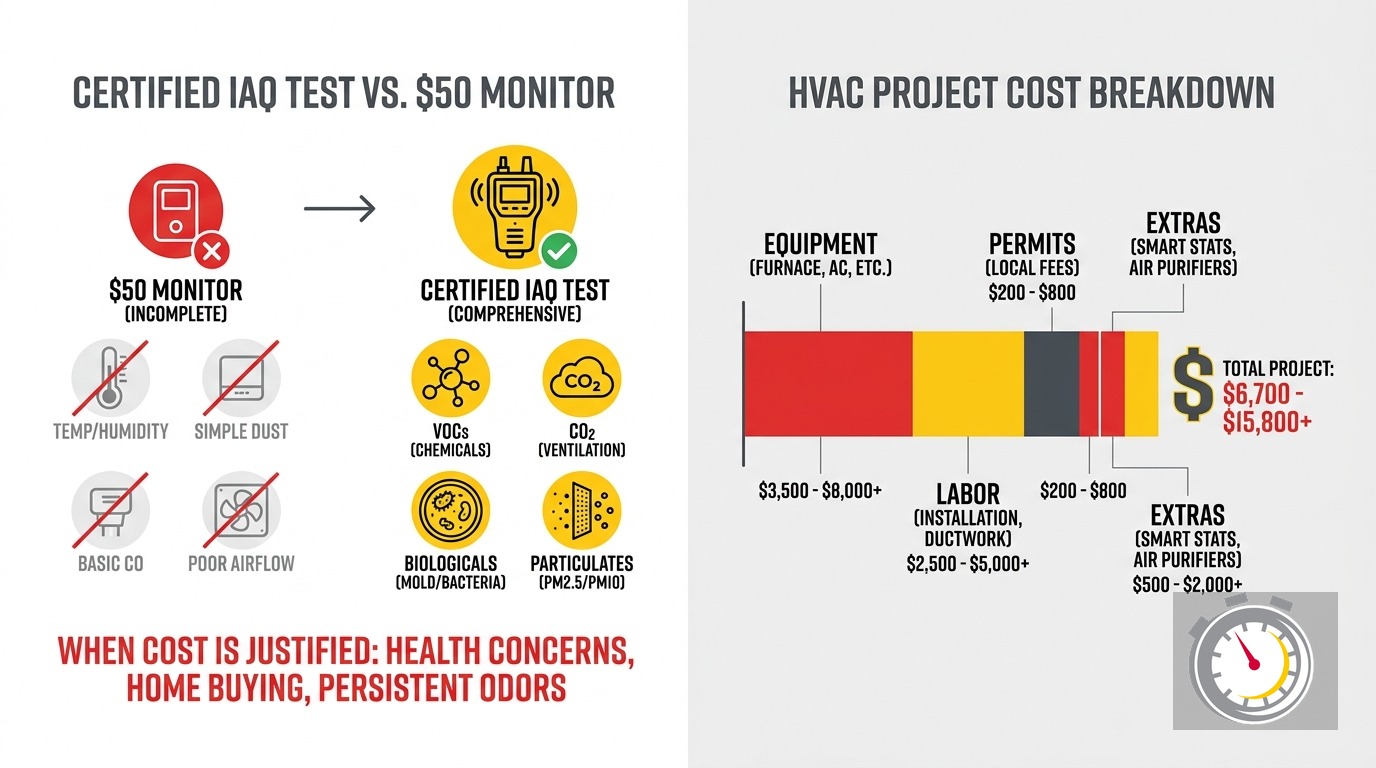
A professional IAQ test measures what consumer devices cannot: individual VOC compounds identified by GC-MS lab analysis, biological particles classified by type and species, actual particle mass and composition, and radon concentrations under EPA-protocol chain of custody. Consumer monitors report readings. Professional tests produce diagnoses.
The $50 air quality monitor on your wall is not useless. It can alert you to significant particulate changes, track CO2 as a rough ventilation proxy, and confirm humidity is in range. But each of those readings has a ceiling on its usefulness. For several key contaminant categories, that ceiling is low enough to miss serious problems entirely.
Different contaminant categories require different professional collection methods. Whole-air Summa canisters for VOCs. Air cassettes, either spore traps or liquid impingers, for biologicals. Weighed filters for gravimetric particulate analysis. Long-term alpha-track devices for radon. No single consumer instrument covers all of them.
Understanding what each test actually captures helps you decide which is worth the investment for your home and situation. Start here.
Can a $50 VOC Monitor Tell You What Is Actually in Your Air?
No. Consumer VOC monitors report a single “TVOC” number calibrated to one reference gas, typically isobutylene. That number is unspeciated, meaning it does not identify which compounds are present or at what concentration. A professional test using a Summa canister analyzed by GC-MS identifies and quantifies hundreds of individual compounds, each comparable to a specific health standard.
Indoor VOC concentrations are consistently 2-5x higher indoors than outdoors, according to EPA research. The agency’s TEAM study found elevated levels inside homes regardless of rural or industrial location. During activities like paint stripping, indoor VOC concentrations can reach 1,000 times background outdoor levels. Those elevated concentrations can persist for hours or days after the activity ends, long after the smell fades.
VOCs enter homes from a wide range of sources. Cleaning products, fresh paint, adhesives, new flooring, pressed wood furniture, cabinetry, and certain personal care products all contribute. Health effects include eye, nose, and throat irritation, headaches, nausea, liver and kidney damage, and central nervous system effects. Some VOCs are suspected or confirmed carcinogens. The specific health risk depends heavily on which compound is present and at what concentration - not on the total load.
Here is the core limitation of a consumer device. Metal oxide or PID sensors detect the total presence of volatile organic compounds and report them as one number. That number is calibrated to one reference chemical. It cannot tell you whether formaldehyde, a probable human carcinogen, is elevated. It cannot distinguish benzene from toluene from acetone. No health standard is written against a TVOC number because health impact depends on which specific compounds are present, not the aggregate.
A professional GC-MS analysis names each compound individually. Formaldehyde, benzene, toluene, and dozens of others each receive a separate concentration value that can be compared against a reference threshold from a public health agency. That is actionable information. A TVOC reading that says “elevated” tells you something is present. It does not tell you what to do next.
If your home had new flooring, fresh paint, or cabinetry installation in the past year or two and you have experienced persistent symptoms, a professional VOC panel is the only test that can confirm whether off-gassing from those materials is still occurring at meaningful concentrations - and identify which compound is driving the problem.
Why Can’t Consumer Monitors Detect Mold and Biologicals?
No consumer air monitor detects biological particles. Optical particle counters used in consumer sensors count particles by size fraction but cannot distinguish a mold spore from a dust particle or a combustion byproduct. Biological testing requires physical collection of an air sample, shipped to an accredited lab for microscopy or culture analysis. This is a categorical limitation, not an accuracy problem.
Biological contaminants include bacteria, mold and other fungi, dust mites, pollen, pet allergens, cockroach proteins, and rodent urine proteins. They go airborne when normal household activity disturbs settled dust, when HVAC equipment draws air across a contaminated surface, or when moisture creates the conditions for active biological growth. Moist, poorly ventilated areas are the most common source.
Minnesota’s climate creates specific biological risk patterns. Basements and crawl spaces that absorbed moisture during spring snowmelt or a humid summer can harbor mold growth behind finished walls or inside HVAC equipment, where it is not visible during a casual inspection. If mold has colonized your evaporator coil, drain pan, or ductwork, your system distributes spores to every register every time it runs. That is a problem worth detecting before it spreads. See the related post on signs of mold in HVAC ducts and what remediation involves.
An optical particle counter sorts particles into size fractions by measuring how they scatter laser light. A mold spore and a similarly sized dust particle produce the same signal. The device has no mechanism to tell them apart. Lab analysis of a physical air cassette is the only method that identifies and counts specific biological types. An accredited analyst examines the collected sample under microscopy and reports both the species present and their concentrations.
The Minnesota Department of Health recommends beginning with a thorough visual inspection before sampling for mold. If visible mold or moisture damage is already present, remediation typically comes before air testing, because the source has been located. Testing without that context can produce ambiguous results and an expensive lab bill with no clear path forward.
What Does Professional Particulate Testing Add?
Consumer PM sensors estimate PM2.5 and PM10 mass concentrations using optical scattering. Accuracy varies by particle type, because different particles scatter laser light differently. Consumer sensors are typically calibrated for one reference aerosol. A gravimetric filter-based professional test captures actual particle mass on a weighed filter, and that filter can go to a lab for compositional analysis, identifying what the particles are made of.
That distinction matters when combustion is a concern. Particles from incomplete fuel combustion can lodge deep in lung tissue and carry other carcinogens with them, including radon decay products. Knowing that PM2.5 is elevated is useful. Knowing whether those particles are primarily combustion-derived, biological, or inert mineral dust tells you which source to address and how urgently.
For most Minnesota homeowners, professional particulate testing is most relevant when a combustion appliance is suspected of incomplete combustion, when vehicle exhaust intrusion from an attached garage is a concern, or when a wood-burning appliance is in regular use. If any of those conditions are present, composition matters, not just count.
How Bad Is Minnesota’s Radon Problem?
Very bad by national standards. Minnesota’s average radon level is more than 3x the national average, and more than 2 in 5 Minnesota homes have radon levels that pose a significant health risk. Radon is the leading cause of lung cancer in non-smokers. A professional long-term alpha-track test meets the EPA protocol and chain-of-custody standard that a consumer monitor does not.
At the EPA action level of 4 pCi/L, 23 out of every 1,000 people in the general population will develop fatal radon-caused lung cancer. Radon is the second-leading cause of lung cancer overall, behind only smoking. In non-smokers, it ranks first. Minnesota’s geology concentrates radon in soil and bedrock. Long winters seal homes for 5-6 months at a stretch. Radon seeps in through basement cracks, foundation penetrations, and soil contact. Without the dilution that natural ventilation provides in milder climates, it accumulates season after season.
A home that tests at 3 pCi/L in late summer, with windows occasionally open, may test above the 4 pCi/L action level in January, when the house has been tightly closed for weeks and the stack effect pulls more soil gas in through the foundation. Short-term readings taken in the shoulder seasons miss this variation entirely.
Consumer radon monitors exist and some are reasonably accurate at measuring a current concentration. The limitation is protocol. An EPA-recommended long-term alpha-track test runs for at least 90 days, captures the full seasonal range including the worst-case winter scenario, and produces a certified lab result that meets the documentation standard for real estate transactions, mitigation contractor planning, and school or workplace disclosure requirements. A digital consumer monitor’s rolling average can shift significantly from day to day with barometric pressure changes. Acting on a reading taken during a low-radon day can produce a false sense of safety.
If you have never tested your home for radon, or if your last test preceded a basement renovation, major air-sealing project, or new window installation, a professional long-term test is a low-cost, high-value step. Remediation, when needed, is a well-established process. But you cannot remediate what you have not measured.
Is Elevated CO2 a Warning Sign for Other Indoor Pollutants?
Yes. CO2 at residential concentrations is not itself dangerous, but elevated CO2 reliably signals that fresh-air exchange is inadequate. When ventilation is inadequate, every other pollutant accumulates alongside it: VOCs off-gassing from building materials, biological particles, combustion byproducts, and radon. A consumer CO2 monitor can flag the condition. A professional assessment interprets it in context.
Some consumer monitors include NDIR CO2 sensors that measure concentration with reasonable accuracy. The gap is not measurement but interpretation. A professional assessment maps your CO2 reading against your home’s size, occupancy load, and HVAC ventilation design, then compares it against ASHRAE 62.2 minimum ventilation rate standards. That comparison tells you whether your system is delivering adequate fresh air or simply recirculating what is already inside.
Minnesota homes are among the tightest in the country once energy upgrades, added attic insulation, and new windows are factored in. An older home that was drafty by default sometimes had better natural ventilation than a renovated one. If your home has been significantly air-sealed without a corresponding mechanical ventilation upgrade, elevated CO2 is a predictable result - and it indicates that every other contaminant category is also accumulating above what it would be in a better-ventilated home. For more on how HVAC systems interact with indoor air quality, see the related post on home air quality monitors and HVAC systems.
When Is a Professional IAQ Test Worth the Money?
Professional IAQ testing is most justified when you have specific triggers: health symptoms tied to time at home, visible moisture or mold, recent renovation, combustion appliance concerns, or an untested radon level. Without a clear trigger, an inspection and HVAC assessment is the better, lower-cost starting point.
The EPA’s Inside Story guide frames it plainly: professional testing for non-radon pollutants is most appropriate when health symptoms or signs of poor ventilation exist and specific sources or pollutants have been identified as possible causes. The right sequence is to observe conditions first, then test to confirm and quantify. Testing first and looking for a cause after produces ambiguous results.
Spend the money on a professional indoor air quality test in Minnesota if any of these apply:
- You or a family member has persistent respiratory symptoms, headaches, or fatigue that improve when away from home and return when you come back.
- Your home has visible mold, water staining, or a known history of moisture intrusion.
- You recently renovated, refinished floors, painted, or brought in significant new furniture or cabinetry, and symptoms appeared afterward.
- Your home has an attached garage with regular vehicle use, a combustion appliance with a suspected issue, or a wood-burning fireplace in regular use.
- You have never tested for radon, or your last test was more than five years ago or preceded a renovation.
- Your home is especially tight: new construction, post-weatherization, or heavily insulated without a mechanical ventilation upgrade to match.
- You are buying or selling a home and need documented baseline data.
- A family member has asthma, chronic respiratory issues, or severe allergies that are not responding well to standard management. The post on HVAC and asthma management in the Twin Cities covers that angle in more detail.
If none of those triggers apply, start with an inspection. MDH recommends inspection before sampling specifically because testing without context produces results that are difficult to interpret and expensive to act on.
What Credentials Should You Look For in a Minnesota IAQ Tester?
Ask for credentials before hiring any IAQ service provider. Look for a Certified Industrial Hygienist (CIH) from the American Industrial Hygiene Association, or certification through the American Council for Accredited Certification (ACAC), which includes the Council-Certified Microbial Consultant (CMC) designation. A qualified professional will tell you which test method they use, which accredited lab analyzes the samples, and how results are interpreted against specific health-based reference values.
Minnesota has no state or federal certification requirement for most IAQ service providers. Asbestos, lead, and radon have separate regulated licensure. For everything else, “IAQ tester” carries no legal meaning. That makes credentials a trust signal, not a baseline expectation. A tester who cannot explain their method, their lab, and their reference values in plain terms is one worth looking elsewhere from.
The MDH guidance on this point also reinforces the inspection-first approach. A credentialed professional can look at your home, identify the most likely source categories, and recommend a targeted test battery. A blind panel that covers every contaminant category costs more and generates more data than most situations warrant.
How Northern One Hour Fits Into This
Northern One Hour is a locally owned and operated Twin Cities HVAC company. We do not perform third-party IAQ laboratory sampling, and we do not hold CIH credentials. What we do is assess your HVAC system and ventilation as the natural starting point for understanding your home’s air quality picture - which is exactly where MDH and the EPA recommend starting.
HVAC systems are among the primary mechanisms for transporting indoor air pollutants. A furnace operating with combustion inefficiency distributes byproducts through every register. A dirty evaporator coil or drain pan grows biological contamination that the system then carries throughout the home. Leaky ductwork pulls unconditioned air from attic or crawl space into living areas. A home without adequate mechanical ventilation concentrates every pollutant category we discussed above. None of those problems show up on a consumer monitor as anything other than a vague elevated reading.
Our team can assess your system’s condition, identify ventilation shortfalls, and guide you toward targeted next steps. That might mean a filter upgrade, a ventilation modification, or a referral to a credentialed IAQ professional when the conditions in your home call for lab sampling. We give you straight answers either way.
We serve homeowners across Minneapolis, St. Paul, Ramsey, Blaine, Maple Grove, Plymouth, Brooklyn Park, Woodbury, Bloomington, and surrounding communities. We are locally owned and built on one commitment: show up when we say we will. That is the foundation behind “Always On Time… Or You Don’t Pay a Dime!(R).”
Call us at (763) 260-6662 or book online. If your air quality picture points toward a larger HVAC upgrade, ask about financing options when you call. For a full look at our indoor air quality services, visit our indoor air quality page.
Frequently Asked Questions
What does a professional indoor air quality test in Minnesota measure? +
Can a $50 air quality monitor detect mold in my home? +
How serious is Minnesota's radon problem? +
When is a professional IAQ test actually worth the money? +
Need a technician now?