
What Home Air Quality Monitor Indoor Numbers Actually Mean
Key Takeaways
- A home air quality monitor indoor tracks PM2.5, CO2, relative humidity (RH), and VOCs in real time. Each metric maps to a different part of your HVAC system.
- PM2.5 above 35 µg/m³ sustained means check your furnace filter. Above 55 µg/m³, check it today and consider a MERV 13 upgrade.
- CO2 above 1,000 ppm in a sealed Minnesota home in January is a ventilation problem. Your HRV needs more run time, not an open window.
- Humidity below 30% in winter is a whole-home humidifier problem, not a ventilation problem.
- VOC spikes call for immediate ventilation. The spike and recovery pattern is the useful signal, not the absolute number.
- Your IAQ monitor does not detect radon. In Minnesota, 2 in 5 tested homes exceed the EPA action level. Test separately with a dedicated kit.
- HRVs are preferred over ERVs in Minnesota’s cold climate. Minnesota code requires balanced mechanical ventilation meeting ASHRAE 62.2-2022.
- Rebates up to $400 are available through Minnesota utilities for qualifying HRV and ERV installations.
What Does a Home Air Quality Monitor Indoor Actually Measure?
A home air quality monitor indoor tracks the concentration of airborne particles, gases, and moisture in real time. Most consumer units report PM2.5, CO2, relative humidity, and VOCs. Some add a carbon monoxide sensor. The readings are only useful if you know which HVAC response each threshold calls for.
The device sits on a shelf and displays numbers. Without a translation layer, those numbers are just noise. With one, they become actionable: this reading means change the filter, that reading means the HRV needs attention, this other reading means buy a radon kit today.
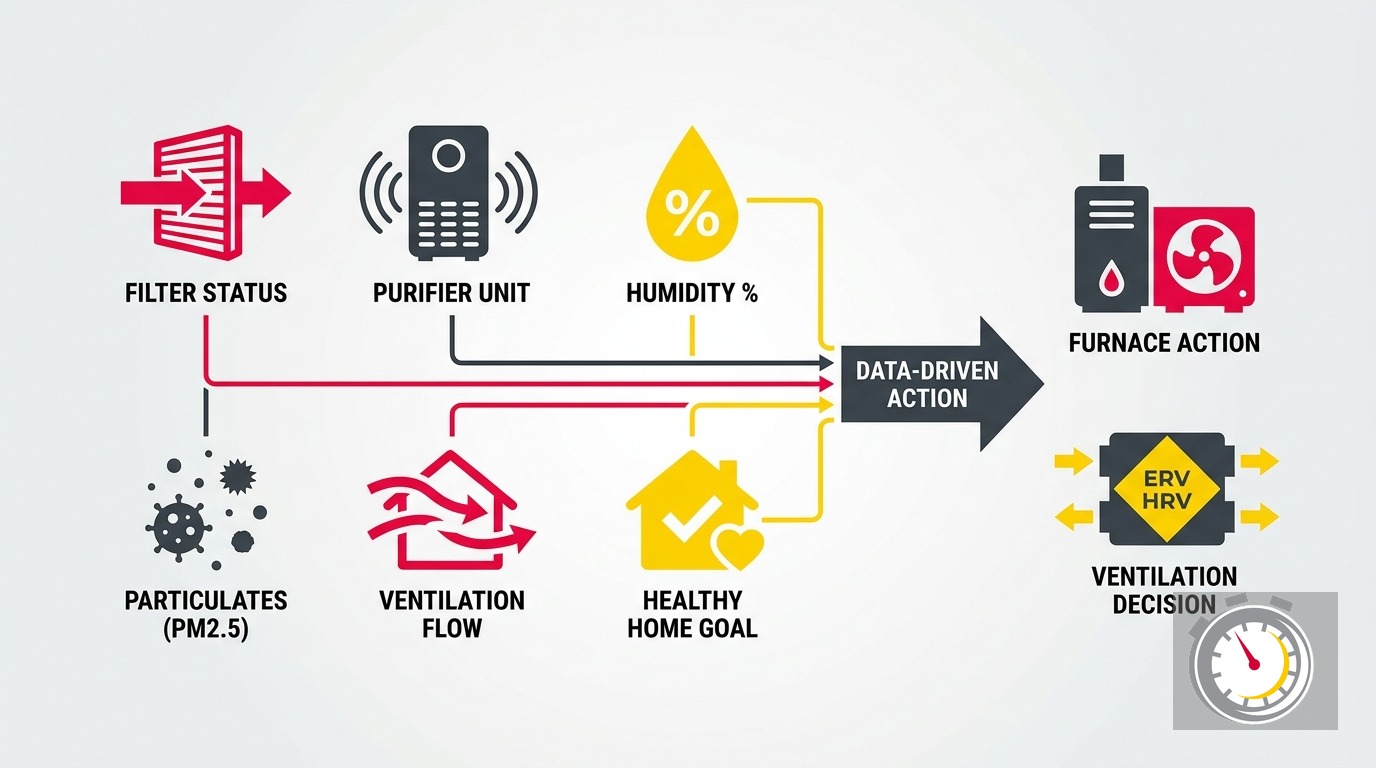
Each metric in your monitor connects directly to a part of your heating and ventilation system. PM2.5 connects to your filter and air purifier. CO2 connects to your HRV or mechanical ventilation rate. Humidity connects to your whole-home humidifier. VOCs connect to your ventilation speed and source control. The sections below map each reading to a specific action for a Twin Cities home.
What Are the PM2.5 Numbers on a Home Air Quality Monitor Indoor?
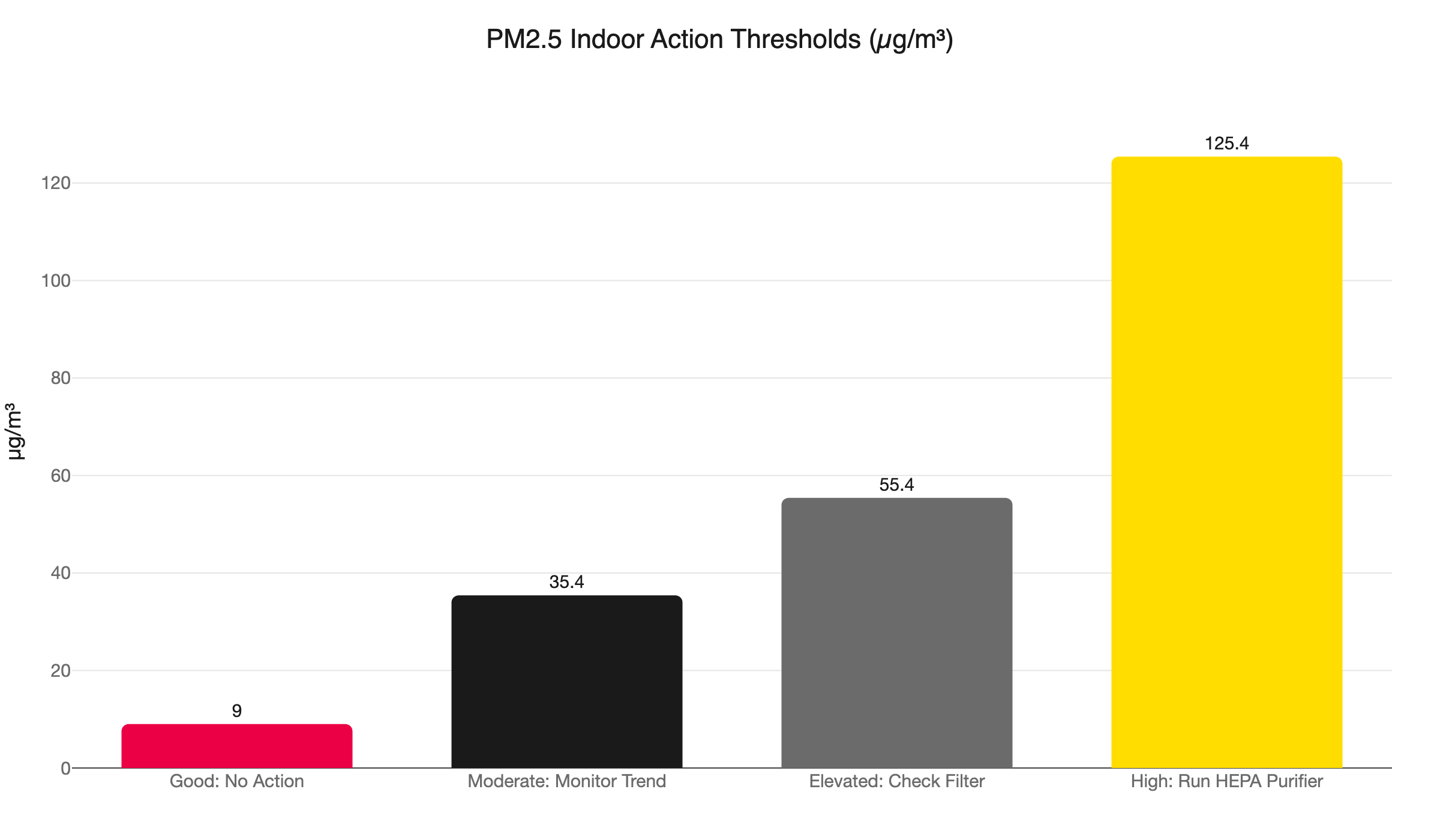
PM2.5 is fine particulate matter 2.5 microns or smaller. The EPA set the annual PM2.5 standard at 9.0 µg/m³ as of February 2024. Consumer monitors report raw µg/m³ directly, not the 0-500 AQI scale used on outdoor weather apps. Readings above 9 are worth watching. Above 35, your filter is the first thing to check.
PM2.5 includes dust, pollen, pet dander, smoke, and combustion particles. These particles are invisible to the eye and penetrate deep into lung tissue. Your furnace filter is the first line of defense against indoor PM2.5.
Filter capacity depends on MERV rating. MERV 8-10 captures pollen and mold spores. MERV 11-13 adds fine dust, pet dander, and smoke. MERV 17 and above meets HEPA standards at 99.97% efficiency at 0.3 microns.
Here is a critical caveat: higher MERV ratings increase static pressure on the blower motor. Not every furnace can handle the added resistance. A system capacity assessment is necessary before jumping to MERV 13 or higher. Our team can tell you whether your equipment is rated for an upgrade before you buy a filter that harms the blower.
Here is how to read PM2.5 and respond:
- 0-9 µg/m³: Good. Your current filter is doing its job.
- 9.1-35.4 µg/m³: Moderate. Watch the trend. If it climbs steadily, check the filter within the week.
- 35.5-55.4 µg/m³ (sustained): Elevated. Inspect the filter. If it is gray and compressed, replace it. Look for an indoor source: a renovation project, heavy cooking, or a wildfire smoke event.
- 55.5-125.4 µg/m³: High. Inspect the filter now. If not already on MERV 13, review whether your system is ready for the upgrade. Run a portable HEPA purifier in occupied rooms.
- 125.5 µg/m³ and above: Run a portable HEPA purifier immediately. Confirm a MERV 13 or higher filter is installed. Identify the particle source.
If PM2.5 stays elevated after a fresh MERV 13 filter, the source may be duct leaks, a cracked heat exchanger, or combustion byproducts entering the air stream. That scenario needs a professional assessment, not another filter swap.
Why Is CO2 High When You Cannot Open a Window in Minnesota Winter?
High CO2 in a sealed Minnesota home in winter is a mechanical ventilation problem. The fix is more HRV run time or a higher fan speed setting. “Open a window” at -10°F spikes your heating bill and risks condensation damage inside the wall cavity. It is not a real answer.
ASHRAE uses 1,000 ppm as the comfort and ventilation guideline for occupied spaces. Above 1,000-1,200 ppm, stale air causes drowsiness. Above 1,400 ppm, controlled studies find cognitive performance drops roughly 50%. The outdoor CO2 baseline sits around 420 ppm in 2026.
In a tightly sealed Twin Cities home during heating season, CO2 climbs as exhaust air fails to be replaced with fresh outdoor air. That replacement is your heat recovery ventilator’s job. If CO2 is elevated and your HRV is running, check two things: whether the HRV core needs cleaning, and whether the fan speed is set to match your home’s occupancy.
If your home has no mechanical whole-home ventilation, elevated CO2 readings during heating season are predictable. Many older Twin Cities homes were built before balanced ventilation was required by code. Read more about whole-home HRV ventilation and whether your home needs it.
One sensor accuracy note: budget monitors derive eCO2 from a VOC sensor, not a true NDIR (non-dispersive infrared) sensor. If your monitor shows CO2 stuck at the same number regardless of how many people are home, you are likely looking at eCO2, a less reliable proxy. True NDIR is what you need for ventilation decisions.
CO2 action guide for Minnesota homes:
- Under 800 ppm: Normal. Good ventilation.
- 800-1,000 ppm: Acceptable. Watch for an upward trend, especially overnight when people sleep in concentrated rooms.
- 1,000-1,200 ppm: Increase HRV run time. If no HRV is present, schedule a ventilation assessment.
- Above 1,200 ppm consistently: Schedule an HRV assessment. The system may be undersized for your floor area and occupancy under ASHRAE 62.2-2022.
What Does Low Humidity on the Monitor Mean for Your Furnace?
Low indoor humidity in winter is almost always a whole-home humidifier problem, not a ventilation problem. Adding more cold, dry outdoor air makes humidity worse, not better. The fix is a humidifier, not an HRV speed increase.
The EPA targets 30-50% relative humidity for indoor spaces. Below 30%, respiratory membranes dry out and infection risk increases. Above 60%, dust mites and mold thrive.
Forced-air gas furnaces dry indoor air significantly during heating season. In a tightly sealed Twin Cities home without a humidifier, relative humidity can drop to 15-20% by January. Your IAQ monitor catches this before you notice the static shocks, the dry throat, and the cracking woodwork.
When humidity drops below 30% in December or January:
- Check whether your whole-home humidifier is operational. The water panel may be clogged with mineral deposits. The bypass damper may be closed from a summer setting. These are the two most common reasons a humidifier runs but produces no moisture output.
- If your home has no whole-home humidifier, a whole-home humidifier installation conditions every cubic foot of air your furnace circulates, not just one room. Portable units cannot keep pace with the air volume a forced-air system moves.
Humidity above 55-60% in summer, especially in a basement, is a different problem entirely. Your AC dehumidifies as it cools. If the reading stays elevated, a dedicated whole-home dehumidifier is the next step. Your IAQ monitor catches both the winter dry-air problem and the summer humid-air problem.
What Do VOC Readings Mean, and When Should You Act?
A VOC spike on your home air quality monitor indoor calls for immediate ventilation. Run your HRV at high speed, or open windows if outdoor temperature allows. Then monitor until the reading returns to your home’s baseline. The spike and recovery pattern is the signal. The absolute TVOC number is not.
Indoor VOC concentrations are consistently 2-5x higher than outdoor levels. Consumer monitors report a relative TVOC index, not specific chemical compounds. This matters: 400 ppb in your home does not mean the same thing as 400 ppb in a neighbor’s home. Your personal baseline is the reference point.
Common VOC events and what to do:
- Painting or staining: Run HRV at high speed or open windows during and for several hours after. Monitor until the index returns to pre-paint baseline.
- New carpet, flooring, or furniture: Increase ventilation rate through HRV settings for several days. Some materials off-gas for weeks after installation.
- Cleaning products: Normal short spike. Ventilate briefly. Recovery should happen within an hour.
- Cooking: Normal mealtime spike. Run kitchen exhaust during and after cooking. ASHRAE 62.2-2022 requires a minimum of 100 CFM intermittent kitchen exhaust.
- Chronically elevated TVOC with no obvious source: Schedule an indoor air quality assessment. Source control often makes more sense than running ventilation at maximum indefinitely.
Does a Home Air Quality Monitor Indoor Detect Radon?
No. This is the single most important gap in what consumer IAQ monitors do. Radon is colorless, odorless, and radioactive. It requires a dedicated test kit or detector. A $150 IAQ gadget will never show you radon, no matter how many sensors it advertises.
In Minnesota, 2 in 5 tested homes have radon at levels that are a major health risk. The EPA recommends mitigation at 4 pCi/L and advises testing at 2 pCi/L. Minnesota’s statewide average tested level sits around 7 pCi/L, well above the action threshold. Most Twin Cities counties are EPA Radon Zone 1, the highest-risk designation in the country.
Radon is the second-leading cause of lung cancer in the United States. Test kits cost roughly $15 and are available at hardware stores and county health departments. A long-term test (90 days) is more accurate than a short-term kit for a definitive reading.
A whole-home IAQ monitor is a useful tool for daily air quality awareness. It is not a substitute for a radon test. These are two separate purchases covering two separate risks.
What Does Minnesota’s Ventilation Code Require?
Minnesota residential buildings must have a balanced mechanical ventilation system meeting ASHRAE 62.2-2022 or Minnesota Rules Chapter 1322. Exhaust-only systems are discouraged. Supply air must be tempered before delivery into the living space, a critical requirement when outdoor air drops to -20°F.
The ASHRAE 62.2-2022 minimum ventilation formula: 0.01 CFM per square foot of conditioned floor area, plus 7.5 CFM per occupant. Occupant count equals the number of bedrooms plus one.
For a 2,000-square-foot, three-bedroom home: (2,000 x 0.01) + (4 x 7.5) = 20 + 30 = 50 CFM minimum continuous whole-house ventilation.
If CO2 readings stay elevated and your HRV is already running, the HRV may be undersized for your floor area and occupancy count. A ventilation assessment measures actual flow rates against the ASHRAE 62.2 target and tells you whether the system needs adjustment or replacement.
HRV or ERV: Which Is Right for a Minnesota Home?
For most Twin Cities homes, an HRV is the better choice over an ERV. HRVs manage latent heat differently, which reduces condensation risk during sustained sub-freezing conditions. Minnesota’s sustained cold from November through February is where this distinction matters most.
Both systems recover thermal energy from exhaust air before it exits the house. Both reduce heating costs compared to simple exhaust-only ventilation. The difference surfaces during deep winter: in extreme cold, ERVs can accumulate moisture in ways that HRVs manage more safely.
Both systems require a permit for installation. We handle permitting as part of the install process.
Read the full comparison, including how to size each system for your home’s square footage and occupancy, in our guide to ERV vs. HRV for Minnesota homes.
Are There Rebates for HRV or ERV Installation in Minnesota?
Rebates are available. Minnesota Energy Resources offers $400 for qualifying systems rated at 65% or higher sensible recovery efficiency at 32°F. Minnesota Power offers $300 for systems at 60% SRE minimum. Federal IRA Section 25C tax credits for HVAC equipment expired December 31, 2025.
Utility rebates are now the primary incentive stack for HRV and ERV installation in the Twin Cities. Programs change and eligibility varies by utility territory. Verify current terms with your contractor at the time of install. We pull the current rebate availability for your specific utility as part of any ventilation consultation.
The Reading-to-Action Decision Table
Each metric, the threshold that calls for action, and the correct HVAC response:
| Metric | Reading | Action |
|---|---|---|
| PM2.5 | Under 9 µg/m³ | No action. Filter is working. |
| PM2.5 | 35-55 µg/m³ sustained | Check and replace furnace filter. |
| PM2.5 | 55+ µg/m³ | Inspect filter now. Upgrade to MERV 13 if system is rated. Run portable HEPA. |
| CO2 | Under 1,000 ppm | Normal. |
| CO2 | 1,000-1,200 ppm | Increase HRV run time. |
| CO2 | 1,200+ ppm consistent | Schedule HRV assessment. Check sizing against ASHRAE 62.2. |
| Humidity | Under 30% | Check whole-home humidifier operation. Schedule install if none present. |
| Humidity | 30-50% | Target range. No action needed. |
| Humidity | 55%+ in summer | Check AC. Consider whole-home dehumidifier. |
| TVOC | Spike above baseline | Identify source. Increase HRV speed. Monitor recovery. |
| TVOC | Chronically elevated | Schedule IAQ assessment. Source control may be needed. |
| Radon | Not shown on monitor | Buy and run a separate dedicated radon test kit. |
When Should You Call Northern One Hour?
Your monitor is a diagnostic tool. It is not a repair tool. Here is when a reading means it is time to call us:
- PM2.5 stays elevated after a fresh MERV 13 filter is installed. The source may be duct leaks or combustion byproducts entering the air stream.
- CO2 stays above 1,200 ppm despite an HRV already running at full speed. The system may be undersized, malfunctioning, or out of balance.
- Humidity will not climb above 25% even with a whole-home humidifier running. The water panel may be clogged or the bypass damper may be incorrectly set.
- You want a permit-compliant HRV, whole-home humidifier, or whole-home IAQ system installed correctly.
- You have not had a combustion safety inspection this heating season. Carbon monoxide and combustion byproducts are not reliably detected by consumer IAQ monitors.
We are locally owned and operated in Ramsey, Minnesota, and we serve the full Twin Cities metro: Minneapolis, St. Paul, Blaine, Maple Grove, Plymouth, Brooklyn Park, Woodbury, and Bloomington. When we say we are on our way, we mean it. “Always On Time… Or You Don’t Pay a Dime!(R)”
Call (763) 260-6662 or book online to schedule an indoor air quality consultation. We will review your monitor readings, compare your ventilation rate against the ASHRAE 62.2-2022 target, and tell you exactly what your home needs before winter sets in.
Frequently Asked Questions
What should PM2.5 be inside your home? +
Why is my CO2 reading high in winter when I cannot open windows? +
Does a home air quality monitor detect radon? +
Need a technician now?