
AC Running but Blowing Warm Air From Vents: Causes & Fixes
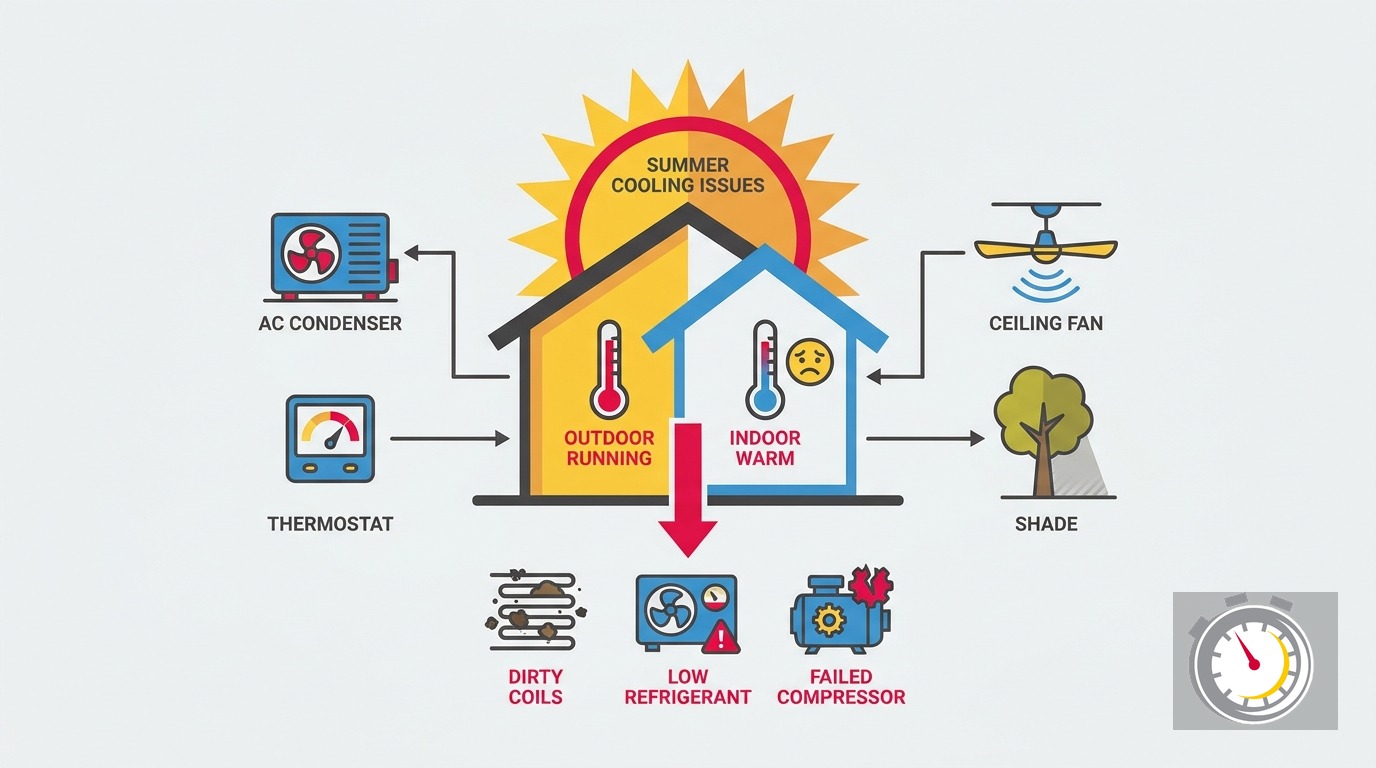
Key Takeaways
- Warm air from a running AC has a cause you can often narrow down by symptom.
- Check the thermostat, the filter, and the breaker first. These take five minutes.
- Note whether the outdoor unit is running or silent. That one clue splits the causes in half.
- Ice on the coil or refrigerant lines means you should shut the system off.
- Never add refrigerant yourself. Low refrigerant means a leak, and venting it is restricted by federal rules.
- Cheap fixes like a capacitor or fan motor are common. A failed compressor is the costly one.
- Twin Cities heat waves push a system hard, so small problems show up fast.
- Call (763) 260-6662 or book online. We arrive within the window you select, or you do not pay for the service.
Why Is Your AC Running but Blowing Warm Air From the Vents?
Your AC blows warm air when it cannot remove heat from your home. The usual causes are a clogged filter, dirty coils, low refrigerant, a failed capacitor or fan motor, or a failing compressor. The fix depends on which part is failing, so symptoms matter.
The system is running. You hear the blower. Air comes out of the vents, but it does not feel cool.
That is frustrating on a humid July afternoon in the Twin Cities. It is also a useful clue. A running blower means the system has power and the thermostat is calling for cooling. The problem sits on the cooling side.
Your AC does not make cold air. It moves heat. Refrigerant picks up heat from your indoor air at the indoor coil and carries it outside. The outdoor unit releases it.
If any step in that loop breaks, the air from your vents stays warm. Below, we go from the easy checks to the serious ones.
We are Northern One Hour Heating & Air Conditioning, locally owned and operated, based in Ramsey. We see this exact problem every summer.
What Should You Check First Before Calling Anyone?
Start with the thermostat, the air filter, the breaker, and your supply vents. Confirm the thermostat is set to cool and the fan is not stuck in a wrong mode. Replace a dirty filter. Reset a tripped breaker once. These checks take minutes and cost almost nothing.
Work through this list in order.
- Thermostat mode. Make sure it says Cool, not Heat or Fan only. Set the temperature at least five degrees below the room temperature.
- Thermostat fan setting. If the fan is set to On, it runs all the time. Air can feel lukewarm between cooling cycles. Switch it to Auto and wait ten minutes.
- Thermostat batteries. A blank or dim screen can mean dead batteries.
- Air filter. Pull it out and hold it up to a light. If you cannot see light through it, replace it.
- Breakers. Check the panel for a tripped breaker on the AC circuit. Flip it fully off, then on, one time.
- Supply vents. Make sure vents are open and nothing blocks them.
The filter check matters more than most people think. ENERGY STAR advises homeowners to inspect, clean, or change filters “once a month in your central air conditioner, furnace, and/or heat pump”. Many homeowners go months without looking.
A clogged filter weakens airflow, and it costs you in other ways too. ENERGY STAR also notes that a dirty filter can increase energy costs and damage your equipment, leading to early failure. Low airflow can also let the indoor coil get too cold and freeze. We cover that below.
If the breaker trips again right after you reset it, stop. Do not keep flipping it. A repeat trip points to an electrical fault in the equipment, and a technician needs to look at it. Our guide on why an AC keeps tripping the breaker has more, but call us first.
If the basic checks do not fix it, use the triage below.
Is the Outdoor Unit Running, or Is It Silent?
Go outside and look at the condenser, the large box with a fan on top. If the fan is spinning and the unit hums, the outdoor side is at least trying to work. If the unit is silent while the indoor blower runs, you likely have an electrical or compressor problem. That split narrows the cause quickly.
Stand near the unit while the AC is calling for cooling. Then match what you see and hear to one of these groups.
Group 1: Outdoor fan spinning, unit humming normally. The electrical side is working. The likely causes are a dirty coil, low refrigerant, or restricted airflow. The compressor may also be weak.
Group 2: Outdoor unit silent, no fan, no hum. Power is not reaching the unit, or a key part has failed. Suspects include the contactor, a tripped breaker or disconnect, and the control wiring.
Group 3: Humming but the fan will not spin. This often points to a failed capacitor or a seized fan motor. The unit tries to start and cannot.
Group 4: Fan spinning but no compressor sound. The fan runs, but the compressor is not starting. A bad capacitor, a failed compressor, or a safety lockout can cause this.
Group 5: Loud clicking, buzzing, or grinding. Shut the system off. Mechanical damage can get worse with every minute of run time.
If your outdoor unit is silent while the indoor blower runs, read our guide on an outdoor AC unit that is not running while the fan spins. The short version: do not keep restarting it. Call for service.
The outdoor unit also needs room to breathe. Leaves, grass clippings, cottonwood fluff, and tall plants can choke airflow around it. Clear at least a couple of feet of open space around the cabinet. Our team can show you the right clearance for your model.
Can a Dirty Coil Make Your AC Blow Warm Air?
Yes. Your system has two coils, indoor and outdoor. Dirt on either one blocks heat transfer. The indoor coil cannot absorb heat well, and the outdoor coil cannot release it. The result is weak cooling and warm-feeling air, even though everything appears to run normally.
ENERGY STAR is direct about this. It states that dirty coils reduce the system’s ability to cool the home. Its checklist calls for cleaning both the evaporator coil and the condenser coil.
Here is what that means in your yard and your basement.
The outdoor coil (condenser). This coil sits behind the metal fins on the outdoor unit. It sheds the heat your home has collected. Over a Minnesota summer it collects dust, pollen, grass clippings, and cottonwood seed. When it clogs, heat cannot escape. The refrigerant stays hot, and the air inside never gets as cool as it should.
You can often see the problem. Look for a gray mat of debris on the fins. A gentle rinse from a garden hose helps, spraying from the inside out when possible. Turn the power off at the disconnect first. Never use a pressure washer. It bends the fins.
The indoor coil (evaporator). This coil sits inside your air handler or on top of your furnace. It is hard to reach. A dirty filter, leaky ducts, or a missing filter lets dust coat it. A coated coil acts like a blanket and cannot absorb heat well.
In most homes you cannot safely clean the indoor coil yourself. It usually means opening panels and handling delicate fins and drain parts. A technician has the tools and the training.
Airflow ties it together. ENERGY STAR reports that airflow problems can reduce your system’s efficiency by up to 15 percent. That is a real loss on a day when you need every bit of cooling.
For the signs of a dirty indoor coil, see our post on dirty evaporator coil AC symptoms in the Twin Cities. You can also ask us at your next visit.
Why Does Ice on the Coil or Lines Mean You Should Shut the System Off?
Ice means the coil is too cold to absorb heat from your air. Airflow or refrigerant is off. Running the AC while frozen can strain the compressor and flood your drain pan when it melts. Turn the cooling off, set the fan to On, and let the ice melt before calling for service.
Look for ice in these places.
- On the copper refrigerant line that runs into the outdoor unit
- On the larger insulated line near the indoor unit
- On the indoor coil, if you can see it through an access panel
- On the outdoor unit itself
A frozen coil is one of the most common reasons a running AC blows warm air. A coil that is a block of ice cannot take in heat, and air cannot pass through it either.
Two things cause most freeze-ups. One is poor airflow, such as a dirty filter, closed vents, or a dirty coil. The other is low refrigerant. Both drop the coil temperature below freezing.
Here is what to do.
- Switch the thermostat to Off.
- Set the fan to On. This moves warm house air across the coil and speeds the thaw.
- Wait several hours. Ice can take a long time to melt fully.
- Place towels near the air handler in case of dripping.
- Replace the filter while you wait.
- Restart the system. If ice returns, call us.
If the ice comes back, the filter was not the only problem. Something else is wrong, and you should not keep restarting the system. Read more in our guide to a frozen evaporator coil and why your AC ices up.
Do not chip ice off with a screwdriver or knife. You can puncture the coil or a line, and a puncture turns a simple thaw into a refrigerant leak.
Is Low Refrigerant the Reason Your Air Feels Warm?
It can be. Refrigerant carries heat out of your home. Too little means weak cooling and warm air. Your AC does not use up refrigerant like gas in a car, so low levels almost always mean a leak. A technician must find and repair the leak before recharging the system.
Think of refrigerant as the delivery truck in your cooling system. It picks up heat inside and drops it off outside. Fewer trucks means less heat moved.
ENERGY STAR notes that too much or too little refrigerant will make your system less efficient. Its checklist calls for checking the level and adjusting it if needed. That check belongs to a trained technician.
Signs of low refrigerant include:
- Air that is cool but not cold, and gets worse over days
- Ice on the coil or the line outside
- A hissing or bubbling sound near the lines or coil
- Cooling that gets weaker during hot afternoons
- Higher electric bills with no change in thermostat settings
You cannot top off an AC like windshield washer fluid. If the system is low, the refrigerant went somewhere. A leak can sit at a joint, in the coil, or in the line set. Adding more without fixing the leak wastes money, because the new charge leaks out too.
There is a legal side as well. The EPA’s Section 608 rules prohibit individuals from intentionally venting ozone-depleting substances or their substitutes while maintaining, servicing, repairing, or disposing of air conditioning and refrigeration equipment. That is one more reason this is not a DIY job. The EPA also sets up four types of technician certification: Type I, Type II, Type III, and Universal. Ask any contractor about their credentials before they touch your refrigerant.
For more on leak signs, see our post on AC refrigerant leak signs in Minnesota.
How Does a Failed Capacitor or Compressor Cause Warm Air?
The compressor is the pump that moves refrigerant. A capacitor gives it the electrical jolt to start. If the capacitor fails, the compressor or fan may not start. If the compressor fails, refrigerant stops moving. In both cases, the blower keeps running and pushes out warm air.
These are two very different problems. One is cheap. One is not.
The capacitor. Think of it as a small battery that kicks the motor into motion. Capacitors wear out, especially in hot weather. A weak one causes humming, slow starts, or a fan that will not spin. A capacitor repair, parts and labor, typically runs $195-$500.
The condenser fan motor. This motor spins the fan on top of the outdoor unit. If it fails, the unit overheats and cannot shed heat. Replacement typically runs $375-$900.
The contactor. This is a switch that sends power to the outdoor unit. If it sticks or burns out, the unit may not start at all.
The compressor. This is the heart of the system. When it fails, you often hear loud clicking, buzzing, or grinding. Or the unit hums and the breaker trips. Compressor replacement typically runs $1,950-$4,500.
Here is the tricky part. From the outside, a failed capacitor can look like a failed compressor. Both give you a running indoor blower and warm air. A technician measures electrical values to tell them apart. That diagnosis can save you thousands.
A weak capacitor can also harm the compressor if you keep running the system. Each failed start strains the motor. If the outdoor unit hums and will not start, shut it off and call.
Learn more in our guides on bad AC capacitor symptoms and AC compressor failure signs and repair costs. They cover what each failure sounds like and what repairs cost in our area.
Warm Air at Every Vent Versus Only Some Vents
If every vent blows warm air, suspect the cooling equipment: refrigerant, compressor, capacitor, or coils. If only some vents blow warm air, suspect airflow: ducts, dampers, closed registers, or a leak. Where the warm air shows up tells you which half of the system to examine.
Warm at every vent. The cooling process itself has failed. This points to the causes above. Check the outdoor unit first.
Warm at far-away rooms only. The system may be undersized, or ducts may leak. Ducts in a hot attic or an unfinished space can lose a lot of cooling before air reaches a bedroom. Upstairs rooms often suffer most in our summers.
Warm at one or two vents. A closed damper, a crushed flex duct, or a disconnected duct run could be the cause. A duct that has come apart in the attic is common in older homes.
Cool at first, then warm. This often points to a frozen coil. Airflow drops as ice builds. It could also be a system that cannot keep up with the heat load.
Warm only in the afternoon. Your system may be struggling with peak heat. That can mean low refrigerant, a dirty outdoor coil, or equipment that is too small or too old for the house.
Duct problems are separate from equipment failures, but they feel the same. Our posts on upstairs rooms that run too hot in summer and how to balance your registers cover the airflow side. Ask us if only some rooms are the issue.
A Quick Symptom Guide for Twin Cities Homeowners
Use this guide to match what you see to the likely cause and your next step. It is not a diagnosis. It helps you describe the problem clearly when you call, which speeds up the visit.
- Outdoor unit silent, indoor blower running. Likely causes: tripped breaker, failed contactor, failed capacitor, or compressor failure. Next step: check the breaker once, then call.
- Outdoor unit humming, fan not spinning. Likely causes: failed capacitor or fan motor. Next step: turn the system off and call.
- Outdoor fan spinning, air cool but weak. Likely causes: dirty coil, low refrigerant, or a clogged filter. Next step: replace the filter and inspect the outdoor coil for debris.
- Ice on lines or coil. Likely causes: restricted airflow or low refrigerant. Next step: shut off cooling, thaw, and call if ice returns.
- Breaker trips repeatedly. Likely causes: electrical fault, shorted motor, or failing compressor. Next step: stop and call.
- Warm at some vents only. Likely causes: duct leak, damper issue, or closed register. Next step: check registers, then schedule an airflow check.
- Loud grinding or squealing. Likely causes: failing motor or compressor. Next step: shut off immediately and call.
Keep a note of what you observed. Mention when it started, what the outdoor unit sounded like, and whether you saw ice. These details help the technician arrive ready.
When Should You Shut the System Off and Call?
Shut the system off if you see ice, smell burning, hear grinding or loud buzzing, or notice a hissing sound near the lines. Also stop if the breaker trips twice. Running a failing system can turn a small repair into a major one.
Turn it off and call right away if you notice any of these.
- Ice on the coil or lines that returns after thawing
- A burning or electrical smell near the unit
- Grinding, screeching, or loud clicking noises
- A hissing or bubbling sound that suggests a refrigerant leak
- A breaker that trips more than once
- Water pooling around the indoor unit
- An outdoor unit that hums but will not start
You can keep the fan running while you wait. It circulates air and does no harm. Just keep the cooling off.
Use fans, close blinds on sun-facing windows, and avoid heat-producing appliances. Stay hydrated, and check on older adults, young children, and pets. A hot house can become a health risk fast.
If you want to know how a visit works, our air conditioning repair service page explains it.
Repair or Replace: What Do the Fixes Cost?
Most warm-air problems are repairs, not replacements. Capacitors and fan motors are modest fixes. A failed compressor is the turning point. When the compressor fails on an older system, replacing the whole AC often makes more sense than paying for a major repair.
Here are typical Twin Cities ranges for installed work, parts and labor included.
- Capacitor repair: $195-$500
- Condenser fan motor: $375-$900
- AC compressor replacement: $1,950-$4,500
- Single tune-up visit: $95-$250
- Central AC replacement, mid-tier installed: $7,500-$10,400
These are ranges, not quotes. Your price depends on your model, its age, and access. We give you the price before work begins.
To decide, ask these questions.
- How old is the system? An older unit with a failed compressor is a poor repair candidate.
- How often has it broken down? Repeated repairs add up.
- What does the repair cost compared with replacement? If a repair costs a large share of a new system, replacement deserves a look.
- Is the system efficient? Older systems cost more to run every month.
- Do you plan to stay in the home? A longer stay makes a new system pay off sooner.
Replacement is a big decision, and we do not push it. If the numbers favor repair, we say so. If replacement makes sense, we walk you through your options. We also offer financing for larger jobs, so you can spread the cost.
Our guides on AC replacement cost in Minnesota and on repair or replace decisions can help you plan ahead. Ask us for a written comparison at your visit.
Why Do Twin Cities Heat Waves Make This Worse?
Long stretches of hot, humid days keep your AC running for hours without a break. That exposes weak parts. A tired capacitor, a dirty coil, or a slow refrigerant leak may hide in cool weather. A heat wave pushes them past their limit, and the warm air shows up.
We say this from experience, not from a published study. In the Twin Cities, summers swing from mild to muggy fast. A system that coasted through June can struggle in the first real heat wave.
Here is why.
- Longer run times. Parts that wear out do so faster under constant load.
- Higher outdoor temperatures. The outdoor unit has a harder time shedding heat.
- Humidity. Your coil works to remove moisture as well as heat. That adds load.
- Dirty coils. Spring pollen and cottonwood season leave debris right before the hot weeks.
- Everyone calls at once. Repair schedules fill up during a heat wave.
That last point is where on-time service matters. When the house is hot, you cannot wait around all day for a technician. We arrive within the time window you select. If our technician does not show up on time, you do not pay for the service. Our promise: “Always On Time… Or You Don’t Pay a Dime!(R)”
Read more in our posts on AC struggling in extreme heat and how to avoid a heat wave breakdown. They explain how to get ahead of peak demand.
How Can You Prevent Warm Air Problems Next Summer?
Change your filter on schedule, keep the outdoor unit clear, and book a pre-season check-up in spring. Most warm-air breakdowns trace back to dirt, wear, or a slow leak. A trained eye catches all three before the first heat wave.
Here is a simple plan.
Every month in cooling season:
- Check the filter. Replace it when it looks dirty.
- Look at the outdoor unit. Remove leaves, grass, and debris.
- Keep vents open and unblocked.
Every spring:
- Schedule a professional cooling check-up. ENERGY STAR recommends that you have a contractor do annual pre-season check-ups, with the cooling system checked in spring and the heating system in fall.
- Ask for coil cleaning, a refrigerant check, and electrical testing.
- Ask the technician to test the capacitor and contactor.
Every fall:
- Cover or clear the outdoor unit as needed.
- Remove leaves and debris from around the cabinet.
- Check the heating system as well.
A tune-up visit typically runs $95-$250. Compare that to a $1,950-$4,500 compressor replacement. A technician who catches a weak capacitor in May can save a compressor in July. Our post on what an AC tune-up includes and what it costs in Minnesota lists what we check, and our air conditioning maintenance page covers our plans.
An annual maintenance plan runs $195-$390. It spreads the care across the year. For many households, that is the easiest way to stay on schedule.
What to Expect When You Call Northern One Hour
Call (763) 260-6662 or book online. Choose a time window that fits your day. We arrive in that window. Our technician checks the thermostat, airflow, coils, refrigerant system, and electrical parts. Then we explain what we found and quote the work before we start.
We are a locally owned and operated Twin Cities HVAC company, backed by the national One Hour Heating & Air Conditioning franchise. Our neighbors are your neighbors. We serve homes in Minneapolis, St. Paul, Ramsey, Blaine, Maple Grove, Plymouth, Brooklyn Park, Woodbury, and Bloomington.
Here is how a typical visit goes.
- You pick a window. Online or by phone, you choose the time that works.
- We arrive on time. If our technician does not show up on time, you do not pay for the service.
- We diagnose the cause. We test, we do not guess.
- We explain your options. You see the problem and the choices in plain language.
- You approve the price. We start work only after you say yes.
- We back our work. Our service carries a 100% satisfaction guarantee.
We stick to HVAC: heating, cooling, indoor air quality, heat pumps, and thermostats. We keep it simple so we can do it well.
If your AC is running but blowing warm air from the vents, do not wait for it to get worse. Shut the system off if you see ice or hear anything unusual. Then call (763) 260-6662 or book online.
Frequently Asked Questions
Why is my AC running but blowing warm air? +
Should I keep running my AC if it blows warm air? +
Can I add refrigerant to my AC myself? +
How much does it cost to fix an AC that blows warm air? +
Need a technician now?