
AC Can't Keep Up on 95-Degree Days: Normal or a Problem?
Key Takeaways
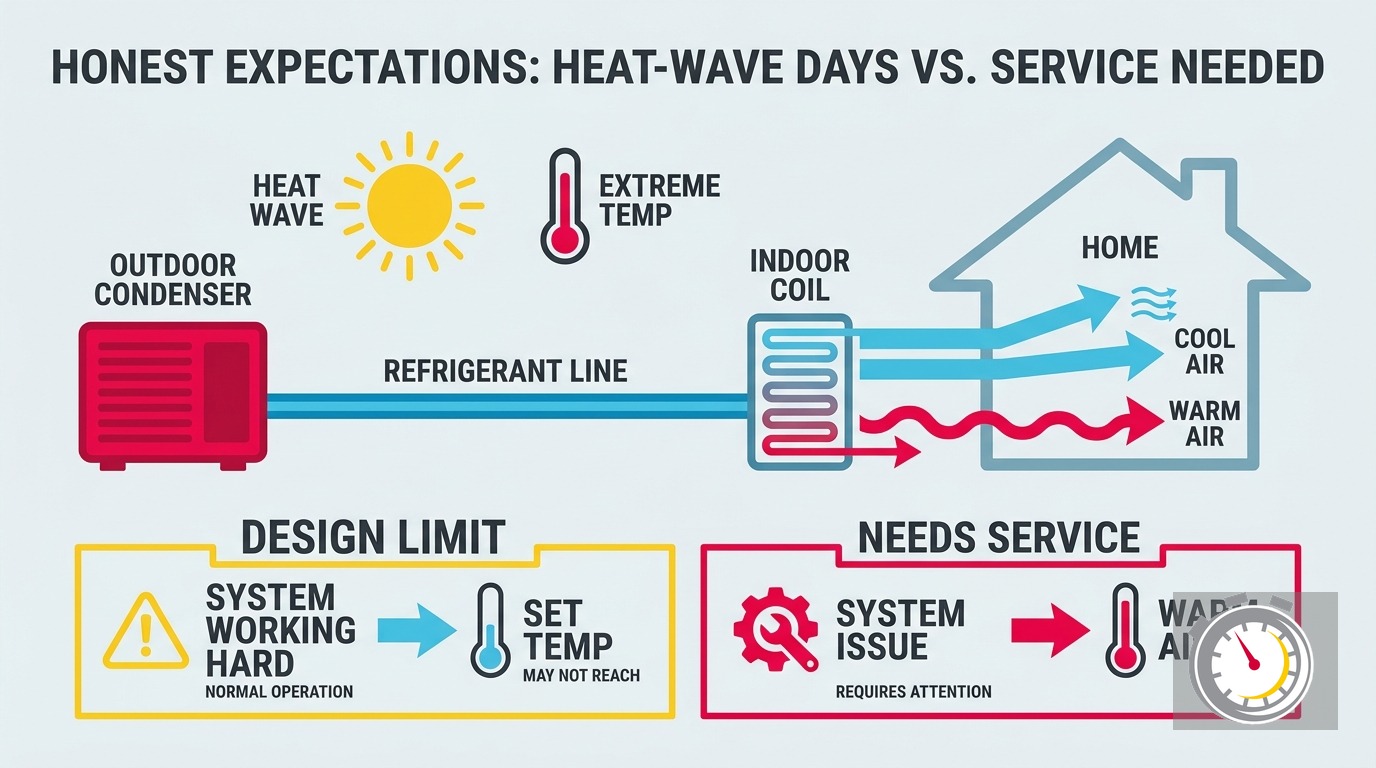
- When your AC can’t keep up on 95-degree days, that’s usually a design limit, not a breakdown. A healthy central AC holds your home roughly 20°F cooler than outdoor temperature. On a 95°F day, 75-80°F indoors is a working system.
- Minneapolis HVAC equipment is sized for a local design temperature of roughly 88-89°F. A 95°F day is already above that mark. Your system is working beyond its rated range before anything else goes wrong.
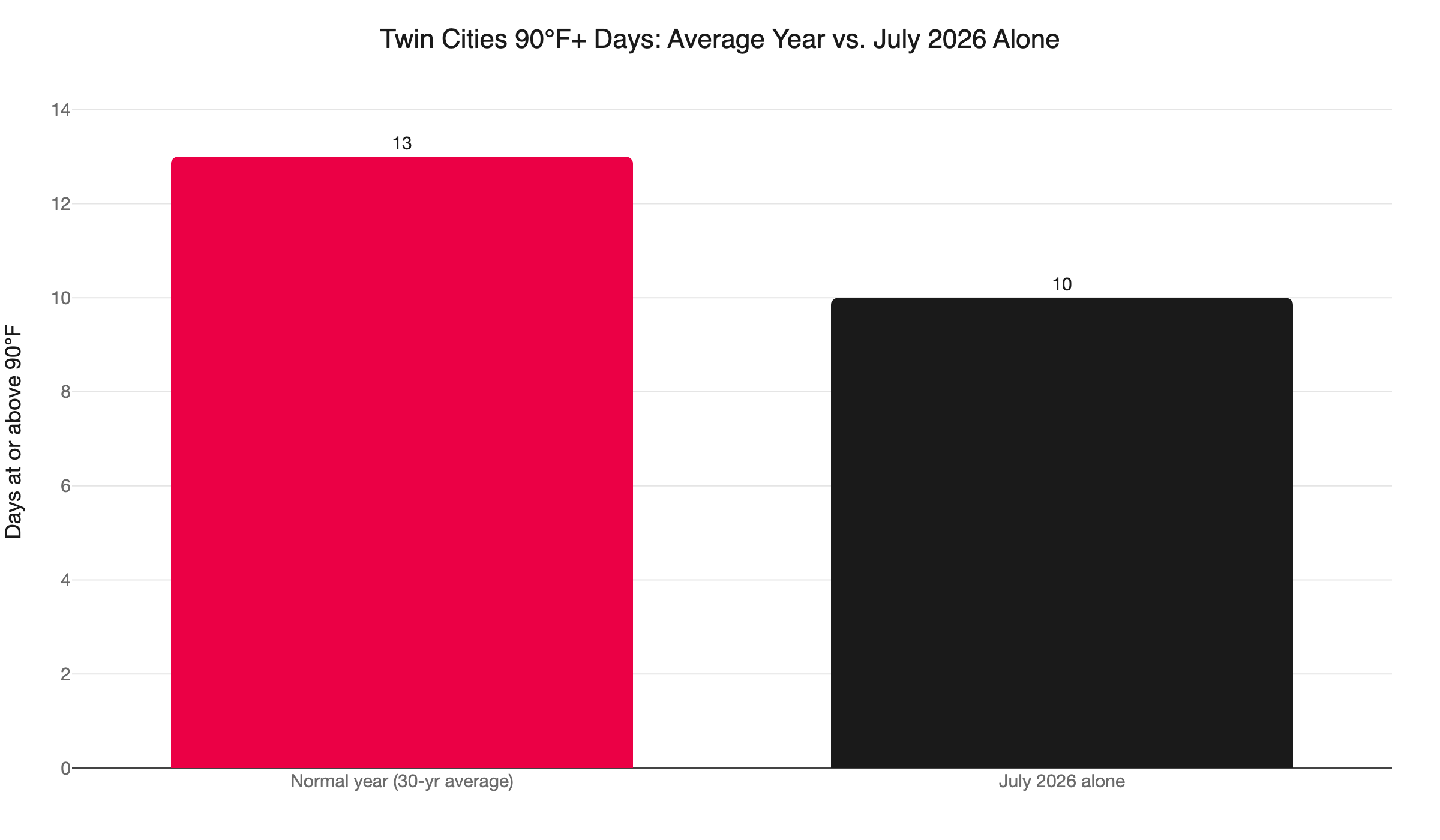
- The July 2026 heat wave gave the Twin Cities 10 consecutive days at or above 90°F. The 30-year normal is 13 such days in an entire year. Your system was not built for that sustained pace.
- A simple thermometer test at your supply registers reveals whether you have a real fault. Healthy cooling delivers air 15-20°F colder than room temperature. Below 8°F, something is wrong.
- Call for service when the indoor-outdoor gap is shrinking steadily over hours, when vents blow warm air, when ice appears on the refrigerant line, or when the breaker trips.
- Minnesota’s overnight lows - typically 65-70°F even during heat waves - are a genuine advantage. Flush heat out of the house at dusk and get ahead of the next day.
Why Was the Summer of 2026 So Punishing?
The short answer: it was genuinely historic. The July 2026 heat wave broke records standing since 1936. Your AC was sized for a typical Minnesota summer, not an exceptional one. If your system struggled, you were not imagining it - and your system was probably not broken.
The Twin Cities recorded 10 consecutive days at or above 90°F in July 2026, the third longest such streak on record. MSP airport reached 100°F on July 27. Heat index values hit 110°F in parts of the metro on the worst days.
The Twin Cities averages 13 days of 90°F or above per year as its 30-year climate normal. Your AC was designed and sized for a Minnesota summer that includes roughly two weeks of significant heat spread across the entire season. Ten consecutive days of it, with a 100°F peak, is a different problem entirely.
Your frustration is justified. What you may not need is a repair call. Understanding the difference between a design limit and an equipment fault is what this post is about.
What Is Your AC Actually Built to Do on a 95-Degree Day?
A standard central AC is designed to keep indoor temperatures roughly 20°F below the outdoor temperature. On a 95°F day, that means 75-80°F indoors is a working system, not a broken one.
This is not a rough estimate. HVAC equipment is ARI/AHRI-rated at exactly 95°F outdoor and 80°F indoor at 50% relative humidity. A 95°F day sits at the literal boundary of the published performance spec. Once outdoor temperatures exceed that mark, rated output begins to drop.
What this means practically: setting your thermostat to 65°F on a 95°F day does not make the air from your registers any colder. The system will run continuously, burning electricity and wearing on components, chasing a setpoint it physically cannot reach. A well-maintained central AC can realistically cool your home to approximately 70-80°F when it’s 95°F outside. That number assumes clean coils, a correct refrigerant charge, and reasonably sealed ductwork. When any of those conditions slip, the real-world number slides further in the wrong direction.
The 20°F rule applies everywhere. What changes in Minneapolis is what happens on top of it.
Why Does Minneapolis Make 95-Degree Days Harder?
Minneapolis combines two factors that don’t appear in most HVAC content: a local design temperature already below 95°F, and summer dew points that force your system to cool and dehumidify at the same time. Both stack against you on an extreme-heat day.
Local design temperature. ACCA Manual J load calculations use local climate data - your home’s insulation levels, window exposure, square footage, and an outdoor design temperature - to determine how much equipment capacity you need. For Minneapolis, the standard cooling design dry-bulb temperature is approximately 88-89°F. Your system was sized to handle a typical hot Minnesota day. A 95°F day is already 6-7 degrees above that local number. The system is running above its rated design threshold before any maintenance issue or age-related wear enters the picture.
Humidity. Your AC removes moisture from the air at the same time it lowers temperature. Those are two separate thermodynamic processes competing for the same capacity. On a hot Twin Cities day, dew points routinely reach 65-75°F. That double load - simultaneous cooling and dehumidification - is a meaningful burden that doesn’t show up in the temperature reading alone. A humid 92°F afternoon in Minneapolis can demand more from your system than a dry 98°F afternoon in Phoenix. Desert heat is hot but light. Our summer heat is hot and heavy with moisture.
The consequence in your home: you may feel warm and sticky on days when the temperature reading alone doesn’t explain it. Your indoor temperature is close to the setpoint, but the air is still clammy because the system is running at capacity without getting ahead of the humidity load. That’s not a malfunction. It’s physics, and it’s specific to this climate.
This combination - above-design outdoor temperatures plus a heavy simultaneous dehumidification demand - is why extreme-heat days in the Twin Cities feel different from anything you’d read about in HVAC content written for Virginia or South Carolina.
Should You Be Worried If Your AC Runs All Day?
No. On a 95°F day, your AC running nonstop is correct behavior. Continuous runtime is not the signal to watch. A gap that keeps shrinking is.
On a mild 78°F day, your system cycles: on for a few minutes, off for a few minutes, on again. That pattern works because the outdoor temperature is comfortably inside the system’s design range and the unit catches up quickly. On a 95°F day, there is no comfortable margin. The system runs at full capacity to hold the gap, and it may never cycle off until outdoor temperatures drop in the evening.
Here is what to watch instead: if outdoor temperatures are holding steady and your indoor temperature is slowly climbing from 76°F to 79°F to 83°F over the course of an afternoon, the gap is shrinking. That trend is worth paying attention to. If you’re holding at 77°F inside while it’s 95°F outside - even if that’s warmer than you’d like - your system is doing its job.
The Register Thermometer Test
You can run a useful first-pass diagnostic before calling anyone. You need a thermometer and about five minutes.
Hold it at a supply register - the vents that push conditioned air into your rooms - and note the temperature reading. Then compare it to the ambient temperature in the room.
A healthy evaporator coil delivers supply air 15-20°F colder than room temperature. If your room is at 78°F, supply air should read between 58°F and 63°F at the register. That spread is called the temperature split, and it tells you whether the coil is actually doing work.
If your reading shows 70-73°F from the register in a 78°F room, you have a 5-8°F split. That’s a real fault - and it’s meaningful regardless of the outdoor temperature. A collapsed split indicates a problem with the coil, the refrigerant charge, or airflow through the system.
The two most common causes of a collapsed split:
- A dirty or frozen evaporator coil. A coil coated with dust restricts heat transfer. A frozen coil - which happens when airflow is blocked or refrigerant is low - stops transferring heat almost entirely.
- Low refrigerant. A system with an insufficient charge cannot absorb enough heat from the air passing over the coil. Low refrigerant is never a top-off situation - it always means there is a leak (see below).
If your split is 15-20°F and the indoor-outdoor gap is holding steady, your system is working. The weather is the problem, not the equipment. Focus on the comfort steps in the overnight recovery section below and wait for the heat wave to pass.
When Should You Call for Service on a 95-Degree Day?
Call when the indoor-outdoor gap is shrinking steadily over hours, when supply air is barely cool at the registers, when you see ice forming anywhere on the system, or when the breaker trips. Running continuously in extreme heat is not a reason to call.
Here is the field guide:
Normal operation - leave it:
- System runs continuously without cycling off
- Indoor temperature holding roughly 20°F below outdoor temperature
- Supply air noticeably cooler than room temperature at registers
Call for service:
- Indoor-outdoor gap shrinking hour by hour while outdoor temperature holds steady
- Supply air at registers only 5-8°F cooler than room temperature
- Ice visible on the refrigerant line, the indoor coil, or the outdoor unit
- Breaker tripping repeatedly
- Short cycling: system kicks on, runs briefly, then shuts off in a repeating loop
That last item - short cycling on a humid day - deserves specific attention. An oversized AC short-cycles: it brings the air temperature down fast, shuts off before completing a full dehumidification pass, and leaves the house feeling warm and muggy even when the thermostat reads the setpoint. On a 95°F Minnesota day with 70°F dew points, an oversized short-cycling unit performs worse than a properly sized system running steadily. If your AC was replaced in the last 5-10 years and has never quite felt right, oversizing is a question worth asking.
Does Refrigerant Run Out?
No. Refrigerant circulates through a closed loop inside your system and should never need topping off unless something has gone wrong. If your system is low on refrigerant, there is a leak, and a recharge without finding and fixing that leak is a temporary patch.
Low refrigerant requires professional leak diagnosis and repair, not just a top-off. A technician needs to locate where refrigerant is escaping, repair it, and then restore the correct charge. Topping off a leaking system buys you a few weeks of improved performance before the same problem returns, along with another service call.
Signs of low refrigerant: ice on the refrigerant line or the indoor unit, a hissing or bubbling sound near the indoor equipment, and a collapsed temperature split at the supply registers. Our post on AC refrigerant leak signs in Minnesota walks through each symptom in detail and explains what the repair process looks like.
What About Leaky Ductwork?
Leaky ductwork silently wastes conditioned air before it reaches your rooms. On a 95°F day when you need every degree of cooling capacity, that hidden loss makes a working system feel like a failing one.
Leaky ductwork can waste 20-30% of conditioned air before it reaches your living spaces. Your system may be producing the right output and losing nearly a third of it to attic spaces, wall cavities, or unconditioned mechanical chases. The result in your rooms: weak airflow, uneven temperatures between floors or wings of the house, and a system that runs constantly without keeping up.
Signs of significant duct leakage: some rooms are noticeably warmer than others during a heat wave, energy bills feel high relative to the comfort you’re getting, or you can find visible gaps and disconnected sections in accessible ductwork. Professional duct sealing in the Twin Cities typically runs around $1,300 and can recover a meaningful share of that lost cooling capacity.
The Minnesota Overnight Recovery Advantage
This is a strategy that works in Minneapolis and doesn’t apply in Texas, Arizona, or most of the southeast. Use it.
Unlike southern states where overnight temperatures during heat waves stay in the 80s, the Twin Cities typically cools to the mid-to-upper 60s overnight. Even during the July 2026 heat wave, overnight lows stayed manageable across much of the metro. That window is real, and it gives your home a recovery opportunity that most of the country doesn’t have.
Here is how to use it:
- At dusk, check whether outdoor temperatures have dropped below your indoor temperature. If so, open windows and run exhaust fans - especially a whole-house fan if you have one - to flush stored heat out of the house and the building mass (walls, floors, furniture) that absorbed it all day.
- Once outdoor air is cooler than indoor air, run fans for 30-60 minutes to pull cool outdoor air through and drop the temperature of the house itself, not just the air inside it.
- Close windows and doors before outdoor temperatures start climbing the next morning, typically by 8-9 a.m.
- Keep blinds and curtains closed on south- and west-facing windows from noon to 6 p.m., the peak solar-gain window.
A home that starts a 95°F day at 72°F has a much bigger buffer than one that starts at 78°F. That 6-degree head start can be the difference between manageable and miserable by 4 p.m.
When Should You Consider Replacing Your AC?
If your system is over 10 years old and struggled this summer, the heat wave may have exposed a problem that was developing for years - not caused one.
ENERGY STAR recommends considering replacement when a system is more than 10 years old and requires frequent repairs. An aging system running with a marginal refrigerant charge, a partially clogged coil, and worn components will hit its performance ceiling sooner and lower than a newer, well-maintained unit. Extreme heat does not break a healthy system - it reveals one that was already struggling. A system installed when the home sold, run for a decade without a tune-up, and now showing a collapsed temperature split on a hot day is almost certainly a replacement conversation.
Replacement costs for a mid-tier central AC in the Twin Cities start around $7,500-$10,400 installed. High-efficiency systems rated 18-20+ SEER2 typically run $11,000-$15,600. Financing is available and can convert a large single expense into a manageable monthly number - ask us about it if cost is the thing holding the decision.
If you’re weighing repair versus replacement, age and repair history are the most important inputs. Our post on AC replacement cost in Minnesota walks through what drives those numbers and what questions to ask your technician before committing either way.
As a locally owned and operated Twin Cities HVAC company, we give you a straight answer on that math. We would rather tell you a repair makes sense for another few years than sell you a replacement you don’t need. And we would rather tell you a repair is money down the drain on a system at the end of its life than take your money and have you back in the same conversation next summer.
Ready to Stop Guessing?
If you’ve run the register thermometer test, watched the indoor-outdoor gap trend, and you’re still not sure whether you’re hitting a design limit or have a real fault, a diagnostic visit answers that question in a single call.
We are Northern One Hour Heating & Air Conditioning, locally owned and operated in Ramsey, MN, serving the Twin Cities. Every visit is backed by our on-time promise: “Always On Time… Or You Don’t Pay a Dime!(R)” If our technician is not there when we said, you owe nothing for the visit.
Call (763) 260-6662 or schedule your service online. On a 95°F day, you don’t have time to wonder.
Frequently Asked Questions
Is it normal for my AC to run all day on a 95-degree day? +
How do I know if my AC has a real fault or is just hitting its design limit? +
Why does my Twin Cities house feel worse on a humid 90°F day than a dry 95°F day? +
When should I replace my AC instead of repairing it again? +
Need a technician now?