
Whole House Fan Minnesota: What Twin Cities Homes Should Know
Key Takeaways
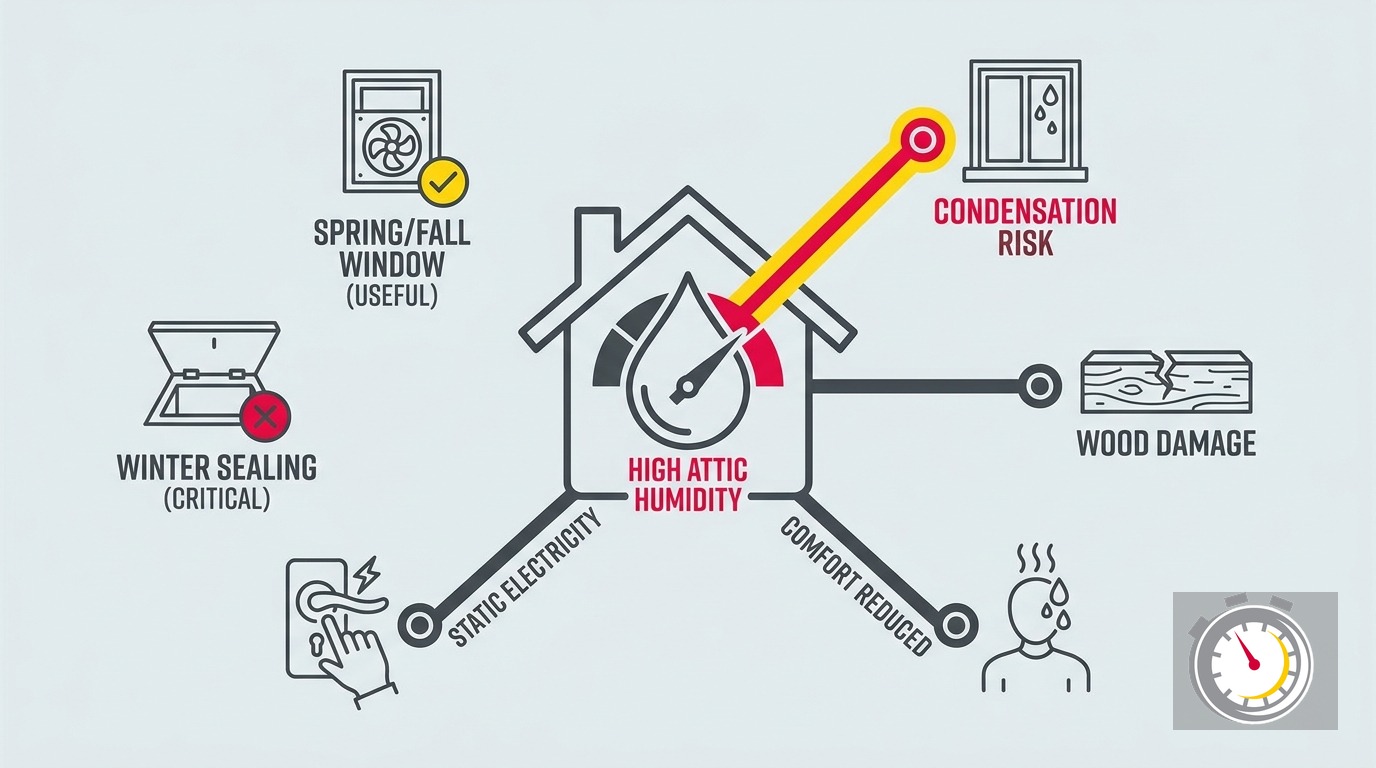
- The whole house fan Minnesota sweet spot is the shoulder seasons: May through mid-June and late August through October.
- July and August are usually the wrong time to run one. Twin Cities dew points regularly hit 65-70°F, and running the fan then pulls humid air into your home and attic.
- Your attic needs adequate vent area. Without enough exhaust capacity, you push warm air into a heat trap instead of cooling the house.
- Older homes with atmospheric-vent gas water heaters or furnaces face a real carbon monoxide risk when a large fan runs.
- Minnesota winters demand tight sealing. An unsealed fan housing at -20°F drives attic frost, ice dams, and added furnace bills.
- No utility or state rebate currently covers whole house fan installation as a standalone upgrade.
What Is a Whole House Fan?
A whole house fan is one of those tools that sounds perfect for Minnesota homeowners: fresh air, low energy cost, fast results. The fan mounts in the ceiling between your living space and your attic. Open windows throughout the house and turn it on. It pulls air from the living area up through the ceiling and out through your attic vents.
On a cool night, this exchange drops indoor temps by several degrees in under 30 minutes. The fan draws a fraction of the electricity a central AC system uses. For Twin Cities homeowners, the appeal is real. So are the caveats.
Is a Whole House Fan Worth It in Minnesota?
For the right home, yes. The Twin Cities shoulder seasons give this tool a genuine window to work well. May through June and September through October bring cool overnight lows and low humidity. Run the fan on those nights and it earns its cost over a few seasons.
The problem is the framing. Most guidance treats whole house fans as summer cooling tools. In Minnesota, that framing leads homeowners astray. July and August humidity spikes change the equation. The fan that works beautifully in May can pull moisture and misery into your home in August.
The real question is whether your home is ready: the attic, the gas appliances, and the winter seal plan. This post walks through each.
When Should You Run a Whole House Fan in Minnesota?
Run it when outdoor temps drop below 65°F at night and dew points fall below 55-60°F. In the Twin Cities, that is roughly May through mid-June and late August through October. The 65°F nighttime threshold is a widely cited benchmark. Above it, the warm air the fan pulls in offsets the cooling from air movement.
What that looks like by season:
- May and early June: Overnight lows often reach the mid-50s to low 60s. Dew points stay low. This is the prime window.
- Mid-June through July: Overnight temps stay warm. Dew points climb into the 60s. Marginal at best for most nights.
- August: Most nights are too warm and too humid. A strong cold front can create an excellent window. Those nights arrive without much warning.
- September and October: Overnight lows drop back into the 50s and 60s. Humidity falls. The second strong window opens.
A few rules regardless of conditions:
- Open windows throughout the house before starting the fan. Running it against a closed house builds dangerous negative pressure quickly.
- Never run the fan with the central AC on. They work against each other.
- Run it in the evening and overnight. Close windows in the morning before outdoor temps rise.
- Watch the dew point, not just the temperature. A 62°F night at a 63°F dew point is not a good night for the fan.
Why Are July and August Usually the Wrong Months?
Minnesota’s summer humidity load makes whole house fan use counterproductive on most July and August nights. When Twin Cities dew points hit 65-70°F, a standard midsummer pattern, you are drawing in warm and humid air. You are not drawing in cool air.
That air moves through your living space and into your attic. Even if indoor temps drop slightly, your humidity load rises. You feel warm and sticky. Your attic sheathing absorbs moisture it did not need.
The PNNL Building America Solution Center documents that pulling warm, moist outdoor air into attic spaces under high-humidity conditions creates pathways for frost and mold damage over time. The moisture risk is real, not theoretical.
The exception is a strong post-cold-front night in late August or September. When the dew point drops below 55°F and overnight lows fall to the upper 50s, the fan works well. Plan around the forecast, not the calendar.
Does Your Attic Need to Be Ready First?
Yes. Insufficient attic vent area turns a whole house fan from an asset into a liability. The fan pushes a large volume of air into the attic. Without enough exhaust capacity, pressure builds and attic temps stay high. Twin Cities attics in poorly vented homes can reach 130-150°F in July. Exhausting into that environment delivers little actual cooling relief to the living space below.
A rough target: 1 square foot of net free vent area per 150 square feet of attic floor. Check your ridge vents and soffit vents before assuming you have enough capacity. Blocked soffit vents or attics with only gable vents may fall short.
The ceiling air seal matters just as much. Gaps around light fixtures, attic hatches, and plumbing penetrations create bypass paths. Even with windows open, the fan can pull conditioned air out through those gaps. PNNL research confirms that negative pressure from whole house fan operation draws air through ceiling gaps, pulling heat and moisture into wall cavities and reducing the fan’s effectiveness.
Pairing the fan installation with ceiling air sealing pays twice: it makes the fan more effective in summer and reduces your heating and cooling load all year. Our post on air sealing before an HVAC upgrade covers the attic and ceiling work worth doing first.
Can a Whole House Fan Create a Carbon Monoxide Risk?
Yes, in homes with atmospheric-vent gas appliances. A large whole house fan places the house under significant negative pressure. Gas appliances that rely on natural draft to exhaust combustion gases can backdraft under those conditions. Combustion byproducts then flow back into the living space instead of up the flue. That is a carbon monoxide risk, not a theoretical concern.
HomesMSP puts it plainly: when the fan runs, the house becomes “a big vacuum,” and atmospheric-vent appliances are the hazard. Draft-hood water heaters are the most common culprit.
Many Twin Cities bungalows, ramblers, and 1950s-70s splits were built with draft-hood gas water heaters. A large share of the Metro’s older housing stock still has one. If that describes your mechanical room, you have two practical paths forward:
- Upgrade the water heater to a sealed-combustion or power-vented model before running the fan.
- Ensure the appliance is on a floor separate from the fan’s main airflow. Verify that passive makeup air is adequate to keep the pressure balance safe.
Do not run a large whole house fan in the same pressure zone as a draft-hood water heater without resolving this first. Our post on exhaust fans and furnace backdraft risk in Minnesota walks through the combustion safety interaction in detail.
What Type of Whole House Fan Works Best for Minnesota Homes?
Insulated fans with motorized, self-closing dampers are the right choice for Minnesota’s climate. Two main types are on the market, and the difference matters here more than in milder states.
Older-style fans use gravity-operated louvers: slats that open when the fan runs and fall shut by gravity when it stops. In mild climates, that is acceptable. In Minnesota winters, a gravity louver does not seal tightly enough. Cold air infiltrates through the gaps. Warm indoor air bypasses the louver and migrates into the attic.
Newer insulated fans use motorized dampers that close positively when the fan shuts off. The insulated panels resist both airflow and heat loss far better than gravity louvers. These models cost more upfront, but in Minnesota’s climate, the winter performance difference is worth the premium.
If you are replacing an older fan or installing for the first time, specify an insulated model with motorized dampers. You will still want to inspect the seal annually, especially after several seasons of use. But the annual attic-box-build-and-remove task goes away, which is a real quality-of-life improvement on a cold October morning.
What Happens to a Whole House Fan in a Minnesota Winter?
An unsealed fan housing is one of the most damaging attic air leaks a Minnesota home can have. Minneapolis home inspector Reuben Saltzman at Structure Tech is direct: “without a doubt, one of the worst sources of air leakage into the attic space is an opening for a whole-house fan.”
Generic winterizing guides understate the stakes in Minnesota. At -20°F to -30°F overnight lows, a poorly sealed fan opening causes compounding damage:
- Attic frost: Warm, moist indoor air rises through the opening and deposits frost on attic sheathing and framing. Over a winter, that drives rot and mold.
- Ice dams: Heat escaping through the fan opening creates the temperature gradient at the eave that causes ice dams. A failing whole house fan seal can be the direct cause of ice dam damage to your roof and gutters.
- Added furnace load: The opening bypasses your insulation entirely. At -20°F, you pay to heat air that goes straight to the attic.
The common workaround of laying fiberglass batts over the opening does not work. Structure Tech is explicit on this point: fiberglass batts block radiant heat transfer. They do not stop air movement. The correct approach for an older fan is an airtight, insulated box built from the attic side each fall. One St. Paul homeowner spent multiple weekends building and fitting a custom cover. For a newer fan with a motorized insulated damper, the damper handles most of this. Inspect the seal every October regardless.
For the full picture on attic air leaks, ice dams, and heating bills in Twin Cities homes, see our guide on attic insulation, ventilation, and ice dams.
Do You Need a Permit to Install a Whole House Fan in Minnesota?
In most Twin Cities jurisdictions, yes. Minnesota mechanical code follows the IRC, and adequate makeup air is a code requirement. This is not paperwork for its own sake. At least one St. Paul building inspector raised depressurization and backdrafting objections during a permit review for a new-construction home. The inspector initially threatened to require a 1:1 mechanical makeup air system. That requirement would have largely offset the fan’s energy savings.
The path through permitting is preparation: document your attic vent area, your makeup air plan, and how you are handling any atmospheric-vent appliances before you apply. A contractor who has pulled these permits in the Twin Cities knows what the inspectors need to see.
Never skip the permit. It protects you at resale and gives you a code-compliant record of the installation.
Are There Rebates for Whole House Fans in Minnesota?
No utility or state rebate currently covers whole house fan installation as a standalone upgrade. Xcel Energy, CenterPoint Energy, and other Minnesota utilities offer HVAC rebates for eligible equipment. Whole house fans are not on those lists.
The Minnesota HOMES program (Home Efficiency Rebates, funded through the Inflation Reduction Act) had not launched as of mid-2026, pending federal DOE approval. When it does, whole house fans are unlikely to qualify on their own. However, the ceiling air sealing you should pair with any whole house fan installation may qualify. HOMES rebates tier by whole-home energy savings: 20-34% savings yields $2,000-$6,000 (income-dependent), and 35%+ savings yields $4,000-$12,000. If your home is a candidate for that level of work, the air sealing conversation is worth having with your contractor.
How Does a Whole House Fan Fit With Central Air Conditioning?
A whole house fan supplements central AC during shoulder seasons. It does not replace it. On cool, low-humidity spring and fall evenings, the fan drops indoor temps faster than the AC. It uses much less electricity to do it. Those are the nights to run it hard.
On hot, humid July and August days, run the central AC and leave the fan off. The AC needs a sealed, dehumidified envelope to do its job. Running the whole house fan against that setup wastes both systems.
The smart pattern: run the fan aggressively overnight during the right windows and close windows in the morning before outdoor temps climb. If the house hits 67°F overnight, your AC may not need to run until midmorning. That flywheel effect is where the real savings accumulate over a season.
If summer humidity is the bigger comfort problem in your home, our post on whole home dehumidifiers in the Twin Cities covers the options.
Ready to Sort Out Your Cooling Strategy?
Northern One Hour Heating & Air Conditioning is locally owned and operated in Ramsey, MN. Our team serves the full Twin Cities metro: Minneapolis, St. Paul, Blaine, Maple Grove, Plymouth, Brooklyn Park, Woodbury, Bloomington, and the surrounding area.
If you are weighing whether a whole house fan makes sense for your home, or thinking about a new central air system or heat pump, our team can walk through the options with you. We give you a straight answer on what fits your home and your budget.
We back every visit with our on-time promise: “Always On Time… Or You Don’t Pay a Dime!(R)”
Call us at (763) 260-6662 or schedule your appointment online.
Frequently Asked Questions
When is it cool enough to run a whole house fan in Minnesota? +
Can I run a whole house fan and central AC at the same time? +
Does a whole house fan replace central air conditioning in Minnesota? +
What is the biggest winter risk of a whole house fan in Minnesota? +
Do I need a permit to install a whole house fan in Minnesota? +
Need a technician now?