
Bathroom Exhaust Fan Furnace Backdraft: A Minnesota Guide
Key Takeaways
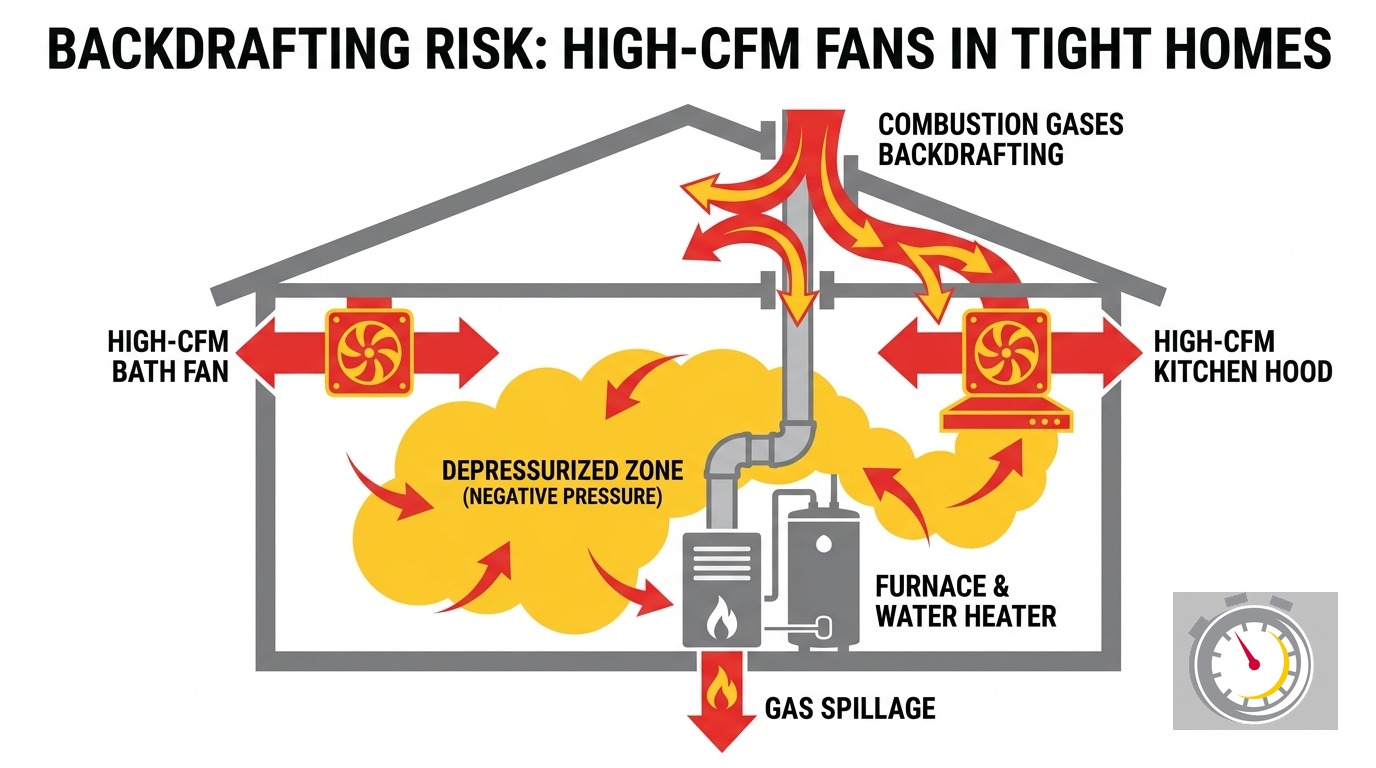
- High-CFM exhaust fans create negative air pressure inside your home. When that pressure drops past certain thresholds, combustion gases reverse direction through your furnace or water heater flue.
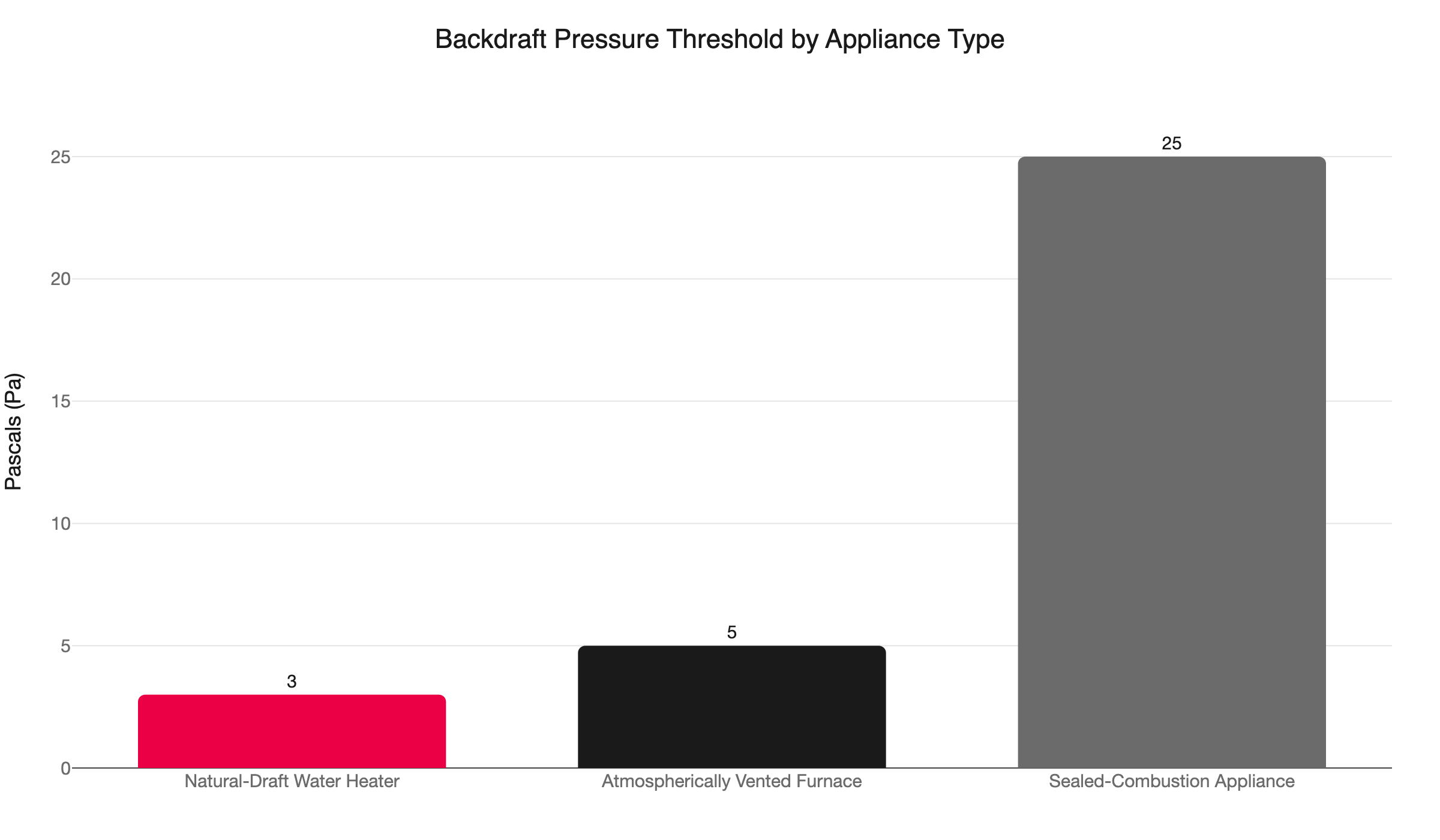
- Atmospherically vented (B-vent) furnaces can backdraft at just 5 Pascals of negative pressure. Natural-draft water heaters can spill combustion gases at 2-3 Pa. Most bathroom fans can exceed both thresholds in a tight house.
- Sealed-combustion appliances draw combustion air from outside and are largely immune to indoor pressure swings. They are the permanent fix.
- Minnesota winters are the worst season: your home is sealed tight, the stack effect pulls warm air up and out, and heating appliances run their longest cycles.
- Pre-2000 homes with recently upgraded exhaust fans carry the highest risk.
- A DIY smoke-match test takes ten minutes and confirms whether a backdraft condition exists.
- CO detectors are essential, but they are a backup, not a prevention. Do not rely on them in place of proper venting and equipment.
Your bathroom exhaust fan is doing exactly what it was built to do. That is the problem. In a sealed-up Minnesota home, a high-CFM exhaust fan does more than clear shower steam. It lowers air pressure inside your house. When that pressure drops far enough, it can reverse the draft on your furnace or water heater. Bathroom exhaust fan furnace backdraft in Minnesota is a documented, measurable safety hazard. It is most common in exactly the kinds of homes that fill Twin Cities neighborhoods: pre-2000 construction with older atmospheric venting, gradually tightened over the years but never recalculated for the pressure consequences.
What Is Furnace Backdraft?
Backdraft is the reversal of combustion gases through a furnace or water heater flue. Instead of exiting the home, those gases, including carbon monoxide, flow back in. The driver is negative air pressure: when your home is depressurized enough, the flue becomes a path of least resistance for air to enter rather than exit. Exhaust fans are a common trigger, especially in tight Minnesota homes.
According to the EPA, backdraft is the pressure-induced reversal of combustion products into the living space, and the primary hazard is carbon monoxide. Carbon monoxide is colorless and odorless. It gives no warning.
A furnace running during a backdraft event may appear completely normal. The burner fires, the blower runs, heat moves to your rooms. Meanwhile, combustion byproducts enter your living space through the draft hood at the appliance. That invisibility is what makes this hazard different from a broken component or an audible problem. Homeowners rarely connect recurring headaches or fatigue during heating season to a pressure problem in the mechanical room.
The Pressure Physics Behind the Problem
Air flows from high pressure to low. Every exhaust fan removes air from your home and creates a slight vacuum. In a leaky old house, replacement air seeps in through gaps fast enough to keep pressure near neutral. In a tight home, those paths are closed.
A 1993 study of newly built energy-efficient Minnesota homes found something direct. Exhaust airflows of 300-550 CFM depressurized those homes to 5 Pa - exactly the threshold at which natural-draft appliances start spilling combustion gases. A 600-CFM kitchen range hood in a tight house can produce negative pressures from 3 to over 20 Pa. That range depends on how sealed the home is.
At those pressure levels, the fan is not just pulling air from one room. It pulls from the entire building envelope. Every gap, every penetration, every low-resistance opening becomes a candidate for makeup air. The furnace or water heater flue is a large, direct connection to the outside. It is often the easiest path available. That is how a bath fan on the second floor ends up pulling combustion gases back down from a basement furnace.
One more factor: the worst-case moment is not when the fan first turns on. It is after the fan has been running long enough to deplete the available envelope leakage. Pressure can continue dropping for several minutes. The furnace may have been drafting fine at startup and fail fifteen minutes later.
Which Appliances Are Most Vulnerable to Backdraft?
Atmospherically vented (B-vent) gas furnaces and natural-draft water heaters carry the highest risk. They rely on passive buoyancy to move combustion gases up the flue, and they fail at very small pressure differences. Sealed-combustion appliances draw combustion air from outside the house and are largely immune to indoor pressure changes.
The specific thresholds make the gap concrete. A natural-draft water heater can spill combustion gases at as little as 2-3 Pascals of negative pressure. An atmospherically vented furnace can backdraft at 5 Pa or less. Sealed-combustion appliances can tolerate 25-50 Pa before they are affected. A standard bathroom exhaust fan can generate depressurization well above the 5 Pa threshold in a tight home.
You can identify your appliance type by the vent pipe. A B-vent is a double-wall metal pipe, usually silver or gray, that exits through the roof. A direct-vent (sealed-combustion) appliance uses two pipes: one draws outside combustion air in, and one exhausts gases out. Both pipes typically exit through a sidewall. If your furnace or water heater has a single vent pipe heading up through the roof, it is almost certainly atmospherically vented.
Homes across Ramsey, Blaine, Maple Grove, Plymouth, and Brooklyn Park are full of these systems. Atmospheric and B-vent equipment was the industry standard through the mid-to-late 1990s. Many of those appliances are still running, in houses that are meaningfully tighter than they were when those appliances were installed.
Why Minnesota Winters Raise the Stakes
Minnesota homes stay sealed for five or more months during heating season. Every window and door stays closed. Mechanical ventilation may be limited to bathroom and kitchen fans. That seal removes every passive ventilation path that would otherwise let a fan pull replacement air without lowering house pressure.
Two forces compound at exactly the wrong time on a cold Minnesota day.
The first is the stack effect. Warm indoor air rises and escapes through gaps and penetrations high in the building. Cold replacement air has to enter from below. If the flue is the lowest-resistance inlet path, that air enters down the flue, working against the combustion gases that need to travel up.
The second is run time. The colder it is outside, the longer your furnace and water heater run. Long run cycles extend the window for a fan-driven depressurization event to intersect with appliance operation. A furnace running nearly continuously at 0 degrees Fahrenheit is in far more danger than one cycling briefly on a mild October night.
The Twin Cities and most of greater Minnesota sit in IRC Climate Zone 6. That classification sets a tightness standard of 3 ACH50 or better for newer construction. Meeting that standard is good for efficiency. It is also exactly the condition that raises depressurization risk whenever exhaust fans run without makeup air.
What’s the Riskiest Setup in Twin Cities Homes?
A pre-2000 home with an atmospherically vented furnace or natural-draft water heater, plus a recently upgraded high-CFM bathroom or kitchen fan. The appliances were designed when the house leaked enough to supply their combustion air. The new fan removes that leakage margin and can tip the pressure balance past the backdraft threshold.
This scenario plays out regularly across Twin Cities neighborhoods. A homeowner remodels a bathroom and replaces the original 50 CFM fan with a modern 110 CFM unit for better humidity control. Or a new kitchen range hood goes in during a renovation. The upgrade seems routine. What changed is the home’s pressure balance.
The older appliances were sized and installed when the house leaked enough through the envelope to supply passive combustion air. Over the years, many of these homes have been progressively tightened: new weatherstripping, caulked windows, spray foam around penetrations. That tightening was smart for energy efficiency. It also reduced the passive leakage those appliances depended on.
Add a new high-CFM fan, and the margin disappears. The furnace or water heater can no longer maintain draft under worst-case fan operation. Combustion gases spill. Because the episode may last only as long as the fan runs, it can be intermittent and easy to miss or misattribute. A household that runs the bath fan for 20 minutes after a shower every morning may be experiencing a daily backdraft event without knowing it.
The inflection point in Minnesota is roughly the 1994 Energy Code. Post-1994 construction is tight enough that makeup air calculations became mandatory under certain triggers. Pre-1994 homes are typically leaky enough to be self-compensating - but many of them also still have the atmospherically vented appliances that are most vulnerable.
How Can You Test for Backdraft at Home?
Close the house, run all exhaust fans and the dryer, fire the water heater, then hold a blown-out match near the draft hood opening. Smoke drifting toward you, rather than up into the vent, confirms a backdraft condition under that fan load. The test takes about ten minutes and requires no equipment beyond a box of matches.
Here is the full sequence:
- Close all windows and exterior doors.
- Turn on every exhaust fan in the home: bathroom, kitchen, whole-house exhaust.
- Start the clothes dryer on a heat cycle.
- Turn the water heater thermostat up until the burner fires.
- Light a match, blow it out immediately, and hold the smoking tip near the draft hood opening on the water heater.
- Watch the smoke. If it drifts toward you or moves horizontally, the house is depressurized enough to backdraft under that load.
Energy auditors and home performance contractors reference this test as a quick worst-case depressurization screen. It confirms whether a problem exists, not the severity of it.
The BPI Building Analyst Standard goes further. A trained technician uses a digital manometer to measure baseline house pressure, then measures worst-case negative pressure under all-fans operation, and compares both readings against each appliance’s backdraft limit. That is the definitive evaluation.
If the smoke-match test flags a problem, stop running the exhaust fan in combination with those appliances until an assessment is complete. Our guide on carbon monoxide safety during furnace season covers immediate precautions while you wait.
What About Carbon Monoxide Detectors?
CO detectors are essential, but the EPA is direct: CO alarms are a backup to, not a replacement for, proper installation and maintenance of fuel-burning appliances. A detector will not prevent backdraft. It alerts you after combustion gases have already entered your home.
Install a CO detector on every level of your home and within 15 feet of each sleeping area. Check the battery and the unit’s expiration date regularly. Many detectors have a seven-year service life, but homeowners often replace the battery and assume the unit is still functional long past that point.
Do not treat a working CO detector as a reason to defer a combustion safety assessment.
Some CO exposure causes symptoms - headaches, nausea, dizziness, fatigue - at concentrations below the threshold at which most consumer detectors sound an alarm. If members of your household feel unwell inside the home during heating season but recover when they go outside, mention that pattern to a technician. It is a recognized indicator of low-level CO exposure.
What Does Minnesota Code Require for Makeup Air?
Minnesota Mechanical Code Section 501.4.3 governs makeup air. The 300 CFM threshold triggers a calculation, but it is not a safe limit. Six specific conditions require that calculation, including adding any exhaust system in a home built after 1999. The actual need for makeup air depends on home vintage, appliance types, and total exhaust load across all fans.
The 300 CFM myth is widespread. It does not work the way most people think. Installing a kitchen fan rated under 300 CFM does not exempt your home from makeup air requirements. Under MN Mechanical Code Section 501.4.3, a makeup air calculation is required whenever any of six triggers are met. Two of the most common:
- Replacing a vented combustion appliance
- Replacing or adding any exhaust system in a home built after 1999
The calculation accounts for home tightness, appliance types, and total exhaust airflow across all fans. A home with an atmospherically vented furnace, a natural-draft water heater, and three bathroom fans may require makeup air even if no single fan exceeds 300 CFM. The total load is what matters.
A permit is required for new makeup air equipment installations in Minnesota. Our post on when an HVAC permit is required in Minnesota covers which projects trigger the permit process and what to expect from it.
How to Fix Bathroom Exhaust Fan Furnace Backdraft
The fix depends on which part of the system is the weakest link. Three approaches address the problem, and they are not mutually exclusive.
Upgrade to sealed-combustion appliances. The EPA identifies this as the definitive fix: replace atmospherically vented appliances with sealed-combustion or power-vented equipment. A sealed-combustion furnace draws its combustion air through a dedicated pipe from outside. Indoor pressure cannot affect it. The same principle applies to a direct-vent or power-vented water heater.
This is the only approach that eliminates the underlying vulnerability rather than managing around it. A modern 95%+ AFUE sealed-combustion furnace also costs less to operate than the B-vent unit it replaces. If your current furnace is 15 or more years old, replacement may already be due on its own timeline. See your furnace replacement options for a look at what is available.
Add a makeup air system. A dedicated makeup air intake supplies replacement air whenever exhaust fans run. Properly designed and permitted under the MN Mechanical Code, makeup air keeps interior pressure near neutral and removes the depressurization risk without requiring appliance replacement. For homes that also want year-round fresh air, a whole-home HRV is the most efficient option in Minnesota’s climate. It supplies fresh air while recovering heat from the exhaust stream, so you are not simply venting conditioned air to the outside.
Right-size the exhaust fan. If the culprit is a grossly oversized bathroom or kitchen fan, replacing it with a correctly sized unit reduces the depressurization load. This is a partial measure. In a tight home with multiple fans, it will rarely be sufficient on its own. Most homes with a confirmed backdraft condition require the first approach.
Are CenterPoint Energy Rebates Available for Backdraft Fixes?
Yes, if the fix involves upgrading the gas furnace or water heater to a high-efficiency unit. CenterPoint Energy offers up to $400 on a 95%+ AFUE gas furnace replacement and up to $750 on a qualifying tankless water heater. Both high-efficiency designs use sealed-combustion or power-vent configurations that eliminate backdraft risk entirely.
These are 2026 program figures. Verify current amounts at centerpointenergy.com before scheduling. CenterPoint serves most of the Twin Cities gas service area, including Minneapolis, St. Paul, Ramsey, Blaine, Maple Grove, and surrounding suburbs.
Paired with federal tax credits under the Inflation Reduction Act - up to 30% of installed cost for qualifying high-efficiency equipment - the net cost of replacing a backdraft-vulnerable system can be meaningfully lower than the sticker price. Ask our team about financing if upfront cost is a factor. A project that eliminates a safety hazard and cuts your heating bill is worth looking at the full financial picture before deciding.
When to Call Northern One Hour
If the smoke-match test flagged a problem, or if you have an older home with B-vent equipment and a recently upgraded exhaust fan, a combustion safety assessment is the right next step. You do not need to wait for symptoms.
Northern One Hour is locally owned and operated in Ramsey, MN. We serve the Twin Cities and surrounding communities: Minneapolis, St. Paul, Blaine, Maple Grove, Plymouth, Brooklyn Park, Woodbury, and Bloomington. We back every service visit with our on-time promise: “Always On Time… Or You Don’t Pay a Dime!(R)”
A combustion safety assessment includes a worst-case depressurization test for each combustion appliance zone, digital manometer readings against backdraft thresholds, and a complete walkthrough of findings and options. We do not lead with a replacement recommendation. We show you the data and let the situation drive the conversation. If the makeup air calculation resolves the problem without a new furnace, that is what we will tell you.
If the assessment does point to an equipment upgrade, we will walk you through replacement options, efficiency ratings, available rebates, and financing. Replacing a backdraft-prone B-vent furnace on your schedule is better than replacing it on a February night. Call us at (763) 260-6662 or book online to schedule your assessment.
Frequently Asked Questions
Can a bathroom exhaust fan really cause carbon monoxide poisoning? +
How do I know if my furnace is at risk for backdraft? +
Does a CO detector protect me from backdraft? +
What is the Minnesota 300 CFM rule for exhaust fans? +
How much does it cost to fix furnace backdraft in Minnesota? +
Need a technician now?