
Radon Mitigation HVAC Minnesota: The Furnace Connection
Key Takeaways
- Radon is the second-leading cause of lung cancer in the U.S. The five-year survival rate after diagnosis is 11-15%.
- Fix at 4 pCi/L or above. Between 2-4 pCi/L, action is still worth considering.
- Most of the Twin Cities metro sits in EPA Radon Zone 1. Average indoor radon above 4 pCi/L is predicted there.
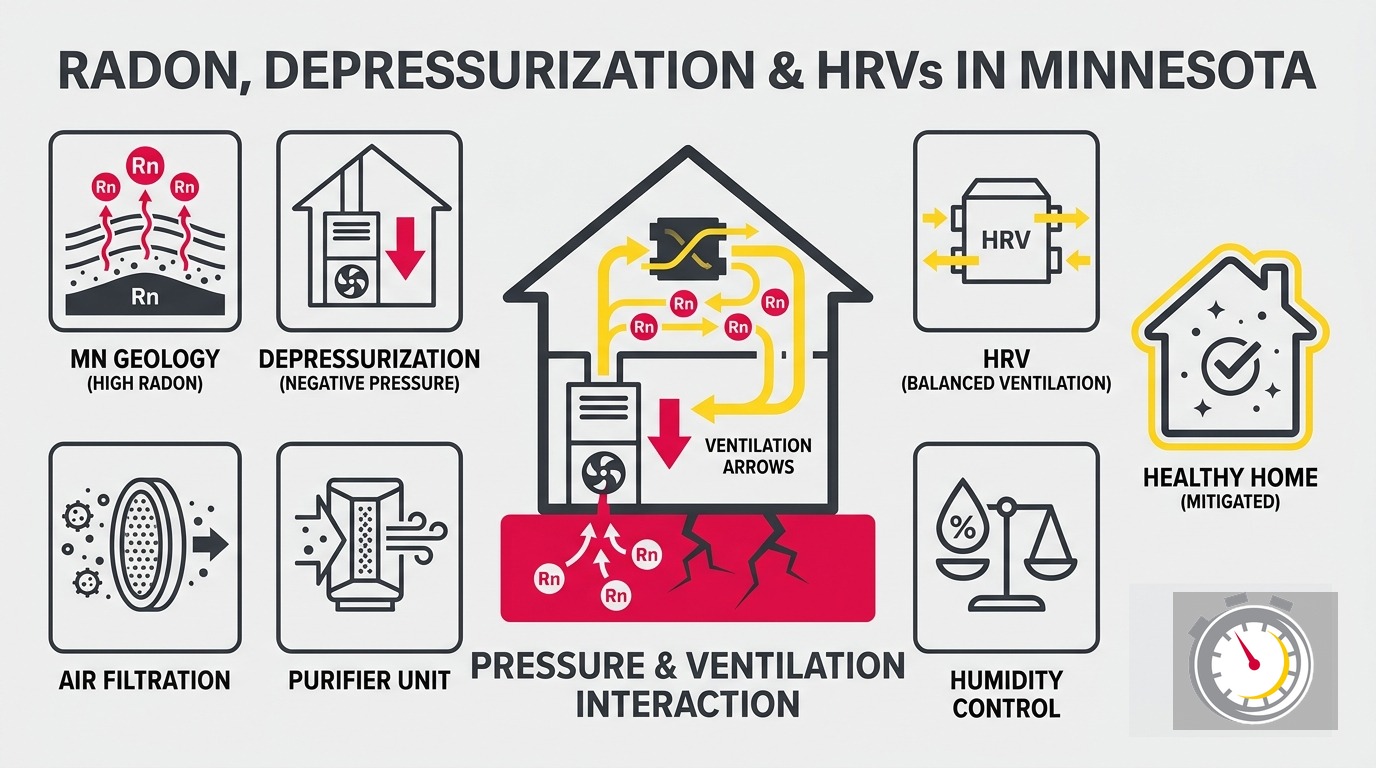
- Your forced-air furnace depressurizes your home’s lower envelope with every heating cycle. That pressure difference pulls radon through foundation cracks, sump pits, and floor drains.
- Minnesota winters seal the house tight and amplify the stack effect. Radon entry and accumulation peak at the same time.
- An HRV dilutes indoor radon but does not stop it from entering. It is not a mitigation system.
- Sub-slab depressurization, or SSD, is the EPA-recommended primary fix for most homes.
- Running SSD and an HRV in the same tight home requires coordination. Done without planning, they work against each other.
- Minnesota requires radon mitigators to be licensed through the Department of Health under MN Stat. 144.4961.
What Makes Minnesota’s Radon Risk So High?
Minnesota’s geology creates near-universal radon risk. Glacial till deposits over uranium-bearing granite bedrock span much of the state. Most of the Twin Cities metro, including Hennepin, Ramsey, Anoka, and Washington counties, sits in EPA Radon Zone 1, where average indoor radon above 4 pCi/L is predicted.
As uranium decays underground, it produces radium, which then decays into radon gas. Radon is colorless, odorless, and tasteless. It moves freely through soil and into structures through any available opening.
The Minnesota Department of Health reports that approximately 40% of tested Minnesota homes exceed 4 pCi/L. The national rate is roughly 1 in 15 homes. That gap is geology-driven. Minnesota’s numbers are not an anomaly. They are a predictable outcome of what sits under the ground across most of the state.
You cannot smell or feel radon. Testing is the only way to know your home’s level. And if your home has a forced-air heating system, your radon exposure may be higher than a test result alone suggests.
Does Your Forced-Air Furnace Pull More Radon Into Your Home?
Yes. A forced-air furnace pulls air through the home for combustion and circulation. That process depressurizes the basement and lower envelope. Negative pressure then draws soil gas, including radon, through every opening in your foundation: cracks in concrete, sump pit lids, floor drain gaps, and unsealed pipe penetrations. The harder your furnace runs, the stronger that pull.
The EPA confirms that most forced-air heating and cooling systems do not bring fresh air into the house mechanically. Infiltration and natural ventilation handle that by default. That means the only air replacing what the furnace draws from the lower envelope enters through uncontrolled gaps, often at or below grade, where soil gas concentrations are highest.
The furnace does not create radon. But it acts as a pump that increases the rate of entry.
Here is what that cycle looks like in practice. Your furnace turns on. It draws air for combustion and circulation. The basement depressurizes slightly. Soil gas moves through the path of least resistance into that lower-pressure zone. Some of that gas mixes with your conditioned air and distributes through the duct system into the living space.
Most radon entry happens during heating season. In Minnesota, that runs from roughly October through April. That is a long window covering exactly the months when your home is sealed and your system runs hardest.
Why Does a Minnesota Winter Make the Radon Problem Worse?
Two forces compound in a Minnesota winter: the stack effect and a fully sealed building envelope. Warm indoor air rises and escapes through upper-floor gaps. Cold air pulls in from below through the same foundation openings that admit radon. A sealed house then traps everything that enters. Entry and accumulation peak at the same time, during the same months.
The stack effect is a pressure difference created by temperature. Warm air is less dense than cold air. It rises and pushes out through gaps at the top of the house. Cold air is pulled in at the bottom to replace it. In Minnesota’s extreme cold, the stack effect is at its strongest. That is also when heating runs hardest.
The stack effect acts on the same entry points as your furnace: foundation cracks, sump pits, floor drains, and utility penetrations. These two forces overlap. You get increased entry and reduced natural dilution at the same time.
The sealed winter envelope compounds the problem further. In July you might crack a window. In January you do not. The house stays shut, and whatever radon enters accumulates rather than diluting through casual ventilation. The combination of maximum entry and minimum natural dilution is worst in deep winter. That is also when you most need your heating system to run.
This is a seasonal HVAC problem, not just a geology problem. The two are linked in Minnesota homes in a way that most radon resources never address.
Does an HRV Actually Fix a Radon Problem?
No. An HRV brings in fresh outdoor air and exhausts stale indoor air while recovering heat energy. That dilutes radon concentration but does not stop radon from entering your home. The EPA does not recommend ventilation as a primary radon fix. Source control through sub-slab depressurization is the correct approach, not dilution.
The EPA describes HRVs as an energy-efficient design feature for bringing outdoor air into a home. The framing is dilution, not mitigation. Dilution lowers the measured concentration only as long as the HRV is running. If radon keeps entering at the same rate, the HRV must run continuously to keep levels down. That is not a sustainable strategy, and it is not guaranteed to work.
There is also a pressure consideration. If the HRV is exhausting more than it supplies, it adds to whole-home depressurization. Under some conditions, that can actually increase radon entry through above-slab pathways.
We install HRVs for many Twin Cities homeowners, and they are excellent for whole-home ventilation and indoor air quality. But when clients ask whether an HRV will solve a radon problem, the honest answer is no. Source control is the fix. An HRV is a supplement.
What Is Sub-Slab Depressurization and How Does It Work?
Sub-slab depressurization, or SSD, reverses the pressure equation under your slab. A licensed contractor installs a pipe through the concrete and connects it to an exhaust fan. The fan creates negative pressure under the slab. Soil gas, including radon, moves toward that lower pressure and vents to the exterior before entering your home.
SSD works by reversing the direction of soil gas flow. Instead of the house pulling radon in, the system pulls radon out. This is source control. The gas never reaches the living space.
The system works even when moderate foundation cracks are present. The pressure field extends through the gravel or aggregate layer beneath most slabs. Suction reaches far enough to capture gas before it migrates upward.
For homes with crawl spaces, similar techniques use vapor barriers and exhaust pipes. Block-wall foundations may need interior drain tile systems. The exact method depends on your foundation type and the pressure field that diagnostic testing reveals. A qualified, MDH-licensed contractor will assess your specific conditions before recommending a design.
SSD is highly effective. The EPA recommends it as the primary mitigation approach for most residential applications. In Minnesota, the work must be done by an MDH-licensed contractor.
Should You Test Before You Mitigate?
Yes, always. Testing tells you your actual level and gives you a baseline to verify mitigation worked. Short-term kits (2-7 days) give a snapshot. Long-term tests (90 days or more) give a seasonal picture. Act at 4 pCi/L. Consider action between 2-4 pCi/L, especially in Minnesota, where winter conditions push levels higher than a single test average suggests.
Test in the lowest livable level of your home. For most Twin Cities homes, that is the basement. Place the kit away from drafts, exterior walls, windows, and sump pits. Follow the instructions for the specific kit you choose.
If your result is at or above 4 pCi/L, mitigate. After mitigation, test again to confirm the system is performing. An SSD system that is poorly designed or improperly installed may not reduce levels enough. Post-mitigation testing closes that loop.
Annual retesting is wise in Minnesota. The geology maintains constant baseline pressure. Structural changes and new penetrations can open entry pathways over time. Retesting catches a rising level before it becomes a long-term health risk.
How SSD and HRV Systems Need to Work Together in Minnesota Homes
Modern Minnesota homes are tightly built. That is good for energy efficiency. It also means that multiple mechanical systems, each affecting indoor pressure, need to be coordinated.
An SSD fan creates a continuous negative pressure zone under the slab. An HRV exhausts indoor air and brings in outdoor air. A common setup error is an HRV that exhausts more than it supplies. That adds to whole-home depressurization that the SSD is already managing. If both systems are pulling against the building envelope simultaneously, entry through above-slab pathways may increase. Wall penetrations and rim joist areas become new weak points.
The solution is not to avoid one system or the other. Both have real value. The solution is coordination. Your HVAC technician should know an SSD system is present. Your radon mitigator should know about your HRV.
A well-coordinated setup runs the SSD continuously. The HRV operates on its own schedule. The building envelope is tight enough that uncontrolled infiltration is not the path of least resistance.
If you are weighing ventilation options alongside a mitigation project, see our post on choosing between an ERV and HRV for Minnesota homes. The choice affects your pressure balance and should factor into how the mitigator sizes the SSD fan.
Minnesota’s Licensing Requirements for Radon Mitigation
Minnesota requires radon mitigators to hold a license from the Department of Health. MN Stat. 144.4961 defines mitigation as repairing or altering a building to reduce indoor radon concentration. The Commissioner of Health sets the work standards and oversees licensing.
New construction is handled separately. Radon-resistant features in newly built homes fall under MN Building Code 326B.106 subd. 6, not the licensing act.
Before any mitigator starts work, ask to see their MDH license. You can verify a license through the MDH contractor lookup at the Department of Health website. An unlicensed contractor may produce an underperforming system, and you will have limited recourse.
Northern One Hour does not perform SSD installation or radon mitigation. That work requires MDH licensure and sits outside our HVAC scope. What we can do is assess your ventilation, pressure dynamics, and HRV performance so your HVAC system is not working against the mitigation system you install.
What Air Purifiers Cannot Do for Radon
This question comes up often. Homeowners install a quality air purifier, feel better about indoor air, and assume the radon problem is handled. It is not.
The EPA is clear: air cleaners only partially remove radon decay products, the radioactive particles radon breaks down into. They do not reduce the amount of radon gas entering the home. The gas itself passes through most filter media.
A HEPA filter or UV purifier can reduce some particulate decay products. That is not nothing. But it is a partial response to a symptom, not a fix for the source. Radon gas keeps entering. Decay products keep forming. The underlying risk does not change.
Do not substitute an air purifier for radon testing and SSD mitigation. For a full look at what air purification and filtration actually accomplish for general indoor air quality, see our post on air purifiers, HEPA filters, and MERV ratings. Those tools belong in a different part of your IAQ strategy.
The HVAC Side of a Radon-Safer Home
Radon mitigation requires a licensed specialist. But your HVAC system shapes how much radon enters your home and how it moves through the building. There are several things our team can address on the HVAC side.
Ventilation. If your home does not have an HRV, this is worth considering. Controlled fresh-air exchange is better than relying on infiltration through the same gaps that admit radon. An HRV recovers heat from exhaust air so you get fresh air without the winter energy penalty.
Pressure balance. Significant basement negative pressure often traces to duct leakage or a supply-return imbalance. A duct inspection identifies where the system is pulling hardest and opens the conversation about sealing leaky ductwork to reduce uncontrolled airflow through foundation openings.
HRV maintenance. An HRV running dirty or out of balance adds to the pressure problems described above. Annual cleaning and balancing keep it operating as designed. An unmaintained HRV becomes part of the problem rather than part of the solution.
Coordination with your mitigator. If you are having SSD installed, let us know. We can review your HRV settings and duct system. That review ensures the two systems are not working against each other.
As a locally owned and operated Twin Cities HVAC company, we take indoor air quality seriously for our neighbors across Ramsey, Blaine, Maple Grove, Plymouth, and the broader metro. We back every service call with a 100% satisfaction guarantee and a promise we stand behind: “Always On Time… Or You Don’t Pay a Dime!(R)”
For an HVAC assessment covering your home’s pressure dynamics and ventilation strategy, call us at (763) 260-6662 or schedule online. We will show up when we say we will.
Frequently Asked Questions
Does running my furnace increase radon levels in my home? +
Will an HRV reduce radon in my home? +
What pCi/L level requires radon mitigation in Minnesota? +
Do I need a licensed contractor for radon mitigation in Minnesota? +
Need a technician now?