
Bathroom Exhaust Fan Winter Moisture: What Minnesotans Miss
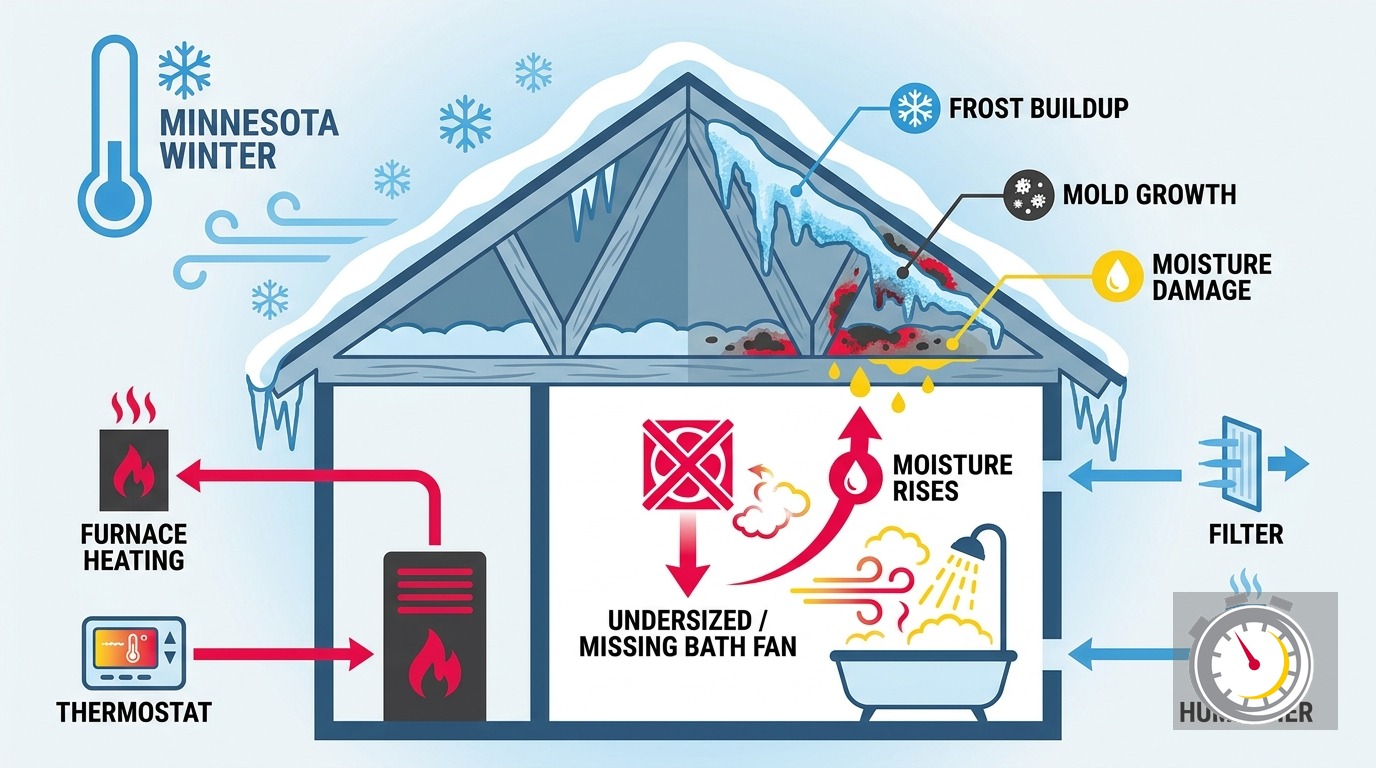
Key Takeaways
- A fan rated 80 CFM delivers that number in free air, with no duct attached. Long attic duct runs with elbows can cut actual delivery by 30-50%, dropping performance below Minnesota’s 50 CFM code minimum.
- Minnesota Mechanical Code Table 403.3.1.1 requires 50 CFM intermittent or 20 CFM continuous for bathrooms.
- Warm shower air entering a cold, uninsulated attic duct condenses before it exits. In documented Twin Cities cases, condensation has filled ducts completely with liquid water.
- Frost accumulates on roof sheathing and nail tips through winter. It melts in spring and mimics a roof leak exactly.
- Run the fan for 60 minutes after every shower. A timer switch makes that automatic.
- Tightly sealed homes face a secondary risk: a bath fan can depressurize the space enough to cause furnace backdraft.
Bathroom exhaust fan winter moisture is one of the most misunderstood problems in Minnesota homes. Every year, Twin Cities homeowners discover spring ceiling stains they assume are roof leaks. The real cause is often a bath fan that passes every visible check, runs every morning, and still fails to remove moisture from the air.
Does Your Bathroom Exhaust Fan Actually Stop Winter Moisture in Minnesota?
Your fan may spin and make noise while delivering well under the required 50 CFM. The motor is rarely the failure point. In most Twin Cities homes with this problem, the duct is the culprit.
A humming fan and a working fan look the same from the bathroom floor. You cannot tell by listening whether the fan is delivering 30 CFM or 80 CFM. Building inspectors and HVAC technicians in the Twin Cities have documented attic frost and moisture damage in homes with fans that ran every single day for years. The fan itself was fine. The duct was too long, too cold, and too restricted to move enough air.
The quick test: hold a tissue against the fan grille while the fan runs. A working fan pulls the tissue firmly against the cover. A tissue that flutters or drops means the fan is moving very little air and deserves closer attention.
Why Does Rated CFM Mislead Minnesota Homeowners?
Fan manufacturers measure rated CFM in free air, with no duct restriction. A real installation adds feet of duct, elbows, and a capped termination. Each one reduces actual delivery, and a nominally compliant fan can fall below code minimum in a standard Twin Cities installation.
Building science documentation from the Twin Cities shows that every foot of duct and every elbow reduces actual airflow. An 80 CFM fan pushing air through a 15- to 20-foot attic run with two 90-degree elbows can deliver fewer than 45 CFM at the exterior cap. That is below the code-required 50 CFM minimum. That is not ventilation.
Minnesota Mechanical Code Table 403.3.1.1 sets the floor at 50 CFM intermittent or 20 CFM continuous for bathrooms. That matches the ASHRAE 62.2 national standard. A fan rated exactly 50 CFM has zero margin. Any duct resistance drops it into deficiency.
Twin Cities bungalows and ramblers from the 1940s through the 1960s are the most common stock with this problem. Original duct runs were sometimes pointed directly into the attic with no exterior termination at all. Minnesota code now prohibits venting into the attic, crawl space, or wall cavity. Ducts through unconditioned spaces must be insulated, and roof caps must include a damper. Many of those original installations were never corrected, and no inspection ever flagged them.
A fan that exists, runs daily, and looks code-compliant on paper can still drive attic damage every time someone showers. The rated label is not a performance guarantee.
What Does Bathroom Exhaust Fan Winter Moisture Do to a Minnesota Home?
Warm, humid shower air enters the duct, hits the cold duct walls in an unheated attic, and condenses. In a Minnesota winter, that condensate freezes on duct walls, roof sheathing, and roofing nail tips. The damage is invisible until spring.
The Twin Cities sits in IECC Climate Zone 6A, with a winter design temperature reaching -9°F. Northern Minnesota is Climate Zone 7. In both zones, the dominant moisture drive is outward: warm, humid interior air pushes toward the cold exterior. Attic condensation is structurally worse here than in most U.S. climate zones, and the physics are unforgiving at those temperatures.
Here is the moisture sequence in a typical underperforming installation:
- A 10-minute hot shower puts roughly a pint of water vapor into the bathroom air.
- The fan pulls that vapor into the duct. If the duct runs 20 feet through a 5°F attic, the air chills to its dew point before it exits.
- Condensation forms on the duct interior. In one documented home in Richfield, MN, an uninsulated attic duct filled completely with liquid water. The fan ran every morning for years. The duct absorbed every drop.
- When the duct is saturated, water drips back through the fan grille. Many homeowners read that drip as a roof leak or a fan failure. It is neither.
- Vapor that makes it past the duct condenses on the coldest attic surfaces: roof sheathing, rafters, and the tips of roofing nails.
- That condensation freezes through the winter, building up frost with every shower.
None of this is visible until temperatures rise in spring.
Is Attic Frost the Same as a Roof Leak?
No, but it looks identical. Water appearing at the ceiling or dripping from a light fixture in early spring is often melting attic frost, not a failed shingle. The distinction matters because the repair is completely different.
Frost accumulation on roof sheathing and nail tips leads to deteriorated sheathing, mold on sheathing, wet insulation, and ceiling stains. Homeowners call roofers. Roofers inspect the roof in April, find no damaged shingles, and leave without identifying a cause. The problem returns the following spring because the bath fan duct was never addressed.
The diagnostic difference comes down to timing and location. A shingle or flashing failure leaks during or after rain. Frost melt happens in the first warm week of spring, often after weeks of cold and dry weather, with no rain event preceding it. The stain clusters near the bath fan penetration, the attic hatch, or recessed lights, anywhere that warm interior air escapes into the attic.
Wet insulation is a compounding cost. In Climate Zone 6A, the ceiling R-value requirement is R-49. Insulation that has been wet and re-frozen loses a significant portion of its R-value. Repeated frost-melt cycles over several winters can degrade attic insulation enough to raise heating bills noticeably all season, not just during the melt event.
When mold follows the moisture, it can spread from the sheathing to the ductwork and eventually the living space. We cover that escalation in our post on mold in HVAC ducts and remediation for Twin Cities homes.
If your ceiling stains appeared in March or April, call an HVAC technician before you call a roofer.
How Long Should You Run the Fan After Every Shower?
60 minutes after the shower ends, not just during it. Running the fan while you shower clears steam. Running it for 60 minutes afterward removes the moisture load from the air. Most households stop after two to four minutes and leave most of the problem in place.
HVAC professionals and building scientists recommend 60 minutes of post-shower fan runtime to return indoor humidity to its pre-shower baseline. The steam clears quickly. The moisture does not. Stopping the fan when the mirror clears handles the visible symptom and ignores the humidity still in the air.
The behavioral fix is a switch upgrade. Dial-type timer switches can be set for 30, 45, or 60 minutes and typically cost $20-50 to install. Humidity-sensing switches run the fan until relative humidity drops below a set threshold, usually 50-60%. Either option removes household compliance from the equation. You set it once, and the fan does the right thing automatically.
What About Backdraft in Tight Minnesota Homes?
A bath fan that depressurizes a tightly sealed home can pull combustion gases back down through a gas furnace or water heater flue. As more Twin Cities homes are weatherized and air-sealed, this risk is growing.
A bath fan is an exhaust device. Every cubic foot of air it pushes outside must be replaced from somewhere. In a loose older home, replacement air infiltrates through gaps in the building envelope. In a tightly sealed home, running a powerful bath fan can create enough negative pressure to pull flue gases back through gas appliances.
Tightly sealed homes can experience combustion appliance backdraft when a bath fan depressurizes the space. Minnesota’s energy code has tightened steadily, and weatherization programs have air-sealed a meaningful portion of the older housing stock. The risk is most acute in homes that were upgraded without a corresponding makeup air assessment.
If your home is recently weatherized, has new windows and door seals, or was built under the 2012 or later energy codes, and you are considering a higher-capacity replacement fan, discuss makeup air with your HVAC technician first. We cover the full picture of exhaust fans, depressurization, and combustion safety in our post on exhaust fans and furnace backdraft risk in Minnesota.
How Do You Know If Your Fan Is Underperforming?
The tissue test, steam clearance time, and winter dripping are the three informal checks any homeowner can run. An HVAC technician with a flow hood gives you the definitive CFM number.
Informal checks you can do yourself:
- The tissue test. Hold a tissue near the fan grille while the fan runs. A healthy fan pulls the tissue firmly against the grille. A tissue that flutters or drops indicates weak airflow.
- Steam clearance time. After a hot shower, bathroom steam should clear from the mirror within two to three minutes with the fan running. Steam that lingers beyond five minutes points to inadequate airflow delivery.
- Dripping in cold weather. Water dripping from the fan grille during or after a cold snap means condensation is forming inside an uninsulated duct and draining back toward the room.
- Loud fan, weak pull. A fan that hums loudly but fails the tissue test usually has a blocked or overly long duct run, not a motor problem.
- Spring ceiling stains. Stains near the fan grille that appear in March or April, especially after a hard winter, are a strong indicator of attic frost melt.
A professional airflow measurement at the grille confirms whether your installed fan actually meets the 50 CFM code minimum under real duct conditions.
What Does It Take to Fix an Underperforming Bath Fan?
The fix depends on the diagnosis. A duct reroute, insulation, a fan upgrade, or a switch swap are each the right answer for a different underlying cause. Replacing the fan first is often the wrong call.
Common scenarios and their solutions:
Duct vents into the attic. This violates Minnesota code and must be corrected regardless of anything else. A new run is required to a proper exterior or roof cap, with insulation through any unconditioned section.
Duct run is too long or too restricted. Rerouting to shorten the run or eliminate unnecessary elbows restores airflow. In cases where the run cannot be shortened, upgrading to a higher-capacity fan can compensate for the resistance.
Duct is uninsulated. Condensation forms on cold duct walls before air exits. Replacing the duct with insulated flexible duct, or wrapping the existing duct, stops the moisture problem at the source without requiring a fan replacement.
Fan is undersized for the room. The standard sizing guideline is 1 CFM per square foot of floor area, with a 50 CFM minimum. Bathrooms with jetted tubs or steam showers need more. A correctly sized replacement fan addresses the shortfall directly.
Fan works but behavior is the problem. A timer or humidity-sensing switch installed in place of the existing wall switch typically costs $30-80 and removes the need for household compliance entirely.
On permits: Minnesota requires a permit when new ductwork is run or when a fan replacement is part of a broader remodel. Like-for-like swaps in the same location may not require one. Minneapolis, Saint Paul, and most suburbs administer their own programs, so verify with your local building department before starting work.
Why Is Bathroom Ventilation an HVAC Issue?
Bath fan underperformance is a ventilation and indoor air quality problem, not a handyman task. It requires the same diagnostic and sizing logic that applies to whole-home mechanical ventilation, and the consequences of getting it wrong reach well beyond the bathroom.
A bath fan is the primary point-source ventilation device in the most moisture-intensive room in the house. When it underperforms, the consequences extend from frost and structural damage to mold and degraded insulation. Our indoor air quality services include ventilation consultation for exactly these situations.
For homes that need whole-home fresh air exchange alongside bathroom moisture control, an HRV system handles both simultaneously and recovers the heat that a simple exhaust fan discards. We explain how that works in our post on whole-home HRV ventilation for Minnesota homes.
Before replacing a fan, it is worth checking for utility rebates. Xcel Energy has offered ENERGY STAR ventilation fan rebates in prior program years. Availability in 2026 is unconfirmed. Verify at xcelenergy.com/savings before counting on it. Minneapolis homeowners can also check the Minneapolis Bonus Rebate Program through MNCEE for eligible energy upgrades.
If your home is certified under ENERGY STAR’s new homes program, it is required to have bath fans independently tested to verify actual airflow rates, not just the rated label. If you do not know whether your fans were tested at installation, an inspection will confirm it.
How Northern One Hour Can Help
We are locally owned and operated in Ramsey, MN, and we serve Minneapolis, St. Paul, Blaine, Maple Grove, Plymouth, Brooklyn Park, Woodbury, and the broader Twin Cities metro.
Bathroom ventilation falls within our HVAC scope. We can measure actual airflow at the fan grille and compare it to the code minimum, inspect the duct run for insulation compliance and proper exterior termination, replace undersized or failed fans with correctly sized units, reroute ducts that terminate in the attic instead of the exterior, install timer or humidity-sensing switches, and flag backdraft risk in tightly sealed homes.
When we say we will be there at the scheduled time, we mean it. “Always On Time… Or You Don’t Pay a Dime!(R)” is a guarantee. If frost damage, spring ceiling stains, or persistent bathroom moisture are showing up in your home, the right move is a diagnosis before the next heating season.
Call (763) 260-6662 or book online to schedule a ventilation inspection.
Frequently Asked Questions
Does Minnesota code require a bathroom exhaust fan? +
How long should I run my bathroom exhaust fan after a shower? +
Why does my bath fan drip water in winter? +
Can a bathroom exhaust fan cause furnace backdraft? +
Need a technician now?