
Kitchen Range Hood Makeup Air: A Minnesota Homeowner's Guide
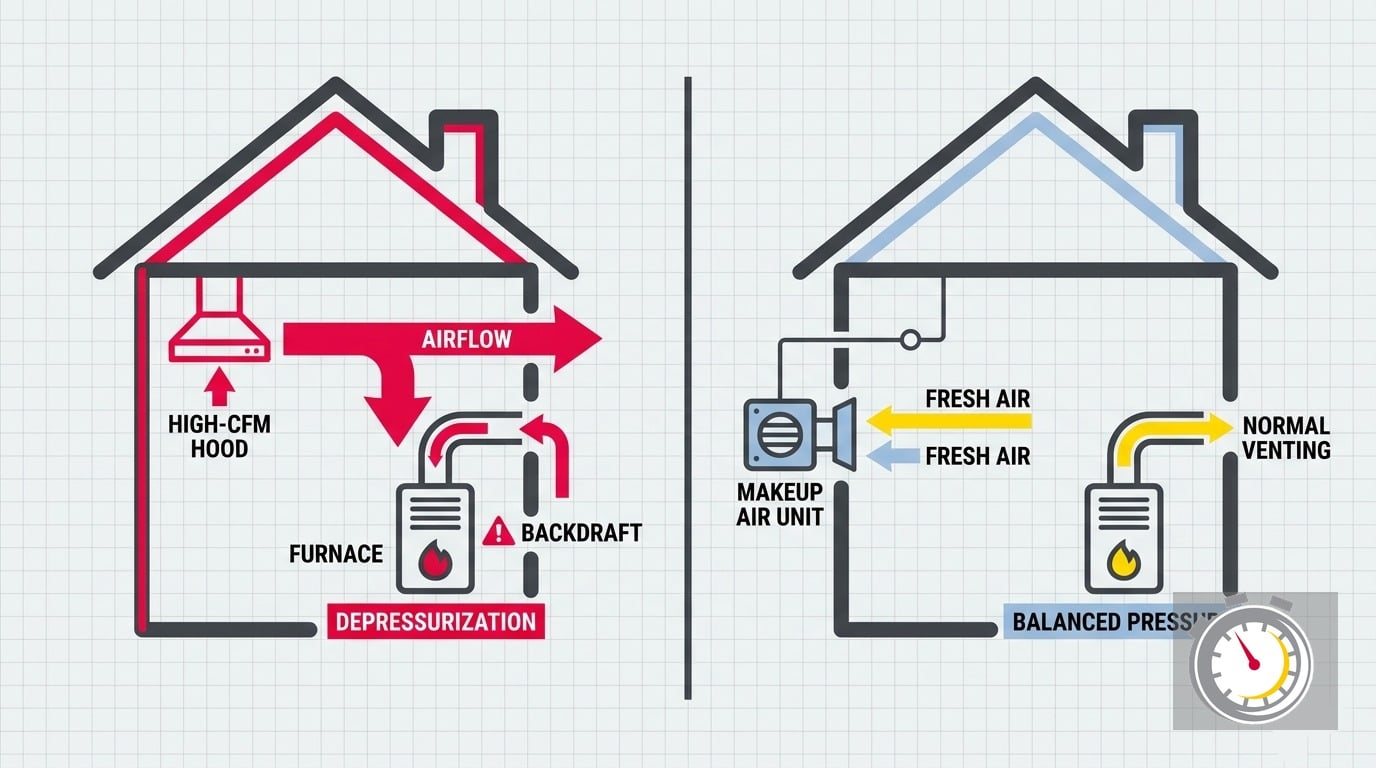
Key Takeaways
- Any hood capable of exhausting over 400 CFM, paired with an atmospheric furnace or water heater, requires dedicated makeup air under IRC M1503.6 and MN Chapter 1346.
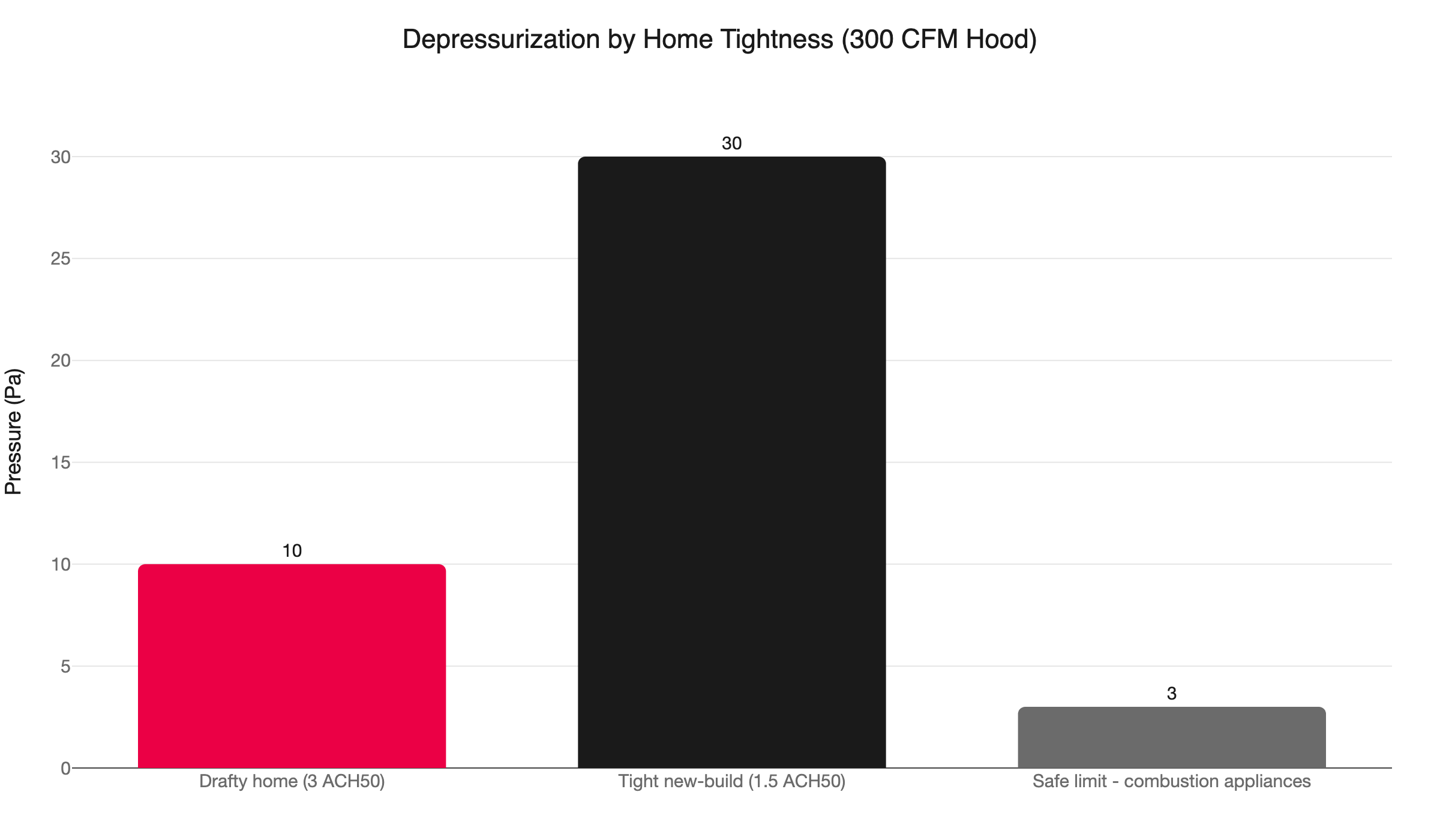
- Backdrafting can start at 350 CFM in a tight home - below the 400 CFM code trigger. A 300 CFM hood in a tight 1.5 ACH50 home creates roughly 30 Pa of depressurization; the safe limit with combustion appliances is 3 Pa.
- Minnesota code requires makeup air to arrive at the supply diffuser at 50°F or warmer. With Minneapolis’s design temperature of -16°F, a duct heater is mandatory in every compliant Minnesota system.
- The makeup air damper and any supply fan must be electrically interlocked with the hood. Passive gravity dampers often do not satisfy this requirement at high flow rates.
- A basic motorized-damper system runs $800-$1,500 installed. A full active system with a duct heater costs more. A permit is required for all installations.
What Is Kitchen Range Hood Makeup Air?
Makeup air is the fresh supply air brought into your home to replace what your range hood exhausts outside. When your hood runs, it pushes air out through a duct. That air has to come from somewhere.
In an older drafty home, replacement air infiltrates through gaps in the building envelope. In a modern energy-tight home, there are no significant gaps. The house pulls replacement air from whatever opening it can find. That opening is often a furnace flue, a water heater vent, or a fireplace chimney. A makeup air system gives that replacement air a controlled, safe path into the house instead.
The distinction matters because an uncontrolled replacement path is also an uncontrolled path for combustion gases to travel in reverse. That reversal is backdrafting, and it is the central risk this post addresses.
Why Do Tight Minnesota Homes Have a Bigger Problem?
Tighter homes depressurize faster for the same hood CFM. A 300 CFM hood in a drafty 3 ACH50 home creates roughly 10 Pascal of negative pressure. The same hood in a tight 1.5 ACH50 home - typical of new Minnesota construction - creates roughly 30 Pa. The safe limit when combustion appliances are present is 3 Pa or less.
Those figures come from Energy Vanguard’s analysis of range hood depressurization. The math scales sharply as homes get tighter.
Minnesota’s energy code currently caps new homes at 3 ACH50. A Fresh Energy analysis of the pending code update moves the next ceiling to roughly 2.5 ACH50 average. Minnesota new homes averaged a HERS index of 47 in 2024. That means they are built roughly 53% more efficiently than a code-minimum standard home. That efficiency is the goal. But it means a high-CFM range hood in a new Twin Cities build creates dramatically more depressurization than the same hood would have in a 1980s construction.
The common renovation profile here makes this urgent. A homeowner buys a 1990s two-story in Maple Grove or Blaine, upgrades the kitchen with a 600 CFM pro-style hood, and still has the original mid-efficiency furnace and tank water heater on B-vent in the mechanical room. That is exactly where backdrafting happens - and the home does not need to be a certified passive house for it to be a problem.
What Happens When Your Hood Pulls Too Much Air?
At enough negative pressure, combustion gases in your furnace or water heater flue reverse direction and enter your living space. That is a backdraft. The primary risk is carbon monoxide. Secondary symptoms include doors that resist opening, cold drafts near electrical outlets and recessed lights, and pilot lights that keep going out.
Green Building Advisor’s analysis of makeup air code history puts specific numbers on this: a natural-draft gas appliance can begin backdrafting at hood flow rates of 350 CFM or less. A gas fireplace in a tight home can backdraft at 250 CFM. Both are below the 400 CFM national code trigger.
These are not rare conditions in the Twin Cities. A 1990s or 2000s home that has been air-sealed and re-insulated during a renovation, but still carries B-vent combustion appliances in the mechanical room, fits this profile exactly. A 350 CFM hood is not an aggressive commercial unit. It is a mid-range residential model.
Backdrafting is not always obvious. A brief depressurization event during a single cooking session may not produce enough CO to trigger a detector immediately. Repeated events over weeks or months can cause symptoms that look like illness before anyone identifies the source. If your home has a high-CFM hood and atmospheric combustion appliances, this risk deserves a direct answer, not a wait-and-see approach.
Does the 400 CFM Code Threshold Fully Protect You?
No. The 400 CFM rule sets a floor for when makeup air is required - not a guarantee that homes below the threshold are safe.
IRC M1503.6 requires makeup air when any hood is capable of exhausting more than 400 CFM with atmospherically vented combustion appliances present. But as noted above, backdrafting can begin at 350 CFM in a tight home. The code reflects the average; your home may not be average.
IRC M1503.6 also makes an important carve-out: all-electric homes and homes with only sealed-combustion appliances are technically exempt. If your furnace has a PVC exhaust pipe and your water heater is a heat pump model, there is no atmospheric flue to backdraft. If you have even one atmospheric appliance in the mechanical room, the risk applies at CFM levels below the code trigger.
The practical rule: if your hood is rated at 400 CFM or above and you have any natural-draft appliance, makeup air is required. If your hood is below 400 CFM but your home is tight and you still have combustion appliances, ask your HVAC technician whether your specific setup crosses the safety threshold.
What Does Minnesota’s Mechanical Code Actually Require?
MN Chapter 1346 requires ducted kitchen exhaust hoods to have makeup air provided per MN Rules Part 1346.0501. Minnesota adds requirements beyond the national IRC baseline, including a temperature floor for incoming air and mandatory electrical interlocking.
MN Rules Part 1346.0505 is the governing provision for ducted kitchen exhaust. The key requirements:
- Electrical interlock: The makeup air damper and any supply fan must activate whenever the hood runs. A passive gravity damper that opens from negative pressure alone often does not reliably meet this at high CFM.
- Temperature floor: Per MN Rules Part 1346.0508, makeup air must arrive at the supply diffuser at 50°F or above. In Minnesota, that is a code floor, not a comfort preference.
- Matched airflow: The makeup air supply must roughly match the hood’s exhaust rate to maintain safe pressure balance across the home.
Local AHJs in Hennepin County, Minneapolis, St. Paul, and Ramsey County inspect for these requirements. A 600 CFM hood installed without a compliant makeup air system will fail a rough-in inspection. See our post on when an HVAC permit is required in Minnesota for a full rundown of what triggers that inspection process.
Why Does -16°F Change Everything About Makeup Air?
Untempered outdoor air at Minneapolis’s design temperature of -16°F entering your kitchen at 600 CFM is a safety and comfort problem, not just a theoretical code gap. MN code’s 50°F floor means your duct heater must bridge a 66-degree delta on the coldest design day. An undersized or absent heater fails both the code requirement and the people in the kitchen.
Minneapolis’s ASHRAE 99% design heating temperature is -16°F. That is the temperature your entire heating system is sized around. When your makeup air system pulls air from outside at that temperature, a duct heater must condition it to at least 50°F before it reaches the kitchen supply diffuser.
Fantech’s guidance on makeup air for tight homes describes pre-heating as a feature for mild climates and a necessity for cold ones. In the Twin Cities, it is the latter. Every active makeup air system installed here needs a heating element capable of conditioning air from the design minimum to code temperature at your hood’s maximum CFM rating.
For homes with a hydronic boiler, a coil tapped into the heating loop is one efficient approach. For forced-air homes, an inline electric duct heater is more common. Your contractor sizes the heater to your hood’s rated CFM and local design conditions - not a national average.
What Types of Kitchen Range Hood Makeup Air Systems Are Available?
Two main categories: passive motorized-damper systems and active fan-forced systems. Both require a duct heater for Minnesota use. A third option pairs the makeup air strategy with an HRV for homes planning a broader ventilation upgrade.
Passive systems use a motorized damper that opens when the hood runs. The hood’s negative pressure draws outdoor air in through a dedicated makeup air duct. They are simpler and lower in cost. In a moderately tight home with a hood in the 400-600 CFM range, a passive system with a properly sized duct heater can meet Minnesota code. Installed cost starts around $800-$1,500 for the damper, controls, and duct penetration.
Active (fan-forced) systems add a supply fan that modulates to match the hood’s exhaust rate. A controller opens the motorized damper, runs the supply fan, and activates the duct heater together whenever the hood operates. The fan maintains the home within the 3 Pa safety window even at full hood speed. These systems are the right choice for hoods above 600 CFM and for very tight homes where a passive system cannot maintain adequate flow.
A third option integrates the makeup air strategy with an HRV (Heat Recovery Ventilator). An HRV recovers heat from the outgoing exhaust stream and uses it to pre-condition incoming fresh air. For homes already planning a whole-home mechanical ventilation upgrade, this pairing can be efficient and rebate-eligible. See our full comparison of ERV vs. HRV systems for Minnesota homes to understand which type fits your situation.
What Does a Makeup Air System Cost in Minnesota?
A basic passive system with a motorized damper and duct heater starts around $800-$1,500 installed. A full active fan-forced system with a duct heater costs more, depending on fan size and duct routing. Get a quote based on your specific hood CFM and home configuration.
Cost variables include:
- Hood CFM rating - higher CFM requires a larger heater and likely a supply fan
- Duct routing distance from the outdoor intake to the kitchen
- Whether an existing duct stub-out can be reused or new penetrations are needed
- Heater type: electric inline vs. hydronic coil off a boiler loop
Financing is available for larger kitchen ventilation projects. Call (763) 260-6662 to ask about current options.
One rebate worth checking: Xcel Energy offers a $400 rebate for an HRV or ERV with 65% or higher Sensible Heat Recovery Efficiency. If your makeup air strategy incorporates an HRV, you may qualify. See the Xcel and CenterPoint 2026 rebate summary for current eligibility details. Xcel gas furnace rebates ended January 1, 2026, but the HRV/ERV program remains active.
How Does Makeup Air Connect to Combustion Air and Backdrafting?
Makeup air and combustion air are separate systems solving related problems. Makeup air keeps the house pressure-neutral. Combustion air supplies the burner. When both are absent, the furnace becomes a backdraft path for the kitchen, and CO enters the living space.
A furnace already operating near its combustion air limits is much more vulnerable when a 600 CFM hood pulls the house negative at the same time. Our post on exhaust fans and furnace backdraft in Minnesota homes covers that full mechanical picture in detail.
If your home has a gas fireplace on top of a furnace and water heater, you have three atmospheric appliances that can become backdraft paths. The combined risk is higher than any single appliance in isolation. If you are planning a kitchen renovation with a high-CFM hood, design the makeup air system before the hood goes in - not after the rough-in inspection comes back failed.
Do You Need a Permit for a Makeup Air System in Minnesota?
Yes, in almost every case. New duct penetrations through the building envelope, new electrical circuits for a duct heater, and new mechanical equipment connected to an exhaust system all trigger a permit in Hennepin and Ramsey counties.
This is not a step to skip. A makeup air system installed without a permit creates real liability if a backdraft event causes a carbon monoxide injury. The inspection is the verification that the system was designed and installed correctly - it protects you, not just the code.
Our team handles the permit application as part of every makeup air installation. You do not navigate the AHJ process yourself. When we finish, you have a stamped permit and an inspected, code-compliant system.
What to Do If You Already Have a High-CFM Hood and No Makeup Air
If your kitchen already has a 400 CFM or higher hood and no dedicated makeup air system, take these steps now:
- Identify your combustion appliances. If your furnace has a PVC exhaust pipe and your water heater is a heat pump unit, the backdraft risk is low. If either appliance has a B-vent metal flue, you have atmospheric combustion and the risk is real.
- Run a simple smoke test. With the hood running at full speed, hold a lit incense stick near your water heater’s draft hood. If the smoke pulls downward into the appliance, you have active backdrafting.
- Place a CO detector near the mechanical room. This is a stop-gap, not a fix. A slow or intermittent backdraft may not spike the detector right away, but a detector in that space gives you the best early warning.
- Call us for an assessment. Our team will evaluate your home’s tightness, hood CFM, and appliance configuration and spec the right makeup air system for your situation.
Ready to Add Makeup Air to Your Twin Cities Kitchen?
We are locally owned and operated in Ramsey, MN. Our team designs, installs, and permits makeup air systems for homes across the Twin Cities - Minneapolis, St. Paul, Blaine, Maple Grove, Plymouth, Brooklyn Park, Woodbury, and Bloomington.
We show up when we say we will. That is the promise: “Always On Time… Or You Don’t Pay a Dime!(R)”
Call (763) 260-6662 or book online through our indoor air quality services page to schedule a consultation. If your hood is already installed and you are not sure whether you need makeup air, we will assess your setup and give you a straight answer.
Key Takeaways
- Kitchen range hood makeup air replaces exhausted air so your home stays at safe pressure.
- Tight Minnesota homes (1.5-3 ACH50) depressurize three times faster than drafty older homes for the same hood CFM.
- Backdrafting can begin at 350 CFM in a tight home - below the 400 CFM code trigger.
- MN Chapter 1346 requires makeup air to arrive at 50°F or above at the supply diffuser. At Minneapolis’s -16°F design temp, a duct heater is mandatory.
- The damper and fan must be electrically interlocked with the hood. Passive gravity-only systems often do not satisfy this requirement.
- A basic passive system starts around $800-$1,500 installed. A permit is required for every makeup air installation in Minnesota.
- Call (763) 260-6662 or book online to schedule an assessment.
Frequently Asked Questions
Does every range hood need a makeup air system? +
Can I install a makeup air system myself? +
How much does a makeup air system cost in Minnesota? +
What happens if I skip makeup air on a high-CFM hood? +
Need a technician now?