
Attached Garage HVAC Carbon Monoxide Risk Minnesota
Key Takeaways
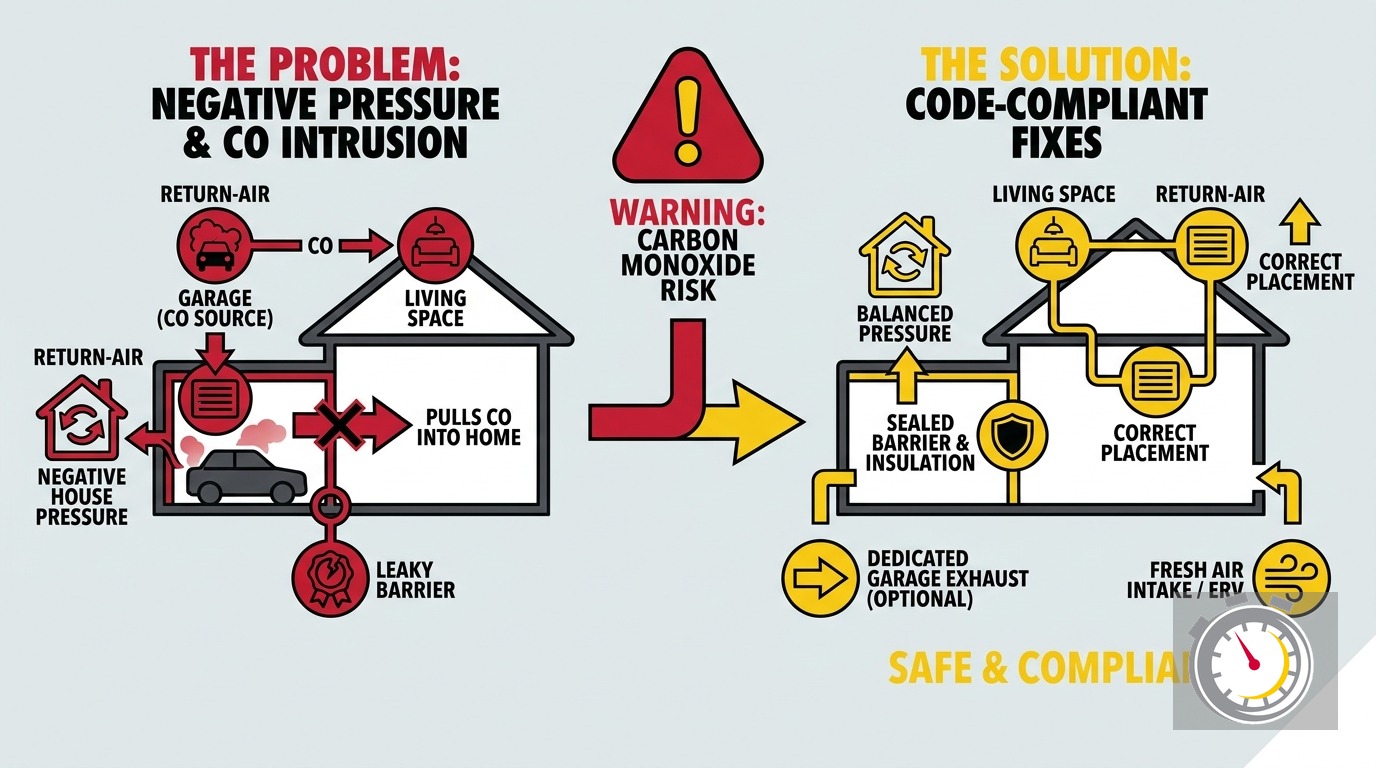
- Running your air handler creates negative pressure on the return-air side. That pressure pulls air through every unsealed crack and penetration in your garage-to-house wall, including vehicle exhaust CO.
- This is how a momentary CO pulse in the garage becomes a whole-house event. The duct system distributes whatever the return pulls in.
- Minnesota’s extreme winters add a second mechanism: stack effect from a -10°F outdoor temperature drives garage air through lower-envelope gaps even when the HVAC is off.
- IRC Section M1602.2 (Minnesota residential code, effective August 2023) prohibits return-air grilles on garage-side walls.
- IRC R302.6 requires a sealed, fire-rated garage-to-house separation: 1/2” gypsum board on the garage side, a minimum 20-minute rated door, and all penetrations sealed.
- Minnesota Statute 299F.51 requires a UL2034 CO alarm within 10 feet of every sleeping area.
- The complete fix has three layers: seal the envelope, audit return-air placement, and verify alarm coverage.
What Is Carbon Monoxide and Why Do Attached Garages Concentrate It?
Short answer: Carbon monoxide is a colorless, odorless gas produced by incomplete combustion. Your vehicle is one of the most concentrated CO sources a home ever encounters. The problem with an attached garage is proximity: the space where CO builds is right next to the living area, separated by a single wall.
There is no sensory warning. No smell, no visible haze, no immediate discomfort at lower concentrations. The only reliable detection is a calibrated alarm or a blood test after the fact.
The EPA identifies automobile exhaust from attached garages as a primary residential CO source, alongside leaking chimneys and back-drafting furnaces. Concentration builds quickly in an enclosed space. The EPA’s guidance is direct: “Don’t idle the car in a garage, even if the garage door to the outside is open. Fumes can build up very quickly in the garage and living area of your home.”
Most homeowners stop the analysis there: keep the car moving, avoid long idles, and you’re covered. That is reasonable advice about the source. It says nothing about the pathway. Once CO is in the garage, how does it reach the living space - and what role does your HVAC system play in moving it there? That is the question most articles skip.
How Does Your HVAC System Turn a Garage CO Pulse Into a Whole-House Event?
Short answer: When your air handler runs, it creates negative pressure on the return-air side. That pressure pulls air through every unsealed crack in the garage-to-house wall. CO from a vehicle exhaust pulse enters the return duct and the blower distributes it through every supply register in the house.
Here is the step-by-step mechanism.
Your air handler sits in the return-air stream. The blower pulls air toward itself from the duct system, lowering the pressure inside the house relative to the garage, which sits at roughly atmospheric pressure. Air moves through openings, joints, and cracks in walls, floors, and ceilings whenever a pressure differential exists between two spaces. The HVAC system creates and sustains that differential every time the blower runs.
If the garage-to-house wall has unsealed penetrations - gas line entries, electrical conduit, plumbing rough-ins, gaps around rim joists, recessed lights in a ceiling over the garage - those become the path. Air moves from the higher-pressure garage into the lower-pressure living space through those gaps. CO rides that airflow.
The distribution mechanism is what elevates the risk beyond localized exposure. Once CO enters the return duct, the blower pushes it through every supply register. A family asleep upstairs faces the same concentration as the room nearest the garage wall.
This is why return-air grille placement is a code requirement, not just a best practice. A return grille placed on a garage-side wall skips the indirect infiltration path entirely - it draws from the garage directly. That placement is explicitly prohibited by code, and in older construction it is more common than most homeowners realize.
For more on how return-air placement affects your whole HVAC system, see our post on return air problems and airflow in Twin Cities homes.
Why Minnesota Winters Make the Attached Garage CO Problem Worse
Minnesota’s heating season adds a second mechanism on top of HVAC depressurization: stack effect.
Stack effect is driven by temperature differential. Warm indoor air is less dense than cold outdoor air. It rises and exits through upper-envelope gaps - ceiling penetrations, top-floor window frames, attic bypasses. As it exits, it draws replacement air in through lower-envelope gaps. The garage-to-house wall at floor level is exactly where those lower-envelope gaps tend to concentrate.
The strength of stack effect scales with the temperature differential. At -10°F to -20°F outdoors and 70°F inside, Minnesota winters produce some of the strongest stack-effect pressure of any residential climate in the country. Air is being actively pulled through the garage-to-house boundary even when the HVAC blower is off.
Add HVAC depressurization on top of natural stack effect on a January morning and the pull on garage air is substantial. Someone starts the car at 6:45 AM to let it warm up. The furnace runs. Stack effect runs. Both draw from the same boundary. The CO from a five-minute cold-start does not stay in the garage.
That is the Minnesota-specific version of a risk that exists in every climate with attached garages. The physics is the same everywhere. The severity in January is not.
What Are the Symptoms of Carbon Monoxide Exposure From a Home Source?
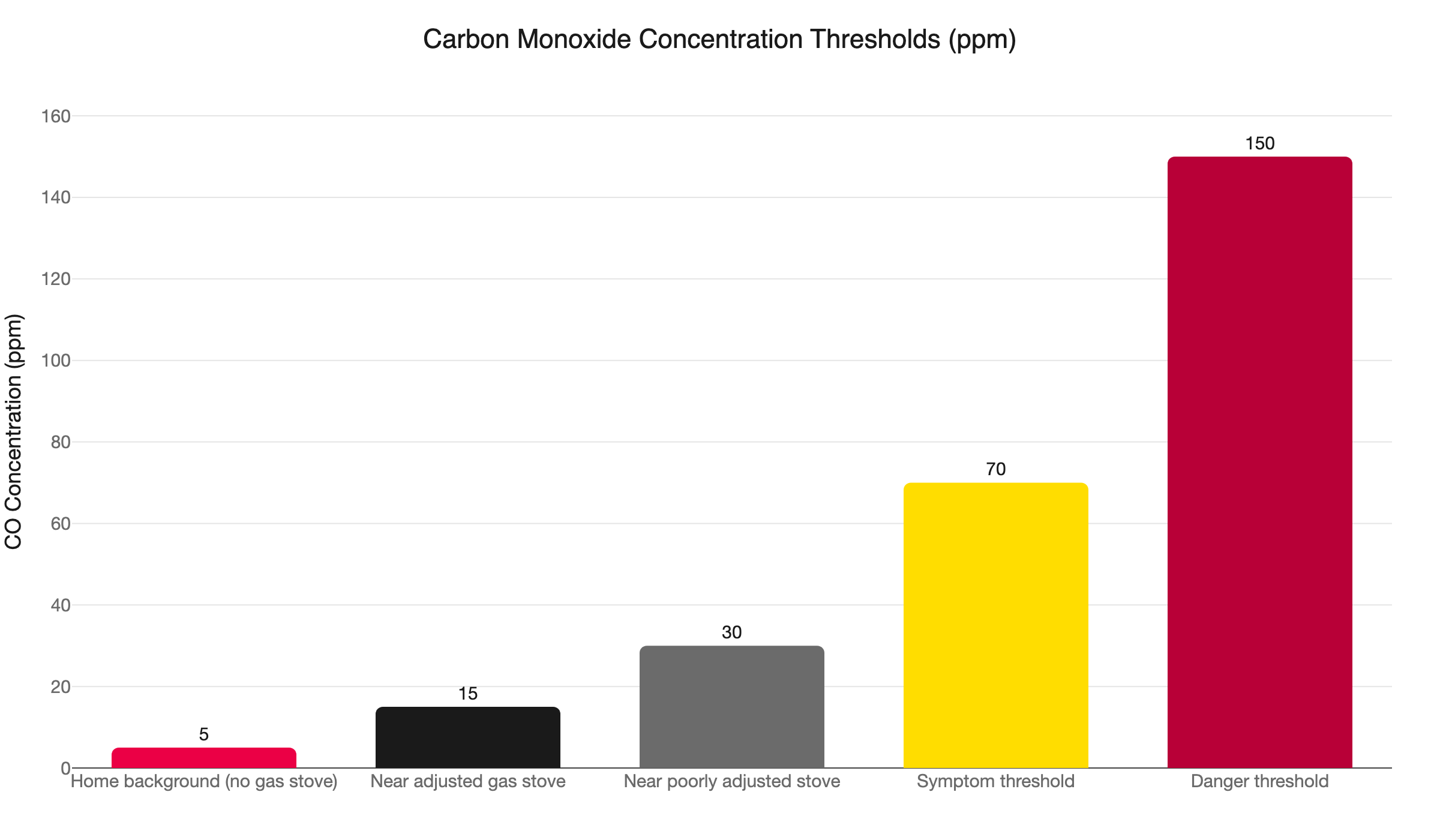
Short answer: CO often presents like the flu - headache, fatigue, nausea, and dizziness. The classic pattern for chronic low-level exposure is symptoms that improve after you leave home. Sustained exposure above 70 ppm produces headache and fatigue. Above 150-200 ppm, disorientation and loss of consciousness become possible.
CO blocks oxygen delivery at the cellular level. The gas forms carboxyhemoglobin in the blood, which oxygen cannot displace easily. The EPA notes that this mechanism makes CO especially dangerous for people with cardiovascular disease, who may experience chest pain at concentrations that produce no symptoms in healthy adults.
The CPSC breaks down the threshold levels this way:
- 1-70 ppm sustained: most people feel nothing. Cardiac patients may experience chest pain.
- Above 70 ppm: headache, fatigue, and nausea typically appear.
- 150-200 ppm sustained: disorientation, unconsciousness, and death become possible.
For context: the average CO level in a home without gas appliances is 0.5 to 5 ppm. Near a properly adjusted gas stove, 5 to 15 ppm. Near a poorly adjusted stove, 30 ppm or higher. A cold engine warming up in an attached garage produces concentrations far above any of those levels.
If anyone in your household has recurring headaches, fatigue, or nausea that clears up after leaving home, CO exposure is on the differential. Do not treat it as coincidence until you have verified alarm coverage and had the HVAC system inspected.
What Does Building Code Require for Attached Garages in Minnesota?
Short answer: Two IRC sections govern this. IRC R302.6 requires a sealed, fire-rated separation between the garage and living space. IRC M1602.2 prohibits return-air grilles from drawing air from garages or spaces with open-combustion appliances. Minnesota adopted both through the 2020 IRC, effective August 2023.
Envelope separation: IRC R302.6
The wall between an attached garage and living space must be covered with a minimum 1/2” gypsum board on the garage side. The connecting door must be a minimum 20-minute fire-rated assembly, with a self-closing mechanism and a continuous seal around the frame. All penetrations through the wall - every gap that connects the two spaces - must be sealed.
R302.6 is primarily a fire code requirement. But the same construction standard that limits fire spread also limits CO infiltration. A sealed, gypsum-covered wall with a rated door has far fewer infiltration pathways than an unfinished wall with a standard hollow-core door and gaps around every pipe.
Return-air prohibition: IRC M1602.2
Section M1602.2 of the 2020 IRC explicitly prohibits return air from being drawn from garages, crawl spaces, attic spaces, or any space containing open-combustion appliances. Return-air grilles and openings cannot be placed on garage-side walls or anywhere that would pull air across an unsealed garage-living boundary.
This section gets less attention than the fire separation code, but it directly addresses the HVAC pathway described above. A grille on a garage-side wall is a code violation and creates direct return-duct access from a space that regularly contains vehicle exhaust.
Older construction - anything built before the 2020 IRC was adopted and enforced - may not have been designed to this standard. If your house was built in the 1990s or early 2000s, the original design may include return-air placement that would not pass today’s inspection.
Three Code-Compliant Fixes for Minnesota Homeowners
The full solution layers three separate corrections. Some of this work is DIY-accessible. Other parts require a licensed HVAC contractor and an HVAC permit.
1. Seal the garage-to-house envelope
Walk the garage-to-house wall and ceiling. Look for: pipe penetrations (gas line, water supply, drain), electrical conduit entries, recessed lights on a ceiling that connects to living space above, gaps around rim joists at the foundation line, and the door frame perimeter.
Use fire-rated caulk or intumescent foam for penetrations. The door needs a full weatherstrip seal and a self-closing mechanism if it does not already have one. If the gypsum board on the garage side is cracked, missing sections, or has holes, replace it before the next heating season.
What you cannot see - gaps inside wall cavities, unsealed top plates, penetrations hidden behind finished surfaces - requires a blower door test to locate. An energy auditor or HVAC technician can run that test and identify infiltration points that a visual inspection misses. For a detailed look at how envelope sealing pairs with an HVAC upgrade, see our post on air sealing before an HVAC upgrade in Minnesota.
2. Audit return-air grille placement
Locate every return-air grille in the house. For each one, identify which wall it is on and whether that wall shares a boundary with the garage. Any grille on a garage-side wall is a potential M1602.2 violation and a direct CO intake pathway.
A licensed HVAC technician can map your return-air system and flag grilles that are drawing from the wrong spaces. Relocating a return involves rerouting ductwork and requires an HVAC permit in Minnesota. This is not a DIY project, and it is not expensive to have assessed - an inspection visit covers it.
3. Verify CO alarm coverage under Minnesota Statute 299F.51
Minnesota Statute 299F.51 requires an approved, operational CO alarm within 10 feet of every room lawfully used for sleeping purposes. The alarm must be certified to UL2034 standards by a nationally recognized testing laboratory. This is the statutory minimum for every single-family and multifamily dwelling in Minnesota.
The CPSC recommends going further: install CO alarms on every level of the home and outside sleeping areas, with interconnected alarms so that when one sounds, they all sound. For a home with an attached garage, an alarm near the garage-to-house wall on the living-space side provides an earlier warning layer than alarms placed only near bedrooms.
Alarms have a rated lifespan, typically 5-7 years, printed on the back of the unit. Replace them if they are past that date regardless of whether they passed their last self-test. A self-test confirms the alarm circuit works. It does not confirm the sensor is still accurate.
For detailed placement guidance near furnaces and boilers - including height and proximity rules - see our post on carbon monoxide detector placement in Minnesota.
When Should You Call a Professional?
Short answer: Call before the next heating season if you have a return-air grille on a garage-side wall, unsealed penetrations you have not been able to close, a furnace showing back-draft signs, or CO alarms older than 7 years.
The annual furnace tune-up is the right time to raise the attached garage question with your technician. A qualified technician checks combustion appliances for back-draft, inspects the heat exchanger for cracks (a cracked heat exchanger releases CO directly into the air stream), and can walk the return-air system to identify misplaced grilles. The EPA recommends annual inspection and cleaning of central heating systems - furnaces, flues, and chimneys - as a standard CO exposure reduction step.
Signs that warrant a call before the annual visit: a furnace with soot staining around the burner compartment or above the flue collar, an alarm that has tripped after vehicle use, or any household member with persistent headaches or fatigue that track with time at home.
Northern One Hour is locally owned and operated in Ramsey, Minnesota. We serve Minneapolis, St. Paul, Blaine, Maple Grove, Plymouth, Brooklyn Park, Woodbury, Bloomington, and the surrounding Twin Cities metro. When you schedule with us, we show up when we say we will. That is the “Always On Time… Or You Don’t Pay a Dime!(R)” promise we back on every call.
Call (763) 260-6662 or schedule a heating inspection online to set up a furnace assessment or full HVAC review. If a return-air correction or envelope audit is part of the scope, we will walk you through the options and give you transparent pricing before any work begins.
You may also qualify for rebates on high-efficiency equipment through Xcel Energy’s heating and cooling programs. Visit xcelenergy.com/programs_and_rebates for current offerings available to Minnesota residential customers.
Frequently Asked Questions
Can my HVAC system pull CO from an attached garage into the house? +
What does building code say about return-air grilles near garages? +
Does Minnesota require CO alarms in homes with attached garages? +
How do I know if my garage is leaking CO into my home? +
Need a technician now?