
Carbon Monoxide Alarm Going Off Near Furnace Minnesota
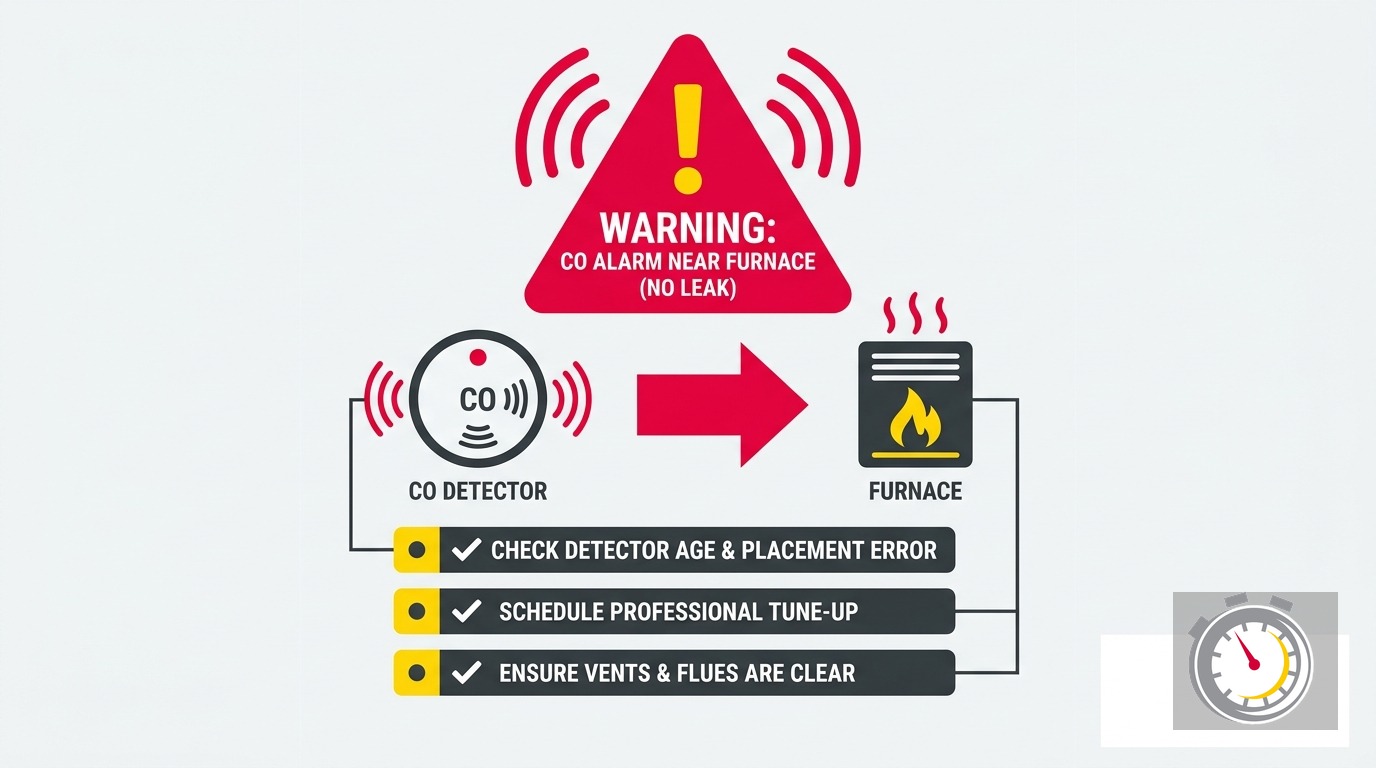
Key Takeaways
- A UL 2034-compliant detector physically cannot alarm below 30 ppm - it is not a hair trigger, and it will not fire on a brief furnace startup puff
- Three sound patterns mean three different things: a chirp every 30-60 seconds is an end-of-life warning, four beeps then a pause is a CO alarm, and continuous rapid beeping means high CO - evacuate now
- CO detectors last 5-10 years; an aging sensor can throw false alarms with no CO present - check the manufacture date on the back of the unit
- The correct mounting distance is 15-20 feet from any fuel-burning appliance, never inside the mechanical room
- Minnesota’s 92%+ AFUE condensing furnaces vent through side-wall PVC that can ice over below 0°F - a blocked exhaust vent is a real CO hazard, not a nuisance alarm
- Evacuate first every time, then troubleshoot
What to Know Before You Panic
Your carbon monoxide alarm went off near your furnace. You got everyone outside, called 911, and the fire crew found no CO. So what happened?
A carbon monoxide alarm going off near a furnace in Minnesota is almost always one of three things: a detector that has aged past its sensor life, a detector mounted in the wrong spot, or a real combustion issue at the furnace itself. Two of those are hardware problems you can solve with a $30 replacement. One requires a licensed HVAC technician and should not wait. This post walks you through how to tell them apart.
What Does a Carbon Monoxide Alarm Near the Furnace Actually Detect?
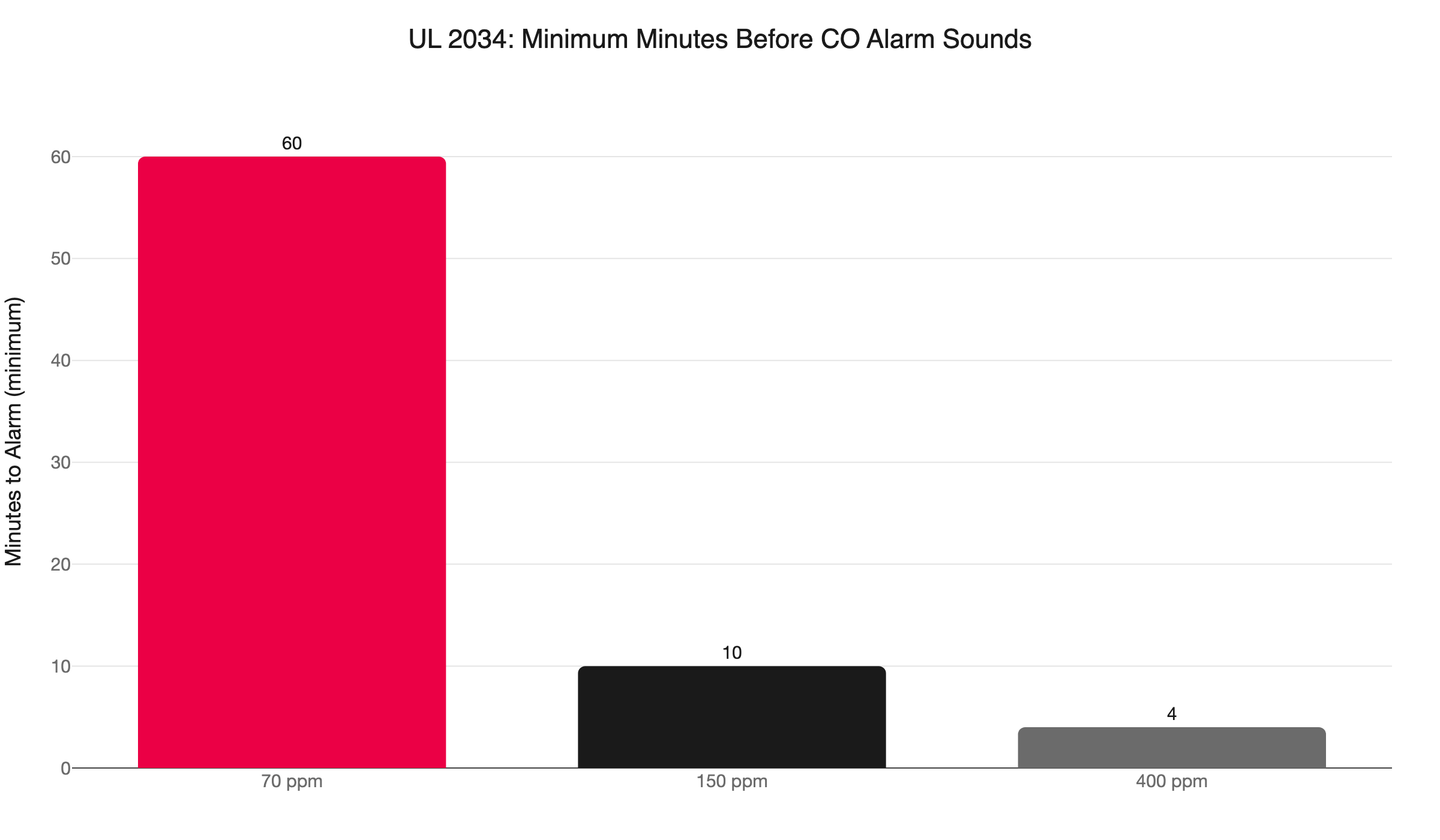
Short answer: CO builds up over time. A UL 2034-compliant detector is designed to alarm after sustained exposure - not on a momentary puff. At 70 ppm it may wait up to four hours before sounding. At 150 ppm it alarms within 10-50 minutes. At 400 ppm it sounds within four to 15 minutes.
That design is intentional. Under UL 2034 standards, a detector must NOT alarm below 30 ppm - ever. That rule exists because low-level CO is always present indoors. The EPA reports that homes without gas stoves typically measure 0.5-5 ppm of indoor CO. Near a properly adjusted gas stove, that number rises to 5-15 ppm.
A furnace ignition produces a brief CO puff while the cold flue warms up and begins drafting. That puff rarely reaches 30 ppm at 15 feet or more from the appliance. A properly functioning UL 2034 detector will not alarm on it. That is the law, not a brand promise.
So when your alarm sounds, one of two things has happened. CO accumulated to threshold levels over time. Or the sensor itself is degrading and firing without a real trigger. Both explanations are worth taking seriously. Neither should be dismissed.
The practical takeaway: a working detector is not a hair trigger. If it alarmed, something caused that alarm. Your job after you are safely outside is to figure out whether that something is a dying sensor, a placement error, or your furnace.
What Are the Three CO Alarm Patterns?
Short answer: A chirp every 30-60 seconds is a low-battery or end-of-life signal - the sensor is done, not detecting CO. Four beeps, a pause, then four more means CO has been detected. Continuous rapid beeping means CO levels are dangerously high and you need to get out now.
Most homeowners have never read the manual that came with their CO detector. Here is what each pattern means:
- Chirp, pause, chirp (repeating every 30-60 seconds): Battery low or end-of-life warning. The unit is not detecting CO. It is telling you it is dying. Replace the unit.
- Four beeps, a pause, then four more beeps: Standard CO alarm pattern on most Kidde and First Alert units. The detector has measured sustained CO above its threshold. Evacuate and call 911.
- Continuous rapid beeping with no pause: High CO concentration detected. Get every person and pet out of the house immediately. Leave the front door open behind you. Call from outside.
One detail that catches homeowners off guard: emergency services sometimes arrive after a brief CO source has cleared and the house has ventilated. A “no CO detected” result from first responders does not mean there was never a problem. It means there is no CO present at that moment. That is a meaningful distinction when you are trying to decide whether to call an HVAC technician.
If emergency crews found nothing and your alarm was making a pattern sound rather than a chirp, still schedule a furnace inspection. The source may have cleared on its own - but cleared is not the same as fixed.
Is Your Detector Old Enough to Retire?
Short answer: Flip the detector over and find the manufacture date. If it is more than seven years old, the electrochemical sensor inside is likely degrading. A degraded sensor misfires, chirps erratically, and becomes unreliable regardless of actual CO levels.
The CDC recommends replacing CO detectors every five years or per the manufacturer’s guidelines. In practice, some units carry longer ratings. According to Structure Tech, Kidde units manufactured after 2013 carry a 10-year rating. First Alert units vary from 5 to 10 years depending on the model.
The critical step: look for the manufacture date stamped or printed on the back of the unit itself. Not the installation date. Not the purchase date. The manufacture date. That is the clock the electrochemical sensor runs on, and it starts ticking the day the unit was made, not the day you mounted it.
An eight-year-old detector throwing a pattern alarm is not necessarily detecting a gas emergency. It may be dying. The right response is still to evacuate and let first responders confirm - but when crews find no CO and the unit is past its rated life, sensor retirement is the most likely explanation.
There is one important caveat here. A nuisance alarm from an aging sensor is not a reason to skip a furnace check entirely. Replace the detector AND have a technician verify combustion is clean before you call the matter closed. You want to rule out both causes, not just the cheaper one.
Is Your Detector Mounted in the Right Location?
Short answer: A detector mounted inside or directly outside the mechanical room, within 15 feet of the furnace, will read elevated CO during normal operation. That is a placement error that generates false alarms, not a gas emergency.
The EPA recommends one CO detector per floor, with priority near sleeping areas. Standard HVAC guidance puts the safe mounting distance at 15-20 feet from any fuel-burning appliance, and explicitly not inside the mechanical room.
Common placement errors that create nuisance alarms:
- Inside the furnace room: Exhaust gases near the appliance are higher at startup even when everything is working correctly. Mounting a detector there guarantees elevated readings.
- Right outside the mechanical room door: Same issue, just slightly diluted. Fifteen feet is the minimum.
- In the kitchen or laundry area: Cooking fumes, steam from a dishwasher, ammonia-based cleaners, and fresh paint can trigger sensitive sensors - especially on older units.
- In a hallway adjacent to an attached garage: Vehicle exhaust is a legitimate CO source. A detector in that hallway may be doing its job correctly. Do not assume it is a false alarm.
- On the ceiling directly above a heat register: Not a common misfire source, but poor airflow in a corner can create concentration pockets.
Minnesota Statute 299F.51 requires a CO alarm within 10 feet of every sleeping room. If your only detector is on the ceiling directly above the furnace, you are both legally underprepared and set up for nuisance alarms. Most homes need at least two detectors - one near sleeping areas and one on each additional floor.
Our carbon monoxide detector placement guide for Minnesota homes with furnaces and boilers walks through correct positioning room by room, including the specific rules for homes with both a furnace and a water heater in the same mechanical space.
A Minnesota-Specific Risk: Iced-Over PVC Exhaust Vents
This section applies specifically to homeowners with high-efficiency condensing furnaces. In Minnesota, that is virtually every homeowner who has replaced a furnace in the past decade.
Minnesota requires all new furnace replacements to meet a minimum 92% AFUE efficiency rating. Every furnace at that rating or above vents through a side-wall PVC pipe rather than a traditional masonry chimney. That plastic exhaust vent terminates on the exterior wall of your home, typically near the foundation, within a few feet of grade.
At temperatures near or below 0°F, the water vapor in the exhaust condenses and freezes right at the pipe opening. Ice builds up ring by ring. If that ice plug grows large enough to block the opening, combustion gases - including carbon monoxide - have nowhere to go. They back up into the furnace cabinet and can spill into the living space.
This is backdrafting. It is a real CO hazard, not a sensor glitch. It appears most often at the start of heating season - when a furnace that sat idle all summer fires up for the first time with an ice ring that formed during the last cold snap of the previous winter. The furnace ran fine all last season. It fires up in October or November. The alarm trips within the first hour.
That sequence is a strong signal to check the exhaust pipe before anything else.
What to check when your alarm trips at the first furnace startup of fall:
- Go outside and locate the PVC exhaust and intake pipes on the foundation wall
- Look for ice rings, frost buildup, animal nesting material, or any debris at the opening
- Both pipes matter: the intake brings combustion air in; the exhaust pushes it out; a blocked intake starves the burner and can cause incomplete combustion
- If either pipe is partially or fully blocked, do not run the furnace again until a technician inspects the system
Our post on blocked high-efficiency furnace exhaust vents in winter covers what those pipes should look like from outside, how to identify a dangerous blockage versus normal frost, and what proper clearance from grade looks like during a Minnesota winter.
Exhaust fans in the home add another layer of risk. Running a bathroom fan, kitchen range hood, or dryer at the same time the furnace is operating can depressurize the house enough to pull exhaust back through loose joints in the vent connector. We cover exhaust fans, furnace backdraft, and combustion air supply in a separate post, including which fan combinations create the highest depressurization risk.
What Should You Do When the Alarm Sounds?
Short answer: Evacuate everyone immediately. Leave the front door open as you go. Call 911 from outside. Do not stop to investigate, grab belongings, or open windows first. Your safety comes before diagnosis.
The sequence to follow every time an alarm sounds:
- Get out now. Every person and every pet. Do not wait to figure out the pattern. Leave the front door open behind you as you exit.
- Call 911 from outside. Fire departments carry calibrated CO meters. Let them take the initial reading before anyone re-enters.
- Do not go back inside until first responders clear the space. CO is colorless and odorless. There is no safe way to eyeball it.
- Note the alarm pattern once you are outside. Chirp-every-minute, four-beep-pause, or continuous. That detail matters for the follow-up conversation with your HVAC tech.
- Check the manufacture date on the back of the unit after the house is cleared. Write it down.
- Call your HVAC technician. Even if first responders find no CO and the detector turns out to be old, schedule a combustion safety check before running the furnace again.
One scenario that surprises homeowners: emergency crews arrive eight to 12 minutes after the alarm sounds. In a house with windows or doors that got opened during evacuation, CO can dissipate significantly in that window. A clean reading at arrival is good news, but it is not a guarantee nothing happened. It is a reason to follow up, not a reason to skip the furnace check.
When a Carbon Monoxide Alarm Going Off Near Your Furnace Points to a Real Problem
Short answer: When the detector is under seven years old, mounted at the correct distance, showing a four-beep pattern rather than a chirp, and first responders confirm elevated CO readings - you have a furnace combustion problem that requires a licensed HVAC technician.
Real CO sources from a furnace include:
- Cracked heat exchanger: A crack in the heat exchanger allows combustion gases to mix directly with the conditioned air circulating through your home. This is the most serious furnace CO failure mode. Symptoms include a sharp smell in heated air, visible soot on the outside of the furnace cabinet, and an alarm that trips reliably during heating cycles. The fix is almost always furnace replacement, not repair.
- Blocked or ice-capped PVC exhaust vent: Covered above. Most common at the first firing of fall or during sustained sub-zero stretches. The solution is clearing the blockage and inspecting the inducer for damage.
- Loose or disconnected vent connector: The flue pipe section between the furnace and where it exits through the wall can vibrate loose over years of operation. A loose joint spills exhaust directly into the mechanical room on every heating cycle.
- Flame rollout: Restricted combustion air forces flames outside the burner box. A soot halo on the cabinet exterior near the burner access panel is the visible sign. A burnt smell in the mechanical room is another.
- Failed or weakened draft inducer motor: The inducer creates the draft that pulls combustion gases out through the vent. If the motor is losing speed, exhaust lingers in the cabinet rather than exiting the home.
None of these are DIY repairs. Detecting a combustion leak requires a calibrated CO meter and knowledge of where to sample - neither is available at a hardware store. If you suspect any of these causes, leave the furnace off and call a technician.
What a Furnace Combustion Safety Inspection Covers
When a licensed HVAC technician performs a combustion safety inspection, the scope includes:
- Heat exchanger integrity: visual inspection for cracks, soot tracking, or deformation, often followed by pressure testing
- Draft inducer operation: confirming the motor is producing adequate static pressure to move exhaust through the vent
- All vent connector joints from the furnace to the exterior, checked for separation, rust, or improper slope
- Live CO measurement at the appliance during an active heating cycle, not just at rest
- PVC exhaust and intake pipe condition: ice damage, proper slope for condensate drainage, joint integrity, clearance from grade
- Combustion air supply adequacy for the mechanical room, particularly in tight modern construction
A furnace inspection in Minnesota runs $95-$250 for a single tune-up visit. That cost covers confirmation that your furnace is safe to run through another Minnesota winter - and gives you a written record of the system’s condition at the start of the season.
If a technician finds a cracked heat exchanger, the economics shift quickly. A heat exchanger swap on an older furnace often costs as much as a new 80% AFUE furnace installation, which starts around $4,950 installed in the Twin Cities. At that point, replacement typically makes more sense than repair.
Our locally owned and operated team serves homeowners across the Twin Cities metro: Ramsey, Blaine, Maple Grove, Plymouth, Brooklyn Park, Minneapolis, St. Paul, Woodbury, and Bloomington. When your carbon monoxide alarm goes off near the furnace, we get there fast and tell you exactly what we find. “Always On Time… Or You Don’t Pay a Dime!(R)”
Call (763) 260-6662 or schedule your furnace inspection online.
Frequently Asked Questions
Can a furnace startup trigger a CO alarm? +
How do I tell a CO alarm from a low-battery chirp? +
Does Minnesota require carbon monoxide detectors? +
How long does a carbon monoxide detector last? +
Need a technician now?