
Not Enough Return Air HVAC Problems in Twin Cities Homes
Key Takeaways
- Not enough return air HVAC problems cause cold bedrooms, stuffiness, and high energy bills - not broken equipment.
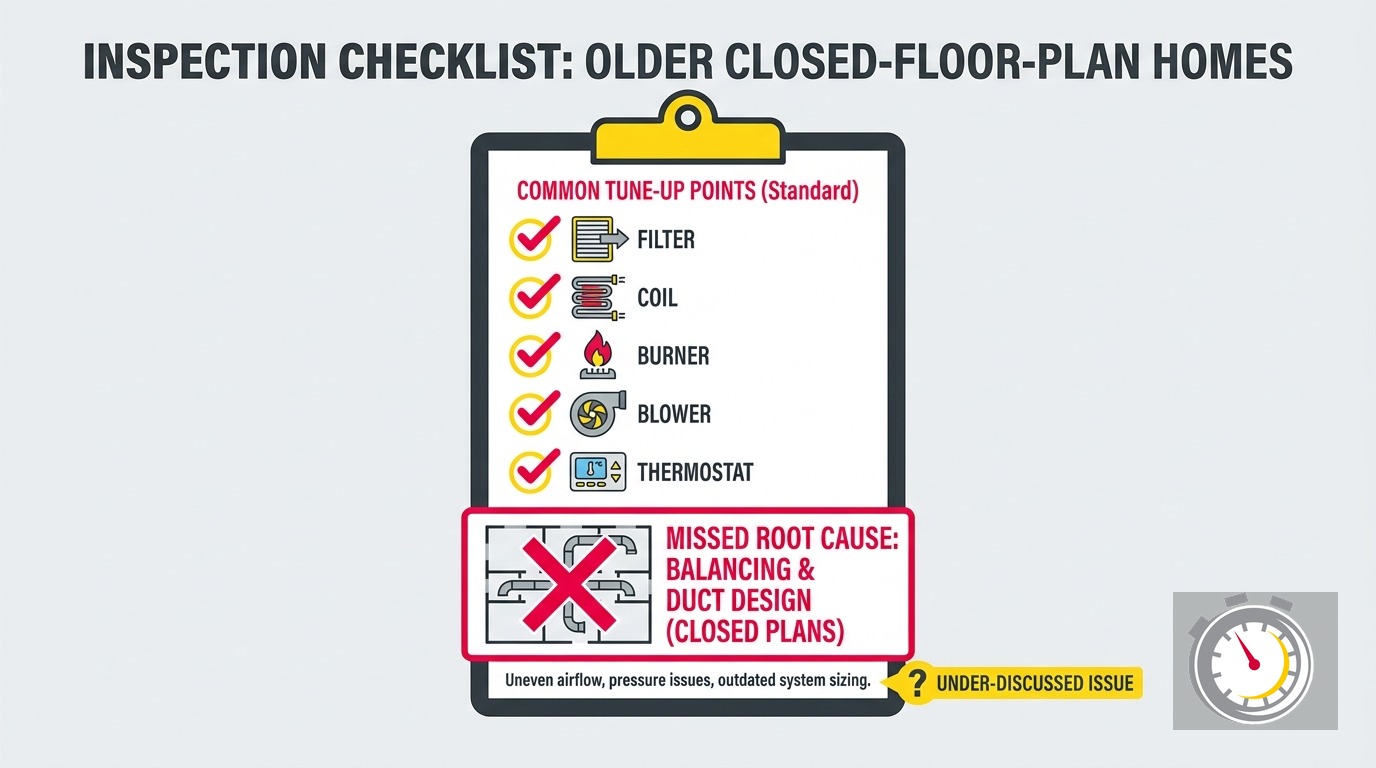
- Most pre-1980 Twin Cities homes have one central hallway return. That design cannot feed a modern variable-speed blower.
- Installing a new high-efficiency furnace without upgrading the return side often makes bedroom comfort worse, not better.
- Fixes range from a simple door undercut (DIY, under $100) to transfer grilles, jump ducts, or a dedicated return run.
- ENERGY STAR reports that typical duct systems lose 20-30% of conditioned air through leaks and poorly connected sections.
- CenterPoint and Xcel both offer 2026 rebates on air sealing work that often accompanies a return air fix.
- Call (763) 260-6662 or book online for a return air assessment with Northern One Hour.
What Is Return Air, and Why Does It Matter?
Return air is the air your furnace or air handler pulls back from your living spaces to recondition. Without enough of it, pressure builds in closed rooms. Conditioned air is forced out through wall gaps. Cold exterior air infiltrates from the other side. Your system works harder and your home stays uncomfortable.
Every forced-air HVAC system runs as a loop. Conditioned air flows out through supply registers. That same air must come back through return grilles. The furnace reheats it. The air conditioner recools it. Both sides of that loop need to be sized correctly.
When the return side is undersized, static pressure rises throughout the ductwork. Rooms that receive supply air but have no return path build up positive pressure. That pressurized air pushes outward through every gap it can find. Cracks around window frames. Outlet boxes. Baseboards. Wall penetrations.
In Minnesota, that gap becomes a constant exchange. January outdoor temperatures in the Twin Cities regularly drop to -10°F. Warm conditioned air exits. Frigid outdoor air enters. Your furnace runs longer to compensate. The bedroom still feels cold.
Why Are Older Twin Cities Homes So Vulnerable?
Most pre-1980 homes in the metro were designed with a single central hallway return. Think ramblers in Eden Prairie, split-levels in Roseville, cape cods in Minnetonka. That design worked for the original equipment. Modern high-efficiency furnaces need significantly more return air to do their job.
The original design was adequate for the era. One large grille in the hallway fed a framing cavity or a basic sheet-metal trunk back to the furnace. Bedroom doors could stay open. The system balanced passively.
Two things changed over the decades. First, homeowners started closing bedroom doors for privacy and temperature control. Second, and more significantly, they replaced aging furnaces with modern high-efficiency units.
According to the Minnesota HVAC Authority, pre-1980 homes commonly have under-insulated duct systems with failed fiberglass tape. Many use framing cavities as return pathways. After 40 years of thermal cycling, that tape has often failed.
The Minnesota Mechanical Code (IMC 2018) now prohibits framing cavities as supply ducts and corridors as return ducts. Pre-1980 homes were built before those standards. No code trigger forces a retrofit when existing homes get new equipment.
New construction in Minnesota requires post-installation duct leakage testing before final inspection. Existing homes have no such requirement. A return system can degrade for 40 years undetected.
What Are the Signs of Not Enough Return Air HVAC Problems?
The clearest signs are: one or two rooms always hotter or colder than the thermostat setting; a bedroom door that resists opening slightly when the fan runs; louder register noise with the door closed; and cold drafts near outlets or baseboards in those rooms.
The full list of symptoms to check:
- Uneven temperatures. Rooms with supply registers but no return path over- or under-heat relative to the rest of the house.
- Pressurized rooms. A closed bedroom door pushes back slightly when the furnace fan runs. Air leaks out around the door frame.
- Noisy supply registers. When the bedroom door is shut, register noise increases. The system is fighting elevated static pressure.
- Cold drafts near outlets and baseboards. Pressurized air exits through wall penetrations. Cold outdoor air infiltrates through other gaps.
- High heating bills despite good equipment. The furnace runs longer to compensate for heat lost through pressure-driven infiltration.
- Furnace short-cycling. In more severe cases, restricted return airflow overheats the heat exchanger. The limit switch trips. The furnace shuts down before the heating cycle finishes.
If your furnace is short-cycling, return air restriction is a cause that often goes undiagnosed alongside more obvious culprits.
The Equipment Replacement Trap
This is the scenario that rarely gets explained clearly, and it is common in the Twin Cities.
A homeowner replaces a 1970s 80% AFUE single-speed furnace. The new unit is a 95-96% AFUE two-stage or variable-speed model. That is a significant and worthwhile upgrade for a Minnesota winter. Our post on furnace AFUE ratings explained shows what that efficiency gap means for your gas bill.
Here is the problem. A modern ECM blower is engineered to move more air than the single-speed unit it replaced. The new blower needs a larger return path to deliver on that design. When the original single-hallway return cannot feed that demand, static pressure climbs.
Bedroom supply registers push more conditioned air into rooms with no return path. Pressurization worsens. More conditioned air exits through wall gaps. The homeowner spent $5,000 to $7,800 on a new furnace and the bedrooms are colder than before.
This is not a furnace defect. It is a duct system mismatch. The fix belongs on the return side, not on the equipment.
How Do Pressure Imbalances Drive Up Your Energy Bills?
A closed bedroom under positive pressure pushes conditioned air out through wall gaps. Cold outdoor air infiltrates from the other side. In Minnesota’s climate zone 6A, the indoor/outdoor temperature difference in January can exceed 80°F. That infiltration shows up on your gas bill every single day.
According to ENERGY STAR, typical duct systems lose 20-30% of the air they move through leaks and poorly connected sections. That translates to 25-40% of heating and cooling energy lost before it reaches the room.
The LBNL Residential Leakage Database, drawing on data from over 150,000 homes, found that buildings get leakier over time. Every year of thermal cycling opens new pathways through insulation and framing. Minnesota’s annual temperature swing exceeds 100°F.
The DOE Building America Solution Center sets a clear benchmark. ENERGY STAR requires that rooms supplied under 150 CFM maintain a pressure differential of no more than plus or minus 3 Pascals. Very few pre-1980 Twin Cities homes meet that standard when bedroom doors are closed.
Climate zone 7A in northern Minnesota sees design temperatures as low as -30°F near Duluth. The energy cost of pressure-driven infiltration in that environment is substantially higher than in mild markets. In the metro’s zone 6A, the gap is still severe enough to see on your monthly utility statement.
The DIY Test: Can You Check for Return Air Problems Yourself?
Yes. The tissue-paper test takes two minutes and costs nothing. It tells you whether a pressure imbalance exists in a given room. It does not quantify the severity, but it confirms whether you have a problem worth investigating.
Here is how to run it:
- Close all bedroom doors.
- Set the furnace fan to “On” at the thermostat (not “Auto”).
- Cut a short strip of tissue paper or a light paper towel.
- Hold it near the bottom gap of a closed bedroom door from the hallway side.
- If the tissue is pulled toward the gap, the room is under negative pressure. The return side is starved for air.
- If the tissue is pushed away from the gap, the room is under positive pressure. Conditioned air is being forced out.
Either result points to a return air imbalance.
You can also check supply registers by hand. Place your palm over the register in a closed bedroom. If airflow feels noticeably weaker with the door shut than with it open, the system is fighting its own static pressure.
These tests tell you a problem exists. Measuring the actual Pascal differential requires a calibrated pressure gauge and a professional visit. That measurement matters when you are choosing between fix options. The severity of the imbalance shapes which solution is right.
What Are the Fix Options for Not Enough Return Air HVAC Problems?
Four options exist, from a DIY door trim under $100 to a new dedicated return duct run. The right choice depends on the imbalance severity and the distance from the room to the central return.
Here is the fix spectrum:
Door undercuts. Trim the bottom of a bedroom door to a 1-inch gap. That gives air a passive path out when the door is closed. It reduces the pressure differential without eliminating it. This is often sufficient for mild imbalances and costs very little.
Transfer grilles. A double-faced grille installed high in a shared wall creates an air pathway without adding ductwork. A technician cuts two holes, installs the grille, and the path is open. This works well when the bedroom shares a wall with a hallway or another return-side space.
Jump ducts. A jump duct is a short duct section running through a ceiling or floor cavity. It connects the bedroom to a return-side space. It is more involved than a transfer grille. It works better in rooms farther from the central return, or where a wall grille is not practical.
Dedicated return duct. A new duct run from the bedroom back to the return plenum. This is the right call when the imbalance is severe. It also fits when the room is far from the central return, or when the whole return network is undersized for the installed equipment. For what system-level signs look like when the entire return side is undersized, see our post on high static pressure in HVAC systems.
The DOE Building America Solution Center lists all four as ENERGY STAR-accepted solutions. It also specifies that framing cavities alone cannot serve as return pathways. Many pre-1980 configurations need upgrading regardless of fix type.
What Does This Work Cost in the Twin Cities?
Door undercuts are a DIY or handyman task under $100. Transfer grilles and jump ducts are moderate scoped jobs. A dedicated return duct run is priced as a ductwork modification. Get a written quote based on your actual home layout.
Door undercuts require a trim saw and an afternoon. They are not an HVAC line item.
Transfer grilles and jump ducts involve cutting into walls or ceilings, installing hardware, and sometimes working in tight framing cavities. Pricing reflects that scope and varies by access difficulty and number of rooms.
Pricing a dedicated return duct run works like any ductwork modification. Run length, access difficulty, and system configuration all factor in. For reference, a full ductwork replacement in the Twin Cities runs $6,500 to $13,000. A scoped return-only modification for one or two rooms is substantially less - but get a specific quote.
If the scope covers multiple rooms, ask your technician for a Manual D airflow calculation. Minnesota requires ACCA Manual D sizing for new residential installations. A proper calculation shows exactly how much return capacity the system needs.
Ask about financing when you call. Northern One Hour offers financing options for larger HVAC projects.
Are There Rebates for Air Sealing Work That Goes with a Return Air Fix?
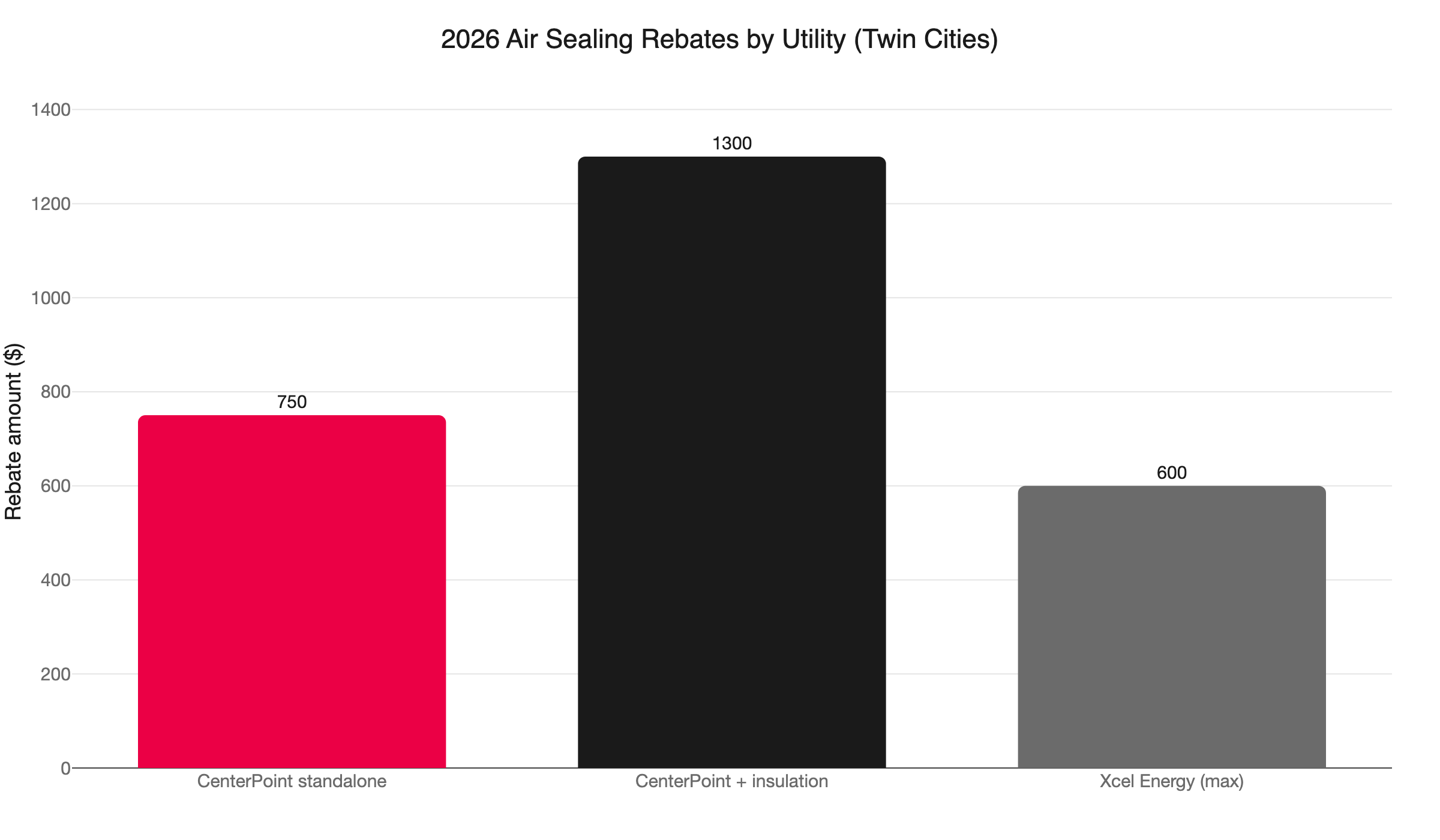
Yes. CenterPoint Energy and Xcel Energy both offer 2026 rebates on air sealing work. That work often accompanies a return air fix. The same project identifies and seals the wall penetrations and duct gaps that pressure imbalance has been exploiting.
Here is what is currently available:
CenterPoint Energy (2026):
- Attic air sealing alone: $750 rebate
- Combined with insulation upgrade to R-49 or higher: $1,300 rebate
- Up to $3,000 total for eligible projects
- Deadline: December 31, 2026
- Must use a BPI-certified installer
- Apply at centerpointenergy.com/insulationrebate
- Source: CenterPoint Energy rebates
Xcel Energy (2024-2026):
- 40% of attic air sealing cost, up to $600
- Whole Home Efficiency bonus: an additional 25% if three qualifying projects are completed within two years
- Home Energy Squad visits are available jointly to Xcel and CenterPoint customers at no or low cost - a useful first step before committing to a fix scope
- Source: Xcel Energy MN residential programs
Many Twin Cities homes have both utilities. If yours does, you may be able to stack rebates from both programs. Our guide on stacking HVAC rebates in Minnesota covers how to sequence both programs without leaving money behind.
When to Call Northern One Hour
If the tissue-paper test confirms a pressure imbalance, schedule a return air assessment. The same goes if your bedrooms have never been comfortable despite working equipment.
We are locally owned and operated in Ramsey, MN. We serve the full Twin Cities area: Minneapolis, St. Paul, Blaine, Maple Grove, Plymouth, Brooklyn Park, Woodbury, Bloomington, and surrounding suburbs.
A return air assessment includes pressure measurement and a review of your existing return network. You get a recommendation sized to your specific home and equipment. Not a generic fix.
We back every service call with “Always On Time… Or You Don’t Pay a Dime!(R)”. If we are not on time, you do not pay.
Call (763) 260-6662 or book online to schedule your return air assessment today.
Frequently Asked Questions
How do I know if my home doesn't have enough return air? +
Why did installing a new high-efficiency furnace make my bedrooms colder? +
Can I fix a return air problem myself? +
What does adding a return air duct cost in the Twin Cities? +
Need a technician now?