Furnace Short Cycling: Causes, DIY Fixes, and When to Call a Pro
Key Takeaways
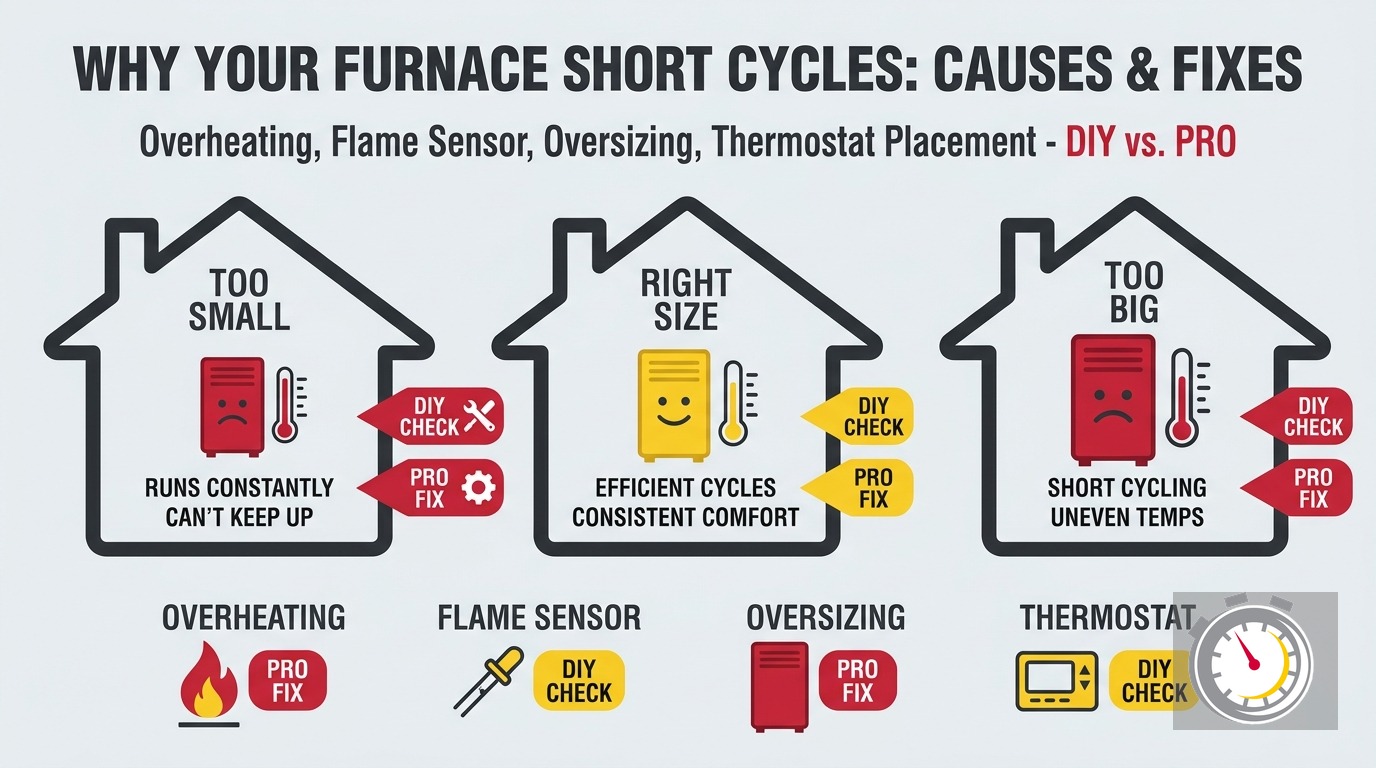
- Furnace short cycling means the furnace runs for only a few minutes per cycle instead of the normal 10-15.
- The four causes, in order of likelihood, are a dirty air filter, bad thermostat placement, a dirty or failed flame sensor, and an oversized furnace.
- A clogged filter that repeatedly trips the high-limit switch can crack the heat exchanger over time. A cracked heat exchanger is a carbon monoxide hazard and requires a same-day service call.
- DIY fixes: replace the air filter, check thermostat placement. Everything else requires a licensed HVAC technician.
- If the root cause is oversizing or a cracked heat exchanger, replacement is often the right financial call. CenterPoint Energy offers up to $1,000 in rebates on 97%+ AFUE replacements, with a December 31, 2026 deadline.
- Northern One Hour is locally owned and operated in Ramsey, MN. Call (763) 260-6662 or book online for service across the Twin Cities.
What Is Furnace Short Cycling?
Short answer: Furnace short cycling is when your furnace ignites, runs for only two to five minutes, shuts off before completing a full heat cycle, and then restarts. A healthy furnace runs full cycles of 10-15 minutes, two to three times per hour. Repeated short cycles are a warning sign, not a quirk.
Your furnace is designed to start, sustain combustion through a full cycle, reach your thermostat setpoint, and shut off cleanly. When something interrupts that process early, the furnace shuts down, cools off, and fires up again. That start-stop-restart pattern is short cycling.
Short cycling is not just annoying. Every extra startup cycle puts wear on the igniter, pressure switches, and heat exchanger. Those components were built for a few thousand starts per season, not tens of thousands. A furnace that short cycles for weeks is aging itself fast.
Why Does Short Cycling Matter More in a Minnesota Winter?
Short answer: The Twin Cities design temperature is -16°F. A furnace that short cycles at -10°F may not be able to hold a safe indoor temperature. That is not a nuisance to schedule for next week. It is a frozen pipe risk.
Most homeowners in moderate climates can put a short-cycling furnace on the to-do list. In Minnesota, January does not give you that option.
Heating accounts for more than half of energy use in a typical Minnesota home - the single largest energy expense for most households here. When your furnace is short cycling, it burns more fuel and still falls short on warmth. The house never stabilizes at setpoint.
If your furnace is short cycling during a cold snap, check the filter today. If that does not fix it, call a technician before the next polar plunge.
Cause 1: A Dirty Filter Is Overheating Your Furnace
The most common cause of furnace short cycling costs a few dollars to fix. A clogged air filter is behind more emergency heating calls in Minnesota winters than any other single issue.
Here is the mechanism. Your furnace pulls air across the heat exchanger, warms it, and pushes it through your ductwork. That airflow is what keeps the heat exchanger from getting dangerously hot. When a dirty filter restricts airflow, heat backs up. The exchanger temperature climbs until it trips the high-limit switch. That safety device cuts power to the burner at roughly 140-170°F to prevent heat damage.
The furnace shuts off. It cools. The limit switch resets. The furnace fires again. If the filter is still dirty, the same thing happens in another few minutes. That loop is furnace short cycling caused by a filter.
ENERGY STAR recommends inspecting, cleaning, or changing air filters every month. A dirty filter “can increase energy costs and damage your equipment, leading to early failure.” That is not boilerplate. It is what happens to a furnace that runs through a Minnesota winter on a clogged filter.
DIY or pro? DIY. Turn off your furnace. Pull the filter from its housing, usually where the return air duct meets the furnace cabinet. If it is gray, matted, or visibly clogged, replace it. A standard 1-inch filter costs $5-$30. Slide in the new one, restore power, and give the furnace 20-30 minutes to confirm the short cycling has stopped.
If you replace the filter and the short cycling continues, move to the next cause.
Is a Clogged Filter Dangerous for Your Heat Exchanger?
Short answer: Yes. Repeated high-limit switch trips from a dirty filter stress the heat exchanger through rapid heat-and-cool cycles. Over time, that thermal fatigue cracks the metal. A cracked heat exchanger leaks carbon monoxide into your home’s air supply. This is a safety emergency, not a maintenance item to schedule next month.
The heat exchanger is the sealed metal chamber that separates combustion gases from the air your family breathes. It is built to handle normal thermal cycling. It is not built to handle repeated overheating caused by a filter nobody changed in October.
Each time the limit switch trips, the exchanger expands under extreme heat and contracts as it cools. Enough of those cycles and the metal fatigues and cracks. Bryant identifies a cracked heat exchanger as a serious safety hazard that requires professional diagnosis before the furnace runs again.
If your furnace is short cycling and anyone in the house has headaches, dizziness, or nausea, or if a carbon monoxide alarm goes off, shut the furnace off immediately. Open windows, leave the house, and call 911. Once the immediate danger is handled, call a licensed HVAC technician before the furnace runs again.
A cracked heat exchanger means either a $1,950-$3,200+ repair or full furnace replacement. On a furnace older than 15 years, replacement is usually the better financial decision. The math on that is covered below.
Is Your Thermostat in the Wrong Spot?
Short answer: A thermostat near a heat register, sunny window, exterior wall, or kitchen reads the room as warmer than it actually is. The furnace shuts off early because the thermostat thinks setpoint is reached. Moving or recalibrating the thermostat often stops this type of short cycling without any furnace work at all.
Your thermostat samples air temperature at its exact location and uses that reading to control the whole house. If it is in a warm microclimate, such as next to a supply register or in afternoon sunlight, it tells the furnace the house is already at setpoint when most rooms are still cold.
Lennox notes that if your furnace “starts running again almost immediately after shutting off, this should only happen in extremely cold, below-zero weather.” A furnace that restarts within minutes on a mild day almost certainly has a thermostat sensing problem.
Common bad thermostat locations:
- On a wall within a few feet of a heat register or supply vent
- On an exterior wall exposed to cold air infiltration
- Near a west-facing window that gets afternoon sun
- In or adjacent to the kitchen, where cooking heat skews the reading
DIY or pro? Check the location first. If the thermostat is a smart thermostat you mounted yourself, relocation may be a straightforward DIY step. Our guide to smart thermostat placement for Twin Cities homeowners covers best-practice positioning in detail.
If the thermostat is hardwired and clearly in a bad spot, a technician can relocate it. This is not a complicated repair, but it does involve shutting off power and working with low-voltage wiring.
Does a Dirty Flame Sensor Cause Furnace Short Cycling?
Short answer: Yes. The flame sensor confirms combustion is happening after the gas valve opens. A sensor coated with oxidation cannot send that confirmation, so the gas valve closes and the furnace shuts off 2-30 seconds after ignition. The furnace then restarts and the same thing happens again.
The flame sensor is a small metal rod in the burner assembly. It conducts a micro-current through the flame. If the current flows, the system knows combustion is active and holds the gas valve open. If the rod is oxidized, the current cannot flow. The valve closes as a safety measure to prevent unburned gas from accumulating in the cabinet.
Bryant notes that flame sensor cleaning is a potential DIY step for homeowners “comfortable performing minor furnace maintenance.” Here is the process:
- Turn off power to the furnace at the circuit breaker or disconnect switch.
- Turn off the gas supply at the shutoff valve on the gas line feeding the furnace.
- Locate the flame sensor rod in the burner assembly. It is a single thin metal rod with a porcelain mounting block.
- Remove the one mounting screw and pull the rod out carefully.
- Gently rub the metal portion with fine steel wool until the surface is bright.
- Reinstall the sensor, restore gas and power, and run the furnace through a full startup.
DIY or pro? DIY only if the rod looks dull or lightly oxidized. If the rod is pitted, corroded, or physically damaged, cleaning will not fix it. A damaged flame sensor needs professional replacement. Installed cost typically runs $100-$250. If you are not comfortable working around gas appliances, skip straight to the technician. This is a straightforward one-appointment repair.
Cause 4: An Oversized Furnace
An oversized furnace heats your home too fast. It blasts BTUs into the space, hits the thermostat setpoint in a few minutes, shuts off, and then restarts when temperatures drop. The house never reaches a stable temperature. The furnace cycles in short bursts all day.
Lennox identifies oversizing as a direct cause of short cycling and lists the downstream effects: humidity swings, uneven room temperatures, and accelerated wear on igniters and pressure switches. A key tell: an oversized furnace short cycles even in very cold weather. A thermostat-placement problem tends to get better as outside temperatures drop. An oversized furnace does not.
Oversizing is common in older Minnesota homes. For decades, contractors routinely padded BTU estimates “to be safe” for a climate where design temperature is -16°F. The result is a generation of Twin Cities homes with furnaces meaningfully larger than what a proper load calculation would specify.
General BTU sizing starting points for Minnesota, from regional HVAC cost data:
- 1,200-1,500 sq ft: 60,000-80,000 BTU
- 1,500-2,000 sq ft: 80,000-100,000 BTU
- 2,000-2,800 sq ft: 100,000-120,000 BTU
These are starting points, not prescriptions. Actual sizing depends on insulation, ceiling height, window area, and infiltration. But if your furnace is significantly above those ranges for your home’s square footage, oversizing is worth a closer look.
How Do You Know If Your Furnace Is Too Big?
Short answer: Pull the model number from the label on the furnace cabinet, look up the BTU output, and compare it to the sizing ranges above. A 120,000 BTU furnace in a 1,400-square-foot house is a clear red flag. The confirming step is a Manual J load calculation by a licensed HVAC technician.
You can do the initial math yourself. Confirming it requires professional equipment and a full load calculation.
Beyond the BTU numbers, watch for these signs of an oversized furnace:
- Temperature swings between cycles: the house heats fast, cools fast, and never settles
- Unusually dry air in winter: short cycles do not run long enough to circulate humidity effectively through the home
- Hot and cold spots between rooms, especially rooms close to the furnace vs. far from it
- Short cycling that does not improve on very cold days, when a correctly sized furnace would run longer cycles
DIY or pro? This is a pro diagnosis. There is no DIY fix for an oversized furnace. The options are managing symptoms with thermostat staging or zone dampers, or replacing the furnace with a correctly sized unit. For a furnace that is also aging, replacement is usually the right call. Our post on furnace replacement costs in the Twin Cities covers what you should expect to pay and what drives the price up or down.
When Should You Replace Instead of Repair?
Short answer: Consider replacement when the root cause is oversizing, when the heat exchanger is cracked, or when the furnace is 15-20 years old and the repair cost exceeds roughly half the cost of a new system. These three conditions often appear together.
The Minnesota Department of Commerce lists age (15-20 years), expensive repairs, and inefficiency as the three replacement triggers for a furnace. When two or three apply at once, repair economics rarely favor the homeowner.
A fast decision matrix:
- Dirty filter or thermostat caused it: DIY fix or a quick technician visit, then move on
- Flame sensor is the culprit: clean or replace the sensor; the furnace likely has years of life left
- Cracked heat exchanger, furnace under 10 years old: heat exchanger repair may pencil out; get a quote
- Cracked heat exchanger, furnace 15+ years old: replace
- Oversized furnace causing short cycling: replace with a correctly sized, high-efficiency unit
Minnesota’s minimum efficiency standard for replacement furnaces is now 90% AFUE for single-family homes. Every new furnace you buy meets that floor. Stepping up from there is where rebates become significant.
What Rebates Are Available for a New Furnace in Minnesota?
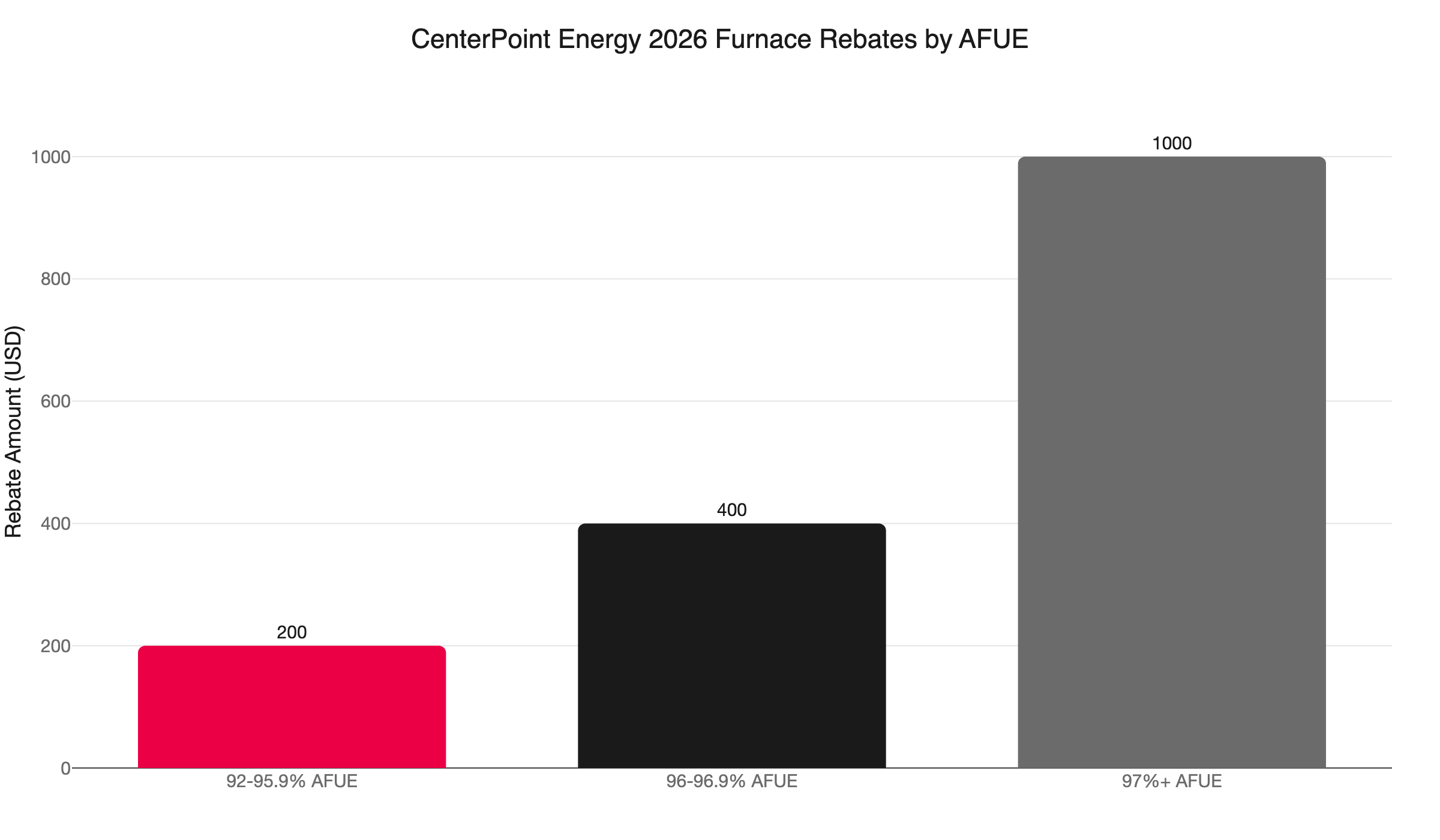
Short answer: CenterPoint Energy offers $200-$1,000 in rebates on forced-air furnace replacements in 2026, with the full $1,000 available on units rated 97%+ AFUE. Applications for 2026 installations must be submitted by December 31, 2026.
If replacement is the verdict, the rebate math matters. CenterPoint’s 2026 tiers:
- 92-95.9% AFUE: $200 rebate
- 96-96.9% AFUE: $400 rebate
- 97%+ AFUE: $1,000 rebate
The jump from 96% to 97%+ AFUE earns you an additional $600 back. Over the life of the furnace, a 97%+ unit also costs less to operate than a 92% unit. Both factors favor the higher-efficiency option when replacing.
Xcel Energy also runs a residential rebate program for high-efficiency furnaces in Minnesota. Current amounts are in their 2024-2026 Rebate Summary. Check your utility provider to confirm what applies to your account. Customers of both utilities may be able to stack rebates.
A $1,000 rebate from CenterPoint meaningfully offsets the cost of a new system in the Twin Cities market. Our team can walk you through financing options at the time of your service call so you do not have to wait for a budget window.
Schedule Service With Northern One Hour
If you have worked through the filter and thermostat checks and your furnace is still short cycling, the remaining causes require a technician with the right tools and training.
Northern One Hour is locally owned and operated out of Ramsey, MN. We serve Minneapolis, St. Paul, Blaine, Maple Grove, Plymouth, Brooklyn Park, Woodbury, Bloomington, and the surrounding Twin Cities metro. We offer furnace repair and furnace tune-ups with the same commitment on every call: “Always On Time… Or You Don’t Pay a Dime!(R)”
An annual professional tune-up covers thermostat calibration, electrical connection checks, lubrication of moving parts, condensate drain verification, and a full startup-and-shutoff inspection. That is the diagnostic work that catches short cycling causes before they become emergency calls in the middle of January.
Call (763) 260-6662 or book online to schedule same-day or next-day service. If your furnace is short cycling in a Minnesota winter, do not let it run undiagnosed through another cold night.
Frequently Asked Questions
What causes furnace short cycling? +
Can I fix furnace short cycling myself? +
How often should a furnace cycle? +
What CenterPoint Energy rebates are available for furnace replacement in 2026? +
Need a technician now?