
Oversized Furnace Problems: Bigger Isn't Better in MN
Key Takeaways
- An oversized furnace runs 4-8 minute cycles instead of the correct 15-16 minutes, wasting 10-30% of your fuel.
- Short cycling shortens heat exchanger lifespan by 20-50%, turning an 18-25 year furnace into one that fails in 8-10 years.
- Minnesota winters push outdoor air into your home at 15-25% relative humidity. A short-cycling furnace cannot distribute moisture, leaving your home far drier than it should be.
- The Minneapolis design temperature is -16°F. Sizing standards already allow a buffer for cold snaps. A 100,000 BTU/h furnace in a 60,000 BTU/h home is not insurance; it is oversized.
- Minnesota code requires a Manual J load calculation for every furnace installation. Many replacements skip this step and replicate the old unit’s size or go bigger.
- Modulating and two-stage furnaces solve short cycling without sacrificing capacity for extreme cold.
- Xcel Energy and CenterPoint Energy offer up to $400 in rebates for qualifying high-efficiency replacements in 2026.
What Problems Does an Oversized Furnace Cause?
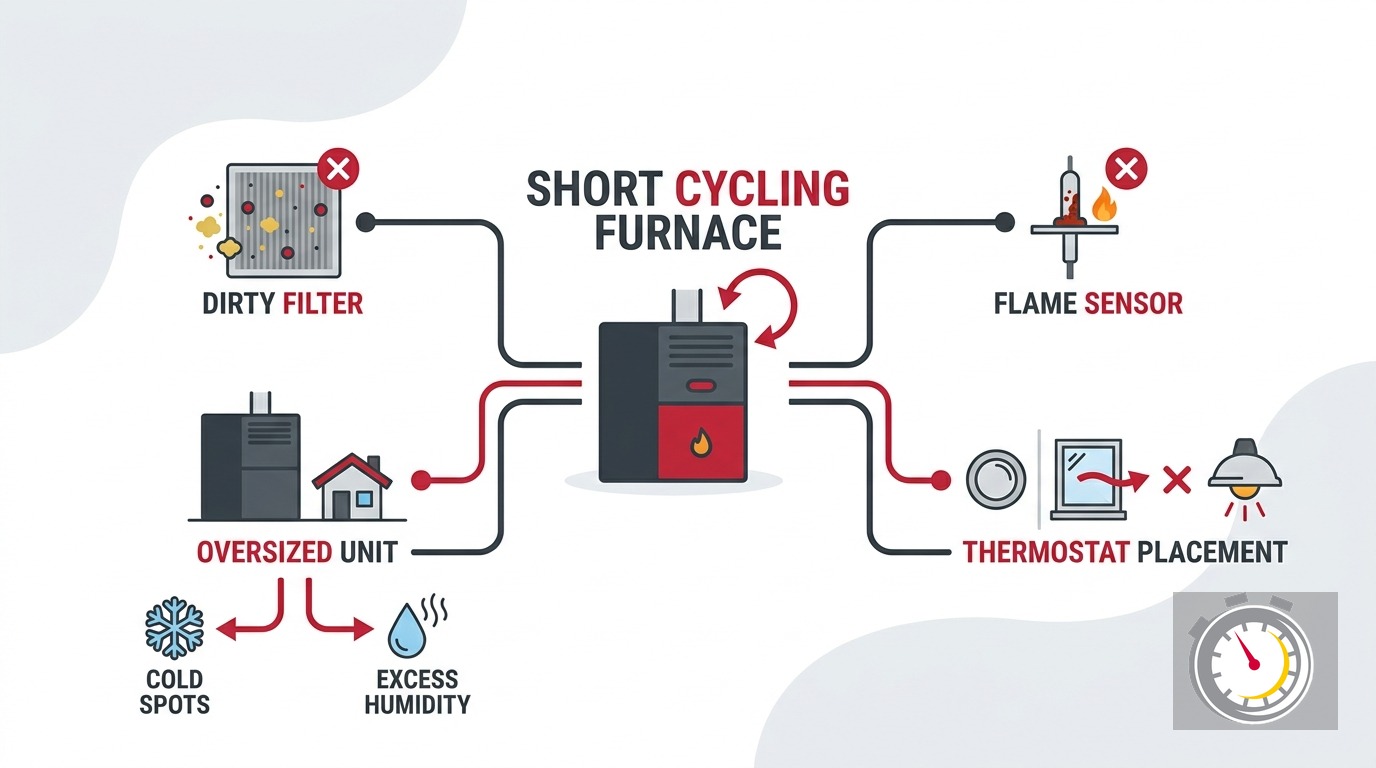
An oversized furnace heats your living space so fast that the thermostat shuts it down before a proper cycle completes. This is called short cycling. Instead of steady 15-16 minute runs, the furnace blasts on for 4-8 minutes, shuts off, and fires back up before the house temperature can stabilize. ENERGY STAR reports that improper installation - which includes oversizing - can reduce system efficiency by up to 30 percent.
The specific oversized furnace problems Twin Cities homeowners notice most:
- Temperature swings of 3°F or more between cycles
- Rooms near the thermostat running warm while far rooms stay cold
- Unusually dry air all winter, even with a humidifier running
- A gas bill that is high relative to how cold it has actually been
- Loud startup and shutdown pressure noise in the ductwork
- A furnace that runs frequently but never for long
That last one is the tell. A furnace that cycles quickly and often is a furnace doing more mechanical and thermal work than it should.
What Does Short Cycling Do to Your Furnace?
Short cycling ages a furnace faster than almost anything else. Every ignition event thermally stresses the heat exchanger. A properly sized furnace cycles 15-20 times a day. An oversized furnace can cycle 40-60 times a day, applying two to three times the stress per winter day across every component.
Research on heat exchanger lifespan shows that rapid burner cycling shortens heat exchanger life. A furnace designed to last 18-25 years can fail in 8-10 years from chronic short cycling. That is not a theoretical risk. It is a pattern our technicians see consistently on replacement calls where the previous unit was clearly oversized from day one.
Fuel costs take a hit as well. Data on furnace short cycling indicates that each ignition event uses more fuel than steady-state operation, and that overall short-cycling waste can account for a notable portion of fuel costs. On a Minnesota gas bill already climbing through January and February, that adds real money to every heating season.
For a deeper look at the diagnostic side, our post on what causes furnace short cycling and when to call a pro covers the full list of root causes beyond oversizing.
What Are the Signs You Have an Oversized Furnace?
The most reliable sign is how long each cycle lasts. On a mild day - 30-40°F outside - a correctly sized furnace runs 12-20 minutes per cycle. If yours shuts off in under 10 minutes, that is worth investigating. Other signs include temperature swings you can feel at the thermostat, rooms that are cold in the far corners of the house despite the furnace running, and a whole-home humidifier that never seems to raise indoor humidity.
Watch for these patterns:
- Cycle duration under 10 minutes on a moderate-temperature day
- Temperature swings of 3°F or more at the thermostat between cycles
- Rooms close to the furnace overheat while far rooms remain cold
- Whole-home humidifier runs continuously but indoor humidity stays below 25-30%
- Gas bills are high relative to recent outdoor temperatures
- The furnace starts and stops throughout the night instead of holding a steady temperature
If you have a smart thermostat with a runtime history view, pull the cycle data. Most modern thermostats log this. A pattern of frequent short runs is visible in the data and is one of the first things our technicians check on a comfort call.
Why Do Contractors Oversize Furnaces?
Oversizing is partly a liability habit and partly a permit shortcut. A contractor who installs a unit that’s too big rarely gets blamed - the furnace heats the house, the customer is warm, and the short-cycling consequences take years to surface. A contractor who installs a unit that’s slightly too small hears about it the first cold snap. The incentive structure pushes toward oversizing.
The permit shortcut is where the code angle matters. A proper furnace replacement in Minnesota requires a Manual J load calculation (ACCA 8th Edition), a Manual D duct sizing check, and a Manual S equipment selection confirming the unit matches the load. That work takes time and requires a permit. Many replacement installs skip it, replicate the old unit’s size, or go up one size “to be safe.” The old unit was often already oversized from the previous replacement cycle.
This is how a home ends up with a 100,000 BTU/h furnace generation after generation, even though the actual heat load might be 55,000 BTU/h. Every skipped calculation locks in the problem for the next 20 years.
How Can I Tell How Big My Furnace Is?
Check the data plate on your furnace cabinet. It lists the input BTU/h (gas the burner consumes) and the output BTU/h (heat delivered to your home). Output is the number to compare against your home’s calculated heat load. If you do not have a Manual J calculation on file, a licensed HVAC contractor can perform one.
Furnace outputs are typically printed in round numbers: 40,000, 60,000, 80,000, or 100,000 BTU/h. Your home’s heat load depends on square footage, insulation levels, window area, air leakage, and your local outdoor design temperature. In the Twin Cities, the ASHRAE 99% heating design temperature for Minneapolis/St. Paul is approximately -16°F. That is the baseline a proper Manual J calculation uses. If your contractor cannot show you that calculation before recommending a replacement size, ask for it directly.
Our post on HVAC sizing and what a Manual J calculation actually involves covers what to expect from a contractor who does this correctly.
The Cold-Snap Myth: Why “Bigger Is Safer” Is Wrong for Minnesota
Here is the argument some contractors make: “Minnesota hits -30°F. You need the bigger unit as insurance.” It sounds reasonable. The actual standards say otherwise.
The Minneapolis/St. Paul ASHRAE 99% design temperature is approximately -16°F. That is the temperature a Manual J calculation uses to determine your home’s peak heat load. ACCA Manual S - the equipment selection standard that follows Manual J - already permits up to roughly 40% oversizing above the Manual J load for gas furnaces. A home with a 60,000 BTU/h calculated heat load can justify up to approximately 84,000 BTU/h without violating sizing guidance. A 100,000 BTU/h unit in that home is not insurance. It is about 67% above the design load.
When it actually drops to -30°F in the Twin Cities - a handful of days per decade - a correctly sized furnace simply runs longer, close to continuous operation. Your home may take an extra hour to recover from an overnight setback. That is the correct tradeoff: a mild inconvenience on a rare extreme day, versus heat exchanger damage on every mild day for the life of the system.
Minnesota municipalities require a Manual J load calculation on permit applications for HVAC work. The state Residential Energy Code requires it. When contractors skip the permit, they skip the calculation, and the oversizing perpetuates itself from one system to the next.
What Happens to Indoor Humidity When Your Furnace Short-Cycles?
Short cycling breaks the humidity distribution loop in a way that is specific to Minnesota winters. Your whole-home humidifier adds moisture to the air, but only while the furnace fan is running. If the furnace shuts off every 5-6 minutes, the humidifier never runs long enough to push conditioned air through the full duct system.
According to Minnesota indoor air quality guidelines, outdoor winter air infiltrates your home at 15-25% relative humidity. The recommended indoor range in winter is 30-60%. In homes with short-cycling furnaces, indoor humidity often stays at 15-25% all season - the same as raw outdoor air - because the humidifier runs in isolated bursts that never circulate far from the supply registers.
The downstream effects are familiar to anyone who has spent a Minnesota winter in an oversized-furnace house:
- Chronically dry skin, eyes, and throat
- Static electricity that follows you from room to room
- Hardwood floors that shrink, gap, and crack
- Worsened allergy and asthma symptoms
- Increased susceptibility to airborne viruses, which survive longer in dry air
If your home feels like a desert all winter despite a humidifier that runs constantly, the humidifier is likely not the problem. The short cycling is preventing it from finishing its job.
What Happens When Ductwork Is Oversized?
Oversized ductwork lowers air velocity, which means supply air loses heat before it reaches the far end of the duct run. Rooms close to the furnace get blasted; rooms at the end of long branch runs stay cold. An oversized furnace compounding this problem by running at higher momentary output than the duct system was designed for also causes the popping and ticking noise that comes from sheet metal flexing under rapid pressure spikes.
When a contractor replaces a furnace without reassessing duct sizing, the problem carries forward. A properly sized replacement with a Manual D review can often address both issues together.
For a different angle on how building changes disrupt furnace performance, see our post on spray foam insulation and combustion air problems in Minnesota. And if you run a boiler rather than a forced-air system and are seeing pressure fluctuations alongside uneven heat, our post on diagnosing pressure loss in Minnesota boilers covers the hydronic side of comfort problems in cold climates.
How Do You Fix an Oversized Furnace?
The permanent fix is a right-sized replacement paired with a Manual J, Manual S, and Manual D review. There is no adjustment or workaround that corrects a fundamental mismatch between equipment capacity and home load. You can tweak the fan-off delay or heat anticipator settings to modestly extend run times, but these address the symptom. The root cause is still there.
When a replacement is the right call, two equipment options directly address the oversizing problem:
Two-stage furnaces operate at two output levels: typically 65% capacity on mild days and 100% on design-day cold. Longer low-fire cycles on moderate days improve humidity distribution, temperature consistency, and heat exchanger life. For a home that is moderately oversized, a two-stage furnace often corrects the core problem without ductwork changes. Our post on two-stage vs. single-stage furnaces in Minnesota covers the efficiency and comfort tradeoffs in detail.
Modulating furnaces run at 40-100% capacity in small steps matched to real-time heat demand. On a 35°F day, a modulating furnace runs near minimum fire in long, even cycles. On a -16°F design day, it scales up toward full output. This eliminates short cycling by design and makes the cold-snap argument irrelevant: the capacity is there when the weather demands it, and it does not deploy when it does not. The payback math for modulating furnaces in our climate is covered in our post on whether a modulating furnace is worth the cost in Minnesota.
What Does a Right-Sized Furnace Replacement Cost in the Twin Cities?
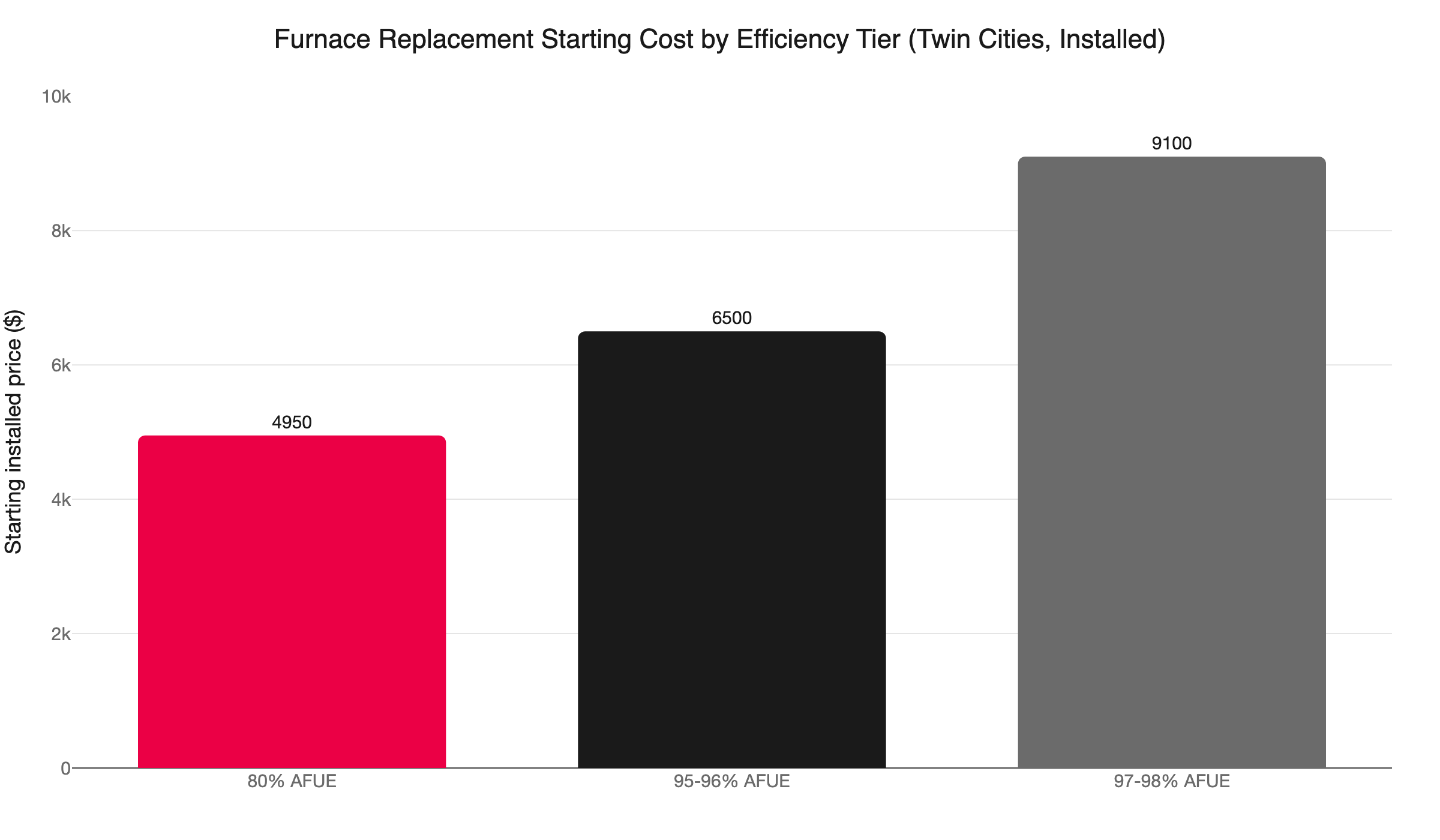
Installed furnace replacement in the Twin Cities starts at $4,950 for an 80% AFUE unit, $6,500 for a 95-96% AFUE model, and $9,100 for a 97-98% AFUE furnace. Those are all-in prices: equipment, labor, permit, and startup. Higher-efficiency units cost more upfront and carry meaningful rebates.
For 2026, Xcel Energy offers $200 for 95% AFUE, $300 for 96% AFUE, and $400 for 97% AFUE furnaces. CenterPoint Energy offers $300 for 94-95.9% AFUE and $400 for 96%+ AFUE, with an additional $100 rebate for an ECM blower motor upgrade. Confirm current amounts directly at CenterPoint’s heating rebates page before your purchase - rebate programs update mid-year and the amounts above are current as of this writing.
Note: the federal 25C energy efficiency tax credit expired December 31, 2025. No federal credit applies to furnaces installed in 2026.
According to the U.S. Department of Energy, a 95% AFUE furnace saves approximately $1,345 over its 21-year lifetime compared to an 80% AFUE unit, calculated at natural gas rates of $0.961 per therm. The best-available 99% AFUE unit saves $1,635 over the same period. Add utility rebates and factor in the avoided early heat exchanger failure that comes with correct sizing, and the higher-efficiency options carry solid payback in Minnesota’s climate.
Financing is available for qualifying replacements. Ask about current options when you call.
Ready to Get Your Furnace Sized Right?
Northern One Hour is locally owned and operated in Ramsey, MN, and serves the Twin Cities metro: Minneapolis, St. Paul, Blaine, Maple Grove, Plymouth, Brooklyn Park, Woodbury, Bloomington, and the surrounding communities.
Every furnace replacement proposal we put together includes a Manual J load calculation. We pull permits, size equipment to your home’s actual heat load, and show up when we say we will. If we don’t, you don’t pay. “Always On Time… Or You Don’t Pay a Dime!(R)” is not a marketing phrase - it is the standard every appointment runs on.
Call (763) 260-6662 or schedule a furnace replacement consultation online to get a properly sized proposal for your Twin Cities home.
Frequently Asked Questions
What are some common furnace problems besides oversizing? +
Who should I call for furnace problems in the Twin Cities? +
Need a technician now?