
Modulating Furnace Worth It in Minnesota? The Honest Answer
Key Takeaways
- A modulating furnace runs between 40 and 100 percent of capacity in small steps. It does not blast on at full power and shut off every 10 to 15 minutes.
- Minnesota averages roughly 7,200 to 8,000 heating degree days per year. That 7-month season amplifies both the comfort gains and the efficiency savings from a better furnace.
- “Variable-speed” (blower motor) and “modulating” (gas valve) are two different features on two different components. Confusing them leads to mismatched expectations when reading a quote.
- Moving from 80% to 97% AFUE can cut your heating fuel cost by roughly 17 percent. For a typical Twin Cities home, that is $300 to $400 per heating season.
- Modulating is NOT the right call for every house. Undersized ducts, small well-sealed homes, and near-term home sales all shift the math toward a two-stage unit instead.
- Utility rebates from CenterPoint Energy, Xcel Energy, and Minnesota Energy Resources can offset $200 to $500 of the upfront premium in 2026.
- Call (763) 260-6662 or book a furnace assessment online for a straight recommendation - not a pitch for the most expensive option.
What Is a Modulating Furnace?
A modulating furnace controls its gas valve in fine increments, running anywhere from about 40 to 100 percent of full output. It adjusts to match what your home actually needs. No full-power blast. No sudden shutdown 10 minutes later.
To understand why that matters, you need to see all three furnace types side by side.
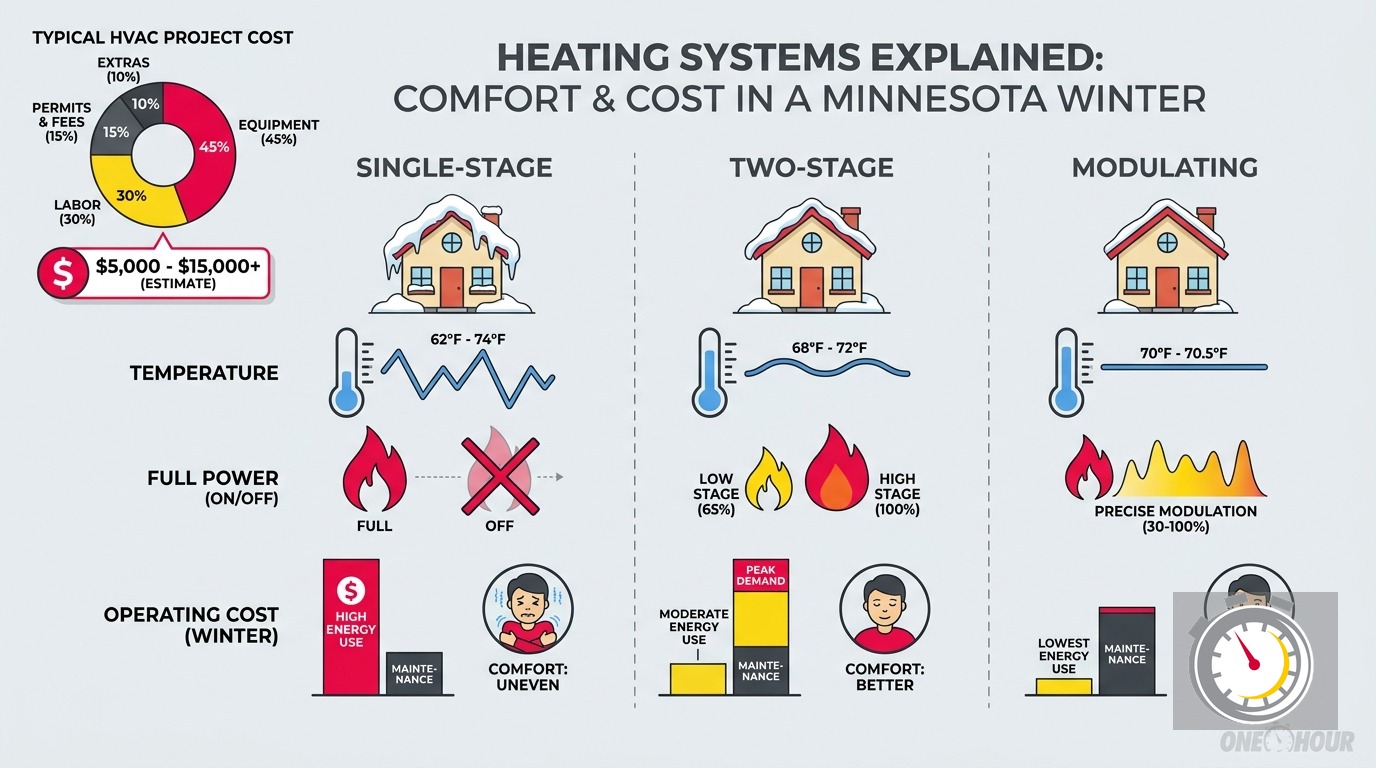
A single-stage furnace has one setting: 100 percent. Your thermostat calls for heat. The furnace fires at full power. The house overshoots its target temperature by a degree or two. The furnace shuts off. The house drifts back down. The cycle repeats every 10 to 15 minutes - all day, all winter.
A two-stage furnace adds a second option. The first stage runs at about 65 percent of capacity for mild days. The second stage fires at 100 percent when temperatures drop hard. It is better than single-stage. But it still gives you only two choices.
A modulating furnace works differently. On a mild October evening, it might run at 45 percent for 40 minutes straight. On a January night with a -20°F wind chill, it ramps to 95 percent and holds there. The result is fewer on/off cycles and steadier temperatures. Run times grow longer, which means air actually circulates through every part of your home.
What Does Each Furnace Type Feel Like Inside Your Home?
Single-stage: you feel the blast, the overshoot, and the cool-down. Two-stage: less aggressive, but still a noticeable on/off pattern. Modulating: your home stays within roughly half a degree of your thermostat setting all day long. You stop noticing the furnace is running.
Here is what that difference looks like in a real house.
Picture a two-story home in Maple Grove on a February morning. The thermostat is set to 68°F. With a single-stage furnace, the living room hits 70°F in a burst of hot air. The upstairs bedrooms sit at 65°F. The heat never had time to circulate before the system shut off. You wake up cold upstairs and overly warm downstairs.
With a modulating furnace running the same scenario, the furnace runs at low capacity for most of the night. Air moves through your ducts continuously, distributing warmth from room to room. The living room holds 68°F. The bedrooms hold 67.5°F. You do not feel the system cycle on and off. You just feel comfortable.
The continuous low-speed airflow has a secondary benefit. A modulating system cycling air at partial capacity filters it more consistently. With a single-stage furnace, filtration only happens during the blast cycles. Between cycles, particulates settle. In a sealed Minnesota home in winter, that difference compounds over months.
Minneapolis averages approximately 7,200 to 8,000 heating degree days per year - one of the coldest major metro areas in the continental United States. Your furnace runs harder and longer for more of the year than homeowners in Chicago or Denver ever experience. A comfort problem that feels like a minor annoyance in November becomes a genuinely disruptive daily pattern by January.
If your upstairs rooms are consistently colder than your thermostat reads, or you hear the furnace roar to life every 10 to 15 minutes, you are feeling the single-stage problem. It is not a duct issue. It is a combustion-rate issue.
For a closer look at why this hits hardest in December and January, see our post on cold spots and warm rooms in winter.
Is “Variable-Speed” the Same as “Modulating”?
No. “Variable-speed” describes the blower fan motor. “Modulating” describes the gas valve. These are two separate components on the same furnace. You can have one without the other. Mixing them up when reading a quote leads to paying for features you did not think you were getting - or missing features you assumed were included.
When a contractor quotes you a “high-efficiency variable-speed furnace,” that phrase tells you about the fan. It says nothing about the gas valve.
A variable-speed ECM blower motor adjusts fan speed to move conditioned air more smoothly and quietly than a standard PSC motor. ECM motors run at lower operating temperatures. They also avoid the mechanical stress of full-torque cold starts, which is why they typically outlast the furnace itself. These are real benefits worth paying for.
But if the gas valve is two-stage rather than modulating, the furnace still fires in two-setting bursts. The air distributes more smoothly. The heat still arrives in a pattern your home notices.
A modulating gas valve is the other half of the upgrade. It controls how much gas the burner fires at any given moment. Without it, the ECM blower improves air distribution - but the comfort ceiling stays lower.
For a Minnesota home with a 7-month heating season, the best combination is a modulating gas valve paired with a variable-speed ECM blower. The valve delivers steady, low-output heat. The motor distributes it evenly. Together, they nearly eliminate the temperature swing problem that makes Minnesota winters uncomfortable in a single-stage house.
When you get a quote, ask specifically: “Is this a modulating gas valve or a two-stage gas valve?” You should get a clear, direct answer. If the technician cannot answer that question, that tells you something worth knowing before you sign.
Is a Modulating Furnace Worth It in Minnesota?
For most Twin Cities homes with properly sized ductwork and a plan to stay for five or more years: yes. Minnesota’s long heating season amplifies efficiency gains in ways that national payback calculators consistently underestimate. The comfort improvement is also more pronounced here than in warmer climates, where furnaces run for 3 to 4 months instead of 7.
Here is what drives that answer.
Efficiency gains compound over a long heating season. The difference between a 97% AFUE modulating furnace and a 96% AFUE two-stage unit might look negligible on a spec sheet. But across roughly 7,500 heating degree days in a typical Twin Cities winter, small percentage differences translate to real savings on your gas bill every year.
Gas prices sharpen that math in 2026. US residential natural gas averaged approximately $1.98 per therm as of mid-2026. At higher gas prices, each therm you save is worth more in dollar terms. Efficiency gains that looked marginal at $1.30 per therm look meaningfully stronger at $1.98.
The comfort value is harder to price, but it is real. If you work from home, have young children or older family members who spend long hours inside during a Minnesota winter, or find uneven room temperatures genuinely disruptive, the modulating furnace’s steady heat has a dollar value to you. Only you can set that number.
One more thing to keep in mind. If your current furnace is 15 years old, failing, or running below 85% AFUE, the replacement decision is already made. You are replacing the furnace regardless of what stage it is. In that situation, the choice between modulating and two-stage is a secondary optimization inside an already-necessary project. The question shifts from “is modulating worth the premium over doing nothing?” to “given I am already spending $3,900 to $6,500 on a replacement, does an extra $650 to $1,300 make sense?” For most homeowners planning to stay, it does.
How Much Can a Modulating Furnace Save on Your Minnesota Heating Bill?
Moving from an 80% AFUE single-stage furnace to a 97% AFUE modulating unit cuts your heating fuel cost by roughly 17 percent. For a typical Twin Cities home, that works out to about $300 to $400 per heating season.
Here is the math.
A standard 80% AFUE furnace wastes 20 cents of every gas dollar up the flue. A 97% AFUE modulating furnace wastes 3 cents. That 17-percentage-point gap is your efficiency gain.
A typical 2,000-square-foot Twin Cities home uses roughly 900 to 1,100 therms per heating season. At $1.98 per therm, that costs $1,780 to $2,180 per year at 80% AFUE. At 97% AFUE, the same home spends roughly $1,480 to $1,810. Annual savings: approximately $300 to $400.
The modulating premium over a comparable two-stage unit typically runs $500 to $1,500 before rebates. At $300 to $400 in annual savings, pure-efficiency payback runs 4 to 7 years. Add utility rebates (covered in the next section) and that payback window shortens to 3 to 5 years on many installs.
Note where the largest gains actually live. The biggest efficiency jump is from replacing any old 80% AFUE single-stage system with a modern 95%+ unit - not from choosing modulating over two-stage. When both alternatives are rated 96-97% AFUE, the direct fuel savings difference between them is smaller. At that level, the comfort improvement and equipment longevity are the stronger arguments for modulating.
Fewer on/off cycles mean less wear on the heat exchanger and inducer motor. A furnace that runs gently tends to last longer and need fewer emergency repairs. That is harder to quantify ahead of time, but it is part of the real-world value over a 15 to 20-year equipment lifespan.
When a Modulating Furnace Is NOT Worth It
This is the section most HVAC companies skip. Here are the four situations where a two-stage furnace is the smarter choice for your home.
Your ductwork is undersized. This is the single biggest reason modulating furnaces underperform. If your ducts restrict airflow at higher fan speeds, the long-run low-output mode that defines modulating comfort cannot work correctly. The system either short-cycles or compensates poorly. If a technician has ever flagged undersized ductwork in your home, fix the ducts before upgrading the furnace. See our comparison of two-stage vs. single-stage furnaces in Minnesota for more on how furnace type interacts with duct capacity.
Your home is small and well-sealed. A 1,100-square-foot home with good insulation and no major air leaks does not have the room-to-room temperature variance that modulating furnaces solve best. The comfort benefit is most pronounced in larger, multi-story, or older drafty homes. In a tight, small house, a two-stage system with an ECM blower is often the better value per dollar spent.
You are planning to sell within 18 to 24 months. Payback on the modulating premium runs 4 to 7 years. If you are not in the house for that window, the premium does not come back to you at closing in any predictable way. A well-installed 96% AFUE two-stage furnace is still a strong asset for a home sale.
You are at your budget limit. A 96% AFUE two-stage furnace is a genuinely high-performing heating system. If the choice is between stretching your budget for modulating or a two-stage furnace with money left for duct sealing and a maintenance plan, the two-stage plus maintenance often delivers better total value than modulating alone.
Honest advice is part of how we do business. If a two-stage furnace is the right fit for your home, that is what we will tell you.
What Rebates and Tax Credits Are Available for Minnesota Furnaces in 2026?
CenterPoint Energy, Xcel Energy, and Minnesota Energy Resources all offer rebates for high-efficiency furnace replacements in 2026. Stack them against the modulating premium and the real out-of-pocket cost gap shrinks considerably.
Here is the current landscape:
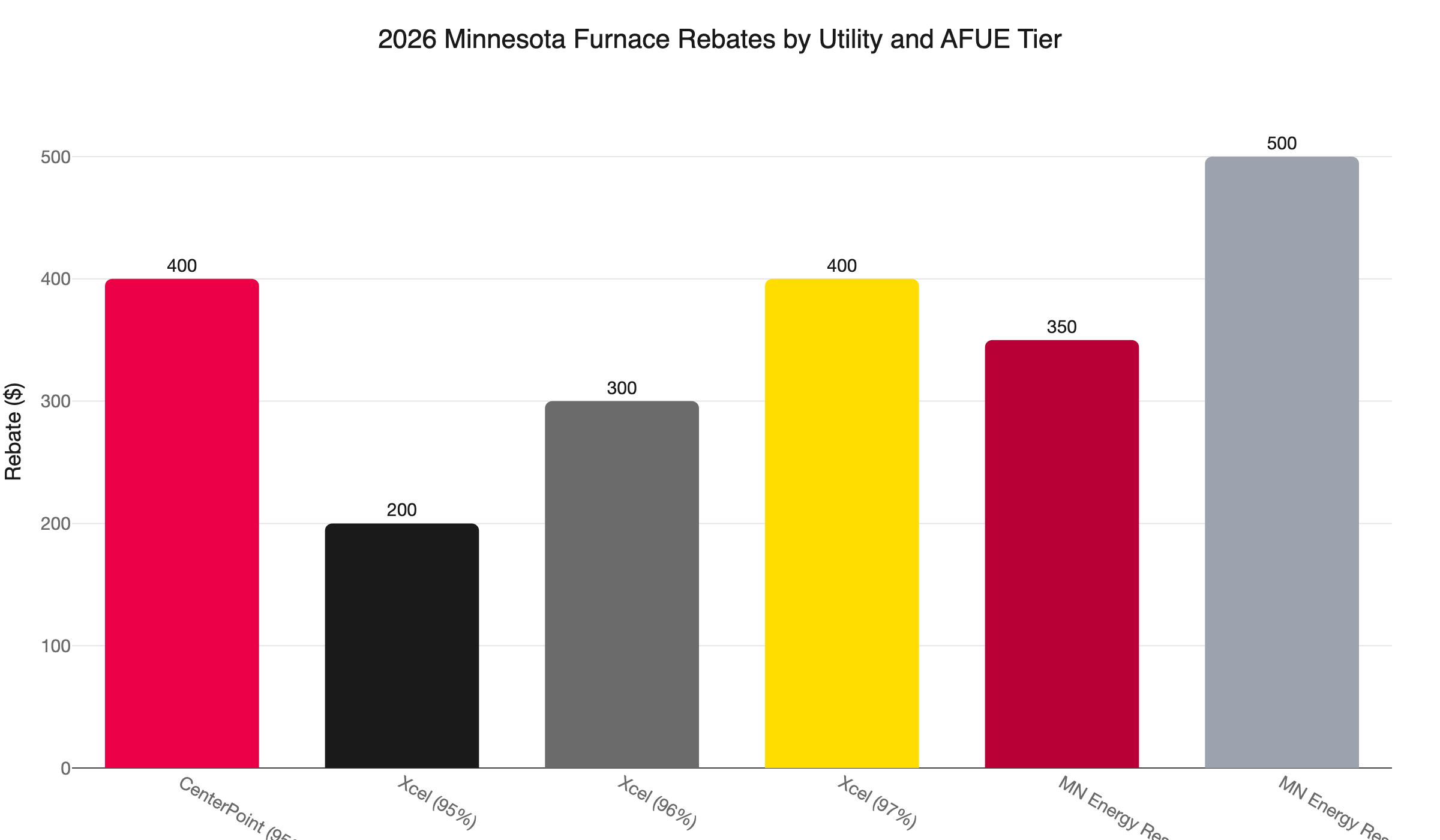
CenterPoint Energy: Up to $400 for furnaces rated 95% AFUE or higher. Income-qualified households may qualify for up to $1,200. Source.
Xcel Energy: Three rebate tiers based on efficiency rating. $200 at 95% AFUE, $300 at 96% AFUE, $400 at 97% AFUE. Homes with dual gas and electric Xcel service may be able to stack these with other program credits. Source.
Minnesota Energy Resources: $350 at 95% AFUE, $500 at 97% AFUE. Source.
Federal 25C Tax Credit: Potentially up to $600 (30% of installed cost) for furnaces at the CEE highest efficiency tier. The status of this credit for the 2026 tax year is uncertain. One source indicates it may have ended in 2025. Review current IRS guidance before assuming it applies to your installation. Confirm eligibility with your tax professional before filing.
Ask your technician to document the AFUE rating on your installation paperwork. You will need that number to file the utility rebate application. For a full breakdown of Minnesota HVAC incentives - including heat pump credits and other programs - see our guide to Xcel and CenterPoint HVAC rebates.
What to Do Before Calling for a Furnace Quote
The right furnace for your home depends on your ductwork capacity, your square footage, your current system’s age, and how long you plan to stay. No article - this one included - can substitute for someone who has actually looked at your home.
A proper Manual J load calculation and a duct inspection take about an hour. They give you real numbers, not ballpark guesses based on square footage alone.
We are locally owned and operated in Ramsey, Minnesota. Our team serves homeowners throughout the Twin Cities metro: Minneapolis, St. Paul, Blaine, Maple Grove, Plymouth, Brooklyn Park, Woodbury, Bloomington, and beyond. When we schedule your appointment, we show up when we say we will. That is the “Always On Time… Or You Don’t Pay a Dime!(R)” promise - not a tagline, a guarantee backed by our 100% satisfaction policy.
Call (763) 260-6662 or book a furnace assessment online. We will check your ductwork, review your current setup, and give you a straight answer: modulating, two-stage, or something else entirely. Financing is available for qualifying furnace replacements if you want to bridge the gap between options.
Frequently Asked Questions
What is a modulating furnace and how does it differ from a two-stage furnace? +
How much more does a modulating furnace cost in Minnesota? +
Is a modulating furnace worth it if I plan to sell my home soon? +
What furnace rebates are available in Minnesota in 2026? +
Need a technician now?