
Variable Speed Blower Motor Furnace: Worth It in Minnesota?
Key Takeaways
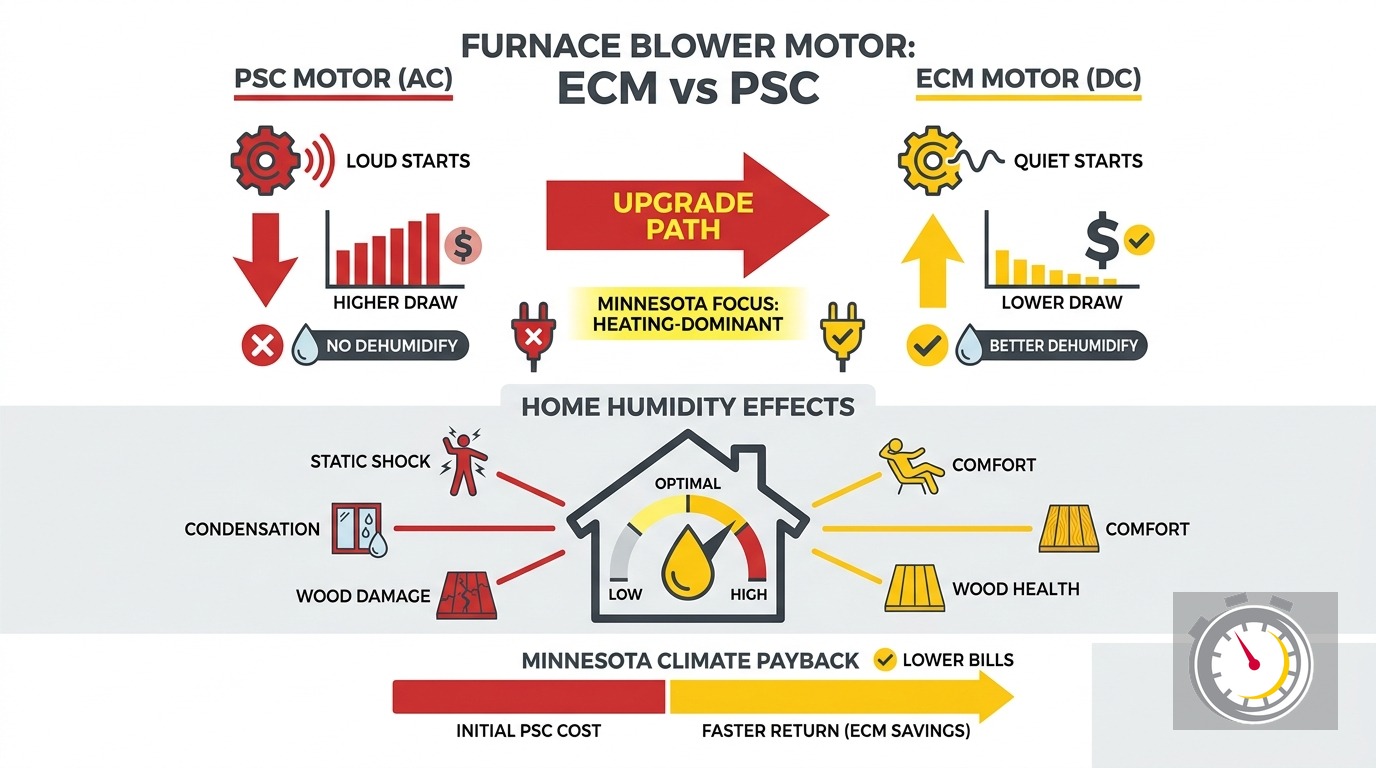
- An ECM blower motor at minimum speed draws roughly 80 watts. A standard PSC motor draws 510-550 watts. The difference adds up fast over a 7-month Minnesota heating season.
- Minnesota logs about 8,000 heating degree days versus 800 cooling degree days. ECM electricity savings come overwhelmingly from heating, not as a summer AC bonus.
- There are three motor tiers, not two: PSC, constant-torque X13 ECM, and true variable speed ECM. Many homeowners are sold “ECM” and receive an X13 instead.
- In 2026, CenterPoint Energy is the only Twin Cities utility offering gas furnace rebates, up to $1,000 for 97%+ AFUE equipment. Xcel discontinued its program January 1, 2026. The federal 25C credit expired December 31, 2025.
- Duct condition matters. An ECM fighting high static pressure from undersized returns or kinked flex duct draws more current and loses most of its efficiency advantage.
- The best time to capture a variable speed upgrade is at furnace replacement, not as a standalone motor swap.
What Is a Variable Speed Blower Motor Furnace?
A variable speed blower motor furnace uses an ECM (electronically commutated motor) to ramp blower speed up and down continuously based on what your home needs. Instead of running at a fixed speed, it starts slow, holds a low steady speed during mild weather, and increases output when conditions call for it. It uses far less electricity than a standard PSC motor.
The standard alternative is a PSC (permanent split capacitor) motor. It runs at one or two fixed speeds. It moves air reliably, but it draws full power every time it runs. At startup, it hits full speed immediately, which is audible and inefficient.
ECM technology has been in residential furnaces since the late 1990s. Most furnaces made after 2010 include some form of ECM motor. The question is which type - and that distinction has a real effect on what you actually get for your money.
Why Does Minnesota’s Climate Change the Payback Math?
Minnesota logs roughly 8,000 heating degree days per year versus about 800 cooling degree days. Your blower runs 7-plus months for heat, not 3-4 months for AC. ECM electricity savings happen overwhelmingly during the heating season, making the payback timeline here materially shorter than national estimates suggest.
Most national content about ECM furnaces frames the efficiency story around summer air conditioning. In Minnesota, that framing undersells the upgrade significantly.
Here, the blower’s primary job is heating. It logs far more hours in your furnace’s heat cycle than in your AC’s cooling cycle. On a -10°F January night, your blower is working. On a 35°F October evening, your blower is working. On a 75°F July afternoon, your blower is working for AC. The ratio is roughly 7-to-3 in favor of heating.
When you compare two furnace quotes - one with a PSC, one with a true variable speed ECM - run the math on a 7-month heating season. That’s the calculation that reflects your home’s actual usage pattern.
The Three Tiers: PSC, X13, and True Variable Speed
Most homeowners walk away from an HVAC conversation thinking there are two options: standard (PSC) and efficient (ECM). There are actually three. The middle tier creates the most confusion.
PSC motors are the traditional standard. Single or dual speed. They draw 510-550 watts in fan-only mode. Reliable at moving air. Not designed to run at a low, sustained partial speed without wasting electricity.
X13 motors (also called constant-torque ECMs) are electronically commutated motors that maintain a constant torque output. Torque is rotational force - not airflow. If your ductwork restricts flow through a dirty filter, an undersized return, or a partially closed register, the X13 delivers less air without compensating. Static pressure shifts; the motor doesn’t adapt. You can have a furnace marketed as “ECM” that underperforms because of conditions your ductwork creates.
True variable speed motors maintain consistent airflow by adjusting their power output to overcome resistance. If a dirty filter or a kinked flex duct raises static pressure, the motor ramps up to hold its target CFM. These are the motors most homeowners picture when they hear “variable speed.” They cost more, and the performance and comfort premium is real.
When a contractor quotes you a furnace with an ECM motor, ask one specific question: is this a constant-torque X13 or a true variable speed? The price difference at furnace purchase is typically $200-$400. The performance difference in a Minnesota heating season is larger.
How Much Electricity Does a Variable Speed Blower Motor Use?
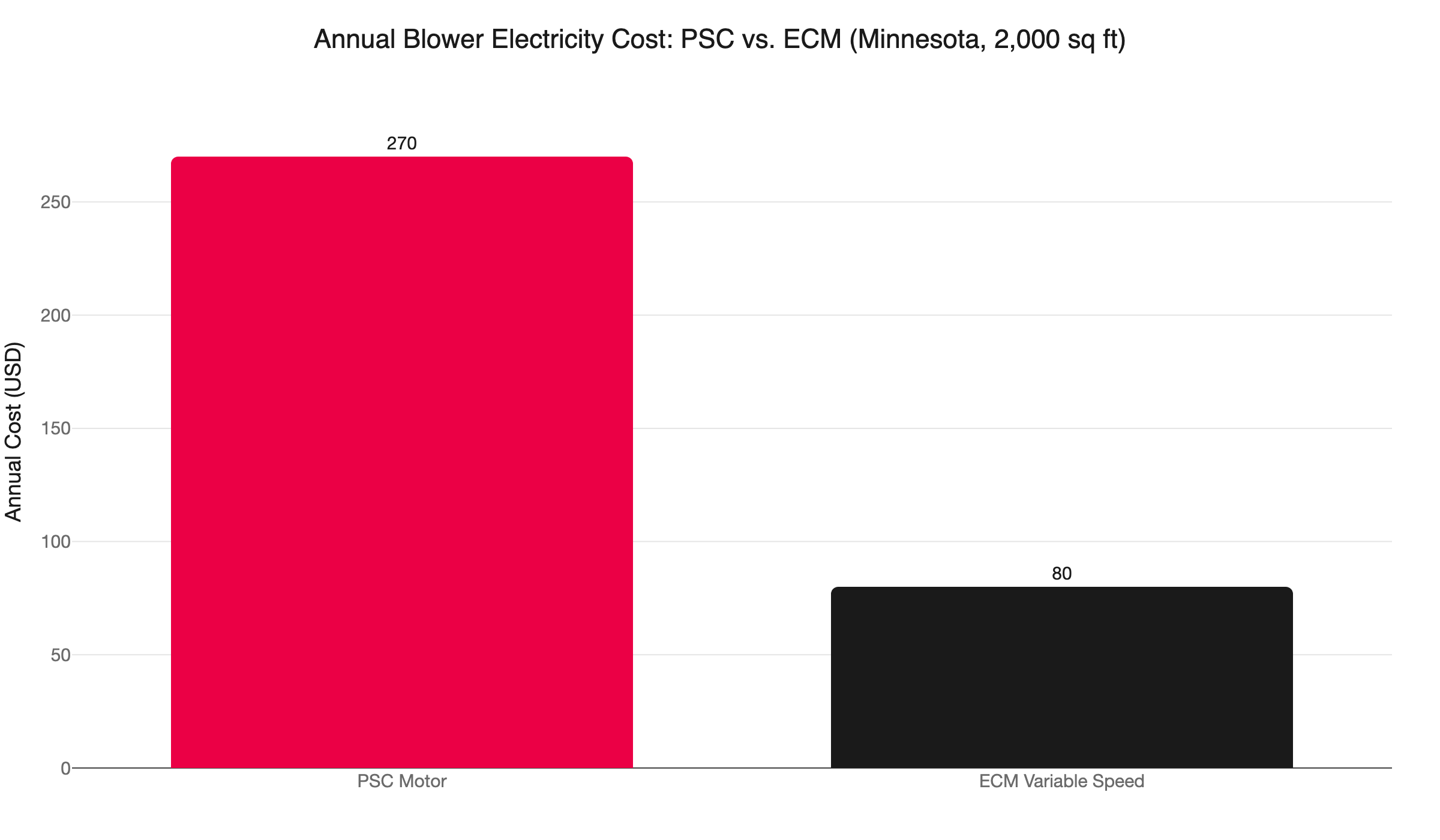
An ECM at minimum speed draws roughly 80 watts - less power than a single old incandescent bulb - while moving the same volume of air a PSC draws 510-550 watts to move. ECM efficiency runs 65-75%; PSC efficiency runs 35-45%. For a 2,000 sq ft Twin Cities home, that gap adds up to roughly $190 per year in electricity savings.
The efficiency gap is widest at partial load. That’s where Minnesota furnaces spend the majority of their runtime. On a 35-45°F October or April day, your furnace doesn’t run at full output. It cycles at partial load repeatedly. A PSC at partial load loses efficiency. An ECM at partial load is at its most efficient operating point.
The annual electricity cost estimate for a Twin Cities home breaks down to roughly $270 per year for a PSC motor and $80 per year for an ECM, based on Minnesota’s average electricity rate of $0.14/kWh across a 7-month heating and 4-month cooling season.
The ECM premium at furnace purchase typically runs $200-$400 over the comparable PSC option. On electricity savings alone, the payback comes in at 1-2 years in a Minnesota heating climate. Over a 15-20 year furnace lifespan, that difference adds up to $2,850-$3,800 at current rates, before any rebates.
Does a Variable Speed Motor Help With Home Dehumidification?
Yes. Variable speed motors running at 40-60% speed increase air contact time with the evaporator coil. More contact time means more moisture removed per CFM. During Minnesota’s humid July and August, this noticeably reduces indoor humidity and makes your home feel more comfortable at the same thermostat setting.
The Twin Cities averages around 65% relative humidity in July. A full-speed PSC rushes air through the system. A slower-running ECM extends the time each cubic foot of air spends near the coil surface. More moisture gets pulled out per pass.
This benefit is secondary to the heating-season electricity savings. But if your home feels sticky even with the AC running, a variable speed blower is part of the fix - along with a correctly sized system and a clean evaporator coil.
What About Running the Blower Continuously in Minnesota Winters?
Running an ECM blower at its lowest continuous speed costs about $3-$5 per month in extra electricity. In return, your filter works around the clock and you eliminate the cold-blast sensation when the furnace fires on a -10°F morning.
With a PSC motor, continuous fan mode is expensive. The motor draws near-full power all day. Most homeowners turn it off because the monthly cost isn’t worth it.
With an ECM, continuous low-speed operation costs almost nothing. Air circulates through your filter between heating cycles. On the worst winter mornings, the blower is already running when the furnace fires. There is no abrupt transition from cold to hot airflow.
This feature has real value during Minnesota’s allergy seasons. Birch and tree pollen peak in May and June. Ragweed peaks in August. Running the blower continuously means your filter captures particles throughout the day, not only during heat or cooling cycles. If anyone in your home deals with allergies or asthma, the difference is noticeable over a full season.
Continuous fan mode also reduces temperature stratification between floors. If your upper level runs consistently colder than the main floor in winter, low-speed circulation can help balance things without running full heating cycles. Our post on why upper floors stay too cold in winter covers the common causes and what actually fixes them.
The Duct Condition Caveat
The U.S. Department of Energy’s homeowner HVAC guide puts it plainly: if your ducts are poorly installed or in bad condition, an ECM motor will work harder to push air through, negating energy savings.
This is a real issue in the Twin Cities. Homes built before the mid-2000s frequently have undersized return ducts, leaky duct joints, and kinked flex duct sections in attics or crawl spaces. Under those conditions, an ECM fighting elevated static pressure draws more current and runs hotter than its normal operating range. The efficiency advantage shrinks. The motor’s projected lifespan can shorten along with it.
Before investing in a variable speed furnace, ask your technician to check static pressure on your current system. High static pressure is a solvable problem. Duct sealing or a return air improvement will amplify the ECM’s benefit rather than neutralize it. Our post on high static pressure symptoms and what to do about them explains what to look for and what the fixes involve.
Duct improvements paired with a new high-efficiency variable speed furnace outperform either upgrade done alone.
What Rebates Are Still Available in 2026?
In the Twin Cities, CenterPoint Energy is the only utility currently offering gas furnace rebates in 2026, with up to $1,000 for 97%+ AFUE equipment. Xcel Energy discontinued its gas furnace rebate program January 1, 2026. The federal 25C tax credit expired December 31, 2025.
Here is where things stand:
CenterPoint Energy (active through December 31, 2026):
- $200 rebate for a 92-95.9% AFUE furnace replacement
- $400 rebate for a 96-96.9% AFUE furnace replacement
- $1,000 rebate for a 97%+ AFUE furnace replacement
Equipment must be AHRI-certified or ENERGY STAR verified to qualify. CenterPoint’s current rebate page has full requirements and any program updates.
Xcel Energy: Gas furnace rebates were discontinued January 1, 2026. Most Twin Cities homeowners use CenterPoint for gas and Xcel for electricity. Only the CenterPoint rebate applies in that case.
Federal 25C tax credit: Expired December 31, 2025. No federal credit is available for furnace replacements installed in 2026.
Minnesota Power (northern Minnesota, not the Twin Cities metro): Offers a $200 rebate for a furnace with an ECM motor when replacing a unit 10 or more years old.
The strongest combination right now: a 97%+ AFUE furnace with a true variable speed motor captures the maximum $1,000 CenterPoint rebate. Add $190 per year in electricity savings and the payback on the higher-efficiency option compresses to under two years for most households.
What Does a Variable Speed Furnace Cost Installed in Minnesota?
Installed costs vary by efficiency tier. A 97-98% AFUE furnace with a true variable speed ECM blower starts around $9,100 in the Twin Cities. That is the tier that captures the maximum CenterPoint rebate and delivers the full electricity savings. Lower-tier units with PSC or X13 motors start lower. They leave both the rebate and the electricity savings behind.
As a general guide by tier:
- 80% AFUE furnace, PSC motor: starting around $4,950 installed
- 95-96% AFUE furnace, often with X13 ECM: starting around $6,500 installed
- 97-98% AFUE furnace, true variable speed ECM: starting around $9,100 installed
These are starting prices for a standard single-family home installation. Your actual cost depends on the manufacturer, your home’s BTU load, current ductwork condition, and any code modifications needed for venting or gas line sizing.
Financing is available for larger furnace replacements. Our team walks through current financing options when we visit for an estimate.
Should You Replace Just the Blower Motor or the Whole Furnace?
If your furnace is 10-plus years old, a standalone ECM retrofit is slow to pay back and often isn’t a direct drop-in replacement. The best time to capture a variable speed upgrade is at furnace replacement, when the motor is matched to the control board and staging from the factory.
A blower motor replacement on an existing PSC-equipped furnace runs $1,100-$2,200 installed, depending on motor type and brand. An ECM retrofit on an older furnace requires compatibility testing with the existing control board. Many older furnaces were not designed to integrate a variable speed motor the way a modern matched system does.
If your furnace is 5-7 years old and running well, motor repair or replacement makes sense. If it’s approaching 15 years or showing other symptoms, furnace replacement gives you the matched components that allow a variable speed motor to perform as designed.
ECM motors have a life expectancy of up to 10 years and log tens of thousands of operating hours. They also run cooler at partial load than PSC motors because they draw less current at that operating point. In a high-runtime Minnesota heating season, that thermal margin extends the motor’s useful life.
What to Expect From Northern One Hour
We’re locally owned and operated in Ramsey, serving homeowners across the Twin Cities: Minneapolis, St. Paul, Blaine, Maple Grove, Plymouth, Brooklyn Park, Woodbury, and surrounding communities.
When we quote a furnace replacement, we tell you exactly what motor tier you’re getting: PSC, constant-torque X13, or true variable speed. We explain what it means for your specific home. We check static pressure. We verify your ductwork won’t undermine the motor you’re investing in.
We walk through the rebate situation as it stands today. Xcel’s gas furnace program is gone. The federal credit is gone. CenterPoint is the active incentive for most Twin Cities households right now. Not every contractor updates their pitch when the incentive landscape shifts.
We show up when we say we will. That’s backed by our guarantee: “Always On Time… Or You Don’t Pay a Dime!(R)”.
If your furnace is showing signs it’s time to replace it, or you want a technician to check how your current system is performing, call us at (763) 260-6662 or schedule a furnace replacement consultation online.
Frequently Asked Questions
What is a variable speed blower motor furnace? +
How much can a variable speed blower motor save on electricity in Minnesota? +
What rebates are available for variable speed furnaces in Minnesota in 2026? +
What is the difference between an X13 motor and a true variable speed motor? +
Need a technician now?