
HVAC High Static Pressure Symptoms: Signs and Fixes
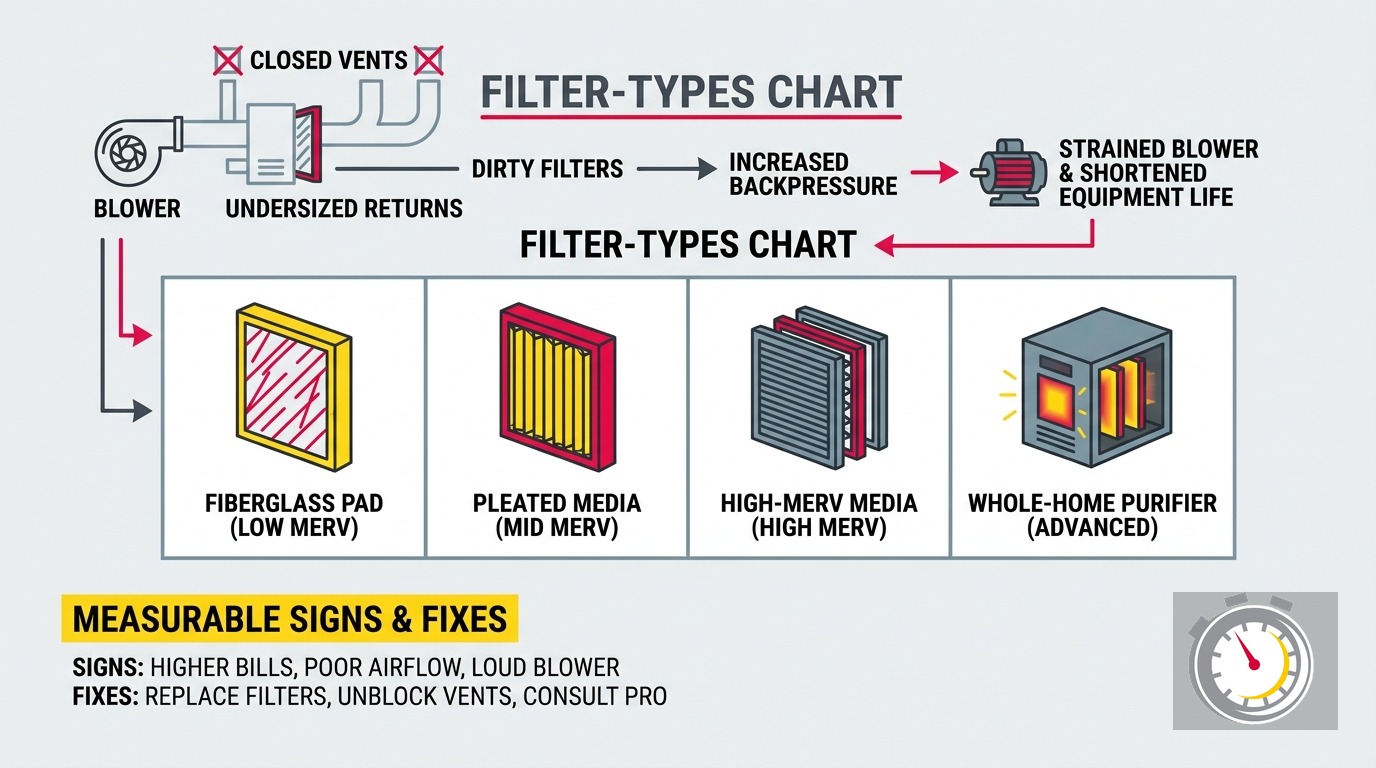
Key Takeaways
- Normal residential total external static pressure is 0.5” WC (inches of water column). Above 0.8” WC signals a restriction problem. Above 1.0” WC is severe.
- Symptoms include whistling at registers, rooms that never reach temperature, a blower running at full speed without cycling down, short cycling, and energy bills that climb without a weather explanation.
- The ECM blower motor - the expensive, efficient one in modern furnaces - is actually more vulnerable to high static pressure than the older PSC motor, for a reason most homeowners never hear.
- The return side of the duct system causes the problem more often than the supply side. A single undersized central return grille is the most common culprit in older Twin Cities homes.
- Replacing a failed blower motor without first measuring static pressure guarantees the same failure on the new motor.
- Duct sealing and return air additions can qualify for CenterPoint Energy rebates and the federal 25C tax credit.
Your blower motor is fighting something it cannot beat on its own. The system runs longer. Certain rooms stay cold in January no matter what you set the thermostat to. The air handler sounds like it is straining at full speed. These are textbook HVAC high static pressure symptoms, and in a Twin Cities home running a furnace 2,800 to 3,200 hours every winter, the damage adds up fast.
This post explains what static pressure is, why it matters more in Minnesota than almost anywhere else, and what you can do about it before it takes out your blower motor.
What Are HVAC High Static Pressure Symptoms?
Quick answer: Hissing at supply vents, rooms that never reach temperature, a blower running at maximum speed constantly, short cycling, and rising energy bills are the primary signs. A static pressure test confirms the diagnosis - normal is 0.5” WC; above 0.8” is a problem that needs attention.
These symptoms overlap with a lot of other HVAC problems, which is why high static pressure often stays hidden until something expensive breaks. A failing blower motor causes airflow loss. A dirty evaporator coil causes uneven cooling. Short cycling points to half a dozen different faults. What separates static pressure from those individual parts failures is that it underlies and accelerates all of them.
Watch for these signs:
- Hissing or whistling from supply registers. Air accelerates through restriction. The sound is the pressure. Registers closest to the air handler tend to be loudest.
- Rooms that stay uncomfortable no matter how long the system runs. Restricted supply means some zones receive less conditioned air than the thermostat demands.
- The blower runs at high speed without cycling down. ECM motors compensate for restricted airflow by speeding up. A motor that never slows is a motor under sustained stress.
- Short cycling on heat or cool calls. Pressure buildup trips limit switches before the call is satisfied. The system shuts off, restarts, and repeats.
- Energy bills that don’t match the weather. Fan power scales with the cube of pressure increase. A 20% increase in static pressure raises fan energy draw by roughly 73%. A 40% increase nearly triples it.
Why Does High Static Pressure Destroy Your Blower Motor?
Quick answer: A PSC motor slows under high static pressure, starving its windings of cooling air until they overheat. An ECM motor does the opposite: it speeds up and draws more current until the control module overheats. The efficient, expensive motor often fails faster than the old one - for a completely different reason.
This distinction matters when you are looking at a repair quote.
Older PSC motors (single-speed, common in furnaces installed before 2010) respond to high static by slowing down. Reduced airflow across the motor windings eventually causes thermal failure. Warning signs are gradual - reduced output, the motor running hot, then a hard failure.
ECM motors (variable-speed, standard in modern furnaces) detect reduced airflow and compensate by increasing speed and torque to maintain target flow. From the homeowner’s perspective, the blower seems to be doing its job. From the motor’s perspective, it is drawing sustained excess current to overcome a restriction it was never designed to fight. The control module - not the windings - overheats from the prolonged overcurrent draw.
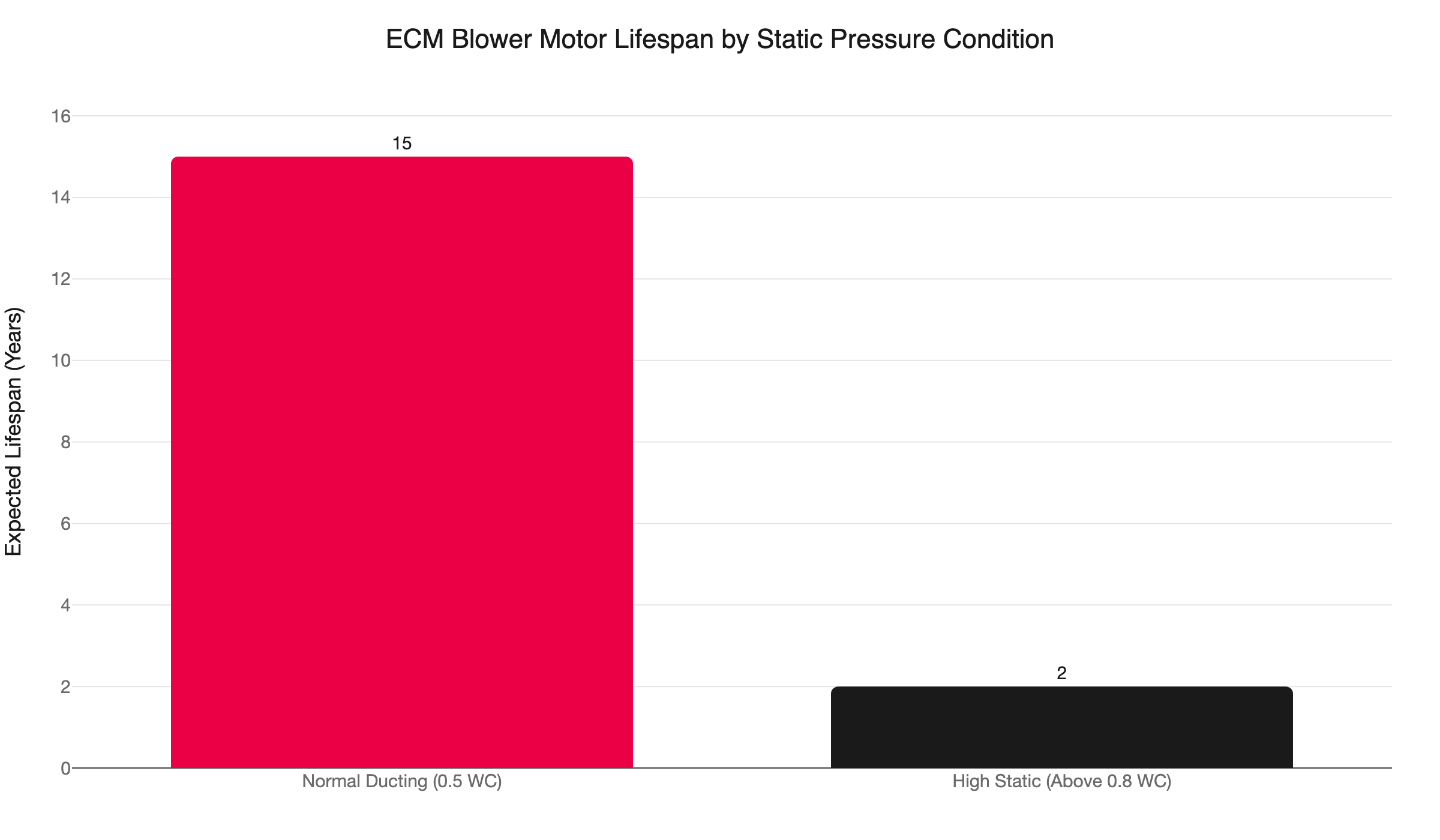
United HVAC Motors reports that high static pressure left unaddressed destroys an ECM blower module in 2-5 years. The same motor in a properly ducted system lasts 15-20 years.
Installed ECM replacement runs about $2,200. PSC replacement runs about $1,100. A static pressure test before the replacement - and fixing the underlying cause - is what makes the next motor last.
The Return Side: Why Most Twin Cities Homes Are Set Up to Fail
Most articles about high static pressure focus on the supply side: close your vents and you raise backpressure. True. But the bigger structural problem in most older Twin Cities homes is the return side of the duct system.
Every residential HVAC system has two sides. Supply ducts push conditioned air into rooms. Return ducts pull that air back to the air handler to be re-filtered and reconditioned. The return side needs enough cross-sectional area to pull air back as fast as the supply side pushes it out. When the return is undersized, the blower fights restriction in both directions at once.
Ramblers and split-levels built in the Twin Cities between the 1960s and 1990s were typically designed with a single central hallway return grille. That design was marginal from the start. It worked acceptably with the MERV 4-5 fiberglass filters and low-static PSC motors of that era. Add any of the following and you cross into high static territory:
- A MERV 13 or MERV 16 filter (a common IAQ upgrade, but far more restrictive than the MERV 8 the duct system was sized for)
- Closed bedroom doors during winter, which block return air from reaching the central hallway grille
- A filter that has not been changed in more than 90 days
- Any kink or partial collapse in a flex duct return run
Energy Star reports that 20-30% of conditioned air is lost through typical duct leaks. Return-side leaks are particularly costly: they pull unconditioned air from crawl spaces and basements into the system rather than recirculating treated indoor air.
Minnesota Mechanical Code (Chapter 1346) explicitly prohibits using building framing cavities - joist bays, stud cavities, floor chases - as supply ducts. Older homes built before that requirement often have exactly this. A framing cavity cannot be sealed the way a metal duct can. If your home has rooms served by openings in the floor or wall with no visible duct liner, those are almost certainly a significant source of both leakage and return air restriction.
What Causes HVAC High Static Pressure?
Quick answer: A clogged or overly restrictive filter, a single undersized return grille, closed supply vents, collapsed flex duct, and return-side duct leaks are the most common causes. Any one of these can push a residential system above the 0.8” WC warning threshold defined by ACCA Manual D.
Ranked by frequency in Twin Cities homes:
- Clogged or wrong filter. The fastest fix. If your filter is dark and opaque, change it today. If you recently upgraded to MERV 13+ for better air quality, the static pressure cost may outweigh the filtration benefit unless your system was specifically sized for high-resistance media.
- Single undersized central return. The structural cause. Found in most pre-1990s Twin Cities homes. Adding a second return in a bedroom or main hallway can reduce static pressure by 0.2-0.3” WC on its own.
- Closed supply vents. Closing a vent does not redirect airflow to other rooms. It raises system-wide backpressure. Our post on closing vents in unused rooms covers why this shortcut backfires.
- Collapsed or kinked flex duct. A few inches of collapsed flex has the same restriction effect as several feet of undersized rigid duct. Common in attic and crawl space runs where duct hangers are too far apart.
- Return duct leaks. Sealing ducts can improve system efficiency by as much as 20%, per Energy Star. Leaky returns are the highest-impact leaks to address.
- Dirty blower wheel or evaporator coil. Both restrict the air path across the coil and can push an otherwise normal system over the threshold.
Does Closing Vents Save Energy?
Quick answer: No. Closing supply vents raises static pressure, forces the blower to work harder, and - in ECM-equipped systems - accelerates control module failure by demanding sustained excess current output. The energy you think you are saving in one room costs more in blower wear and elevated utility bills system-wide.
This is one of the most persistent myths in residential HVAC. The logic seems sound: if a room does not need heating, close its vent. But an HVAC blower is not a water pipe where closing one outlet increases flow elsewhere. The blower moves against total system resistance. More resistance means more power drawn at the fan.
That power scales with the cube of the pressure increase, not linearly. Close two registers in a four-bedroom rambler and you have not redistributed 20% of the airflow to three other rooms. You have raised system backpressure and pushed the blower further up its power curve.
The right solution for rooms that run too hot or too cold is duct balancing, added return air, or a zoning upgrade. A static pressure test and a Manual J load calculation together identify which approach fits your home’s specific layout.
Is High Static Pressure Damaging My System Right Now?
Quick answer: If your blower runs at high speed without cycling down, or rooms never hit temperature on the coldest January days, there is a real chance your system is already operating above 0.8” WC. The only way to confirm it is a static pressure test during a diagnostic visit.
Minnesota amplifies the stakes considerably. A system fighting 0.9” WC static in a warm climate logs roughly 1,200 heating hours per year. In the Twin Cities, with an ASHRAE 99% heating design temperature of -16°F to -20°F, that same system logs closer to 3,000 hours annually. Every hour above the threshold static pressure is wear the equipment cannot recover from.
Peer-reviewed research confirms that excess static pressure increases annual energy costs, with the magnitude varying strongly by blower type and climate. Cold climates land at the high end of that range.
The DOE has identified duct leakage and undersized ductwork as having the highest potential for significant HVAC performance degradation among all residential system problems. Static pressure is not a minor efficiency annoyance. It is the primary mechanism by which duct problems destroy equipment.
One pattern we see repeatedly in older Twin Cities homes: a homeowner replaces a blower motor and the new motor fails within a few years. The installer replaced the part without testing static pressure first. The new motor inherited the exact conditions that killed the original. If you are being quoted a blower motor replacement, ask whether a static pressure test is included in the diagnostic scope.
How Is Static Pressure Measured and Fixed?
Quick answer: A technician drills small test ports into the supply and return plenums and reads pressure differentials at key points in the system with a digital manometer. The readings map exactly where the restriction lives - filter, coil, return duct, or supply duct. The fix follows the reading.
The test takes about 20 minutes. Most of its value is in locating the restriction rather than simply confirming one exists. A reading that spikes across the filter means a filtration problem. A reading that spikes across the return plenum means a return-side restriction. A reading that is elevated throughout points to duct design rather than a single clog.
Once the readings are in hand, fixes are ranked by cost and impact:
Immediate, low cost:
- Replace the filter with a clean MERV 8 on a 60-90 day schedule during peak heating and cooling season.
- Open all supply registers fully and keep bedroom doors open during heating season to restore return air paths.
Moderate investment:
- Add a return air grille in a key location - a primary bedroom or main hallway. This is often a half-day project and can drop static pressure by 0.2-0.3” WC in a single-return home.
- Seal accessible duct leaks with mastic compound or foil tape on metal connections. This is also the documented scope that supports utility rebate claims on duct sealing projects.
Larger-scope work:
- Replace collapsed or undersized flex duct sections with properly sized rigid duct.
- Full duct system replacement or redesign. In the Twin Cities, full duct replacement typically runs $6,500-$13,000 depending on home size and current system condition.
A duct system installed in the 1970s was designed for a different era of filter grades and blower technology. Installing a modern ECM furnace and a MERV 13 filter into that original duct envelope puts the new equipment into conditions it was not built to handle. The static pressure test shows whether the existing ductwork can support what is now connected to it.
Rebates and Next Steps for Minnesota Homeowners
Duct work and equipment upgrades driven by a static pressure diagnosis carry real rebate support right now. Here is where things stand:
CenterPoint Energy: A 95%+ AFUE furnace qualifies for up to $400 rebate standard, or up to $1,200 for income-qualified customers. A ducted hybrid heat pump is $1,100. If the static pressure diagnosis points toward equipment replacement as well as duct work, these rebates stack with the project.
Federal 25C tax credit: 30% of project cost, up to $600 for high-efficiency furnaces and central air conditioners, and up to $2,000 for qualifying heat pumps. Stackable with utility rebates.
Xcel Energy: Gas furnace rebates ended January 1, 2026. Cold-climate heat pump rebates of up to $1,500 remain active. Verify current amounts at xcelenergy.com/rebates before committing to a project budget.
Minnesota HOMES program: This program would make duct sealing eligible for additional rebate support, but it is still awaiting DOE approval as of early 2026 with no confirmed launch date. Homeowners who planned to rely on HOMES funding should not delay. Stack CenterPoint and 25C now. Revisit HOMES if it launches before the project closes.
For larger duct replacement or new equipment, HVAC financing options are worth discussing on the estimate. A system that is actively destroying its blower motor is not a project to defer until next season.
The fix starts with the measurement. Our team carries static pressure equipment on every diagnostic visit - it is part of finding the root cause rather than just swapping parts. We are locally owned and operated in Ramsey, and we back every visit with our on-time guarantee: “Always On Time… Or You Don’t Pay a Dime!(R)”
Call (763) 260-6662 or book a diagnostic through our heating service page. We will find what is fighting your system - and fix it so the next motor lasts as long as it should.
Frequently Asked Questions
What are the most common HVAC high static pressure symptoms? +
Can closing vents in unused rooms fix uneven heating or cooling? +
How long does an ECM blower motor last under high static pressure? +
What static pressure is normal for a residential HVAC system? +
Need a technician now?