
Air Handler in Attic Problems Minnesota Homeowners Face
Key Takeaways
- Minnesota attics range from roughly -20°F in winter to 130°F in summer, a 150-degree annual swing no other residential equipment location matches.
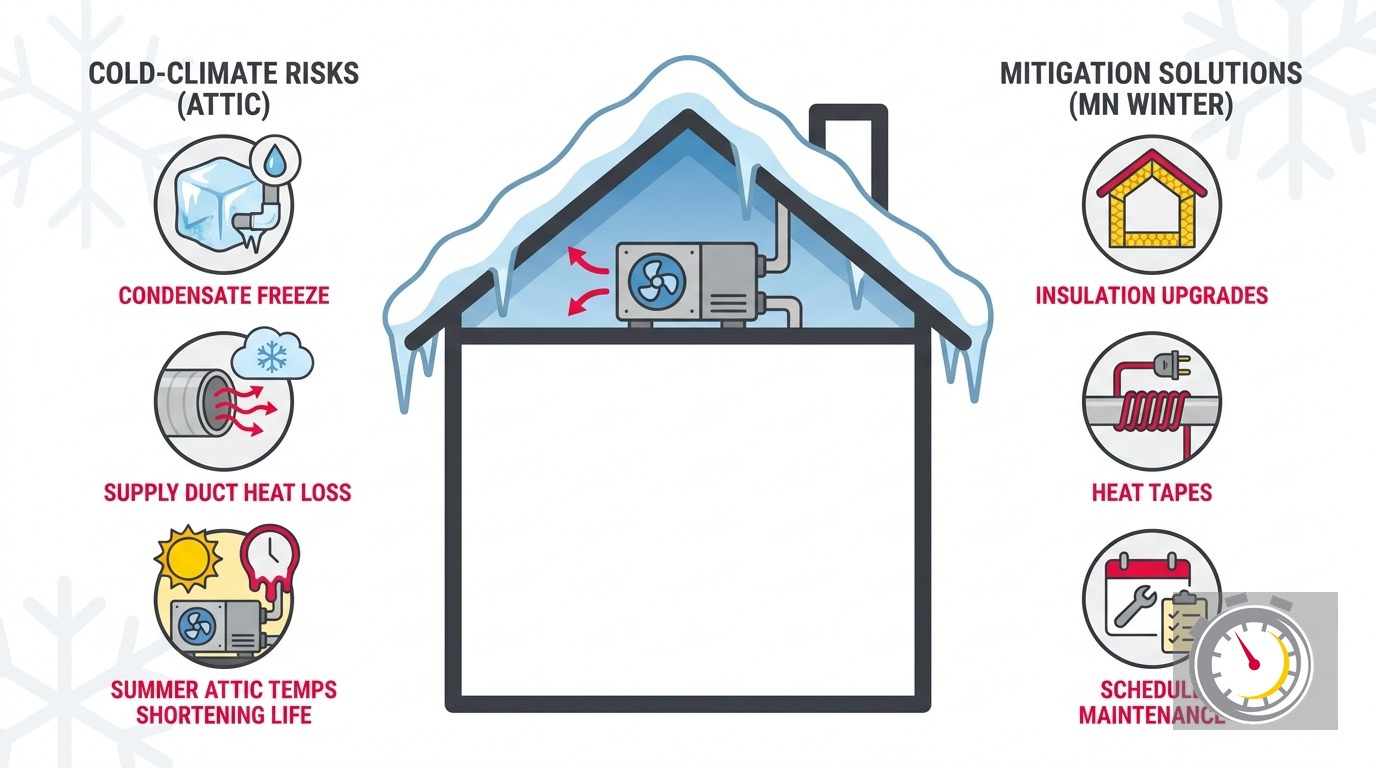
- Condensate lines and internal traps in high-efficiency air handlers freeze during the heating season. When they crack, water damage follows before you see it at the register.
- DOE research shows duct systems in unconditioned attics lose at least 10% of heating and cooling energy. Minnesota homes with long duct runs and aging insulation are near the high end.
- Minnesota Rule 1322.0403 requires R-8 minimum on attic ducts plus a vapor retarder. Most old flex duct carries R-4 or R-4.2, well below that standard.
- The permanent solution is a conditioned attic, with insulation moved to the roofline so the air handler sits inside the home’s thermal envelope.
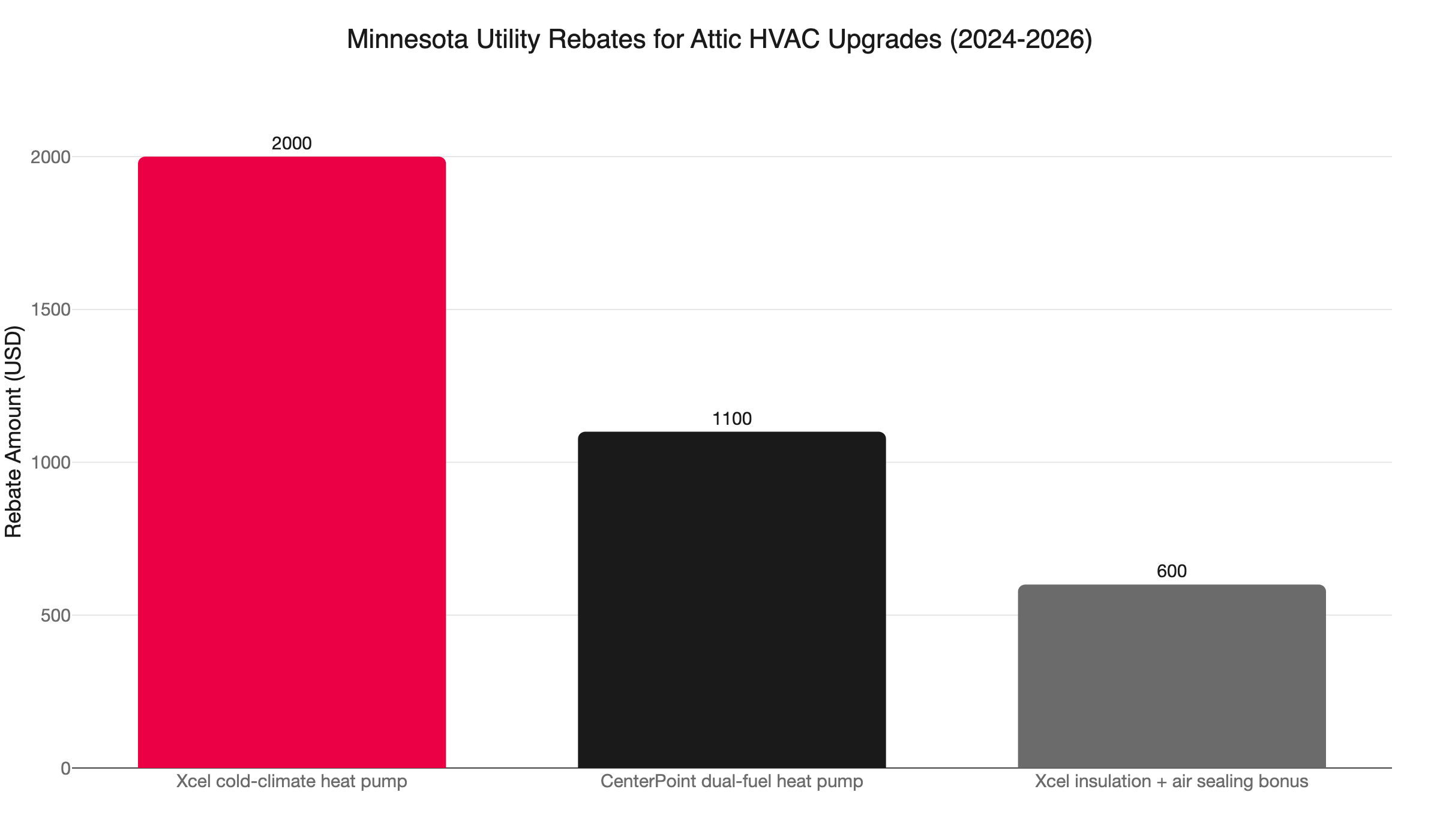
- Xcel Energy and CenterPoint together offer rebates up to $3,100 for qualifying heat pump upgrades through December 2026.
Air Handler in Attic Problems: Why Minnesota Is Different
Most guides treat air handler in attic problems as a warm-weather issue. Hot attic air surrounds the cabinet, the unit works harder, and cooling efficiency drops. That is real and it happens here too.
But in Minnesota, winter is where attic-mounted equipment takes its worst damage.
Twin Cities metro sits in ASHRAE Climate Zone 6A, with a design temperature near -16°F for Minneapolis. Northern Minnesota is Zone 7, where -30°F is a realistic design condition. These are among the most demanding heating climates in the contiguous United States.
Our attics drop to -20°F or colder during deep cold snaps. The same attic hits 130°F in summer when the roof deck radiates heat directly onto the cabinet. That is a 150-degree annual temperature swing. No other common residential equipment location sees anything close to that range.
Building scientist Joseph Lstiburek put it directly: “The worst thing you could do is install furnaces and air conditioning systems in vented attics. They don’t last very long. They need to be in a better place.”
Understanding what “better” looks like starts with the specific failures an attic creates here.
Does Cold Weather Freeze an Attic Air Handler’s Condensate Line?
Yes, and the crack often happens well before anything shows at the thermostat. High-efficiency air handlers produce condensate during normal operation. That water drains through an internal trap and a line, typically PVC. In an unheated Minnesota attic, both are exposed to outdoor temperatures. Water in the trap expands as it freezes, cracks the drain line, and often lets the equipment keep running until a backup stains the ceiling below.
The internal trap is the harder failure to catch. It sits inside the cabinet, outside the actively heated section of the unit. Standard heat tape cannot reach it easily. Many January service calls trace back to a trap that split in an earlier cold snap and only became visible when water worked its way down to the ceiling finish.
The immediate standard fix is thermostat-activated heat tape on the external drain line and as much of the trap as is accessible, combined with insulation wrap. Heat tape keeps the line above 32°F. Insulation slows heat transfer to give a buffer. Neither is permanent. Cold reaches standing water eventually when temperatures stay low long enough.
The more durable repairs are relocating the condensate trap to conditioned space and replacing the PVC drain line with PEX. PEX expands under freeze pressure rather than cracking. It will not prevent a freeze, but it typically survives one without splitting. Both are good upgrades when a technician is already accessing the unit.
If your attic air handler has been running for more than a decade and the condensate system has never been addressed, ask about it on the next service visit. For a closer look at how condensate freeze plays out in high-efficiency systems through our winters, see our post on frozen condensate drains in Minnesota high-efficiency furnaces.
How Much Heat Do Attic Ducts Lose in a Minnesota Winter?
Between 10% and 45% of your heating energy, with Minnesota homes closer to the high end. The loss comes from two sources: heat conducting through thin duct walls into cold attic air, and conditioned air leaking through gaps before it reaches a register. On a -15°F morning, warm supply air sheds heat fast through any duct jacket thinner than R-8. That lost heat warms your attic, not your living space.
DOE research shows that between 10% and 45% of heating and cooling energy disappears through under-insulated attic duct walls. On top of that, duct air leakage in unconditioned spaces commonly exceeds 20% of conditioned airflow. That is one in five cubic feet of conditioned air your system paid to heat, escaping into an unoccupied space.
Minnesota Rule 1322.0403 sets the floor at R-8 plus a vapor retarder for attic ducts. Standard flex duct from the 1980s and 1990s was installed at R-4 or R-4.2. It was borderline at installation and has degraded further since. High-performance retrofits target R-12.
Sealing comes before insulating. Adding insulation jacket over leaky ductwork reduces conductive wall losses but does nothing for conditioned air escaping through gaps. Our post on duct insulation and attic energy loss walks through the sequencing in detail.
Duct sealing typically runs around $1,300. Full ductwork replacement, when existing ducts are too far gone to seal and re-insulate, ranges from $6,500 to $13,000 depending on the home’s size and run layout. Those numbers look different when weighed against what a leaking attic duct system costs every heating season.
What Does Summer Heat Do to an Attic Air Handler?
It accelerates wear on every component sensitive to temperature. A standard vented attic hits 130°F on hot summer days, with direct radiant load from the roof deck onto the cabinet. Your air handler runs hardest during these conditions. Maximum load at maximum ambient temperature is the worst combination for equipment longevity.
Capacitors are the most common early casualty. They store the energy needed to start the compressor and blower. Elevated operating temperatures shorten their rated life. A capacitor rated for 10 years in conditioned space may fail in five or six years in a 130°F attic. Blower motor bearings, control boards, and refrigerant circuit components face the same accelerated wear pattern.
Summer also creates a condensation risk, though it differs from what warm-climate articles describe. An attic cabinet baking at 120°F can sweat when the AC cycles on and quickly drops the surface temperature. That moisture falls onto insulation and framing below the unit. In Minnesota it rarely reaches Southern severity, but it adds to the cumulative wear picture over time.
The 150-degree annual swing matters because the stress is cumulative. Equipment cycling through -20°F and 130°F every year ages faster than equipment in a mechanical room. This is part of why attic air handlers in Minnesota often need replacement before their rated service life.
Does the Stack Effect Cause Moisture Damage in Attic Air Handler Installations?
Yes, and the damage builds over multiple winters before it becomes visible. Cold-weather pressure differences drive warm, moist indoor air upward through duct penetrations, gaps at duct boots, and connections at the air handler itself. When that air hits a cold attic surface, it deposits frost. The frost melts in spring. The cycle repeats.
Over several seasons, this freeze-thaw pattern rots framing lumber, stains ceiling finishes from above, and creates conditions for mold growth. When a homeowner spots a ceiling stain, the structural damage above it has typically been building for months.
Duct air sealing addresses the energy loss and the moisture pathway at the same time. Sealing duct penetrations at interior wall tops, duct boots, and the air handler cuts the primary moisture entry points into the attic. This is why the DOE’s Building America program treats conditioned attics as a top solution for homes with attic mechanical systems: better energy performance and better structural protection come from the same work.
For a walkthrough of what the sealing process involves and where the major leak points typically are, see our post on duct sealing and leaky ductwork.
What Are the Warning Signs of Air Handler in Attic Problems?
Any of these in a home with an attic-mounted air handler deserves a professional look before winter. The symptoms do not all point to the same failure. A water stain means something different from a short-cycling fault code. But both signal that the system is losing its fight with the attic environment.
- Water stains on the ceiling directly below the air handler or along attic duct runs
- Reduced airflow from registers closest to the attic unit
- Higher heating bills in January or February without a change in how you use the heat
- Frost or ice visible on the condensate drain line when you access the attic
- The unit shutting itself down during heating season, often a condensate backup safety cutoff
- Rooms that used to heat or cool evenly that now feel noticeably off
- A musty or damp smell from ceiling registers
A water stain is the most urgent. By the time moisture has reached the ceiling finish, it has been sitting in the attic above for some time. The visible damage is the trailing edge of a problem that started earlier.
A heating-season safety shutdown frequently traces to the condensate drain. Most high-efficiency units shut down when the drain pan fills or the pressure switch reads abnormal. Heat is off until someone clears the blockage or replaces a cracked component. That is a winter service call that was predictable with an earlier inspection.
Can You Fix an Attic Air Handler In Place?
Yes, and done properly, mitigation can keep an attic system running reliably for years. Not every homeowner can relocate equipment or convert the attic in a single season. Mitigation done correctly makes a real difference. The limitation is that you are managing the attic environment, not changing it.
The standard mitigation package for a Minnesota attic air handler:
- Heat tape on the condensate system: Thermostat-activated tape on the external drain line and trap is the minimum standard for any system staying in the attic through our winters.
- Condensate trap relocation: Moving the trap to conditioned space removes the highest freeze-risk component. Not always practical without significant access work, but the right call when the unit is already open for service.
- PEX drain line replacement: PEX handles freeze expansion without cracking. It does not prevent freezing but survives it, buying a margin of error when temperatures spike beyond what heat tape can handle.
- Duct sealing and insulation upgrade: Seal first, then insulate to R-12. Cuts energy loss, reduces moisture infiltration, and addresses the stack effect pathway simultaneously.
- Improved attic ventilation: Better ridge and soffit ventilation lowers peak summer temperatures. A useful step, but one that does not address the winter failure modes.
Annual inspection matters more for attic-mounted equipment than for systems in conditioned space. The environment degrades components faster and the failure modes are harder to see from the ground. A single tune-up visit runs $95 to $250. A maintenance plan covering both the heating and cooling inspection runs $195 to $390 per year. For a system working in one of the hardest residential equipment environments in the country, that inspection cadence is worth it.
The Conditioned Attic: The Right Long-Term Solution
A conditioned attic moves insulation from the attic floor to the roofline. The attic space shifts from outside the thermal envelope to inside it. Temperatures stay within a few degrees of the living space year-round. The air handler is no longer fighting -20°F winters or baking in 130°F summers.
Building America research at DOE confirms that unvented, conditioned attics substantially improve energy performance and are the correct long-term solution when HVAC equipment is in the attic. Duct losses drop to near zero. Any heat that escapes the duct stays in conditioned space instead of disappearing into the outdoor cold. The condensate system is in a heated environment and cannot freeze.
This is a larger project than duct sealing alone. It involves spray foam or rigid insulation applied along the roofline, blocking ridge and soffit vents in the converted space, and permit work depending on the municipality. It pairs naturally with equipment replacement: if you are already opening the attic and pulling permits, upgrading the air handler at the same time avoids a second labor mobilization later.
When the conditioned attic conversion combines with a cold-climate heat pump installation, the rebate picture adds real money to the equation.
What Rebates Apply When You Upgrade Attic HVAC in Minnesota?
Minnesota homeowners have meaningful utility incentives available right now, through December 2026. Both major Twin Cities utilities run rebate programs funded through Minnesota’s Conservation Improvement Program, and they stack for homeowners served by both.
Xcel Energy offers a $2,000 rebate for a qualifying cold-climate air-source heat pump, with a $600 bonus when insulation and air sealing are included in the same project. Equipment must be installed and invoiced by December 31, 2026.
CenterPoint Energy offers a $1,100 rebate for a ducted air-source heat pump installed as a dual-fuel system alongside a gas furnace rated 92%+ AFUE. The heat pump must be programmed to switch to gas backup at 40°F or below.
Twin Cities homeowners on both utilities can stack these for up to $3,100 in direct utility incentives. The federal 25C tax credit adds another 30% of qualified costs, up to $2,000 for heat pump equipment. Our post on Minnesota heat pump rebates and tax credits covers the full stacking picture, including how to combine utility rebates with the federal credit.
Both programs draw from Minnesota Statutes §216B.241, which requires utilities to run Conservation Improvement Programs. That funding is already built into your utility rates. Capturing it is a matter of timing the project within the program window.
Talk to a Locally Owned Team That Knows Minnesota Winters
Attic air handler problems in Minnesota get worse over time. A condensate trap that cracked quietly last winter will fail more visibly the next. An attic duct system running at R-4 is not going to insulate better on its own.
Our locally owned and operated team serves Ramsey, Blaine, Maple Grove, Plymouth, Brooklyn Park, and the Twin Cities metro. We diagnose attic air handler problems, handle condensate line repairs, and help homeowners compare the mitigation path against the conditioned attic path based on equipment age and budget.
We show up when we say we will. “Always On Time… Or You Don’t Pay a Dime!(R)”
Call (763) 260-6662 or book online. If your attic air handler has not been inspected recently, schedule a visit now. Winter does not wait.
Frequently Asked Questions
Will my attic air handler's condensate line freeze in a Minnesota winter? +
How much heating energy do I lose through attic ducts? +
What is a conditioned attic and why does it solve the problem? +
What Minnesota rebates apply to upgrading attic HVAC equipment? +
Need a technician now?