
Insulate Ductwork in Attic Minnesota: What You Need to Know
Key Takeaways
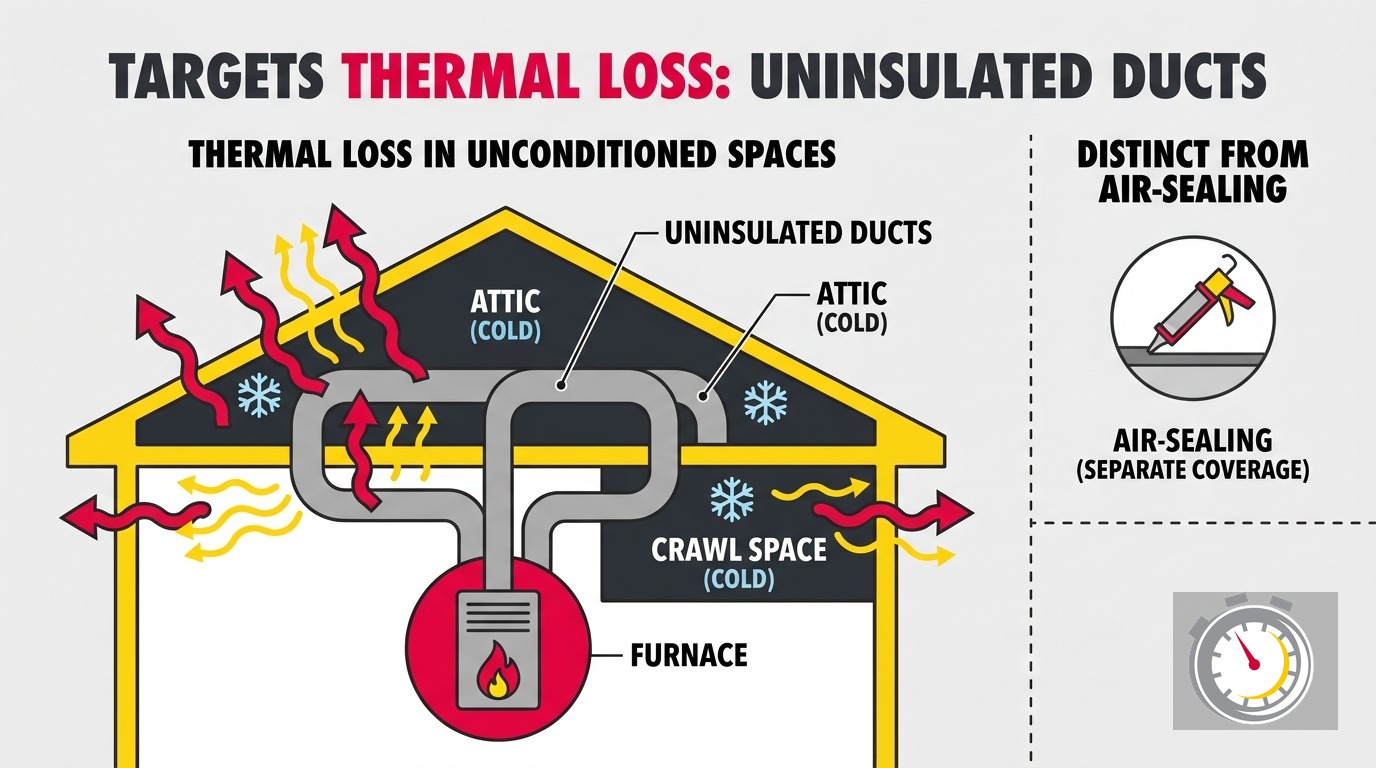
- Uninsulated or under-insulated attic ducts lose 10% to 45% of your home’s heating energy through the duct walls alone, separate from any air leaks.
- Air sealing and duct insulation solve two different problems. You need both.
- Minnesota Rule 1322.0403 requires a minimum of R-8 plus a vapor retarder for ducts in attics. Many professionals now target R-12.
- A Minnesota attic swings from roughly -20°F in deep winter to 150°F in July. Standard R-4 flex duct jacketing does not meet current code.
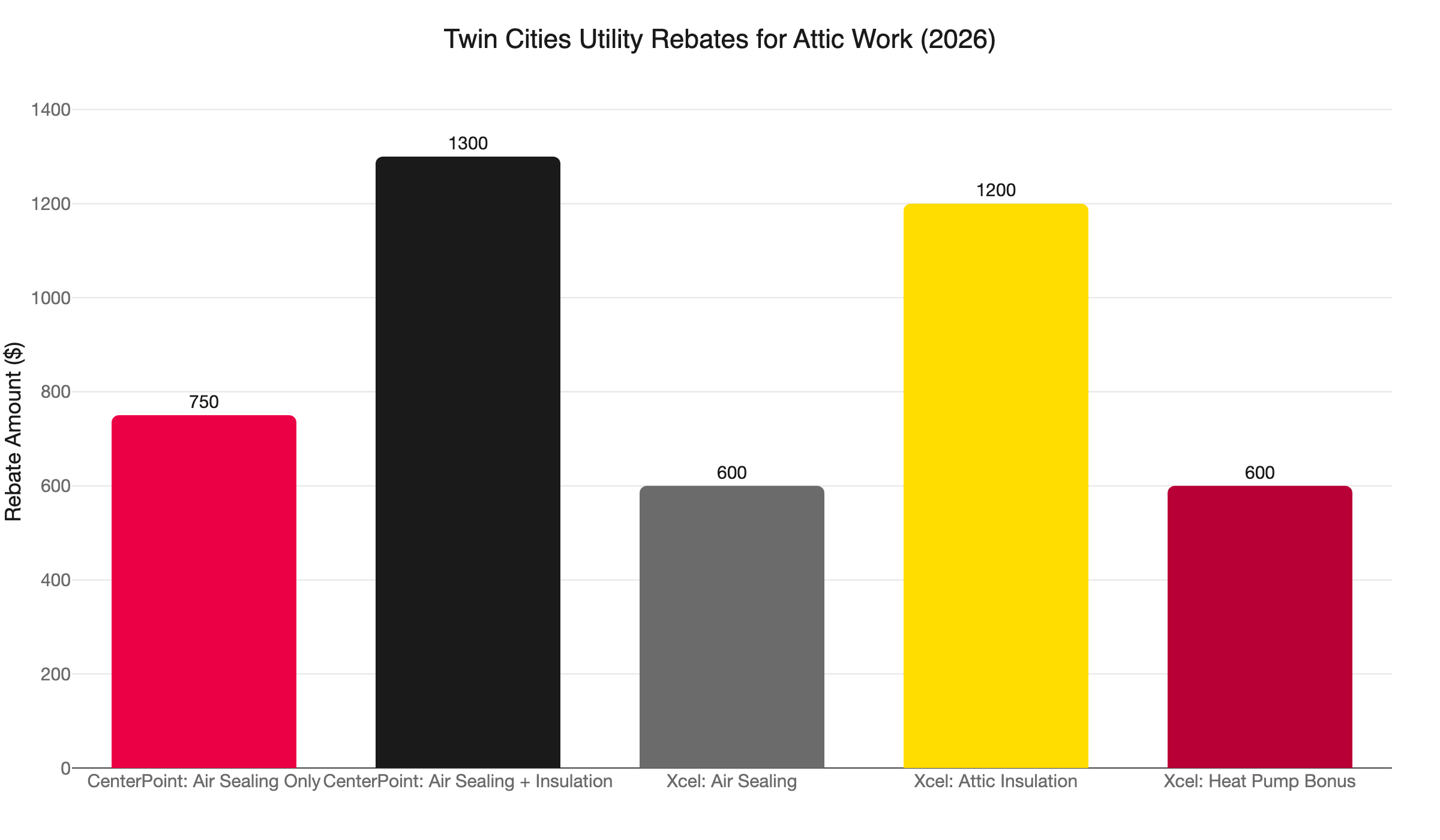
- CenterPoint and Xcel Energy both offer 2026 rebates for attic air sealing and insulation. Duct insulation is not a standalone rebate measure, but it pairs directly with rebate-eligible scope.
- No permit is typically required to wrap existing ductwork, but new duct runs in an attic require a mechanical permit. Confirm with your local authority having jurisdiction.
If your heating bills keep climbing through January and February, your attic may be the reason. Specifically: the ducts running through it. Knowing how to insulate ductwork in attic Minnesota homes is one of the most direct ways to stop paying for heat that never reaches your living room.
This guide covers the two separate failure modes behind attic duct energy loss, what Minnesota code actually requires, the right materials for our climate, 2026 rebate programs, and how to decide whether this is a DIY project or a professional one.
Why Are Uninsulated Attic Ducts a Minnesota Heating Problem?
Short answer: Minnesota attics drop to -20°F or colder in deep winter. Warm supply air traveling through an uninsulated duct sheds heat to the surrounding cold before it reaches your registers. That heat does not warm your home. It warms your attic.
The Twin Cities metro sits in ASHRAE climate zone 6A, with a design temperature near -16°F for Minneapolis. That framing matters because most national resources on duct insulation focus on summer cooling loss in warm climates. Minnesota’s problem is the opposite. Our heating season is the dominant one, and our attics are the most thermally extreme space in the house.
Standard flex duct from the 1980s and 1990s carries an R-4 or R-4.2 jacket. That was below code even then, and it is well below what Minnesota’s energy code now requires. If your attic ductwork has not been evaluated or upgraded, you are running a heating system that is losing energy inside your own house on every single cycle.
There is a second issue beyond simple heat loss. The stack effect in cold climates drives warm, moist air from the conditioned living space up through duct penetrations and gaps into the attic. In winter, that moisture can freeze on attic surfaces. In spring, it melts. Over several seasons, the result is rot, mold, and structural damage. Duct insulation paired with proper air sealing at penetrations addresses both the energy loss and the moisture problem.
What Is the Difference Between Duct Insulation and Duct Sealing?
Short answer: Sealing stops conditioned air from physically escaping through holes and gaps in your duct joints. Insulation stops heat from conducting through the duct walls themselves. They are two separate failure modes with two separate fixes, and most Minnesota attics need both.
This distinction is the gap that most guides on this topic miss. Here is how each failure mode actually works.
Air leakage happens at seams, joints, and connections. Conditioned air escapes into the unconditioned attic before it reaches a vent. Duct air leakage commonly exceeds 20% of conditioned air flow when ducts run through unconditioned space. You are paying to condition air that never enters a room.
Conductive heat loss happens through the duct walls themselves, even when the ducts are perfectly sealed at every joint. Warm air inside a duct gives up heat to the cold attic through the duct skin. The thinner and less insulating the jacket, the faster that transfer happens. This is basic physics: heat moves from warm to cold, and it will not stop moving until temperatures equalize.
These two losses stack on each other. A leaky, uninsulated duct loses energy two ways at once. Sealing the duct without insulating it still leaves conductive heat loss in place. Insulating without sealing reduces thermal loss but does not stop conditioned air from escaping through gaps. The DOE’s guidance is direct on this point: conductive losses are typically at least as large as air-leakage losses, which means insulation is not optional even on a well-sealed duct.
When our team inspects attic ductwork, we assess both. A duct that passes a visual leakage check can still be a significant source of energy loss if the jacket is thin, torn, or simply too low an R-value for our climate. And a well-insulated duct with gaps at the collar connections is still losing conditioned air. The fix for each is different.
How Much Heat Can Uninsulated Ducts Waste?
Short answer: Between 10% and 45% of your heating and cooling energy can disappear through under-insulated attic duct walls. In Minnesota, where attic temperatures regularly drop below -20°F, homes with long attic duct runs and thin jackets are closer to the high end of that range.
That wide range reflects differences in duct length, existing jacket condition, and how cold the surrounding space gets. A short flex duct stub in an attic that is relatively sheltered from the cold sits at the lower end. A long supply trunk running the length of an attic in a northern Minnesota home, with its original R-4 jacket, sits much higher.
The practical consequence: your furnace compensates for lost heat by running longer cycles. You pay for heat your living room never feels, month after month, all winter. Over a single heating season in the Twin Cities, that can add up to hundreds of dollars in excess gas or electric costs, depending on system size and duct condition.
See our post on leaky ductwork and energy loss for a broader look at how duct system condition affects your overall efficiency.
What R-Value Does Minnesota Code Require to Insulate Ductwork in Attic Spaces?
Short answer: Minnesota Rule 1322.0403 requires R-8 plus a vapor retarder for ducts in attics, garages, and ventilated crawl spaces. High-performance and new construction work often targets R-12.
Here is the full breakdown so you know what applies to your home:
Minnesota code minimum (prescriptive path): R-8 plus a vapor retarder, per Minnesota’s own Table R403.2.1. Minnesota replaced the relevant IECC section with its own table, so the enforceable floor here is R-8, not the R-12 that the IECC 2015 prescribes for climate zones 5-8.
ENERGY STAR minimum: R-8 plus a vapor barrier for ducts in unconditioned spaces. ENERGY STAR aligns with the Minnesota code floor.
High-performance target: R-12. The IECC moved climate zones 5-8 to R-12 in the 2015 edition, which is why manufacturers now produce single-piece R-12 duct wrap products. Many Minnesota contractors doing high-performance retrofits or new construction specify R-12 because our climate puts ducts under more thermal stress than the R-8 minimum accounts for.
Why the vapor retarder requirement matters: A Minnesota attic in January can be 60 to 80 degrees colder than the air inside the duct. That temperature differential causes condensation to form on the outside of a duct that is not properly insulated or vapor-managed. Without a vapor retarder on the outer surface of the insulation assembly, moisture infiltrates the insulation layer itself, degrading its R-value over time and creating conditions for mold growth and duct jacket deterioration. The vapor retarder always goes on the warm side of the insulation, which in this application is the outside of the wrap.
If your home currently has flex duct with an R-4 jacket, you are at roughly half the code minimum. Upgrading to R-8 brings you to code compliance. Upgrading to R-12 is the better investment if you are already pulling ducts or installing new runs.
What Materials Are Used to Insulate Ductwork in Attic Spaces?
Several products are used in residential attic duct insulation work. The right choice depends on the duct type, its current condition, and whether you are wrapping existing ducts or installing new runs.
Fiberglass duct wrap is the most common retrofit product for existing rectangular sheet metal ducts. It comes in roll form, typically R-6 to R-8 per inch of thickness, and is applied in layers around the outside of the duct. The foil-faced outer surface serves as the vapor retarder when seams are properly taped. Achieving R-8 typically requires a 2-inch wrap. Achieving R-12 requires either a thicker product or a double-layer installation with offset seams.
Pre-insulated flexible duct is sold with an integrated fiberglass insulation jacket and mylar vapor barrier already attached. It is available in R-6, R-8, and R-12 ratings. If you are replacing old flex duct that has deteriorated or was never adequate for our climate, buying the higher-rated product from the start is the smarter move. Labor cost is nearly identical. Material cost difference is modest compared to the energy savings over the life of the duct.
Rigid duct board is a fiberglass board product used to fabricate ducts with integral insulation built into the duct wall itself. It is more common in new construction than in retrofit work, but it appears in attic applications when new trunk runs are being designed as part of a larger system change.
Spray foam at penetrations is often used around duct collars and connections where ducts pass through the ceiling plane from the conditioned space into the attic. This addresses the stack-effect air pathway at the transition. It is not the primary insulation product for the duct body, but it is a necessary companion step when proper air sealing is part of the project scope.
What to avoid: Do not simply bury existing R-4 flex duct under blown-in attic insulation and call the job done. That approach can offer some thermal benefit, but it traps ducts in a way that makes future repairs nearly impossible, and it does not address vapor management requirements. Proper duct insulation means wrapping or replacing the duct as a standalone step, then restoring attic insulation around it.
Can You Get Rebates for Insulating Ductwork in Attic Spaces in the Twin Cities?
Short answer: Not for duct insulation as a standalone line item. But CenterPoint Energy and Xcel Energy both offer 2026 rebates for attic air sealing and insulation work that routinely happens alongside duct upgrades.
Here is the current program landscape:
- $750 for attic air sealing alone
- $1,300 for attic air sealing plus qualifying attic insulation (existing attic at R-30 or lower, raised to R-49 or higher)
- Work must be performed by a Rebate Eligible Installer with active BPI certification
- Applications due December 31, 2026
- $600 for attic air sealing
- $1,200 for attic insulation (40% of project cost, capped)
- Additional $600 bonus if a qualifying heat pump is installed within two years of the insulation work
Your eligibility depends on which utility delivers your gas. Both CenterPoint and Xcel serve the Twin Cities metro, but coverage areas do not overlap. Your gas bill header will tell you which applies.
The practical framing: duct insulation in an unconditioned attic is a code compliance and efficiency fix. It pairs naturally with attic air sealing and insulation. When we assess your attic ducts, we can look at the full picture and tell you whether the scope of work makes a utility rebate worth pursuing.
For a full overview of HVAC rebate programs available in Minnesota, see our post on Xcel and CenterPoint HVAC rebates.
Should You Hire a Professional to Insulate Ductwork in Your Attic?
Short answer: A capable DIYer can wrap sheet metal ducts with fiberglass duct wrap. But attic access is difficult, vapor retarder installation has a right and a wrong side, and damaged or deteriorated flex duct should be replaced rather than wrapped. Most homeowners are better served by a professional who can do the full assessment and fix both failure modes in one visit.
Here is the honest breakdown:
What makes this harder than it looks:
- Attic access is tight, especially around duct runs. Working in a Minnesota attic in winter is cold. Working in one in July is dangerous.
- Fiberglass duct wrap must be installed with the vapor retarder facing outward and all seams taped. Reversed installation does not work as a vapor barrier and will fail over time.
- Flex duct that is kinked, torn, or has separated joints should be replaced, not wrapped. Telling the difference between a duct worth wrapping and one that needs replacement requires hands-on inspection.
- New duct runs in an attic require a mechanical permit. That work cannot be done without an inspection and is not a DIY path.
- Air sealing at ceiling penetrations is a separate step that must happen alongside the duct insulation for the project to perform as intended. Missing it leaves a major moisture pathway open.
What a professional brings:
- Assessment of existing duct condition: current R-value, jacket integrity, joint sealing
- Clear diagnosis of which failure mode is costing you the most energy
- Correct product specification for Minnesota’s climate
- Proper vapor retarder installation and seam sealing
- Air sealing at duct penetrations through the ceiling plane
- Permit handling for any new duct runs
- Guidance on whether the scope triggers a utility rebate application
If your attic insulation and ventilation is also inadequate, that conversation belongs in the same site visit. Duct performance and attic thermal performance are connected. Addressing one without the other leaves money on the table.
What to Expect When You Call Northern One Hour
We are locally owned and operated in Ramsey, MN, and we serve the Twin Cities metro. When you call us about attic ductwork, we send a technician who knows what a Minnesota attic actually looks like after thirty years of temperature cycling: aged flex duct with a jacket that has gone brittle, joints that have pulled apart at the collar, and an R-value that was marginal when it was installed and is now far below code.
We show up when we say we will. That commitment is behind our promise: “Always On Time… Or You Don’t Pay a Dime!(R)”. It is not a marketing line. It is the standard we hold ourselves to on every visit.
Our technician will inspect your attic duct system: existing insulation R-value, jacket condition, joint sealing, and duct penetrations at the ceiling plane. We will identify the gap between your current condition and Minnesota’s R-8 minimum and walk you through options: wrap, replace, or a combination, depending on what we find. We price the work transparently, with no surprises.
If your heating costs have been climbing and your system is running longer cycles than it used to, attic ductwork deserves a look before you assume the furnace is the problem. The fix is often straightforward. The savings continue every month of every heating season after.
For homes with ductwork running through below-grade spaces as well, see our post on crawl space HVAC efficiency.
Call us at (763) 260-6662 or book online. We serve Minneapolis, St. Paul, Ramsey, Blaine, Maple Grove, Plymouth, Brooklyn Park, Woodbury, Bloomington, and the surrounding Twin Cities metro.
Frequently Asked Questions
What R-value does Minnesota require for attic ductwork? +
Is duct insulation the same as duct sealing? +
Are there rebates for duct insulation work in the Twin Cities? +
Need a technician now?