
Ductwork Replacement Cost: When Sealing Stops Making Sense
Key Takeaways
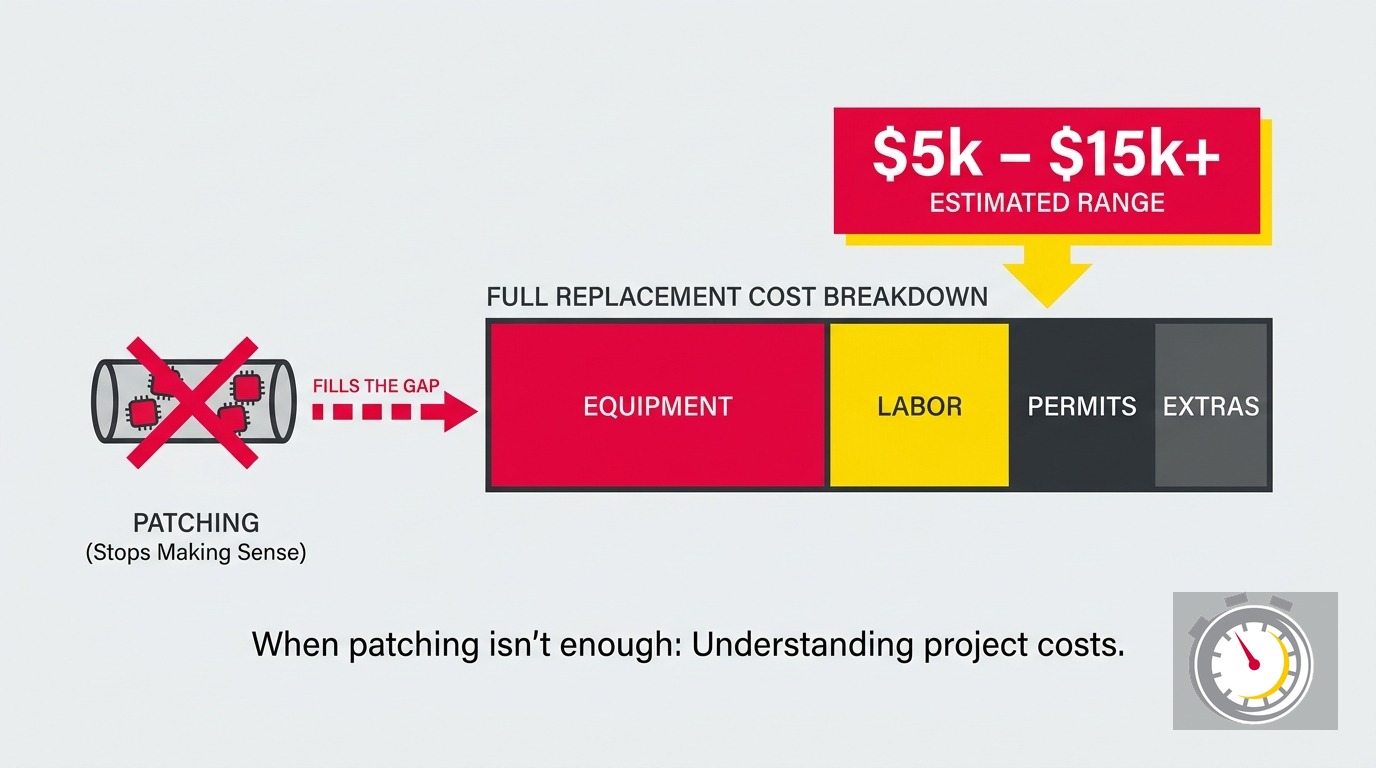
- Full ductwork replacement in the Twin Cities costs $5,000-$12,000, with most jobs landing between $7,800 and $13,000.
- The leakage rate is the real decision driver: seal if under 15-20%, replace if over 25-30% or if there is widespread physical damage.
- Flex duct has a 10-15 year lifespan. If your home has flex duct installed before 2011, it is at or past the end-of-life window.
- The federal 25C tax credit for ductwork expired December 31, 2025. It is not available for work placed in service in 2026.
- Xcel Energy rebates up to $750 are still available for qualifying insulation and air sealing work.
- Bundling duct replacement with a new system typically saves $650-$2,600 in shared labor.
- Every Minnesota duct replacement requires a mechanical permit. Budget $50-$175 depending on your city.
- Replacing ducts without a Manual D sizing calculation is a common contractor shortcut. Insist on proper sizing.
What Does Ductwork Replacement Cost in the Twin Cities?
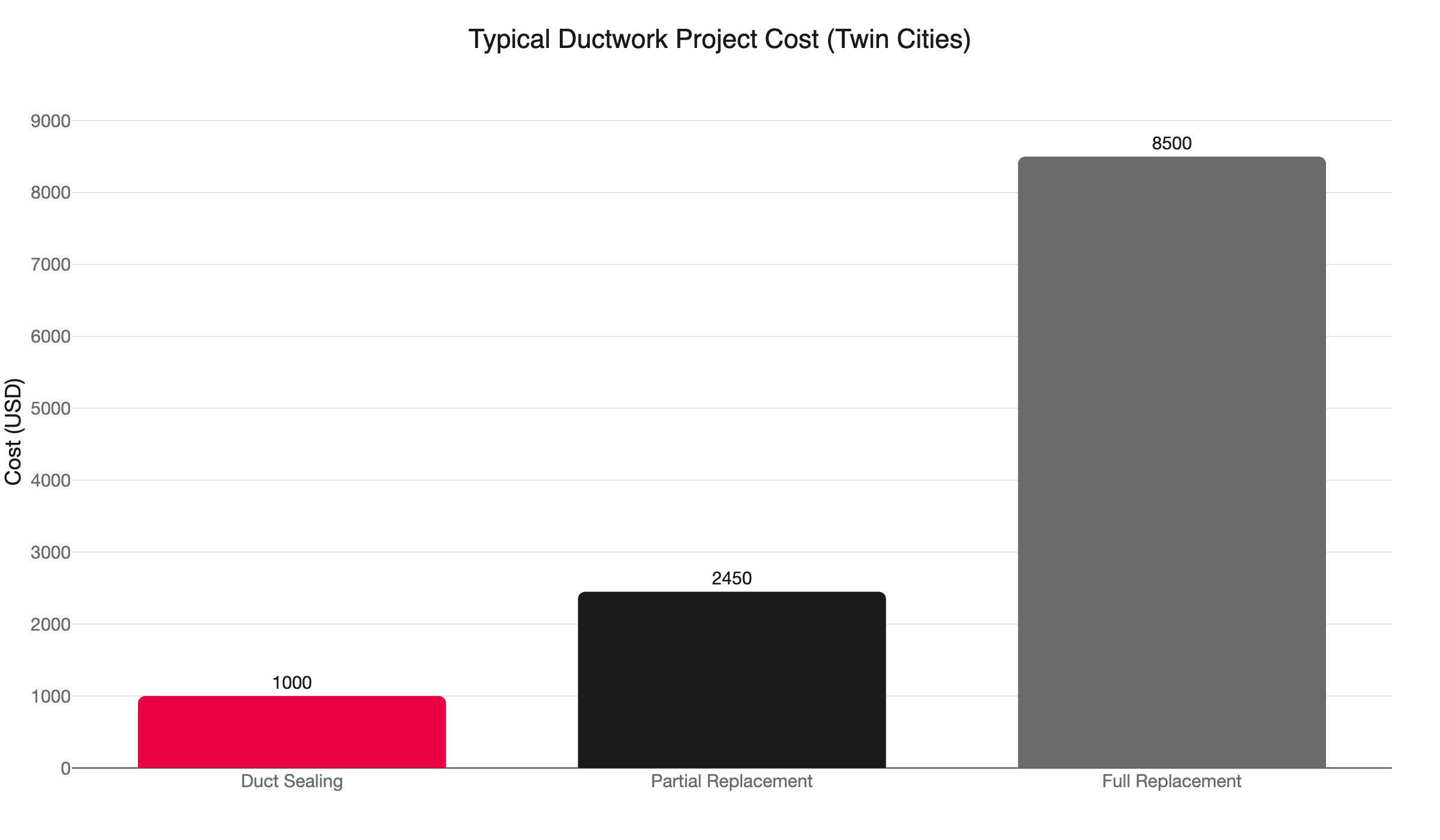
The short answer: Most homeowners pay $5,000-$12,000 for a full replacement, with the typical job landing between $7,800 and $13,000. National cost data puts Midwest pricing at the national baseline, so Twin Cities homeowners are not paying a regional premium or discount relative to the rest of the country.
The line-item breakdown looks like this:
- Material and labor: Angi’s duct replacement cost data shows installed ductwork running $10-$25 per linear foot on the low end, $20-$60 per linear foot including removal. Most homes carry 150-350 linear feet of ductwork.
- Partial replacement: $1,400-$3,500. One zone or a single problem run, not the whole system.
- Full replacement: $5,000-$12,000, with most homeowners paying $6,000-$10,000.
- Mold or asbestos present: $4,000-$10,000, because remediation is required before the duct work begins.
- Permit fees: $75-$175 in Minneapolis and St. Paul, $50-$150 in most suburban Twin Cities municipalities.
A few variables push the number in one direction or the other. Home size and number of stories matter: a single-story 1,800-square-foot ranch carries far less linear footage than a two-story home with a finished basement. Accessibility matters too. Ducts buried behind a finished ceiling or in an encapsulated crawl space cost more to reach than open-basement runs. Material choice affects both upfront cost and long-term value. Sheet metal costs more than flex duct initially but outlasts it by 20-plus years.
One number that surprises many homeowners: bundling duct replacement with a new furnace or AC system typically saves $650-$2,600. The HVAC crew is already on-site and in the mechanical room. Combined scheduling eliminates duplicate mobilization costs. If your ducts and equipment are aging out together, the timing makes the economics clear.
Should You Seal or Replace Your Ductwork?
The short answer: Seal if your leakage rate is under 15-20% and the duct structure is physically intact. Replace if leakage exceeds 25-30%, if there is widespread physical deterioration, or if your flex duct is at or past its end-of-life window. The threshold is measurable, not a judgment call.
This is the question the national cost articles skip entirely. They price replacement. They do not tell you when replacement beats sealing. Here is the framework.
The leakage-rate threshold
ENERGY STAR estimates that a typical U.S. home loses 20-30% of conditioned air through duct leakage. Professional duct sealing, using mastic sealant or Aeroseal injection, costs $650-$1,950. That is a fraction of replacement cost and the right call when leakage is under 15-20% and the duct structure is physically sound. A duct system under 10-15 years old testing at 15% leakage or below is a strong Aeroseal candidate.
Once leakage exceeds 25-30% with accompanying physical damage, sealing rarely pencils out over the long term. You are patching a network that is failing structurally. Above 40% leakage, the math is not close. You are conditioning the attic or crawl space, not the living area.
What drives leakage rates up?
Most duct leakage happens at joints, connections, and anywhere a duct has sagged, kinked, or disconnected. In Twin Cities homes, the usual suspects are original flex duct that has degraded at the connections, sheet metal joints that were never properly sealed at installation, disconnected branches in attics or finished ceilings, and pest damage at connectors.
A blower door test combined with duct pressurization testing gives you the actual number. Any technician recommending a $9,100-plus replacement without testing first is working from assumptions, not data. Insist on the test.
For a closer look at sealing options and when they make sense, our post on leaky ductwork and duct sealing energy loss covers the process in detail.
How Old Is Too Old? Material Lifespan and the Age Trigger
Duct age is a hard trigger independent of measured leakage rate. Two materials, two very different timelines.
The short answer on age: Flex duct has a 10-15 year lifespan and a roughly 10-year manufacturer warranty. Sheet metal runs 30-50 years with proper maintenance. If your home has flex duct installed before 2011, it is at or past the warranty window in 2026. If it predates 2001, it is past expected lifespan.
Sheet metal is a different story. A 1985 galvanized steel system that was properly installed and maintained can still be structurally sound. The question for older sheet metal shifts from age to leakage rate and sizing: is it leaking, and is it the right size? Those answers come from testing, not the calendar.
Mixed systems are common in Twin Cities homes that have had partial work or additions over the years. Sheet metal trunk lines that are solid can stay. Flex branch runs that are failing come out. A section-by-section evaluation is the right approach, not a blanket replacement quote.
Signs that physical replacement is warranted, regardless of material or age:
- Rooms that run noticeably warmer or cooler than the rest of the house
- Visible sagging, kinking, or disconnected sections in the basement or attic
- Musty or stale odors from supply registers
- Energy bills climbing steadily without another clear explanation
- Excessive dust at registers even with a recently changed filter
Our post on duct insulation and attic energy loss in Minnesota covers one specific failure mode in detail, particularly relevant for Twin Cities homes with attic duct runs exposed to Climate Zone 6 temperatures.
What Are the Signs Your Ducts Need Replacing?
The short answer: Uneven temperatures room to room, visible physical damage, musty odors from registers, rising energy bills without another cause, and excessive dust are the five clearest indicators. A professional pressurization test confirms which factor is driving the problem and how severe it is.
Uneven temperatures are the most common complaint that leads to a duct inspection. When one side of the house runs 4-6 degrees warmer or cooler than the other during a polar vortex, poor duct distribution is usually involved. It might be leakage, undersizing, or both.
Musty odors matter specifically because they point to either moisture intrusion, such as condensation on poorly insulated ducts in an attic or crawl space, or active mold growth inside the duct system. When mold is confirmed inside the ducts, remediation and replacement can reach $4,000-$10,000. Cleaning without replacing is a partial fix if the underlying moisture source is not corrected.
Rising energy bills with no other obvious cause are a subtler signal. ENERGY STAR notes that air leakage accounts for 25-40% of home energy used for heating and cooling. Leaky ducts running through an unconditioned attic during a Minnesota January dump your furnace output into a 5-degree space before the air ever reaches a living room register.
Does Ductwork Replacement Cost Less When Bundled With a New System?
The short answer: Yes, typically $650-$2,600 less. The HVAC crew is already on-site with access to the mechanical system. If your furnace or AC is 15-plus years old, get a duct assessment at the same time you price the equipment. The combined project almost always saves money over separate scheduling.
Timing matters beyond cost savings. A new high-efficiency furnace installed into an old leaky duct system cannot deliver its rated efficiency into the living space. You pay for a 96% AFUE furnace and get closer to 75% AFUE in real-world delivery, because a meaningful share of the output escapes into the attic or crawl space before it reaches a room.
Minnesota requires a minimum 92% AFUE furnace in Climate Zones 6 and 7, which covers the entire state. That code minimum only translates to real-world performance when the duct system can actually deliver the conditioned air to the rooms. Leaky ducts defeat the efficiency investment from day one.
If a heat pump is on your radar, the same principle applies. Installing a cold-climate heat pump into a leaking, undersized duct system is an expensive way to underperform. The equipment and the distribution system need to work together.
Do You Need a Permit to Replace Ductwork in Minnesota?
The short answer: Yes. Ductwork replacement requires a mechanical permit in Minnesota. Minneapolis and St. Paul charge approximately $75-$175. Most suburban Twin Cities municipalities run $50-$150. Any contractor who suggests skipping the permit is a red flag, not a cost-saving move.
The permit is not a formality. Minnesota code sets specific requirements for duct replacement that exceed the federal baseline.
Duct insulation requirements: Minnesota Rules Chapter 1322 (residential mechanical code) requires a minimum R-8 insulation rating on ducts over three inches in diameter in unconditioned spaces, including attics, crawl spaces, and attached garages. When you replace ductwork in any of those locations, the new installation must meet R-8 minimum. Under-insulated ducts in a Minnesota attic lose meaningful heat load before the air ever reaches a register on a cold January morning.
Why Minnesota’s standard is higher than the federal floor: Climate Zone 6 covers most of the state. Winter design temperatures run from -5 to -20 degrees Fahrenheit, and heating degree days routinely exceed 7,500 per year. The code standard reflects the thermal reality of building in that climate. R-8 is the floor, not the goal.
The permit fee is a small fraction of the overall project cost. Skipping it exposes you to complications at resale, potential liability if something fails, and the cost of opening finished surfaces to bring unpermitted work up to code after the fact. It is not worth it.
For a full breakdown of when HVAC permits are required in Minnesota and what to expect from the inspection process, see our post on HVAC permits in Minnesota.
Why Proper Sizing Matters More Than You Think
This is the point most duct replacement conversations miss entirely.
Replacing ductwork like-for-like, without resizing it, perpetuates whatever sizing problems the original installation had. Many Twin Cities homes built before 2000 have ductwork sized for a different system, a different load, or simply estimated by a contractor working without formal design calculations.
ACCA Manual D is the industry standard for duct system design. It must be matched to a Manual J load calculation for the home. Together, they determine the correct duct diameter, branch run sizing, and static pressure targets for every room. Undersized ducts force the air handler to work harder to push air through restricted passages, consuming 20-30% more energy to deliver target airflow. Oversized ducts let air stagnate and distribute unevenly across the house.
Studies from NIST and Lawrence Berkeley National Laboratory document residential duct systems commonly losing 25-40% of net delivered HVAC capacity to leakage, undersizing, and uninsulated runs in unconditioned space. That is capacity you are paying to produce and not receiving in the rooms where you live.
A contractor performing a proper duct replacement should deliver a Manual D calculation as part of the project documentation. If they do not mention it, ask. If they say it is not necessary, that is a signal to keep looking.
What Rebates Are Available in 2026?
The short answer: The federal 25C tax credit expired December 31, 2025, and is not available for work done in 2026. Xcel Energy offers up to $750 for qualifying insulation and air sealing work, plus a $600 bonus rebate for customers who add a qualifying heat pump within two years. CenterPoint Energy does not offer a standalone duct rebate.
Here is the full picture.
Xcel Energy (residential): Up to $750, structured as 30% of project cost, for qualifying insulation and air sealing improvements completed by a participating contractor. If your duct replacement is part of a broader air sealing project, this rebate applies. The $600 bonus rebate for customers who complete the air sealing work and then install a qualifying heat pump within two years stacks on top of the base rebate.
CenterPoint Energy: No standalone duct rebate. CenterPoint offers up to $1,500 for ducted air-source heat pump installation. If your duct replacement is part of a heat pump conversion, that incentive is worth exploring alongside the Xcel rebate.
Dual-utility stacking: Homeowners with both Xcel and CenterPoint service can stack incentives on a dual-fuel heat pump system, reaching up to $3,100 combined.
Minneapolis Green Cost Share: Minneapolis residents may qualify for additional rebates up to $14,000 on qualifying energy upgrades. Specific income and project requirements apply. Worth a call to the city program office before finalizing your project scope.
The federal situation: The One Big Beautiful Bill Act, signed July 2025, repealed the 25C Energy Efficient Home Improvement Credit effective December 31, 2025. If you completed qualifying ductwork in 2025, you can still claim that credit on your 2025 tax return. For any work placed in service in 2026, there is no federal credit. That is a firm line, not a gray area.
DOE HEAR program: The Home Electrification and Appliance Rebates program lists insulation, air sealing, and ventilation as eligible measures at up to $1,600. Minnesota has not launched its state-level HEAR program as of August 2026. When it does, it may create another rebate path for duct-related work.
For the current full breakdown of what is available in Minnesota from both utilities, our post on Xcel and CenterPoint HVAC rebates in Minnesota covers the specifics.
Financing is also worth discussing for any project in the $6,000-$10,000 range. Ask about options when you call to schedule your assessment. Spreading a large project over manageable monthly payments can make the difference between doing the job right now versus deferring it another winter.
What to Ask a Contractor Before You Commit
A duct replacement is a significant project. These questions separate a thorough contractor from one who is cutting corners.
- “Will you test leakage before and after?” Before-and-after pressurization testing is the only way to verify the new system actually reduced leakage. It should be standard, not an add-on.
- “Are you pulling a mechanical permit?” If the answer is no, stop the conversation there.
- “What R-value goes on ducts in unconditioned spaces?” Minnesota code requires R-8 minimum. Ask for the specific product.
- “Will you perform a Manual D calculation?” Proper sizing is not optional. Ask for the documentation upfront.
- “What does the labor and materials warranty cover?” Understand what happens if a connection fails in year two.
- “Do you offer financing?” For a $7,000-$10,000 project, payment options can make the right decision the practical one.
Northern One Hour is locally owned and operated in Ramsey, Minnesota, serving Minneapolis, St. Paul, Blaine, Maple Grove, Plymouth, Brooklyn Park, Woodbury, Bloomington, and the surrounding Twin Cities communities. We carry a 100% satisfaction guarantee and stand behind our on-time promise: “Always On Time… Or You Don’t Pay a Dime!(R)”
Ready to find out what your ducts actually need? Call us at (763) 260-6662 or book online to schedule an assessment. We will test, size, and give you an honest picture before we recommend anything.
Frequently Asked Questions
How much does ductwork replacement cost in the Twin Cities? +
Should I seal or replace my ductwork? +
Is the federal 25C tax credit available for ductwork in 2026? +
Do I need a permit to replace ductwork in Minnesota? +
What is Manual D and why does it matter for duct replacement? +
Need a technician now?