
Flex Duct Airflow Problems: Older Twin Cities Home Guide
Key Takeaways
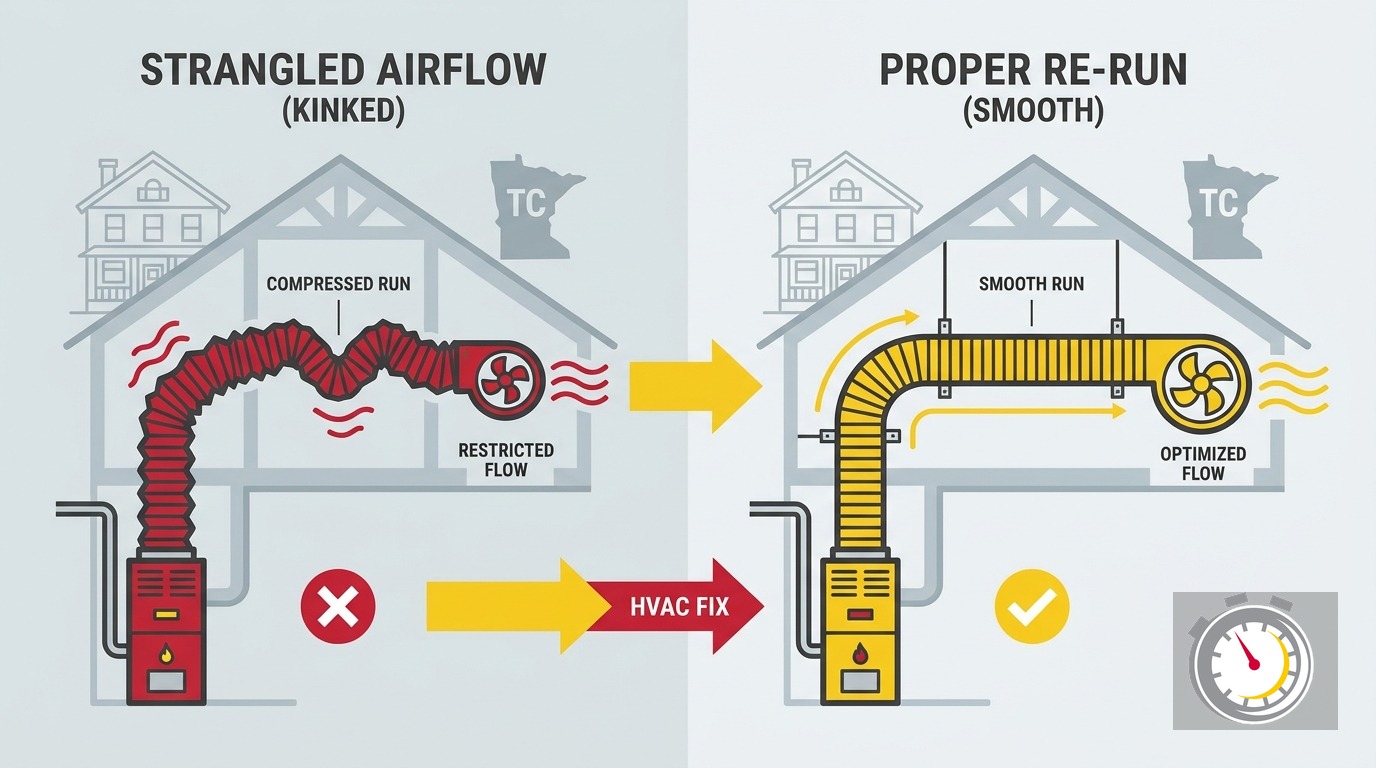
- A flex duct compressed just 25% can lose up to 50% of its airflow capacity.
- Kinks, sags, and over-length runs force your furnace to work harder throughout Minnesota’s long heating season.
- Minneapolis averages roughly 8,300 heating degree-days per year. Restricted airflow is not a comfort nuisance. It is sustained mechanical stress on your furnace for months at a time.
- DOE standards require supports no more than 4 feet apart, each at least 1.5 inches wide, with no more than 1/2 inch of sag per foot between supports.
- Minnesota’s mechanical code caps flexible air connectors at 14 feet per run.
- Homes built between the 1950s and 1980s in the Twin Cities often predate these standards and are the most likely to have problem runs.
- A proper re-run, not just a patch, is the correct fix.
- Paired with a qualifying heat pump upgrade, stacked utility and federal rebates can total $3,000-$5,000.
What Are Flex Duct Airflow Problems?
Flex duct airflow problems happen when flexible duct runs kink, sag, compress, or run too long - cutting the volume of conditioned air that reaches a room. Even a well-installed flex run has more internal friction than smooth hard duct. Add a kink or a sag, and airflow can drop by half or more.
Flex duct is a standard choice in residential HVAC because it is inexpensive and easy to route around framing. It has three layers: a corrugated inner liner, fiberglass insulation, and an outer jacket. The corrugated liner creates friction even in a straight, properly supported run. That friction compounds quickly when the liner gets pinched, sags between hangers, or bends past its design radius. The furnace blower pushes against more resistance. Air slows. The room at the end of that run stays cold no matter how long the system runs.
Why Does Flex Duct Lose Airflow?
Four failure modes cause most flex duct problems on older Twin Cities installs. Each one restricts the duct’s cross-section or adds friction. In combination, they can reduce delivery to a room by more than half even when the furnace is running correctly.
Compression. A flex duct compressed just 25% can lose up to 50% of its airflow capacity. Compression happens when a run is stuffed into a tight space, rests on a joist without proper support, or is installed with too much slack and left to pile up on itself.
Kinks and sharp bends. The inner liner must maintain a bend radius of at least one duct diameter. A tighter bend collapses the liner and blocks airflow. The DOE Building Science Education Center prohibits sharp turns with a radius less than one duct diameter and requires the liner to be pulled taut with no kinks or u-turns.
Sagging. DOE standards require hangers no more than 4 feet apart, each at least 1.5 inches wide, with no more than 1/2 inch of sag per foot between supports. A run that droops past that threshold adds friction equivalent to several feet of extra duct on every cubic foot of air moving through it.
Over-length runs. Minnesota’s mechanical code limits flexible air connectors to 14 feet per run. Beyond that length, friction accumulates to a point where delivery to the connected room falls well below design. Many older homes have runs that exceed this limit, built under less restrictive codes that were in effect at the time.
Why Does Kinked Flex Duct Matter More in Minnesota?
In Minnesota, flex duct airflow problems are not a comfort issue. They put sustained mechanical stress on your furnace for most of the year. Minneapolis averages roughly 8,300 heating degree-days annually. A struggling furnace is short-cycling on its limit switch for six months straight, not two weeks.
Minneapolis is in IECC Climate Zone 6A with approximately 8,300 heating degree-days annually - one of the highest totals for any major metro in the lower 48. The heating season runs six to seven months. Winter design temperatures fall to around -9°F.
When restricted ductwork cuts airflow, your furnace runs longer cycles trying to meet setpoint. Heat builds inside the heat exchanger. The high-limit switch trips. The system shuts down before the house reaches temperature. That cycle repeats all winter.
If many heat runs are kinked or crushed, it can cause the furnace to overheat and cut out on limit - and sustained overheating can crack the heat exchanger over time. A cracked heat exchanger is a carbon monoxide risk, not just an efficiency problem. See our guide to cracked heat exchanger signs in Minnesota for the specific symptoms to watch for before calling for service.
The DOE estimates that poor HVAC installation can reduce overall system energy efficiency by up to 30%. In Minnesota, that efficiency loss runs for six consecutive months.
How Do You Know If Your Flex Duct Is the Problem?
The clearest sign is one or two rooms that stay cold in winter, or warm in summer, while the rest of the house is comfortable - despite a furnace that runs frequently and a thermostat set correctly. Weak airflow at a specific register and long run cycles with little temperature movement are the two things to check first.
Other indicators to watch for:
- One or two registers with noticeably weaker airflow than others on the same system
- A furnace that trips its limit switch repeatedly, often visible as a flashing error code on the control board
- Long heating cycles that do not move the thermostat reading much
- Energy bills that feel high relative to your setpoints and insulation level
If you can get into your attic or basement, look directly at the flex runs. A run that has gone slack and coiled on top of a joist, taken a sharp angle around framing, or visibly sagged between hangers tells you exactly what you are dealing with. A run that looks fine from a distance may still be compressed at the boot end or kinked where it connects to the trunk - the spots that are hardest to see from the floor.
For context on how ductwork, insulation, and air sealing interact in older homes, our post on why older Twin Cities homes struggle more with winter comfort covers the full picture.
The Older-Home Factor in Twin Cities Ductwork
Twin Cities homes built between the 1950s and the 1980s deserve extra attention when it comes to flex duct. Most of the worst cases our technicians encounter are in this housing stock.
Many of these homes were built before current standards existed in their present form. The 14-foot connector limit, the 4-foot hanger interval, and the specific bend-radius requirements were not the universal baseline when these homes went up. Installers used available materials and followed the code of the day. A home built in 1963 in Ramsey or Brooklyn Park may have original flex runs that are 18 to 22 feet long, supported only at the ends, with one or two kinks where the run routes around framing.
That home has operated this way for six decades. The homeowner assumes the cold room is just a quirk of the house. The real cause is ductwork that has been underperforming since installation.
A thorough inspection of these homes frequently turns up multiple defects on a single run. A kink at the trunk connection. A sag in the middle third. A compression at the register boot. Each defect adds restriction. Together they can cut delivery to a room by more than half, and none of them are visible without physically tracing the run through the space.
Minnesota’s mechanical code also requires all flex duct to be listed and labeled Class 0 or Class 1 per UL 181. Older unlisted material, if it remains in place, adds a compliance issue on top of the airflow problem. When we pull an old run on a 1970s install, it is not unusual to find material that predates modern listing requirements entirely.
What Does a Proper Flex Duct Re-Run Look Like?
A proper re-run is not a patch. It is the full removal of the defective run and installation of a correctly routed, correctly supported replacement from trunk connection to register boot - nothing less.
Here is what that process looks like on a typical older Twin Cities home.
Diagnosis and measurement. A technician traces the run from register back to trunk, documents its total length, and identifies every defect. Airflow at the register is measured before any work begins. That baseline number gets verified against after the re-run is complete.
Removal. The old flex run comes out completely. Splicing new material into the middle of a defective run is sometimes done as a shortcut. It rarely produces the same result as a full replacement, because compression and kinking at the fittings often remain.
Route planning. The new route is planned to minimize length, eliminate sharp turns, and stay within Minnesota’s 14-foot limit. If the distance requires a longer path, the correct answer is a transition to hard duct for part of the run, not a flex connector that exceeds code.
Inner liner stretch. The corrugated inner liner must be pulled taut between fittings before the run is secured. A liner with even modest slack adds friction equivalent to several extra feet of duct. This is the step that separates a correct installation from a mediocre one, and it is the step most often skipped on quick re-runs.
Support installation. Hangers go in no more than 4 feet apart, each at least 1.5 inches wide. Sag between supports stays under 1/2 inch per foot.
Boot seal. The connection at the register boot is sealed with mastic or UL 181-rated tape. An unsealed boot loses conditioned air into unconditioned space, partially defeating the re-run.
Verification. Airflow is measured again at the register. The technician confirms that delivery has improved and that the furnace is no longer short-cycling on that zone.
Where a run passes through unconditioned attic space, the DOE requires minimum R-8 insulation on new flex duct. In a Minnesota attic, this is not a technicality. It directly affects whether conditioned air arrives at the register at anything close to its supply temperature.
What Does Flex Duct Repair Cost in the Twin Cities?
Costs vary based on scope. A duct sealing visit - which addresses leaks at boots and connections but does not re-route defective runs - runs around $1,300. Full duct replacement, where all runs are removed and re-installed correctly, runs $6,500-$13,000 depending on home size and how accessible the spaces are.
Individual run re-routes fall between those two numbers. A single re-run with new flex, correct support spacing, and a sealed boot is a contained job. The exact cost depends on the route length and the difficulty of access in your attic or basement.
If your ductwork problems are paired with a furnace that is already showing stress from years of restricted airflow - short cycling, repeated limit trips, or a heat exchanger with a history of overheating - it makes sense to evaluate both together. See our post on ductwork replacement cost in the Twin Cities for what drives full-system pricing in this market.
Can a Flex Duct Re-Run Qualify for Rebates or Tax Credits?
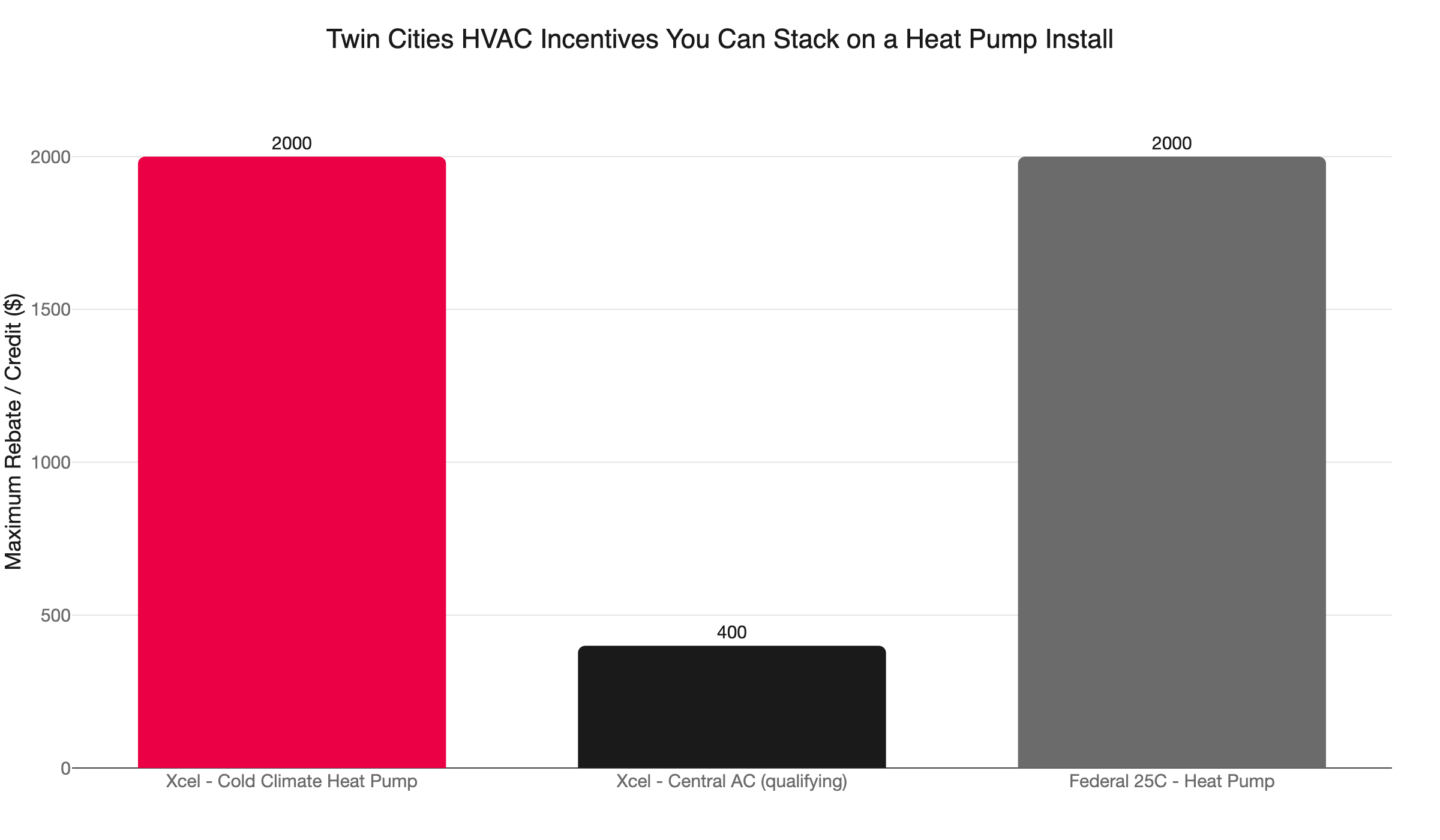
Duct repair alone does not typically qualify for a direct utility rebate. But pairing a re-run with a qualifying cold-climate heat pump install can unlock up to $2,000 from Xcel, $2,000 from the federal 25C credit, and additional money from the Minneapolis bonus program.
Xcel Energy’s current Minnesota residential program includes up to $2,000 for a qualifying cold-climate ducted heat pump and $400 for a qualifying central AC replacement. Note that Xcel discontinued gas furnace rebates as of January 1, 2026. The federal 25C tax credit adds 30% of project cost, capped at $2,000, for a qualifying heat pump. Combined, Twin Cities homeowners doing a heat pump install can access $3,000-$5,000 in stacked incentives, per Central Minnesota Heating and Cooling’s 2026 rebate summary.
If you are in Minneapolis, the Minneapolis Bonus Rebate Program stacks on top of Xcel and CenterPoint rebates for qualifying improvements made after December 15, 2025.
The case for pairing duct work with a heat pump upgrade is practical. A heat pump installed in a home with correctly functioning ductwork performs better than one fighting restricted runs from day one. Fixing the ductwork at the same time maximizes the efficiency gain, protects the new equipment, and positions the project to capture the full rebate stack.
For the complete breakdown of available programs and how to stack them, see our post on Minnesota heat pump rebates and tax credits.
Why Flex Duct Problems Are Worth Fixing Now
A kinked flex run is not just a cold room.
Sustained short-cycling over a Minnesota winter adds up in real terms. Repeated limit trips put cumulative stress on the heat exchanger. A cracked heat exchanger is the path from a ductwork problem to a carbon monoxide problem, and that path runs faster when the furnace has been overheating on high-limit every night for several winters in a row.
Restricted ductwork also drives your energy costs up every month the heating system runs. In Minnesota, that is a six-month-a-year penalty that compounds year after year until the ductwork is fixed. The longer the problem goes unaddressed, the more the savings from a correct installation are deferred.
These problems are diagnosable and fixable. A proper inspection identifies which runs are the issue, what the correct scope of repair is, and whether a targeted re-run or a broader duct replacement is the right call for your home’s layout and age.
Schedule a Flex Duct Inspection with Northern One Hour
Northern One Hour is locally owned and operated, serving homeowners across the Twin Cities, including Ramsey, Blaine, Maple Grove, Plymouth, Brooklyn Park, Woodbury, and Bloomington. We back every visit with our on-time promise: “Always On Time… Or You Don’t Pay a Dime!(R)”
If you have a room that stays cold, a furnace that short-cycles, or flex runs you suspect have never been properly inspected, call (763) 260-6662 or book online. We will send a technician to assess your ductwork, measure actual airflow at the registers, and give you a straight answer on what needs to be done.
If your inspection points toward a system upgrade, ask about financing. Pairing a duct re-run with a new furnace or a qualifying heat pump can be structured to fit your budget, and the rebate stack can bring the net cost down substantially.
Frequently Asked Questions
How much airflow can kinked flex duct lose? +
What is the Minnesota code limit on flex duct length? +
Does flex duct repair qualify for utility rebates? +
Need a technician now?