
Asbestos Duct Insulation in Older Minnesota Homes: A Guide
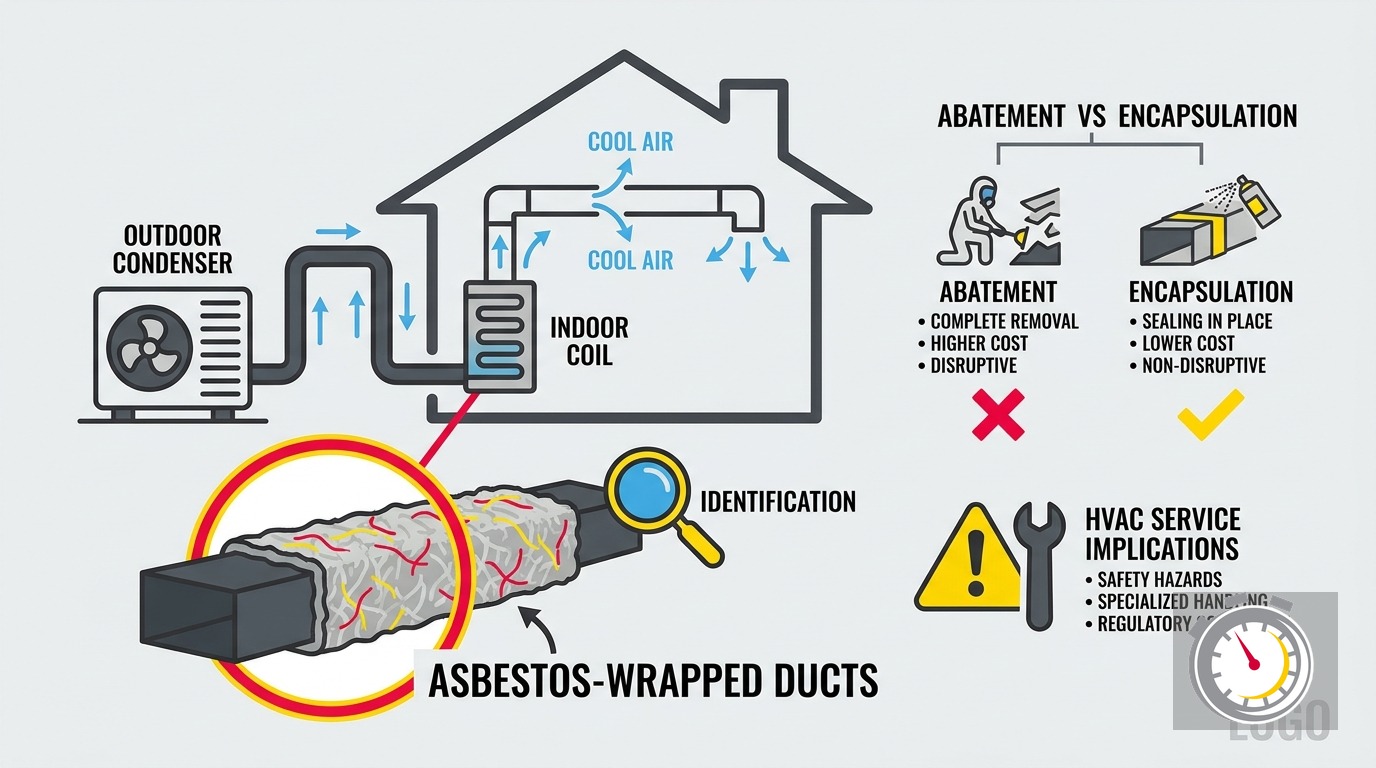
Key Takeaways
- Asbestos in duct systems typically appears as a cloth-like or canvas wrap on trunk lines, gray or white tape at duct joints, and flexible pads above the furnace.
- The Minnesota Department of Health lists ductwork insulation and furnace insulation among materials that may contain asbestos. MDH recommends checking for asbestos markings or hiring a certified inspector before disturbing any suspect material.
- Minnesota regulates asbestos-related work at 10 linear feet, 6 square feet, or 1 cubic foot. A single duct run typically exceeds all three thresholds.
- Even encapsulation (not just removal) counts as regulated asbestos-related work in Minnesota and requires MDH notification before work begins.
- If a technician spots suspect duct wrap during an HVAC appointment, the right move is to pause the job and refer you to a licensed inspector - not proceed.
- Never scrape, chip, or sample suspect material yourself.
- Use the MDH asbestos contractor directory to find a licensed inspector or abatement contractor in your area.
If your Twin Cities home was built before 1978, asbestos duct insulation is a real possibility in your basement. Homes in Minneapolis, St. Paul, Ramsey, Blaine, and across the metro were built during the peak years of asbestos use in residential HVAC construction. Most homeowners never think about it until a contractor shows up for service - and by then, the situation can get complicated fast.
This post covers how to identify asbestos duct insulation in an older Minnesota home, how the state regulates it, what your options are once material is confirmed, and what should actually happen when an HVAC technician walks into a pre-1978 basement.
What Does Asbestos Duct Insulation Look Like in an Older Home?
Asbestos duct insulation appears as cloth-like or canvas wrap on trunk lines, gray or white tape at joints, vibration dampener pads above the furnace, rough fibrous duct sections, and spray-applied gray material on pipes. Any of these in a pre-1978 home should be treated as suspect until a certified inspector tests it.
Asbestos was standard in residential HVAC construction through the late 1970s. It was cheap, heat-resistant, and durable - exactly what builders wanted around a furnace and ductwork. In a typical Twin Cities basement, it shows up in five forms:
- Full trunk wrap. A cloth-like or canvas material covers the large rectangular or round duct runs branching from the furnace. This is the most common form and the hardest to miss.
- Joint tape. Gray or white tape seals the seams where duct sections connect.
- Vibration dampener pads. Flexible pads sit between the furnace and the first duct section. They absorb motor vibration and are often the first thing a technician handles.
- Asbestos cement sections. Some duct runs used asbestos cement. Cut edges look crumbly and fibrous.
- Spray-applied insulation. Gray, textured material on pipes or duct surfaces, often in mechanical rooms or utility closets.
Published guidance on duct asbestos identification notes that visual red flags include flaking or fraying wrap, cloth-like texture, and gray or white tape at joints. The same source is clear: homeowners should never scrape or sample suspect material themselves.
Here is the key limit of visual inspection: you cannot confirm asbestos by looking at it. Only a certified inspector with laboratory testing can make that call. If your home predates 1978 and you see any of the above, treat the material as asbestos until a licensed professional says otherwise.
Is Asbestos Duct Insulation Dangerous?
Asbestos-containing duct insulation poses a health risk when fibers become airborne. Intact, undisturbed material carries lower immediate risk. The danger rises sharply when the wrap is fraying, crumbling, or disturbed by renovation, duct cleaning, or HVAC service work. Inhaled asbestos fibers cause serious lung disease.
Asbestos-containing materials (ACM) that are intact and left alone are not an immediate hazard. The problem is disturbance. When someone cuts, scrapes, drills near, or mechanically contacts ACM, fibers become airborne. In a duct system, those fibers can travel through the air distribution system and reach every room in the house.
The service context matters more than most homeowners realize. A duct cleaning in a pre-1978 home - especially on older flex connections or wrapped trunk lines - can stir material that has been stable for decades. A furnace tune-up that requires disconnecting a vibration pad or moving a duct section near the furnace can do the same. Even a rough visual inspection that involves pressing on or bending wrapped material can release fibers.
The Minnesota Department of Health recommends checking for asbestos markings or hiring a certified inspector before disturbing any suspect materials. MDH also warns that many home inspectors will not test for asbestos. Buyers and sellers of pre-1978 properties should ask specifically - a standard inspection report will not necessarily flag it.
If you are planning a purchase or sale of an older Twin Cities home, see our HVAC checklist for buying a home in Minnesota for the full list of questions to raise before closing.
What Are Your Options Once Asbestos Is Confirmed?
Once a licensed inspector confirms asbestos and assesses the material’s condition, there are three paths: leave it alone, encapsulate it, or remove it. The inspector’s condition assessment drives the decision. No general HVAC contractor should be making this call on your behalf.
Leave it alone
If the material is intact, firmly adhered, and not in the path of any planned HVAC service or renovation work, Minnesota guidance supports leaving it in place. Undisturbed ACM that is not deteriorating poses minimal immediate risk.
This is not a permanent answer as the material ages. Revisit the condition before any duct-related service call or home renovation, and check it annually in the meantime.
Encapsulate it
Minnesota Rules part 4620.3100, subpart 19 defines encapsulation as treatment with a sealant material that surrounds or embeds asbestos fibers in an adhesive matrix to prevent fiber release. Two types are used in practice:
- Bridging encapsulants create a membrane over the surface of the material.
- Penetrating encapsulants bind the internal components of the ACM itself.
Encapsulation works when the material is deteriorating but still coherent. It is not a substitute for removal when material is already friable (crumbling or sagging). Loose or hanging ACM must be removed before encapsulation can proceed.
One detail most homeowners do not know: duct insulation that already has a canvas or paper covering is considered previously encapsulated under Minnesota rules. “Patch and repair” work applies encapsulant to return it to intact state. If that canvas covering is what you see in your basement, that history matters to the abatement contractor’s scope decision.
Remove it
Abatement is required when the material is friable, damaged, or directly in the path of planned renovation or HVAC system replacement. If you are replacing a furnace or the full duct system, abatement typically comes first - then HVAC work proceeds after a clearance air test confirms the work area is clean.
These two scopes use separate contractors, separate permits, and separate timelines. Plan for both when budgeting a project in a pre-1978 home.
Asbestos Duct Insulation in Older Minnesota Homes: What State Law Requires
Minnesota regulates asbestos-related work in residences at thresholds low enough to capture almost any duct work in a pre-1978 home. Most homeowners assume regulation applies only to commercial buildings or full demolition. It does not.
Minnesota’s regulatory thresholds for asbestos-related work in a residence are:
- 10 linear feet of pipe or duct insulation
- 6 square feet of other flat materials
- 1 cubic foot in any form
A single furnace trunk line easily exceeds all three. That means repairs, encapsulation, and removal of duct insulation in an older Minnesota home will almost always fall under state regulation.
The part that surprises most people: encapsulation counts. It is not just removal that triggers the rules. Applying encapsulant to asbestos-containing duct insulation is asbestos-related work (ARW) under Minnesota law. That means it requires a licensed MDH contractor and advance notification before work begins.
The notification requirements are specific:
- MDH requires at least 5 calendar days’ notice before regulated asbestos-related work begins.
- The MPCA requires at least 10 working days for renovation or demolition projects.
- Both encapsulation and removal require an MDH-licensed contractor above those thresholds.
MDH licenses asbestos inspectors and abatement contractors separately. Ask for both credentials before signing any contract. If a company wants to inspect and abate without showing two distinct license numbers, call MDH to verify their standing before work begins. The MDH Asbestos Program can be reached at (651) 201-4620.
What Happens When Your HVAC Tech Arrives at a Pre-1978 Home?
A responsible HVAC technician who spots suspect duct wrap should stop the appointment and refer you to a licensed asbestos inspector before any duct cleaning, furnace service, or system replacement touches that material. Proceeding without testing can circulate fibers through your entire home’s air supply.
This is the part of the conversation most homeowners never hear - because most HVAC companies do not raise it before the visit.
When our team arrives at an older Twin Cities home for a furnace tune-up, system replacement, or duct cleaning, we pay attention to what we are working around. If we see suspect material - cloth wrap on trunk lines, gray tape at joints, crumbling insulation near the furnace connection - we stop. We let you know what we found, and we recommend a licensed asbestos inspector before any duct-related work proceeds.
That is not excessive caution. It is basic professional responsibility. Disturbing ACM during a cleaning or tune-up can send fibers through the air distribution system and into every room in the house. That is the kind of problem that does not show up immediately and does not resolve on its own.
The same logic applies to duct cleaning. Running a cleaning machine through wrapped trunk lines without first confirming there is no asbestos present is how fibers end up circulating through an older home’s entire duct system. If you are considering duct cleaning in a pre-1978 home, our post on whether air duct cleaning is worth it in the Twin Cities covers what to ask before you schedule.
If your home was built before 1978 and you have never had the duct wrap inspected, mention it when you call to schedule service. A note before arrival lets the technician come prepared to assess, rather than finding out mid-appointment.
Does Asbestos Duct Insulation Affect a Home Sale in Minnesota?
Yes. Pre-1978 Twin Cities homes frequently change hands with asbestos-wrapped ducts that neither buyer nor seller knows about. Standard home inspections typically do not test for asbestos. MDH warns buyers and sellers to ask specifically. Addressing it before listing puts you in a stronger position.
Pre-1978 homes sell every year in Minneapolis, Ramsey, Woodbury, and across the metro with asbestos-containing duct insulation that goes undetected through the entire transaction. The reason is a straightforward gap in standard practice.
MDH explicitly warns that many home inspectors will not check for asbestos products. A general home inspection addresses visible condition and mechanical function. It does not include material sampling or laboratory testing. An inspector may note that duct wrap is present and appears worn - but they will not tell you whether it contains asbestos.
If you are selling a pre-1978 Twin Cities home:
- Consider scheduling an asbestos inspection before you list.
- Document the condition in writing. Intact material with a written assessment is a cleaner disclosure than an unknown flagged by the buyer’s inspector.
- If abatement is needed, completing it before listing removes a common pressure point in negotiations.
If you are buying a pre-1978 home:
- Do not assume the general inspection covers asbestos.
- Add a separate asbestos inspection to your inspection contingency.
- Ask whether any duct, furnace, or pipe insulation was previously identified, tested, or disturbed.
The MDH warning is worth taking seriously. A pre-purchase asbestos inspection costs far less than dealing with a disclosed finding after you have already closed.
What Happens to Your Ducts After Asbestos Abatement?
Once abatement is complete and the work area passes a clearance air test, duct repair or replacement can proceed. If you were already planning a furnace replacement or full system upgrade, the same sequence applies: abatement first, clearance second, HVAC work third.
Abatement and HVAC replacement are separate scopes of work. They require different contractors, different permits, and different timelines. Trying to compress them into a single visit creates both regulatory and air quality risk.
Full ductwork replacement in the Twin Cities typically runs $6,500 to $13,000 for a full system, depending on home size, configuration, and access. Budget for both scopes separately and build in time for the clearance test between them. The clearance test is not optional - it confirms the work area meets MDH air quality standards before anyone else enters to continue the project.
If the scope is smaller - replacing a single damaged duct section rather than the full system - the same sequence applies at that scale.
How Do You Find a Licensed Asbestos Contractor in Minnesota?
MDH maintains a searchable contractor directory. Look for separately licensed inspectors and abatement contractors. The MDH Asbestos Program at (651) 201-4620 can answer questions about notification requirements and which license type covers a given scope of work.
Start at the MDH asbestos contractor lookup. The directory lists both licensed inspectors and licensed abatement contractors. When you contact a contractor, look for:
- An MDH-licensed inspector credential, separate from the abatement license
- An MDH-licensed abatement contractor credential
- A clear notification process: a reputable contractor handles MDH notification on your behalf as part of the job
If you are unsure whether a specific scope triggers regulation, or if you have questions about the MDH licensing process, call the MDH Asbestos Program at (651) 201-4620 before committing to a contractor. That call is free and can save you from hiring someone without the right credentials.
Ready to Schedule Service at Your Twin Cities Home?
Asbestos duct insulation in an older Minnesota home is a manageable situation. The path is well-defined: licensed inspection first, condition assessment second, abatement or encapsulation if required, then HVAC work in sequence.
Northern One Hour Heating & Air Conditioning is locally owned and operated in Ramsey, MN. We serve Minneapolis, St. Paul, Blaine, Maple Grove, Plymouth, Brooklyn Park, Woodbury, Bloomington, and the full Twin Cities metro. When we arrive at an older home and see something that should be inspected before we proceed, we tell you. That is what “Always On Time… Or You Don’t Pay a Dime!(R)” looks like in practice - honest service, not just a fast appointment.
Call (763) 260-6662 or book online to schedule your service. If you have questions about what a tune-up or duct cleaning involves in an older home, we can talk through the specifics before you book.
Frequently Asked Questions
How can I tell if my ducts have asbestos insulation? +
Can I leave asbestos duct insulation alone? +
Does Minnesota regulate asbestos work in residential homes? +
What should an HVAC technician do when they spot suspect duct wrap? +
Need a technician now?