
HVAC Duct Camera Inspection: What It Finds in Old Ducts
Key Takeaways
- A duct camera gives you a visual evaluation of the inside of your ductwork. It does not measure leakage or airflow.
- It can show debris, suspect mold, rodent signs, crushed or disconnected sections, and wet insulation.
- It cannot identify asbestos. If you see suspect wrap, stop and do not disturb it.
- Mold that keeps coming back usually means a moisture problem. Fix the moisture first.
- The inspection makes the most sense before a remodel, a sale, or a purchase of an older home.
- The “pays for itself” case is scenario logic, not a sourced statistic. A small inspection beats a big surprise after walls are open.
- Call (763) 260-6662 or book online to schedule a visit.
Is an HVAC duct camera inspection worth it?
Yes, in three cases: before a renovation that opens walls or ceilings, before you list a home, and before you buy an older one. A small camera shows the inside of your ducts. You see debris, moisture, loose joints, and damage before they turn into surprise costs.
If your ducts are newer and nothing seems wrong, the inspection is optional. For older Twin Cities homes, it often earns its keep. A camera has limits, though. It cannot identify asbestos or measure air leaks. Those limits are covered below.
We are Northern One Hour Heating & Air Conditioning, a locally owned and operated Twin Cities company.
How does a duct camera inspection work?
A technician feeds a thin, flexible camera into your ducts through small openings or existing vents. The camera has its own light and sends live video to a screen. The technician moves along each run, notes problems, and records footage you can keep.
The tool is called a borescope: a slim cable with a lens and light on the end. It lets us see where a person cannot reach.
A typical visit goes like this:
- We look at the system first. We find the furnace or air handler, the trunk lines, and the branch runs.
- We pick access points. These might be supply registers, return grilles, or small openings cut near the unit.
- We run the camera through each section. We check the bottom, sides, and top of the duct.
- We note joints, bends, and transitions, since most trouble hides there.
- We save video and photos so you can see what we saw.
The footage matters. You can show it to a second contractor, a home inspector, or a buyer. Nobody has to take your word for it.
Do duct cleaners have cameras?
Some do, and some do not. Many duct cleaning crews carry a camera to show before-and-after views. Others work without one. If you are paying for cleaning, ask whether the crew can show you footage first.
Without a camera, you rely on the word of the person selling the cleaning. With one, you can see the dust, the mold, or the clean metal for yourself.
The EPA gives guidance on when cleaning makes sense. Its page on whether to have your ducts cleaned says cleaning is worth considering with “substantial visible mold growth inside hard surface (e.g., sheet metal) ducts.” It also lists rodent or insect infestation and ducts clogged with excessive dust and debris as reasons to clean.
Note the word “visible.” A camera is how you check. For our take on whether cleaning is worth it, read our guide on duct cleaning in the Twin Cities. You can also learn about our duct cleaning service.
What does a camera find in older Twin Cities ductwork?
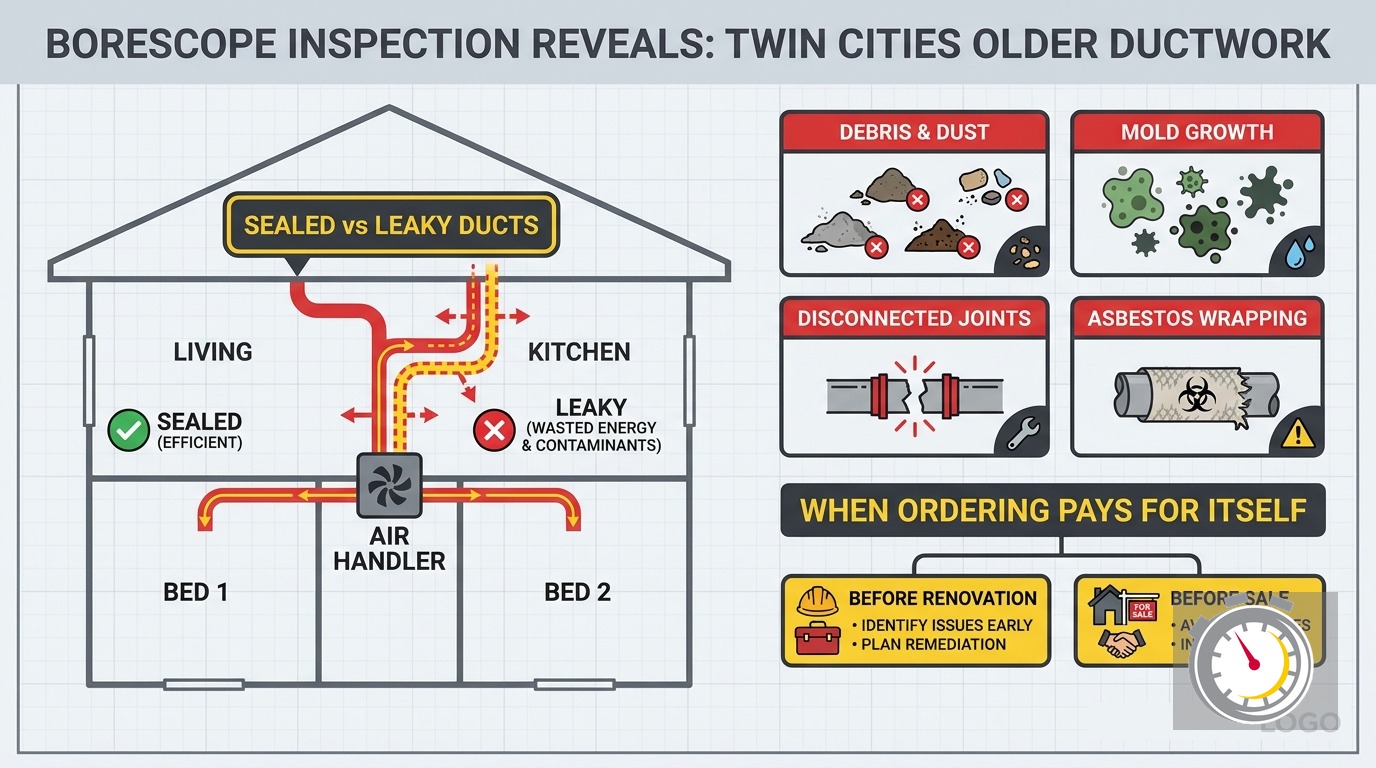
In older homes, a camera most often finds built-up debris, signs of moisture or mold, rodent evidence, and joints that have come apart. It can also show crushed sections and wet insulation. Each finding calls for a different fix.
Many Twin Cities homes were built decades ago. Their ducts have been through many freeze-thaw cycles, remodels, and furnace swaps. That history shows up on camera.
Debris and dust
Some dust in a duct is normal. Heavy buildup is not. A camera shows the difference in seconds.
Look for these signs on the screen:
- Thick, matted dust along the floor of the duct.
- Drywall dust, sawdust, or paint chips left over from past projects.
- Lost items, such as toys, pencils, and bits of packaging.
- Dust that coats the duct walls and not only the bottom.
Remodels are a common cause. If ducts stayed open during work, debris falls in. Our post on duct cleaning after a home renovation explains how that happens and what to do.
Mold and moisture
Mold is the finding most homeowners worry about. Handle it carefully.
Something that looks like mold may not be mold. The EPA notes that you may need “laboratory analysis for final confirmation.” Per the EPA page, “For about $50, some microbiology laboratories can tell you…” what a sample is. That page dates to 1997, so treat the price as dated.
Here is what the EPA says about moisture and mold in ducts:
- “Controlling moisture is the most effective way to prevent biological growth in all types of air ducts.”
- “If the conditions causing the mold growth in the first place are not corrected, mold growth will recur.”
- Wet or moldy insulation “cannot be effectively cleaned and should be removed and replaced.”
- “Once fiberglass duct liner is contaminated with mold, cleaning is not sufficient to prevent re-growth.”
In short, cleaning mold without fixing the water source wastes money. The camera helps you find where the moisture comes from. For signs and next steps, see our guide to mold in HVAC ducts.
Disconnected joints and damaged sections
This is where the camera earns its reputation. A duct that has separated at a joint can send conditioned air into a wall, attic, or crawl space. You paid to heat or cool that air, and it never reaches the room.
The camera can show:
- Seams that have pulled apart.
- Sections that slipped off a connector.
- Crushed or kinked flex duct.
- Torn or sagging runs.
- Gaps where a duct meets the furnace or a register boot.
If one room never feels right, a disconnect may be the cause. Our post on flex duct problems covers common failures in that duct type.
Rodents and insects
Mice get into Minnesota homes every fall. Ducts offer shelter, and a camera shows droppings, nesting material, and chewed insulation. The EPA lists rodent or insect infestation as a reason to consider cleaning. Footage lets you decide with facts.
Can a camera identify asbestos wrapping?
No. A camera can show wrapping that looks suspect, but it cannot tell you what the material is. Only lab testing by a certified inspector can identify asbestos. If you see old, white or gray, papery wrap on ducts or pipes, stop and do not disturb it.
This is the biggest limit of the camera. Many older homes have duct or pipe wrap installed decades ago, and some of it may contain asbestos. You cannot tell by looking, and neither can we.
If the camera or your own eyes show suspect wrap:
- Stop work. Do not cut, tear, sand, or scrape the material.
- Keep people and pets away from the area.
- Do not run a vacuum over it or try to sweep it up.
- Arrange testing through a qualified, certified professional.
- Hire a licensed contractor if removal turns out to be needed.
The Minnesota Department of Health is direct on this. Its homeowner page on asbestos insulation states, “There is no known safe level of asbestos exposure.” The advice is “Leave it alone.” The department “strongly recommends using a Minnesota-licensed asbestos contractor.”
That page covers asbestos insulation in general. It does not specifically mention duct or pipe wrap. We cite it for the general rule: do not disturb suspect material.
The EPA says the same about duct cleaning. Your provider should confirm “there are no asbestos-containing materials” before cleaning. If present, they “should not be disturbed or removed except by specially trained and equipped contractors.”
For more on what older wrap can mean for your home, read our post on asbestos duct wrap in older Minnesota homes.
What about Minnesota’s renovation rules?
Minnesota has rules around asbestos inspections. The Minnesota Department of Health covers them in its Work Practices section for professionals. That page links a pamphlet on state and federal asbestos requirements.
We have not confirmed how those rules apply to every owner-occupied single-family home. Do not guess. Before you open walls or ceilings in an older house, call the MDH Asbestos Unit at 651-201-4620 and ask what applies to your project. Your remodeler should also know the answer.
How do Minnesota winters and humidity affect older ducts?
Our climate is hard on ductwork, especially in unconditioned spaces. Ducts in attics, crawl spaces, and unheated chases face wide temperature swings. Warm, humid air meeting a cold duct surface forms condensation. Over years, that moisture can cause trouble.
Here is how it plays out in the Twin Cities:
- Winter: Cold attic air chills uninsulated or thinly insulated ducts. Warm air inside can leave moisture behind.
- Summer: Cool air in a duct meets warm, humid air outside it. The duct surface can sweat.
- Freeze-thaw swings: Repeated expansion and contraction can loosen joints and tape over time.
- Old insulation: Wet or compressed insulation stops doing its job.
The EPA’s point about moisture applies here. Moisture is the root cause. A camera helps you spot damp areas, but the fix is often insulation, sealing, or rerouting.
Our posts on ductwork sweating in basements and duct insulation in attics explain the cause and the fix in more detail.
How do you inspect an HVAC system beyond the camera?
A full HVAC inspection looks at the equipment, the airflow, the controls, and the safety checks. The duct camera is one tool among several, and it covers only the inside of the ducts. The rest of the system needs its own checks.
A solid inspection usually covers:
- The furnace or boiler: burners, heat exchanger, venting, and safety switches.
- The air conditioner or heat pump: coils, refrigerant lines, fans, and electrical parts.
- The thermostat and controls.
- Filters and the blower.
- The condensate drain and any pump.
- Venting and combustion safety, including carbon monoxide risks.
- The ductwork, by eye where you can reach it, and by camera where you cannot.
Our furnace inspection guide walks through what a heating check includes. For a buyer’s view, see our HVAC checklist for buying a Minnesota home.
When we visit, we arrive in the window you choose. That is the on-time promise behind every visit: “Always On Time… Or You Don’t Pay a Dime!(R)” If the technician does not show up on time, you do not pay for the service.
Do I need an HVAC inspection before buying a house?
You are not required to get one, but it is a smart move, especially for an older home. An HVAC inspection shows the age and condition of major equipment. A duct camera adds a look at the parts you cannot see. Both help you negotiate or plan for repairs.
A standard home inspection looks at HVAC briefly. It often checks only that the system turns on and runs. It does not dig into ducts inside walls, ceilings, or crawl spaces.
For an older home, consider asking for:
- A full HVAC inspection of the furnace or boiler and the AC.
- A camera look at the ducts, especially if you smell mustiness.
- The equipment age and any service records.
- A check for suspect wrap on ducts and pipes.
Furnaces and ACs cost thousands to replace. Our pricing floors show the scale. A furnace replacement typically runs $3,900 to $7,800 installed. Central AC replacement in the mid tier runs $7,500 to $10,400. Full duct replacement typically runs $6,500 to $13,000. Learn more in our guides on furnace replacement cost and ductwork replacement cost.
Knowing these facts before closing gives you leverage. You can ask the seller for a credit, request repairs, or walk away.
When does a duct camera inspection pay for itself?
It pays for itself when it prevents or shrinks a bigger, later cost. We do not have sourced payback data for renovations or home sales, so this is scenario logic, not a statistic. A small inspection costs less than a surprise discovery after walls are open.
Here are the three situations where the math tends to work.
Before a renovation
Say you plan to open a wall, ceiling, or floor in an older home. Ducts often run right through that space. If you find suspect wrap or damaged ducts after demolition starts, work stops. You face testing, possible specialist removal, and schedule delays.
A camera look first gives you a heads-up. You can plan, budget, and sequence the project. You can also ask about notification and inspection rules before the crew arrives.
Our guide to HVAC planning for a home renovation shows how to bring HVAC into the plan early. Renovation also changes your heating and cooling needs, so check resizing after home improvements.
Before listing a home
Buyers and their inspectors may find duct problems anyway. If you find them first, you control the story. You can fix a disconnected joint, clean up debris, or address moisture before photos go online.
Footage also builds trust. A seller who hands over a clean inspection video and a repair record looks prepared. See our guide on HVAC steps before selling a Minnesota home. Good records help too, as we explain in our post on HVAC documentation for a home sale.
Before buying an older home
Here, the camera helps you price risk. If it shows sound ducts, you can buy with confidence. If it shows mold, wet insulation, or crushed runs, you know what to ask for.
The same scenario logic applies. A modest inspection fee is small next to a duct replacement bill. If you are financing the purchase, you may be able to negotiate repairs into the deal.
When it probably does not pay off
Skip the camera if:
- Your ducts are newer and your system works well.
- You have no odors, no moisture signs, and no comfort complaints.
- You have no plan to open walls or sell soon.
In those cases, regular maintenance does more for you. See our look at whether an HVAC maintenance plan is worth it.
What are the limits of a camera inspection?
A camera gives you a visual evaluation and nothing more. It cannot identify asbestos or confirm mold. It also cannot measure how much air leaks or how well air flows. Those questions need other tests.
Know the limits before you pay:
- Asbestos: Only lab testing identifies it. The camera shows suspect wrap at best.
- Mold: The camera shows what looks like mold. Lab analysis confirms it.
- Leakage: The camera shows gaps. Duct leakage testing measures the loss.
- Airflow: Static pressure and airflow readings need separate tools. Our guide to high static pressure symptoms explains this.
- Reach: The camera cannot go everywhere. Tight bends and sealed sections may block it.
- Hidden runs: Ducts buried in walls or slabs may have only a few access points.
Many sources claim large energy losses from leaky ducts. We have not verified a specific figure from a government source, so we will not quote one. We can say that a disconnected joint wastes conditioned air. Sealing starts around $1,300 in our market. Read more in our post on duct sealing and energy loss.
How can footage verify a cleaning job or a mold claim?
Video shows what is inside your ducts. Ask for footage before and after any cleaning. If someone claims you have mold or pests, ask to see it on camera before you pay for remediation. Then you decide with evidence, not pressure.
Try this approach:
- Before cleaning: Record the ducts so you know the starting point.
- After cleaning: Record the same sections again. Compare them.
- For a mold claim: Ask to see the area on camera. Ask whether a lab confirmed it.
- For a pest claim: Look for droppings, nests, or chewed material.
Also get quotes in writing. The EPA suggests getting “at least three different service providers” and written estimates. Its page says duct cleaning costs “range in cost from $450 to $1,000 per heating and cooling system.” That figure comes from a page dated October 1997, so today’s prices differ. Use it only as a reminder to compare quotes.
Be wary of anyone who pushes a cleaning without showing you a problem. Our list of HVAC contractor red flags can help you spot pressure tactics. A second opinion is also reasonable for big recommendations.
What should you do after the inspection?
Match the fix to the finding. Not every problem needs a big repair. Start with the cause, then pick the smallest fix that solves it.
| What the camera shows | Likely next step |
|---|---|
| Light dust | Replace filters and keep up maintenance |
| Heavy debris | Consider cleaning |
| Visible mold in metal ducts | Fix the moisture, then consider cleaning |
| Wet or moldy insulation or liner | Remove and replace the affected parts |
| Disconnected joints | Reconnect and seal |
| Rodent signs | Remove the nesting, seal entry points, and clean |
| Suspect wrap | Stop and do not disturb. Arrange lab testing |
| Widespread damage | Discuss repair or replacement |
Larger jobs like duct replacement can feel heavy. Ask us about financing so the work does not have to wait. See our overview of HVAC financing options.
To compare bids on a big job, our guide to comparing HVAC bids shows what to look for. If the camera points to a bigger comfort issue, our indoor air quality services may help.
A note on scope: we handle heating, cooling, indoor air quality, heat pumps, and thermostats. If your renovation also involves electrical or plumbing work, we can point you to our sister Northern brands.
Ready to see what is inside your ducts?
If you own an older Twin Cities home, a camera look can answer questions you cannot answer from the outside. It shows what is real, what is not, and what needs a specialist. You also get footage to guide your next move.
We are locally owned and operated. We show up in the window you choose, or you do not pay for the service. That is our promise: “Always On Time… Or You Don’t Pay a Dime!(R)”
Call (763) 260-6662 or book online to schedule your visit. Tell us if you are renovating, selling, or buying. We will help you decide what makes sense and what can wait.
Frequently Asked Questions
Can a duct camera tell me if my ducts leak air? +
What should I do if I think duct wrap is asbestos? +
Does a camera inspection replace duct cleaning? +
How much does it cost to test suspect mold from a duct? +
Need a technician now?