
HVAC Inspection When Selling a Minnesota Home
Key Takeaways
- Minnesota law (Minn. Stat. § 513.55) requires sellers to disclose all known HVAC defects in writing before the purchase agreement is signed. Buyers have two years after closing to sue for undisclosed known defects.
- Age alone is not a disclosable defect. Known malfunctions, repeated repairs, and imminent failure are.
- Minneapolis and Saint Paul require Truth-in-Sale of Housing (TISH) reports before listing. Richfield requires HVAC certification by a licensed journeyman or master heating installer.
- Standard home inspectors often cannot diagnose a cracked heat exchanger. Only a dedicated HVAC technician inspection catches it reliably.
- Minnesota has no statewide individual HVAC technician license. Contract language demanding one is unenforceable under state law.
- Sellers typically recover 40-60 cents per dollar on pre-sale HVAC replacement. A closing credit is usually the better financial move.
- Replace before listing and the buyer captures your utility rebate. A closing credit lets the buyer claim both the rebate and the federal tax credit.
- FHA and VA loans require functional HVAC at closing. A failed system blocks loan approval outright.
What Does Minnesota Law Require You to Disclose?
Minn. Stat. § 513.55 requires sellers to disclose all known material facts about home condition - including HVAC - in writing before the purchase agreement is signed. Known malfunctions, repeated repairs, and imminent failure must be disclosed. Age alone is not a required disclosure. Buyers have two years after closing to sue for undisclosed known defects.
The practical test is simple. If you know your HVAC system has a problem, you must disclose it. If you have never had it professionally inspected, you are disclosing what you know - which may be limited to the system’s age and basic operation. That is legally acceptable. But it creates exposure if a problem surfaces post-closing that a technician would have found before listing.
Minnesota real estate guidance is consistent on one point: “old” is not the same as “defective.” A 20-year-old furnace that heats reliably every Minnesota winter is not a defect you must flag. A 10-year-old furnace with two failed igniters, a known leak history, and a heat exchanger a technician flagged last season - that is. Disclose what you know.
As-is sales do not change this. An as-is contract tells the buyer you are not making repairs. It does not release you from disclosing defects you are aware of. The obligation runs with your knowledge, not with your willingness to fix things.
Does Your City Require a Point-of-Sale HVAC Inspection?
Several Twin Cities cities have point-of-sale inspection requirements that operate on top of state disclosure law. Minneapolis and Saint Paul require Truth-in-Sale of Housing (TISH) reports before any listing. Richfield requires HVAC certification by a licensed journeyman or master heating installer. Check your city before you schedule anything else.
Minneapolis: The city requires a TISH Disclosure Report in the seller’s name before any sale. Some items identified in the mandatory evaluation must be corrected by the buyer after closing, unless a Certificate of Approval has been issued. Failing to file the Acknowledgment of Responsibility within one business day of closing is a misdemeanor.
Saint Paul: Saint Paul’s TISH program (last updated July 15, 2026) is disclosure-only. The report identifies observed conditions but does not require sellers to fix everything before closing. It applies to single-family homes, duplexes, condos, and townhomes.
Other cities with requirements: Bloomington, Richfield, St. Louis Park, South St. Paul, and Maplewood all have their own point-of-sale requirements that vary in scope. Richfield specifically requires HVAC certification by a licensed journeyman or master heating installer - not just a general home inspection report. That is a meaningful distinction if you are selling in that city.
If you are selling in any of these municipalities, schedule your HVAC inspection before you list. The city’s mandated report may reference HVAC condition. Having your own documentation in hand before an inspector writes it up gives you options.
What Do Standard Home Inspectors Miss?
Standard home inspectors can flag HVAC age, visible condition, and obvious malfunctions. What they often cannot do reliably is diagnose a cracked heat exchanger - the most dangerous furnace defect, and the one most likely to trigger a safety-based buyer walkout or a lender hold. Catching it requires a dedicated HVAC technician with the right equipment.
A cracked heat exchanger does not always show visible signs. It can release combustion gases into living spaces while the furnace appears to run normally. Diagnosing one requires a trained HVAC technician using combustion testing equipment - not a generalist running through a multi-system home inspection checklist.
This matters because of what happens when a cracked heat exchanger surfaces in a buyer’s inspection instead of yours. A buyer’s technician who flags it can recommend red-tagging the furnace as a safety hazard on the spot. That is not a repair negotiation. It is a potential safety condemnation, a hard lender hold, and a deal at serious risk - at the worst possible point in the transaction.
Getting ahead of it is straightforward: schedule your own HVAC inspection before you list. If there is a problem, you find out first. You decide on your terms whether to repair, replace, or disclose.
For a detailed look at what a failing heat exchanger actually signals, see our post on cracked heat exchanger warning signs for Minnesota homeowners.
Unpermitted HVAC installations are another common inspector flag. If a previous owner replaced a furnace without pulling a mechanical permit, a buyer’s inspector will note it. Retroactive permits may require opening walls to verify venting. Permit fees run $75-$150 in most suburbs and $150-$300 in Minneapolis and Saint Paul. Our guide to HVAC permits in Minnesota covers what unpermitted work means for a sale and how the permit process works.
What Is the Minnesota HVAC Licensing Gap?
Minnesota has no statewide individual HVAC technician license. The state requires only contractor bonding: a $100 bond, valid two years, at the business level - not per technician. Contract language in a purchase amendment requiring “inspection by a licensed HVAC technician” has no enforceable meaning under Minnesota law.
This catches buyers’ agents off guard. The phrase “licensed HVAC technician” appears in purchase amendments regularly. It sounds official and precise. But it does not correspond to any actual licensure category in Minnesota state law. There is nothing to verify against.
What does matter is city-level contractor authorization. Minneapolis requires HVAC contractors to hold a city-specific Competency Card. Saint Paul, Bloomington, and Saint Cloud each have their own separate contractor authorization requirements. When you choose a company for a pre-sale HVAC inspection, ask whether they hold the appropriate city contractor authorization - not just whether their technicians are “licensed.” At Northern One Hour, our technicians are authorized to work in Minneapolis, Saint Paul, and across the Twin Cities metro.
Should You Repair, Disclose, or Replace Before Listing?
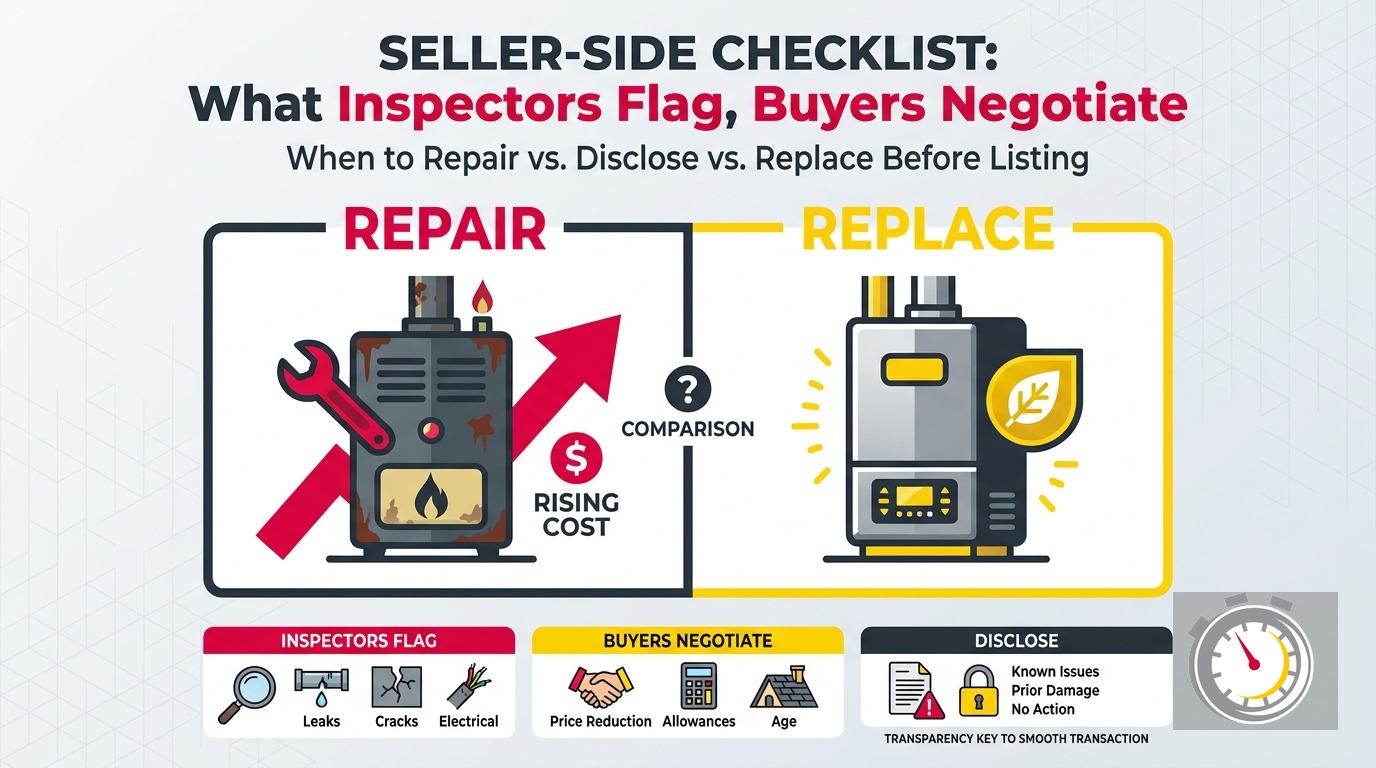
Sellers typically recover about 40-60 cents per dollar spent on pre-sale HVAC replacement. A closing credit or price adjustment is usually the better financial move. The exceptions are a fully failed system and buyers using FHA or VA financing, which require functional HVAC for loan approval.
Here is a decision framework:
Repair: Best when the system is functional and the repair cost is low relative to system age. A useful age-times-cost rule of thumb: multiply the system’s age in years by the repair cost in dollars. If the result exceeds $5,000, replacement is generally more cost-effective than repair. A 14-year-old furnace needing a $400 repair lands at $5,600 - that crosses the threshold.
Disclose without repair: Valid when the system is aging but functional and you have no knowledge of a specific defect. Include system age and maintenance history on the disclosure form. Price the home to reflect condition.
Closing credit: Often the best move for both sides. Instead of spending $4,950 or more on a furnace replacement that returns 40-60 cents on the dollar, offer the buyer a credit toward their own replacement. They hire their own contractor, choose their own equipment, and claim the rebates themselves. You skip the capital outlay and avoid the rebate trap covered below.
Replace: The right call when the system has failed completely, when the buyer’s lender requires it for loan approval, or when the system poses a documented safety risk. For Twin Cities furnace replacement, plan on $4,950 and up for an 80% AFUE unit, $6,500 and up for a 95-96% AFUE model, and $9,100 and up for a top-tier high-efficiency system - installed, parts and labor.
For a deeper look at how a new HVAC system affects your home’s sale value, see our post on HVAC and home resale value in Minnesota.
Do You Lose the Rebate If You Replace Before Listing?
Yes. Utility rebates attach to the equipment owner at the time of installation. Replace before listing and you absorb the full cost - but the buyer captures the rebate when they take ownership. A closing credit lets the buyer fund their own replacement and claim the rebate themselves, which often makes a credit the faster resolution for both sides.
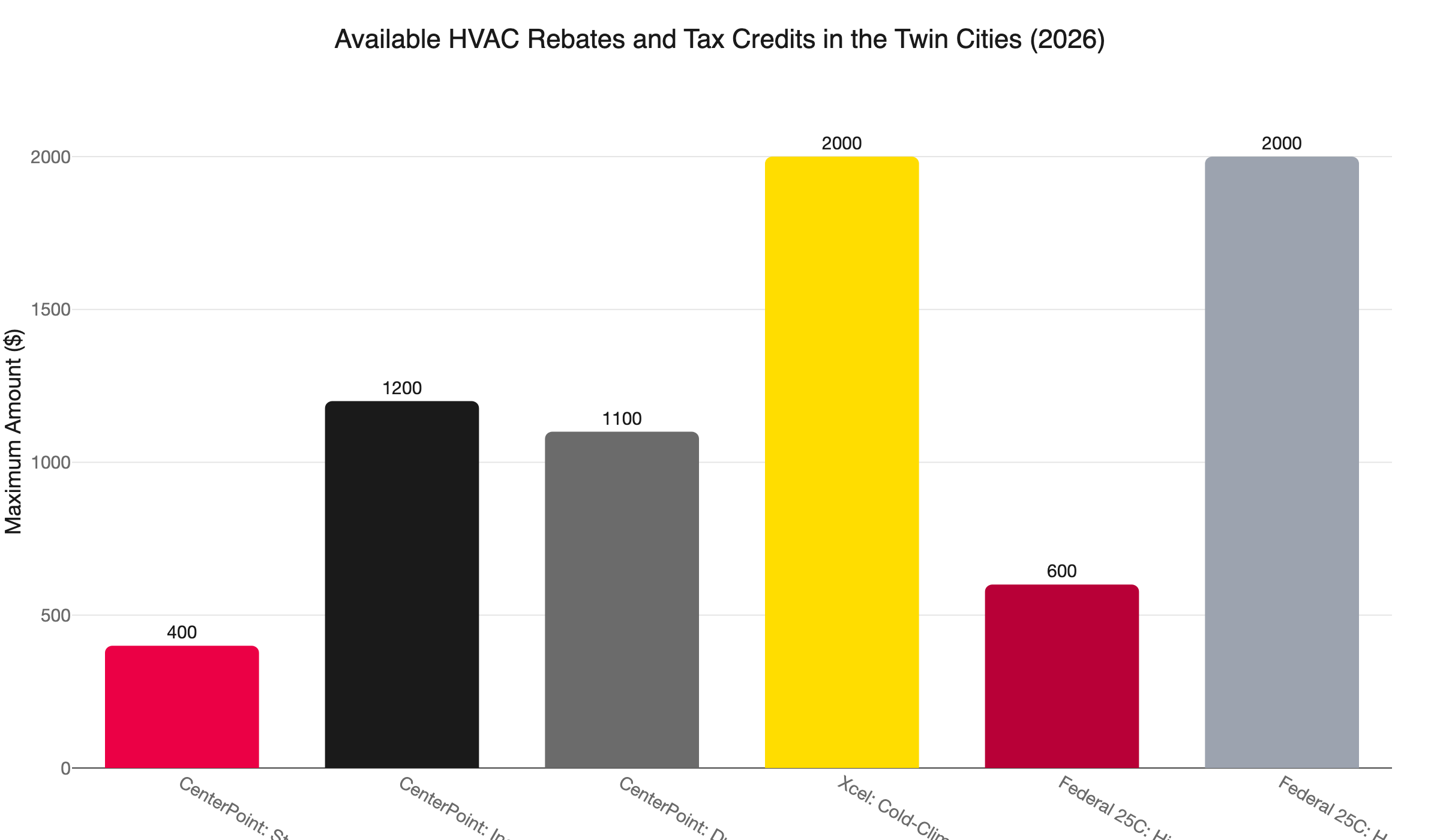
Here is what is on the table in the Twin Cities in 2026:
CenterPoint Energy: Up to $400 on a 95%+ AFUE gas furnace. Up to $1,200 for income-qualified households. Up to $1,100 on a dual-fuel heat pump paired with a 92%+ AFUE furnace. Full rebate details are available here.
Xcel Energy: Gas furnace rebates ended January 1, 2026. Cold-climate heat pump rebates remain, up to $2,000.
Federal Section 25C credit: Up to $600 for qualifying high-efficiency furnaces and up to $2,000 for qualifying heat pumps, covering 30% of installation costs. Note: some sources report the federal heat pump credit ended December 31, 2025. Verify current status before committing to a specific system.
A buyer who negotiates a closing credit can apply it toward their own installation and claim the applicable rebate on top. That combination - credit plus rebate - is why closing credits often resolve HVAC issues faster than a pre-listing replacement does for either party. Our Xcel and CenterPoint HVAC rebates guide covers the full picture for Twin Cities homeowners.
What Happens With FHA or VA Buyers?
FHA and VA loans require functional HVAC at closing. A system that has failed or been condemned does not create negotiating leverage - it blocks loan approval. If your buyers are using government-backed financing, a non-functional HVAC system must be repaired or replaced before closing. A closing credit does not satisfy the lender’s requirement.
This is the one scenario where repairing to functional status - or replacing outright - is required rather than optional. Talk with your listing agent early about the type of financing your buyers are likely to use. FHA buyers are common across many Twin Cities price ranges. Their lenders will require a working system before a loan closes. You want to know that before you are in contract, not after.
If your system has failed or been flagged as unsafe, call us before you list. We can assess what it takes to bring the system to functional status and tell you whether a targeted repair or a full replacement fits your timeline and sale price.
How Much Does a Pre-Sale HVAC Inspection Cost in Minnesota?
A dedicated pre-sale HVAC inspection with a written condition report typically runs $95-$250. That cost is small relative to what it protects against: a safety flag during buyer negotiations, a heat exchanger diagnosis that surfaces at the worst moment, or an FHA lender hold the week before closing.
The inspection delivers a written assessment of current system condition. Share it with your listing agent. Include it in your disclosures. Use it to decide whether a repair makes sense before going live. It also documents that you acted in good faith - which matters if a disclosure question comes up after closing.
Many pre-sale inspections include a tune-up pass at the same visit. For aging systems, the technician can tell you directly whether a repair crosses or falls below the replacement threshold. If the repair is the right call, it can usually be handled that same day.
Schedule Your Inspection Before You List
We are Northern One Hour Heating and Air Conditioning, locally owned and operated in Ramsey, MN. We serve Minneapolis, Saint Paul, Blaine, Maple Grove, Plymouth, Brooklyn Park, Woodbury, Bloomington, and the surrounding Twin Cities metro. When you call us for a pre-listing inspection, you get a straight answer about what the system’s condition is - not a sales pitch.
Our promise is “Always On Time… Or You Don’t Pay a Dime!(R)” That applies to your pre-listing inspection the same as any other service call. We show up when we say we will, and we give you a written report you can take into the sale with confidence.
Call (763) 260-6662 or book online to schedule your pre-listing HVAC inspection. The sooner you have documentation, the more options you have when offers start coming in.
Frequently Asked Questions
Is a separate HVAC inspection required when selling a home in Minnesota? +
What HVAC defects must I disclose when selling in Minnesota? +
Should I replace my HVAC system before selling my home? +
Who gets the utility rebate if I replace the furnace before selling? +
Need a technician now?