
Does New HVAC Increase Home Value in Minnesota?
Key Takeaways
- Sellers who ask does new HVAC increase home value in Minnesota get a partial yes. Full replacement recoups 40-70% of installation costs at appraisal and helps homes sell 10-15% faster.
- The bigger financial impact is usually avoiding the $4,500-$20,000 in buyer concessions that an aging or failing system triggers at inspection. HVAC is the second-most-common concession trigger.
- In Minnesota, a 15-year-old furnace carries more risk at closing than in warmer markets. Heating is essential infrastructure here, not a comfort add-on.
- Twin Cities sellers on both Xcel Energy and CenterPoint can stack up to $3,100 in combined 2026 utility rebates. Minneapolis city programs can add up to $14,000 for qualifying heat pump installations.
- The federal 25C tax credit ended December 31, 2025. Utility and city rebates are now the primary financial lever for pre-listing replacements.
- A pulled permit and a passed inspection create the paper trail that supports a positive appraisal condition rating. Unpermitted HVAC work is one of the strongest negative signals an appraiser can find.
The Real Question Is What Your Old System Costs at Closing
Most sellers ask the wrong question. “Does new HVAC increase home value in Minnesota?” frames this as an asset question. The more useful frame is different. What is your aging system silently costing you at the negotiation table?
A buyer’s inspector flags a 17-year-old furnace in October. The buyers send back a $9,000 credit request. You either give up the money or risk the deal. That scenario plays out across the Twin Cities every fall. It happens because heating is not optional here the way cooling is in milder markets. A flagged furnace is nearly always a concession point.
In warmer states, an aging AC system is a negotiating inconvenience. In Minnesota, a failing furnace is a deal-stopper. That distinction changes the entire financial calculus for sellers here.
This post walks through how appraisers actually score your mechanical systems and what buyers demand at inspection. It also covers how the 2026 rebate math might make a pre-listing replacement more affordable than you expect.
How Do Appraisers Actually Score HVAC in Minnesota?
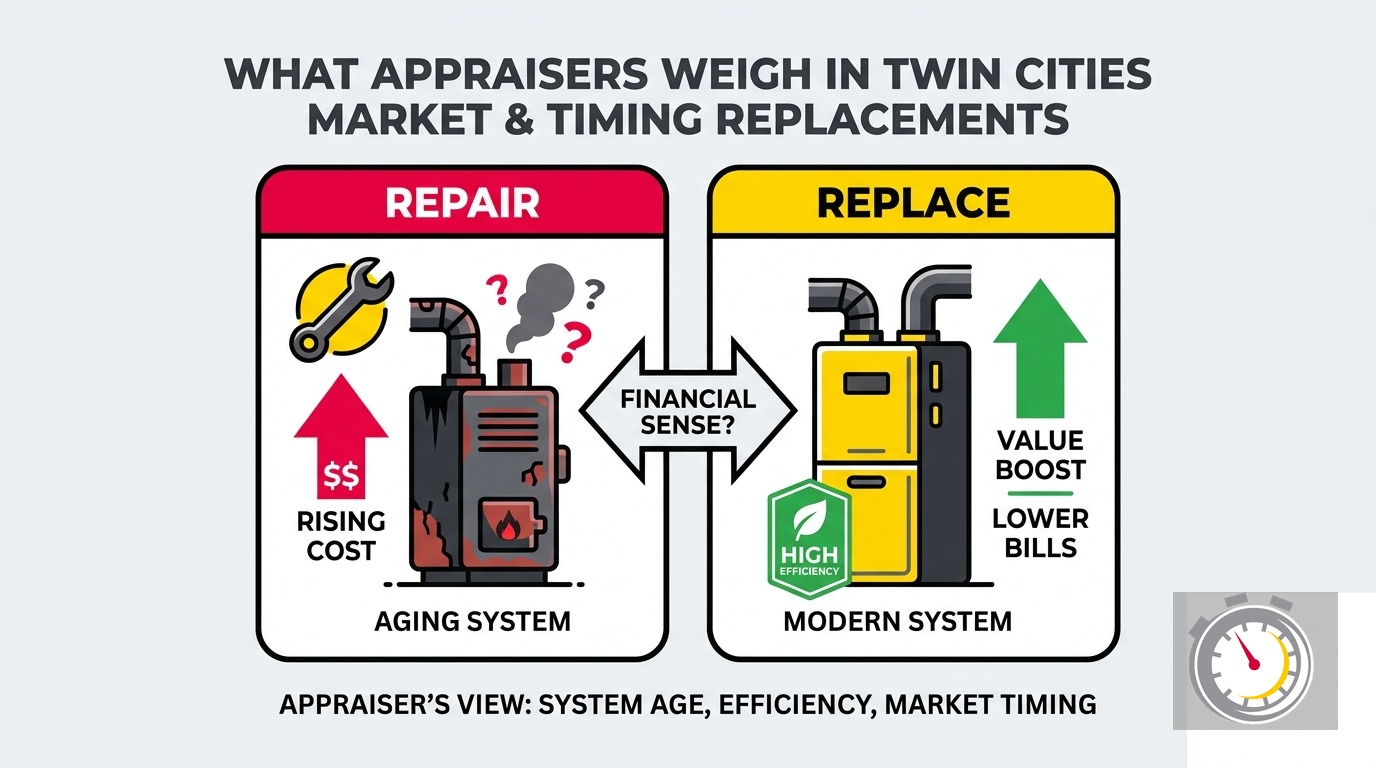
Short answer: Appraisers do not give your HVAC a standalone dollar value. They score it under Physical Condition, and the system’s remaining useful life adjusts your home’s “effective age.” A high-efficiency system supports a younger effective age. A failing system drags the whole appraisal down.
Under USPAP guidelines, HVAC falls into the Physical Condition category alongside plumbing, electrical, and the roof. Appraisers do not write a separate line item for your furnace or AC. Instead, they assess remaining useful life. That judgment folds into an effective-age calculation that ripples through the entire comparable analysis.
Two efficiency metrics have become increasingly visible to appraisers as of 2026: SEER2 for cooling and AFUE for heating. A system rated SEER2 16 or higher and AFUE 95% or better supports a positive condition adjustment. Obsolete systems trigger a deferred-maintenance flag. High-efficiency systems can reduce monthly utility bills by 10-30%, and appraisers translate those savings into positive adjustments on the condition rating.
One important distinction: a repair alone does not move the needle. It prevents a negative flag. It does not earn a higher Overall Condition rating. Only a replacement, with the right equipment, properly permitted and installed, supports an upward adjustment.
The system’s age also matters to lenders. Deferred HVAC maintenance signals broader neglect. That increases lender risk. It can push an appraiser toward a more conservative overall valuation, not just a mechanical note.
What Happens When Buyers Flag an Aging System at Inspection?
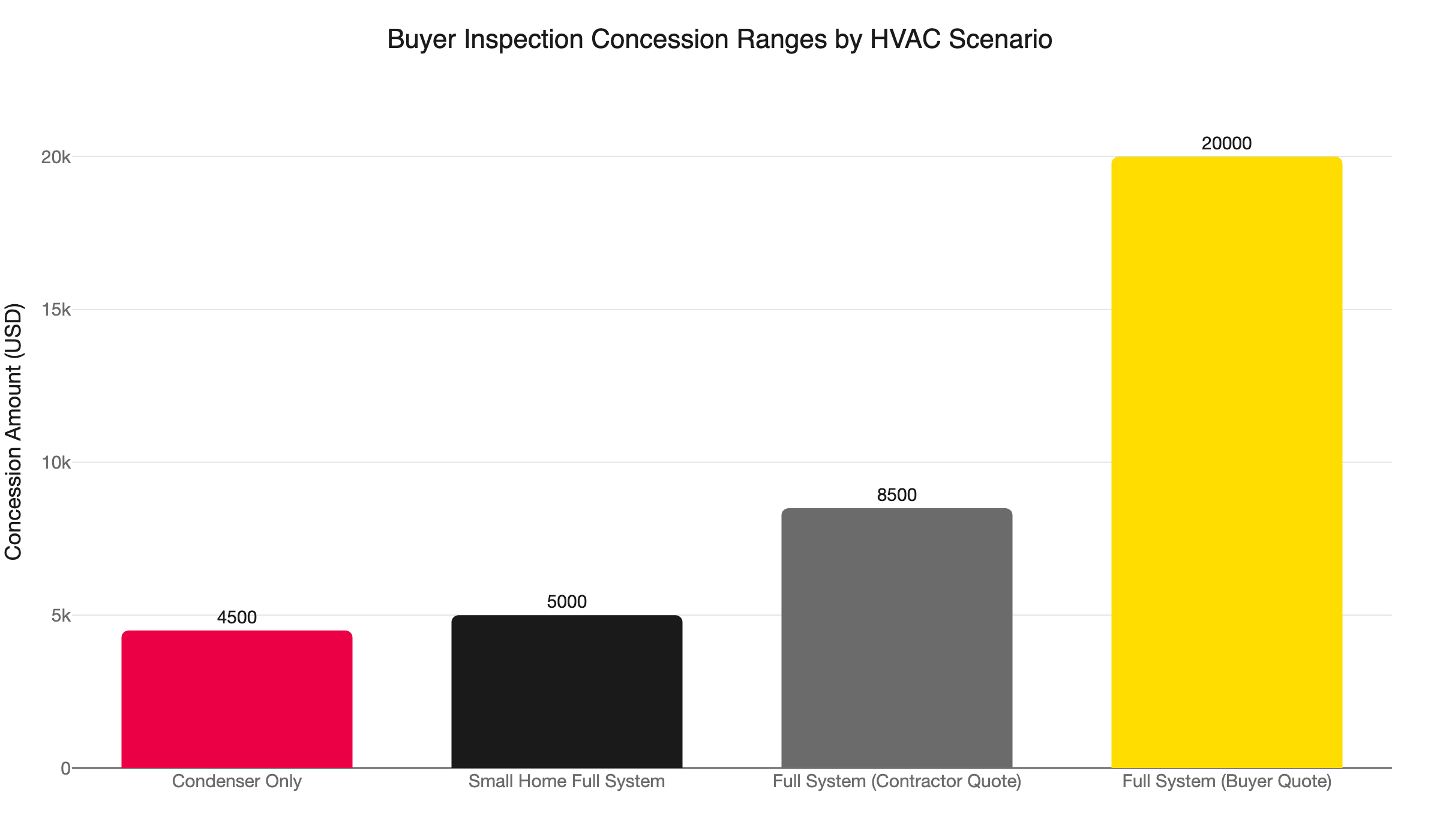
Short answer: HVAC condition is the second-most-common concession trigger at inspection, behind price reductions. Concession requests range from $4,500 for a condenser-only swap to $20,000 if the buyer sources their own contractor quote. That is a wide window of financial exposure sitting on your listing.
About 27% of recent buyers asked sellers for repair money at inspection. HVAC tops the list of what triggers those requests. Here is what the concession amounts look like in practice:
- Condenser-only swap: around $4,500
- Small home full system replacement: around $5,000
- Full system failure at contractor pricing: $8,000-$9,000
- Full system if the buyer brings their own quote: up to $20,000
These are not estimates from a model. They are actual concession amounts from broker interviews. In a competitive market, a seller can sometimes hold firm. In a slow market, a $9,000 credit request can end a deal. Or it forces a price drop that costs more than the replacement would have.
The leverage also shifts completely once the inspection report is filed. Buyers know exactly what they found. They have a written document. Replacing the system before listing removes that concession window entirely. You negotiate from a clean report rather than a repair-request letter.
Should You Replace, Offer a Credit, or Leave It Alone?
Short answer: The answer depends almost entirely on system age and current condition. Systems under 10 years old and working normally need nothing. Systems 10-15 years old warrant a pre-negotiated credit. Systems 15 or more years old with any intermittent problems need a pre-listing inspection. Non-functional systems should be replaced before listing.
Here is the full framework, built from guidance from real estate brokers and HVAC professionals:
Under 10 years old and working: Do nothing. The system is young enough that buyers have no grounds for a concession request. Appraisers will not flag it. Replacing a healthy 8-year-old furnace wastes money you will not recover.
10-15 years old and working: Offer a pre-negotiated credit rather than replacing. The system has useful life remaining. But it is old enough to generate buyer anxiety. Getting ahead of it with a transparent credit signals honesty and removes the inspection concession from play before it becomes a standoff.
15 years or older, or showing intermittent problems: Get a pre-listing inspection from a licensed HVAC technician. A tune-up and a clean service log can extend the system’s useful life and give buyers confidence. If the system is beyond reliable service, replacement before listing is the smarter financial move. You control the cost. The buyer does not.
Non-functional: Replace before listing. A dead furnace or a non-working AC unit will kill a deal or force an enormous last-minute discount. There is no credit amount that makes a non-functional heating system acceptable to buyers or lenders in Minnesota.
For context on what a replacement actually costs in our market, our guide to furnace replacement costs in the Twin Cities breaks down the price range by equipment type and efficiency tier.
Does New HVAC Increase Home Value in Minnesota? What the Data Shows
Short answer: Yes, but not dollar-for-dollar. Full HVAC replacement recoups 40-70% of installation costs on appraisal and helps homes sell 10-15% faster than homes with aging systems. The like-for-like ROI from industry data runs closer to 30%, with a 5-7% home value bump. The bigger financial impact is the concession risk you are no longer carrying.
The right way to think about it: you are not installing new equipment to profit on the upgrade. You are protecting the deal. A new system eliminates the inspection concession window, supports a better appraisal condition rating, and gives buyers confidence that a major capital item is not sitting on borrowed time.
One note on heat pump conversions specifically: heat pump ROI peaked nationally at 96.1% in 2023. It dropped to 49-66% in 2024 and fell out of the top 10 nationally in 2025. If you are considering a heat pump conversion primarily for resale value, the economics are less clear than they were two years ago. The efficiency and comfort gains are real. A guaranteed appraisal uplift that covers the full project cost is not.
A like-for-like replacement, properly permitted, at a high-efficiency rating, is the most defensible pre-listing investment. It removes the concession risk, supports the appraisal, and documents the home’s mechanical history for the buyer.
For help timing a replacement to get the most value, see our post on the best time to replace a furnace and AC in the Twin Cities.
Why Does HVAC Condition Matter More in Minnesota Than in Warmer States?
Short answer: In Minnesota, heating is not optional. A furnace failure in January is a household emergency. Buyers and appraisers in cold-climate markets weight heating system age and condition more heavily than they do in markets where heat is a comfort feature rather than essential infrastructure.
Phoenix sellers list with 15-year-old AC units and rarely lose deals over it. A Twin Cities seller with a 15-year-old furnace flagged in a November inspection faces a different negotiation entirely. Buyers here know this system will run continuously for five to seven months a year. They know sub-zero temperatures are not edge cases. They know what a mid-winter breakdown costs - emergency service rates, hotel stays, potential pipe damage.
That cold-climate risk premium shows up at the appraisal level too. Deferred maintenance on HVAC signals broader neglect to appraisers, increasing lender risk and triggering downward adjustments that go beyond the mechanical line item. A Minnesota appraiser reviewing a home with a 20-year-old furnace is not treating it as a minor checkbox. It is evidence about how the home has been cared for across the board.
The load-bearing nature of heating in our climate also means that furnace condition is weighted more heavily than AC condition in a Minnesota appraisal. Both matter. But a failing furnace in January is a more immediate liability than a struggling AC unit in July.
How Does the 2026 Rebate Math Change the Replace-vs-Credit Decision?
Short answer: The federal 25C tax credit ended December 31, 2025. But Xcel Energy and CenterPoint Energy rebates remain active in 2026. Twin Cities households on both utilities can stack up to $3,100 in combined rebates on a qualifying dual-fuel system. Minneapolis city programs can add up to $14,000 on qualifying heat pump installations. That math changes the net cost of a pre-listing replacement significantly.
Here is the current rebate landscape for 2026:
Xcel Energy:
- Furnace: $200 at 95% AFUE, $300 at 96% AFUE, $400 at 97% AFUE
- Central AC: $150-$450 (13.4-15.2 SEER2) with Quality Install by a participating contractor
- Cold-climate heat pump: up to $2,000
- Bonus $600 when installed after qualifying insulation or air-sealing work
CenterPoint Energy:
- Furnace: up to $400 standard (95%+ AFUE), up to $1,200 for income-qualified households
- Dual-fuel heat pump (paired with a 92%+ AFUE gas furnace, switching to gas at 40°F or colder): $1,100
- Note: CenterPoint does not rebate mini-splits or full-electric replacements
Xcel and CenterPoint customers can stack both utility rebates on a qualifying dual-fuel system for up to $3,100 combined. Minneapolis city rebates can add up to $14,000 for heat pump installations on top of utility rebates.
That stacking math reframes the decision. A $12,000-$13,000 pre-listing replacement drops closer to $9,000-$10,000 net after utility rebates. That is roughly what a buyer might demand as an inspection concession anyway. You absorb a similar cost either way. But replacing before listing means you control the contractor, the timeline, and the quality of the work.
For a full breakdown of current programs and how to apply, see our guide to Xcel and CenterPoint HVAC rebates in Minnesota.
Is Your System Running R-22? That Is a Disclosure Problem.
Short answer: R-22 refrigerant was phased out under EPA regulations. Systems still running R-22 cannot be recharged. A pre-listing inspection that surfaces an R-22 unit creates a disclosure obligation and a near-certain buyer concession. New systems use R-454B, which is compliant and signals positively to appraisers.
If your outdoor AC or heat pump unit is more than 15 years old, there is a real chance it is still on R-22 refrigerant. You cannot top off a leaking R-22 system with new R-22. The supply is gone. You either run it undercharged, or you replace it. A pre-listing inspection that surfaces an R-22 system creates a disclosure obligation that the buyer’s agent will act on at the negotiation table.
This is a different kind of risk than age-related wear. An R-22 system is not just old. It is a refrigerant-compliance problem. Buyers and their agents know this. Knowing before you list is always better than the buyer’s inspector surfacing it in the written report.
Our post on the R-22 freon phase-out and what it means for older AC units in Minnesota covers the full compliance picture and what your options are if your system is still running the old refrigerant.
Do HVAC Permits Affect Your Appraisal?
Short answer: Yes. A pulled permit and a passed inspection create the paper trail that supports a positive condition rating. Unpermitted HVAC work is one of the strongest negative signals an appraiser can find. It raises lender risk and can trigger downward adjustments even when the physical work itself is solid.
Furnace replacement requires a mechanical permit in virtually all Minnesota jurisdictions under Minnesota Statutes Chapter 326B. High-efficiency condensing furnaces require PVC venting and drainage provisions that are inspected differently from mid-efficiency units. Central AC installations trigger both a mechanical permit and an electrical permit. These are not optional steps.
When a buyer’s agent or appraiser asks for documentation on recent HVAC work, a permit record and passed inspection is the right answer. A handwritten receipt and a verbal “we had someone come out” is not. If you are planning a pre-listing replacement, confirm that the contractor pulls the required permits before work begins. The paper trail they create is part of what you are paying for.
Buyers increasingly ask for HVAC documentation during due diligence. A clean permit record, combined with a current service log, tells a buyer that the system was installed correctly, inspected by the jurisdiction, and maintained since. That is confidence the buyer is not going to pay you to give them if the record is missing.
When Should a Twin Cities Seller Replace Before Listing?
Short answer: Plan for at least six to eight weeks between the replacement decision and your first showing. That window covers equipment lead time, installation, permitting, and inspection. Spring and fall offer the best contractor availability and shortest lead times in the Twin Cities.
Spring and fall are the optimal replacement windows in our market. Contractors are not at peak demand. Equipment lead times are shorter. You have time before the system comes under heavy seasonal load. Replacing a furnace in September before a January listing gives you a clean service record to show buyers, and enough runway for any minor commissioning issues to surface and get resolved before the inspection.
On the calendar side, avoid trying to schedule a pre-listing replacement during the December-January heating rush or the July AC peak. Lead times stretch. Prices can climb. And you lose the cushion you need before the first showing.
If you are not sure whether your system needs replacement or just maintenance, a pre-listing inspection is the right starting point. A qualified technician can walk through the system, tell you honestly where it stands, and document the condition in writing. That report is useful whether you replace, offer a credit, or simply show up to the inspection table with a clean service history.
Schedule a Pre-Listing HVAC Inspection With Our Team
As a locally owned and operated HVAC company serving the Twin Cities, Ramsey, Blaine, Maple Grove, Plymouth, Brooklyn Park, and the surrounding area, we help homeowners understand exactly where their system stands before they list. We give you an honest condition assessment. We do not push replacement on systems that do not need it.
When a replacement does make sense, we pull the permits, install the equipment to manufacturer and code standards, and walk you through the Xcel and CenterPoint rebate process so you capture every dollar available before your first showing.
We back every appointment with “Always On Time… Or You Don’t Pay a Dime!(R)”. Your time and your sale timeline matter to us.
Call (763) 260-6662 or book your pre-listing inspection online today.
Frequently Asked Questions
Does replacing HVAC before selling increase home value in Minnesota? +
What HVAC rebates are available in Minnesota in 2026? +
How old does my HVAC system need to be before I should replace it before selling? +
Need a technician now?