
HVAC Records for Home Sale Minnesota: What to Keep
Key Takeaways
- Keep service receipts, installation invoices, warranty cards, permit copies, and rebate paperwork for every furnace, AC, boiler, and heat pump.
- Records turn an unknown, like an old furnace, into a known item a buyer can price.
- Missing paperwork often reads as missing maintenance. Buyers and their agents notice.
- Minnesota sellers must disclose known material facts. A two-year liability window follows closing.
- Ask your city for a permit history. Permits are issued city by city.
- A documented service history protects you as well as helping you sell.
- Check your warranty terms before assuming coverage transfers to the buyer.
Quick Answer: What to Gather Before You List
Pull every HVAC receipt, warranty card, and permit copy you own into one folder before you list your home. That folder proves how old your system is and how well you cared for it. In Minnesota, it also helps protect you after closing.
We are Northern One Hour Heating & Air Conditioning, a locally owned and operated team serving the Twin Cities. We see these files, and the empty ones, every week.
Why Do HVAC Records Matter When You Sell a Minnesota Home?
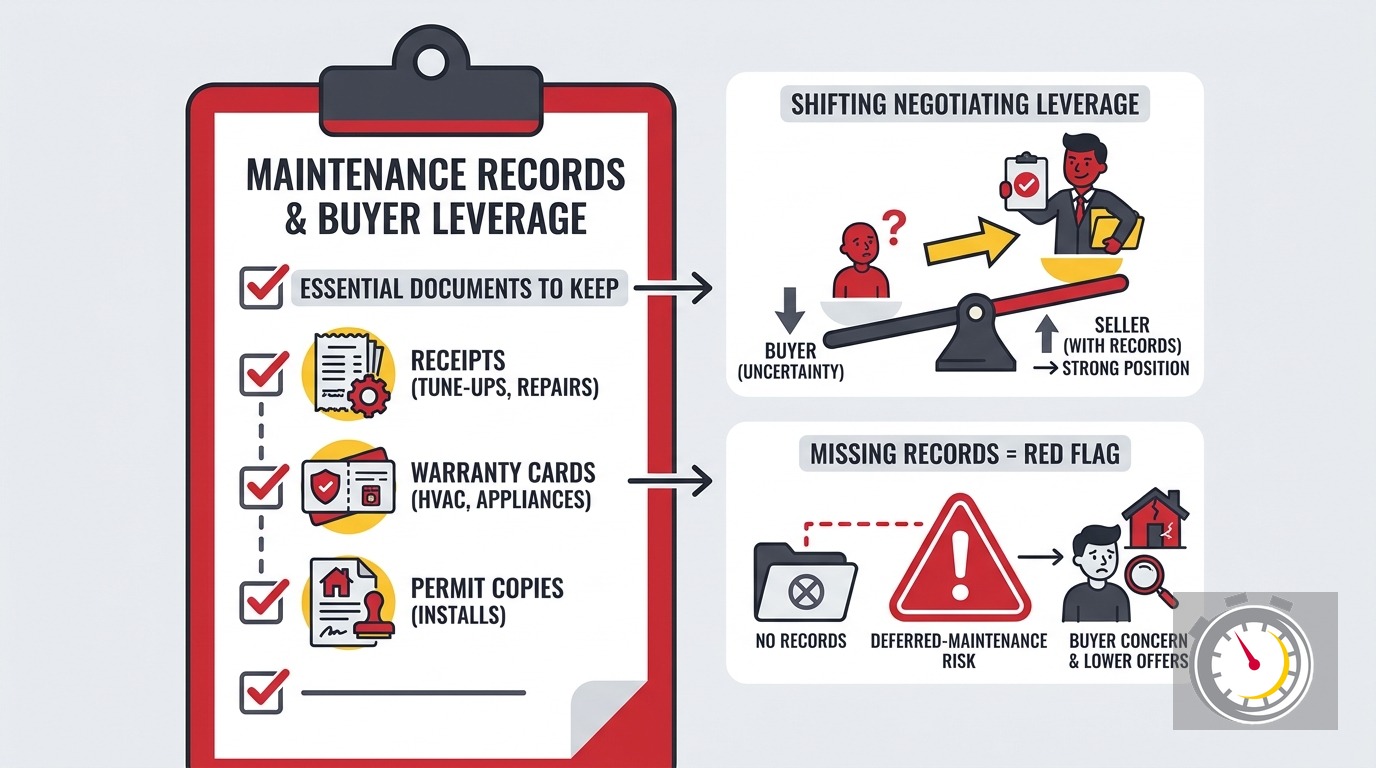
HVAC records show a buyer what the system is, how old it is, and how it was treated. They replace guesses with facts. A buyer who sees proof of care worries less and negotiates less. A buyer who sees nothing assumes the worst.
Picture how a sale unfolds. The buyer hires an inspector. The inspector finds a furnace with a nameplate that dates to 2009 and writes a line in the report.
That line is where leverage lives. An undocumented 15-year-old furnace is an unknown. The buyer’s agent will ask for a credit to cover it.
With records, the same furnace is a known item. It was tuned up every fall. It had one flame sensor cleaning. It still has years left. The buyer can price that, and pricing is easier than fear.
Minnesota winters sharpen this. A buyer touring in January is picturing the next January. Furnace age and heat exchanger condition sit near the top of most buyers’ worry lists.
MNCEE, a Minnesota nonprofit, reports that about 55% of the energy used by Minnesota homes goes to heating and cooling. The system is a big part of what the buyer will pay to run the house.
What Does Minnesota Law Say About Disclosing HVAC Problems?
Minnesota requires sellers to disclose all material facts they know of that could significantly and adversely affect a buyer’s use and enjoyment of the home. The disclosure must be made in good faith and reflect your best knowledge. A heating system with known problems can qualify.
The rule comes from Minn. Stat. 513.55. The key phrase is “of which the seller is aware.” The law turns on what you know, not what you wish you knew.
Now the liability side. Under Minn. Stat. 513.57, a seller who knew of material facts and failed to disclose them is liable to the buyer. The action must start within two years after the buyer closed.
That window changes what your records are for. They are evidence of what you knew and when, as well as a sales tool.
Say a buyer’s furnace fails 14 months after closing, and they claim you hid a problem. A folder with annual tune-ups, a technician’s note on the furnace’s condition, and your honest disclosure is a strong response.
The same statute offers some relief. A seller is not liable for errors outside personal knowledge if they used ordinary care. It also preserves fraud and negligent-misrepresentation claims. Records show ordinary care.
This is not legal advice. Talk to your real estate agent or an attorney about your disclosure. The practical point still holds: documented care protects you.
Which HVAC Receipts and Service Records Should You Keep?
Keep every document that shows what was installed, what was repaired, and when. That means installation invoices, repair invoices, annual tune-up reports, filter or part purchase receipts, and any technician notes about condition. Organize them by system and date.
Here is the core list:
- Installation invoice. It shows the install date, the brand, and the model number. This is your proof of equipment age.
- Tune-up reports. Each one shows the date and what the technician checked.
- Repair invoices. They show what failed, what was replaced, and the cost.
- Technician notes. A note like “heat exchanger inspected, no cracks” carries weight.
- Part and filter receipts. They show routine care between visits.
- Carbon monoxide test results. Combustion safety checks matter on gas systems.
One Minnesota seller guide puts it plainly: “Inspection reports, permits, repair invoices, and warranties help verify your disclosures.” It also says sellers should report problems they already fixed.
A repaired problem with a receipt is a small story. A repaired problem with no receipt is a rumor.
What should a tune-up record show?
A good tune-up record lists the date, the company, and what was checked. MNCEE explains that a tune-up checks for worn parts, cleans the system, and checks carbon monoxide levels. The results show the system’s condition and whether it is nearing replacement age.
Buyers care most about that last detail. A report that says “good condition, normal wear” is gold. Ask your technician to write it plainly.
The same page puts an average furnace tune-up at $75 to $200. A few of those receipts cost far less than the credit a buyer might request for an undocumented system. For what a visit includes, see our guide on what a furnace tune-up covers.
How should a seller record the DIY work?
Write it down. Filter changes count. MNCEE suggests replacing the filter every three months. If you did that, a simple dated log is fine.
A log is weaker than a technician’s report, but far better than silence. Keep it short: date, task, and filter size.
What Warranty Paperwork Should You Hand the Buyer?
Hand the buyer the warranty card or registration confirmation, the equipment manual, and any extended-warranty contract. Also include proof that you registered the equipment. These documents tell the buyer what coverage exists and what steps keep it alive.
Warranties are easy to lose. They end up in a drawer, a basement box, or an email from 2017. Search for them now, not the week before closing.
Here is what to look for:
- The original manufacturer warranty card or registration confirmation.
- The equipment manual, which lists model and serial numbers.
- Any extended or parts-and-labor warranty contract.
- Proof of service, if your warranty depends on it.
Be careful about promises. Some warranties may need proof of regular service to stay valid. Others may not transfer to a new owner, or may require a transfer step. Terms differ by manufacturer and by contract.
Don’t tell a buyer “it’s still under warranty” unless you have checked. Read your terms and the transfer rules. If you are unsure, call the manufacturer with your serial number.
Our team wrote a full guide on what homeowners miss when registering HVAC warranties. Read it before you list.
Which Permit Copies Do You Need?
Keep the permit and final inspection record for any furnace, AC, boiler, or heat pump install or replacement. In many Minnesota cities, even a same-for-same swap needs a mechanical permit. An unpermitted replacement can become a disclosure problem when you sell.
Individual cities issue permits. Rules, forms, and lookup processes differ from Minneapolis to Blaine to Woodbury, so no single rule fits every city.
The disclosure form is direct about this. The seller guide notes that the form asks about “Any work done without permits.” You will need an honest answer.
Here is a practical plan:
- Find the permit copies you already have.
- Call your city’s building or inspections office.
- Ask for a permit history for your address.
- Match each permit to an install invoice.
- Note any equipment with no matching permit.
If you find a gap, don’t hide it. Talk to your agent early. Fixing a permit gap before listing is cheaper than fixing it during a buyer’s inspection period.
Our guides on when an HVAC permit is required in Minnesota and permit costs can help you plan. A reputable contractor pulls the permit for you and gives you the paperwork.
Does a contractor’s bond prove the work was good?
No. Minnesota has no state mechanical contractor license. Businesses must file a $25,000 mechanical contractor bond with the state, according to the Minnesota Department of Labor and Industry. The filing fee is $100, and the filing is valid for two years.
A bond is a financial backstop, not a test of skill. A buyer cannot assume the last installer was competent. Your paperwork shows what was actually done.
How Do Records Shift Negotiating Leverage?
Records shift leverage by turning vague risk into a priced, known item. Without them, a buyer can ask for a large credit to cover unknown costs. With them, you can show the system’s age, care, and condition, which narrows what a reasonable buyer can ask for.
Consider two sellers with identical 14-year-old furnaces.
Seller A has a folder. It holds the install invoice, 13 years of tune-up reports, one repair receipt, and the permit. The inspector’s note says “operating normally, age noted.” The buyer’s agent has little to argue.
Seller B has nothing. The inspector writes the same note. The buyer’s agent calls the furnace near end of life, undocumented, and a risk, then asks for a credit toward replacement.
For context, a furnace replacement in the Twin Cities commonly runs $3,900 to $7,800 installed, with high-efficiency models costing more. See our furnace replacement cost guide for the details. Even a partial credit toward that number can exceed the cost of every tune-up you skipped.
At the table, records do three things:
- They answer questions before the buyer asks.
- They shorten the inspection-response phase.
- They keep the talk on your terms, not the buyer’s worst case.
They do not guarantee a price. A system at the end of its life is still at the end of its life. But records stop a buyer from assuming the worst.
Why Do Missing Records Look Like Deferred Maintenance?
Buyers have no other evidence to read, so missing records look like deferred maintenance. A buyer’s agent sees an old system and an empty folder. The simplest explanation is that nobody serviced it. That assumption becomes a negotiating point.
Most sellers don’t see this coming. You may have cared for your furnace well and changed filters on schedule. If you cannot prove it, the buyer cannot credit it.
Think of a used-car buyer. A car with a stack of oil-change receipts feels safe. A car with no history feels like a gamble. HVAC works the same way.
Our own experience backs this up. Skipped maintenance shows up in the equipment, and an inspector or technician can often tell. We cover this in what happens when you skip HVAC maintenance for years.
A gap does two kinds of damage. It hides your good care, and it invites a buyer to price in bad care.
What can you do if your records are thin?
Start with what you can recover:
- Call past HVAC companies. Many keep service histories on file.
- Search your email for invoices and appointment confirmations.
- Check bank and credit card statements for HVAC payments.
- Ask your city for a permit history.
- Find the equipment’s age using the nameplate. Our guide on finding your HVAC system’s age shows how.
- Schedule a current inspection and tune-up to create a fresh, dated record.
That last step is the most useful. A tune-up report written this month tells the buyer the system’s condition today. It does not erase past gaps, but it replaces the blank with something real.
Be honest in your disclosure. If you do not know the install date, say so. Don’t guess. Minn. Stat. 513.55 asks for your best knowledge, in good faith.
Does Replacing HVAC Increase Home Value?
Replacing an aging HVAC system can help a home sell, but the return varies. Buyers value a newer system with a warranty and proof of install. They often discount an old one. The paperwork matters as much as the equipment, because buyers pay for what they can verify.
We won’t promise a dollar return. It depends on your home, your market, and the system you replace. A new system removes a big worry from the buyer’s list and resets the age clock.
There is a catch. A new system without records is a weaker story than a new system with them. Keep the install invoice, the permit, the warranty registration, and any rebate paperwork. Those documents prove the system is new, correctly installed, and covered.
If you are deciding whether to replace before listing, read our guide on resale value and new HVAC in Minnesota. Also compare it with our advice on HVAC before selling your home.
Sometimes the better move is a tune-up and a clear record, not a full replacement. A technician can tell you which path fits your system. If you do replace, ask about financing for the larger job.
What About Rebate and Tax Credit Paperwork?
Keep rebate approvals, invoices, and equipment model numbers. They double as proof of the equipment’s age and efficiency, which a buyer cannot easily verify otherwise. They also show that the work met program requirements.
Utility rebate programs often require qualifying equipment and an invoice. Amounts, caps, and deadlines change, so confirm current details with your utility. Our guide on Xcel and CenterPoint HVAC rebates walks through the programs we see most.
The federal credit works differently. The IRS energy efficient home improvement credit applied to improvements made through December 31, 2025. Heat pumps were capped at $2,000 per year. Central AC and gas furnaces or boilers were capped at $600 per item, within an overall $1,200 per year limit.
That credit has ended. A buyer may still ask whether it was claimed on equipment you installed. If you claimed it, your tax records and the install invoice tell the story.
The IRS page says nothing about keeping receipts, so treat this as common sense, not a rule. If you claimed a credit or rebate, keep the paperwork with your HVAC file.
Ask your tax preparer what you filed. Don’t guess what the buyer might ask about.
How Do You Build Your HVAC File in One Weekend?
Set aside two hours to gather paper and digital records. Sort them by system. Scan everything. Add a one-page summary listing each system, its install date, its last service, and its permit status. Hand a copy to your agent before photos are taken.
Here is a simple process:
- Make a folder for each system. Furnace, AC, boiler, heat pump, thermostat, and any air quality equipment each get their own.
- Collect what you have. Check drawers, basements, email, and your furnace room.
- Photograph the nameplates. Capture the model and serial number on each unit.
- Request what is missing. Call past contractors and your city.
- Scan everything. Save PDFs with clear names, like “furnace-install-invoice-2016.”
- Write the one-page summary. Keep it factual and short.
- Share it with your agent. They can put it in the listing materials.
If you changed filters yourself, add a short service log. Date, task, and filter size are enough.
Keep a paper copy near the furnace or in a labeled folder in the home. Buyers and inspectors like seeing it on site. It signals an owner who pays attention.
What Should You Do Before the Buyer’s Inspection?
Schedule a tune-up before you list. A technician can catch small problems, clean the system, and write a dated report. That report goes straight into your file. It also lets you fix issues on your timeline, not during a buyer’s inspection window.
Timing matters. A tune-up in the weeks before listing gives you a current condition report and time to handle any repair at a fair pace.
If the technician finds something, you have two options. Fix it and keep the receipt. Or disclose it honestly and let the buyer decide. Both beat a surprise.
Our technicians arrive within the time window you choose. We stand behind it with our promise: “Always On Time… Or You Don’t Pay a Dime!(R)” If the technician does not show up on time, you do not pay for the service. That helps when you are juggling showings and closing dates.
As a locally owned and operated company, we also keep service histories on the homes we visit. If we have worked on your system, we can help you retrieve the records.
Get Your HVAC Records Ready With a Local Team
Good records protect your price. They show a buyer that the system was cared for, and they give you evidence if questions come up after closing.
If you are preparing to sell, we can tune up your system, document its condition, and write a plain report you can hand to your agent. If a repair or replacement makes sense, we will explain your options, including financing for larger jobs.
Call Northern One Hour at (763) 260-6662 or book online to schedule fast. We serve homeowners across the Twin Cities, from Ramsey and Blaine to Maple Grove, Plymouth, Woodbury, and beyond.
Frequently Asked Questions
Are there Minnesota rebates for energy-efficient HVAC in Minneapolis? +
Are there Minnesota rebates for energy-efficient HVAC in Saint Paul? +
What if the furnace was installed before I bought the house? +
Need a technician now?