
Skipping HVAC Maintenance Consequences: A Cost Ladder
Key Takeaways
- Skipping HVAC maintenance costs more in repairs, comfort, and safety than a tune-up costs.
- A dirty flame sensor is the cheapest rung on the ladder. A new furnace is the most expensive.
- A cracked heat exchanger is a safety issue because of carbon monoxide risk.
- Federal safety guidance recommends a yearly professional inspection of fuel-burning heating systems.
- Minnesota law requires a working CO alarm within 10 feet of every sleeping room.
- A tune-up with Northern One Hour runs $95 to $250. A maintenance plan runs $195 to $390 per year.
- Utility rebates may offset part of a high-efficiency replacement. Confirm current amounts first.
What happens when you skip HVAC maintenance?
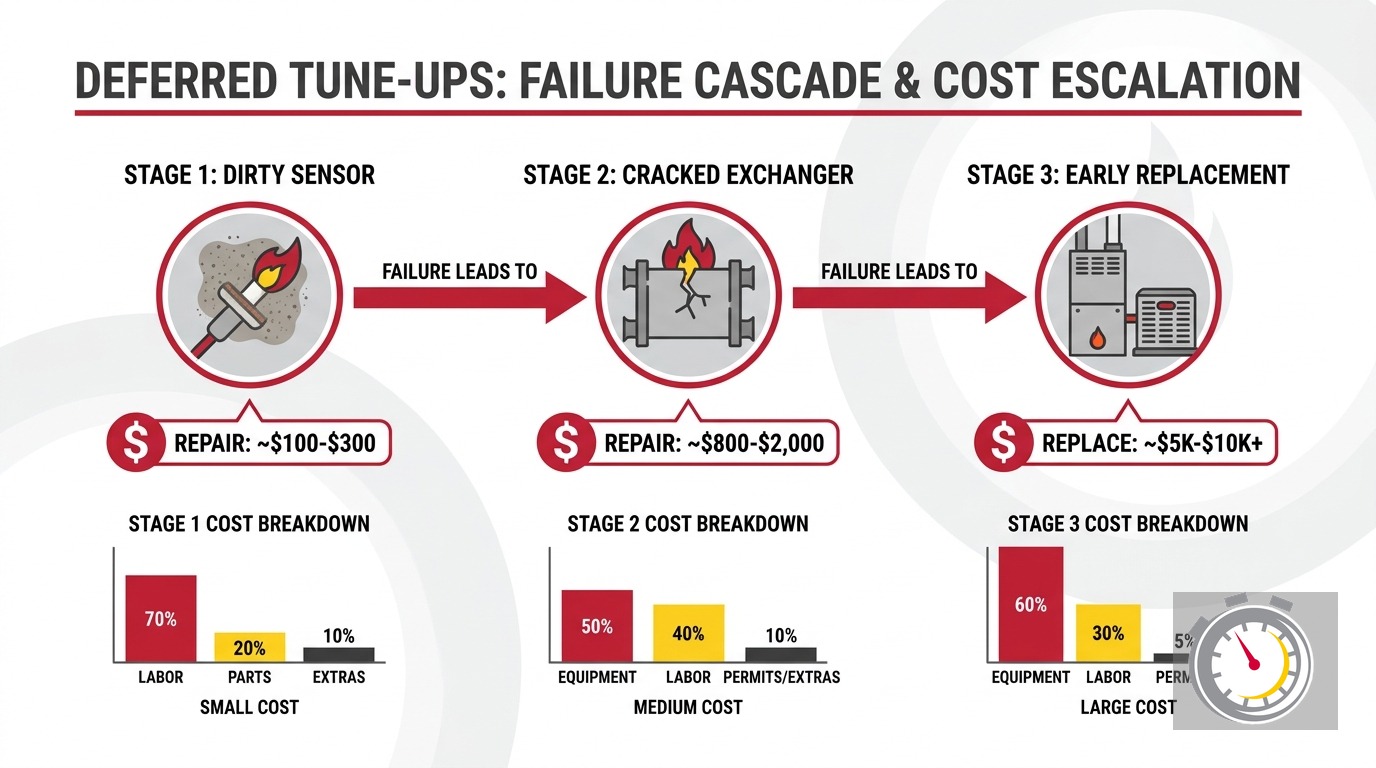
Skipped maintenance rarely breaks a system all at once. It wears the system down in stages. A small part gets dirty, the system works harder, and a minor repair becomes a major one. In a Twin Cities winter, the last stage can be a no-heat night, a safety risk, or a furnace replaced years early.
We call one common failure pattern for gas furnaces the cost ladder. Each rung costs more than the one before it.
- A flame sensor gets coated with residue.
- The furnace starts lighting, shutting off, and locking out.
- The system runs under stress, and parts that were never meant to run hot take the strain.
- A heat exchanger develops a crack.
- The repair costs so much that replacement makes more sense.
Not every dirty sensor leads to a cracked heat exchanger. Many homes never reach the upper rungs. This is a pattern we see, not a guaranteed chain of cause and effect.
Our team is locally owned and operated in Ramsey. We work in Twin Cities homes all winter. The same story shows up again and again: the cheap fix was available, and nobody made the call.
Why does a dirty flame sensor start the problem?
A flame sensor is a thin metal rod inside your furnace. It confirms the burner is lit. When residue coats the rod, it cannot sense the flame. The furnace then shuts the gas off as a safety step, even though the flame is fine.
Picture a smoke detector that has gone deaf. The furnace cannot tell everything is working, so it plays it safe and stops.
A thin film builds up on the rod over time. A yearly cleaning removes it. Skip the cleaning, and the film keeps growing.
What the first warning signs look like
The early signs are easy to dismiss. You might notice:
- The burners light, run for a few seconds, then shut off.
- The furnace cycles on and off without heating the house.
- The thermostat calls for heat, but the home stays cold.
- A blinking light on the control board that repeats a pattern.
Many homeowners reset the furnace and move on. That works for a day or two. Then the problem returns.
What this rung costs
This is the cheapest rung. National cost data puts flame sensor replacement at a modest repair cost, and the part itself is fairly inexpensive. Those are national figures, not Twin Cities prices.
At Northern One Hour, a flame sensor or igniter service runs $95 to $325. Often the sensor only needs cleaning, and that falls inside a standard tune-up. For a full walkthrough, read our guide to cleaning a dirty flame sensor and what it costs.
Catch it here, and you have spent a few hundred dollars at most. Everything after this costs more.
How does a lockout turn into overheating?
A lockout happens when the furnace fails to light several times in a row. The control board then stops trying. You get no heat until someone resets it or fixes the cause. In January, that is an emergency.
Repeat lockouts mean the system is struggling. Each failed start stresses parts that expect a clean, steady cycle. Ignoring them is like driving with the check engine light on.
Why overheating matters
Your furnace is built to move heat out of the burner area quickly. Airflow carries that heat into your ducts. When airflow drops or the burners cycle oddly, parts can run hotter than designed.
Several things can restrict airflow:
- A clogged filter.
- A dirty blower wheel.
- Blocked or undersized return air.
- Closed or blocked vents.
Each one makes the furnace work harder. A safety device called a limit switch shuts the burners down if temperatures climb too high. That protects you. But a limit switch that trips again and again tells you something is wrong.
We cannot point to a neutral study that proves one dirty part causes the next failure. Still, heat and stress are hard on metal. A furnace that runs under strain for several winters ages faster than one that runs clean.
Related reading: dirty blower wheel symptoms and not enough return air problems in Twin Cities homes both explain how airflow trouble builds.
What this rung costs
At this stage, you may need a new limit switch, a cleaned blower wheel, or a control board repair. Our control board work starts around $750 installed. A draft inducer motor runs $375 to $900. A blower motor runs $1,100 for a PSC motor and $2,200 for an ECM motor.
Notice the jump. A cleaning was a small bill. A stressed system hands you mid-sized bills, one after another.
How does a cracked heat exchanger happen?
A heat exchanger is the metal chamber that separates burning gas from the air your family breathes. Hot combustion gases pass through it. Your blower moves house air across the outside. A crack lets combustion gases mix toward your living space.
Metal expands and contracts every time the furnace cycles. Over many winters, that adds up. Age, poor airflow, and repeated stress all play a part. A crack can also come from normal wear, with no neglect at all.
That is why a yearly inspection matters. A trained technician can spot early rust, cracks, and flame problems. You cannot see inside the heat exchanger from the basement.
Why it is a safety issue
This rung is about more than money. It is about carbon monoxide, or CO. CO is a colorless, odorless gas. You cannot smell it.
Minnesota Commerce explains that CO buildup is often caused by improper venting, which may include a cracked furnace heat exchanger, blocked or undersized chimney or vents.
The U.S. Consumer Product Safety Commission adds a hard number. According to the CPSC home heating equipment page, more than 200 people die from unintentional non-fire related carbon monoxide poisoning. It also notes that heating equipment and portable generators are among the top contributors to CO deaths.
That page does not single out heat exchangers. It does make the larger point: fuel-burning heat needs regular professional care.
Signs to watch for
Call us right away if you notice:
- Headaches, dizziness, or nausea that ease when you leave the house.
- A CO alarm that sounds.
- Soot, rust streaks, or water near the furnace.
- A flame that looks lazy, yellow, or uneven.
- A strange smell when the furnace runs.
If your CO alarm goes off, leave the house first and call for help from outside. Our guide on what to do when a CO alarm goes off near your furnace lays out the steps. You can also read about the signs of a cracked heat exchanger.
What this rung costs
HomeGuide lists national heat exchanger replacement at $1,000 to $3,000. It also notes other sources range from $500 to $4,000 or more. The spread is wide because the part, the furnace brand, and the labor all vary.
There is a catch. A heat exchanger repair on an older furnace is often a poor investment, because the rest of the unit has the same age and wear. Our post on heat exchanger replacement cost versus a new furnace walks through the math.
When does a furnace get replaced early?
A furnace is replaced early when repair costs climb faster than the system’s remaining life. A cracked heat exchanger on an older unit is the classic trigger. Repeated part failures can also push you there. At that point, a repair buys little.
Many homeowners ask when repair stops making sense. A common rule of thumb says to consider replacement when repairs approach half the cost of a new system. Age matters too. The U.S. Department of Energy suggests considering replacement if a furnace or boiler is over 15 years old.
For more on timing, read how long furnaces last in Minnesota and our repair or replace guide.
What the top rung costs
New furnace pricing depends on efficiency. At Northern One Hour, a furnace replacement runs $3,900 to $7,800 installed. By tier, pricing starts at:
- $4,950 for an 80% AFUE furnace.
- $6,500 for a 95-96% AFUE furnace.
- $9,100 for a 97-98% AFUE furnace.
AFUE measures how much of your fuel becomes heat. Higher numbers waste less. You can compare tiers in our AFUE rating explainer. For a full price breakdown, see furnace replacement cost in the Twin Cities.
Early replacement hurts for another reason: it rarely happens on your schedule. A furnace that dies in a January cold snap leaves little time to compare options. A planned replacement lets you shop, ask questions, and line up financing.
We offer financing on larger jobs like this. Call (763) 260-6662 to ask about current terms. You can also read about HVAC financing options.
The cost ladder at a glance
Side by side, the pattern is plain. Costs stack up as the problem moves deeper into the system.
- Rung 1, sensor cleaning or replacement: $95 to $325 at Northern One Hour.
- Rung 2, lockouts and stressed parts: several hundred to a few thousand dollars, depending on the part. Examples include a $375 to $900 draft inducer motor or a $750 control board.
- Rung 3, cracked heat exchanger: national estimates run $1,000 to $3,000, with a wide range around that.
- Rung 4, early replacement: $3,900 to $7,800 installed, and higher for premium efficiency.
Compare that to a single tune-up visit at $95 to $250. A Northern One Hour maintenance plan runs $195 to $390 per year. Even the top of that range costs far less than a stressed-parts repair.
Not every home climbs the ladder. Some furnaces run twenty years with little care. But you cannot know in advance which kind yours is. A tune-up is the cheapest way to find out.
How much should an air conditioning service cost?
A single AC tune-up in the Twin Cities typically runs $95 to $250 at Northern One Hour. A yearly maintenance plan runs $195 to $390 and usually covers heating and cooling checks. Price depends on system type, age, and what the technician finds.
Skipped cooling maintenance follows a similar ladder. The costs differ, but the logic holds. A dirty coil, a weak capacitor, or a failing fan motor can lead to a compressor failure.
Here is how the AC side compares at Northern One Hour:
- Capacitor repair: $195 to $500, part and labor.
- Condenser fan motor: $375 to $900.
- Compressor replacement: $1,950 to $4,500.
- Central AC replacement, mid-tier: $7,500 to $10,400.
A short cooling season in Minnesota can fool homeowners. The AC sits idle for months, so it feels like it needs no care. But dust, debris, and wear do not take a winter off. See our AC tune-up guide for what a visit includes. You can also read about bad capacitor symptoms and AC compressor failure signs.
Our air conditioning maintenance service page lists what we check.
What does a yearly furnace tune-up check?
A yearly furnace tune-up checks the parts that fail first and the parts that keep you safe. A technician cleans key components, tests safety controls, inspects the heat exchanger, and checks venting. The goal is to catch small problems before winter.
The CPSC urges a yearly professional inspection. Its home heating equipment page says to schedule a yearly professional inspection of all fuel-burning home heating systems. It lists furnaces, boilers, water heaters, chimneys, flues, and vents.
An older CPSC release on annual furnace inspection describes what the inspection should cover. That includes checking chimneys, flues, and vents for leakage. It also includes checking the proper fuel input rate and gas pressure. Treat it as a guide to scope, since the release is old.
Minnesota Commerce agrees. Its energy tips page says fuel-burning appliances should be checked by a qualified heating contractor every year.
A typical Northern One Hour visit looks at:
- The flame sensor and igniter.
- Burners and flame quality.
- The heat exchanger.
- Venting and flue connections.
- The blower and the filter.
- Safety switches and the control board.
- Gas pressure and combustion.
Some visits also include a combustion analysis, which measures how cleanly the furnace burns. Learn more in our combustion analysis guide. You can also see what a furnace tune-up includes and costs.
Prefer to book now? Visit our furnace tune-up service page.
Is a maintenance plan worth it?
For many homes, yes. A plan spreads out the cost and puts both seasons on your calendar. Our honest take is in this look at whether an HVAC maintenance plan pays off. We lay out who benefits most and who may not need one.
What does Minnesota law require for CO alarms?
Minnesota requires at least one operational CO alarm within 10 feet of every room used for sleeping. The alarm is your last line of defense if a furnace, boiler, or water heater vents poorly. Test it monthly and replace it on the maker’s schedule.
That requirement comes from the Minnesota Commerce energy tips page. A CO alarm does not replace maintenance. The alarm warns you after gas is already in the air. A tune-up helps prevent the problem.
The two work as a pair:
- The tune-up lowers the odds of a leak or venting failure.
- The alarm warns you if something slips through.
For placement tips, see where to put CO detectors near your furnace or boiler. Our carbon monoxide safety guide for furnace season covers more.
Can rebates offset a replacement?
Sometimes, yes. Xcel Energy has offered rebates for high-efficiency furnaces in Minnesota. Amounts change, and equipment must qualify. Confirm the current offer before you commit to a purchase, and ask your contractor to help with the paperwork.
Xcel Energy’s existing-home program listed furnace rebates of $200 at 95% AFUE or higher, $300 at 96% or higher, and $400 at 97% or higher. Equipment must also appear on the AHRI directory. You can see the details in the Xcel Energy rebate brochure.
Treat those amounts as a starting point. An older brochure showed different numbers. Utility programs update often, so check the current terms or ask us.
A rebate will not erase the cost of a new furnace, but it softens it. Pair it with financing, and a planned replacement is easier to manage than an emergency one.
More on stacking savings:
Is it better to not turn off the AC?
Leaving the AC running all the time is not necessary. Raising the thermostat a few degrees while you are away saves energy and does not harm the system. Constant running adds wear. We cover this in the FAQ below.
How do you stop the cascade?
You stop it at the first rung. Book a yearly tune-up for your furnace in early fall and your AC in spring. Replace your filter on schedule. Pay attention to small warnings like short cycling, strange noises, and repeat lockouts.
Here is a simple yearly routine for Twin Cities homeowners:
- Early fall: schedule a furnace tune-up before the first cold snap.
- Monthly in winter: check your filter and test your CO alarm.
- Spring: schedule an AC tune-up before the first hot week.
- Any time: call at the first sign of trouble, not the third.
Filter timing matters more than most people think. See how often to change your HVAC filter in Minnesota.
If your system is already acting up, do not wait. Our guides on furnace short cycling and furnace not turning on can help you narrow it down. For an inspection, read about furnace inspection in Minnesota.
Why choose a local team
Northern One Hour is locally owned and operated, with our shop in Ramsey. We serve homeowners across the Twin Cities, including Minneapolis, St. Paul, Blaine, Maple Grove, Plymouth, Brooklyn Park, Woodbury, and Bloomington. We know what a Minnesota winter does to a furnace.
We also back our schedule with a promise: “Always On Time… Or You Don’t Pay a Dime!(R)” In plain terms, we arrive within the time window you select. If your technician does not show up on time, you do not pay for the service.
Timing matters most when the heat is out. Read why in why on-time service matters for Twin Cities homes.
Our service also comes with a 100% satisfaction guarantee and honest, transparent pricing. You will hear the price and the plan before work begins.
Take the next step
Do not wait for a lockout in January to learn what your furnace needs. A tune-up now is the cheapest rung on the ladder.
- Call us at (763) 260-6662.
- Or book online and pick the time window that works for you.
If your furnace is already old or failing, we can talk through repair versus replacement and walk you through financing. Visit our furnace repair or furnace replacement pages to see what we offer.
Skipping maintenance feels like saving money. In practice, it often just delays the bill and makes it bigger. Spend a little now, and keep your Twin Cities home warm and safe this winter.
Frequently Asked Questions
Is it better to not turn off my AC? +
Can a dirty flame sensor really ruin a furnace? +
How often should a Minnesota furnace get a tune-up? +
Does Northern One Hour offer financing for a furnace replacement? +
Need a technician now?