
What Does an AC Tune-Up Include? 20-Point vs. Filter-Swap
Key Takeaways
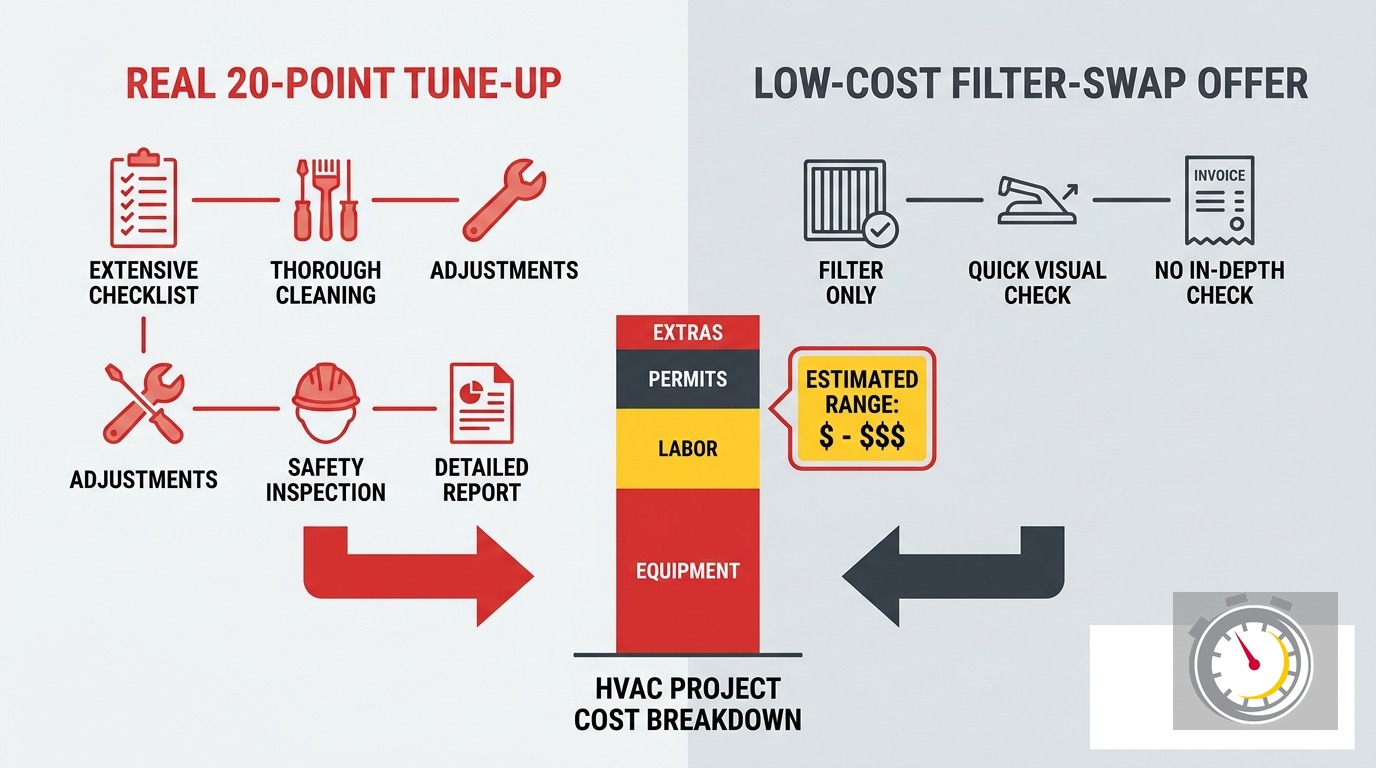
- A real AC tune-up covers 20 or more service checkpoints and takes 60 to 90 minutes minimum.
- A filter-swap special covers roughly three items: a new filter, a coil rinse, and a visual check.
- EPA Section 608 requires certification to handle refrigerants including R-410A and R-454B. Without it, a technician cannot legally verify your charge or inspect for leaks.
- DOE/OSTI research found only 38% of tested residential systems had correct refrigerant charge. Most systems run undercharged.
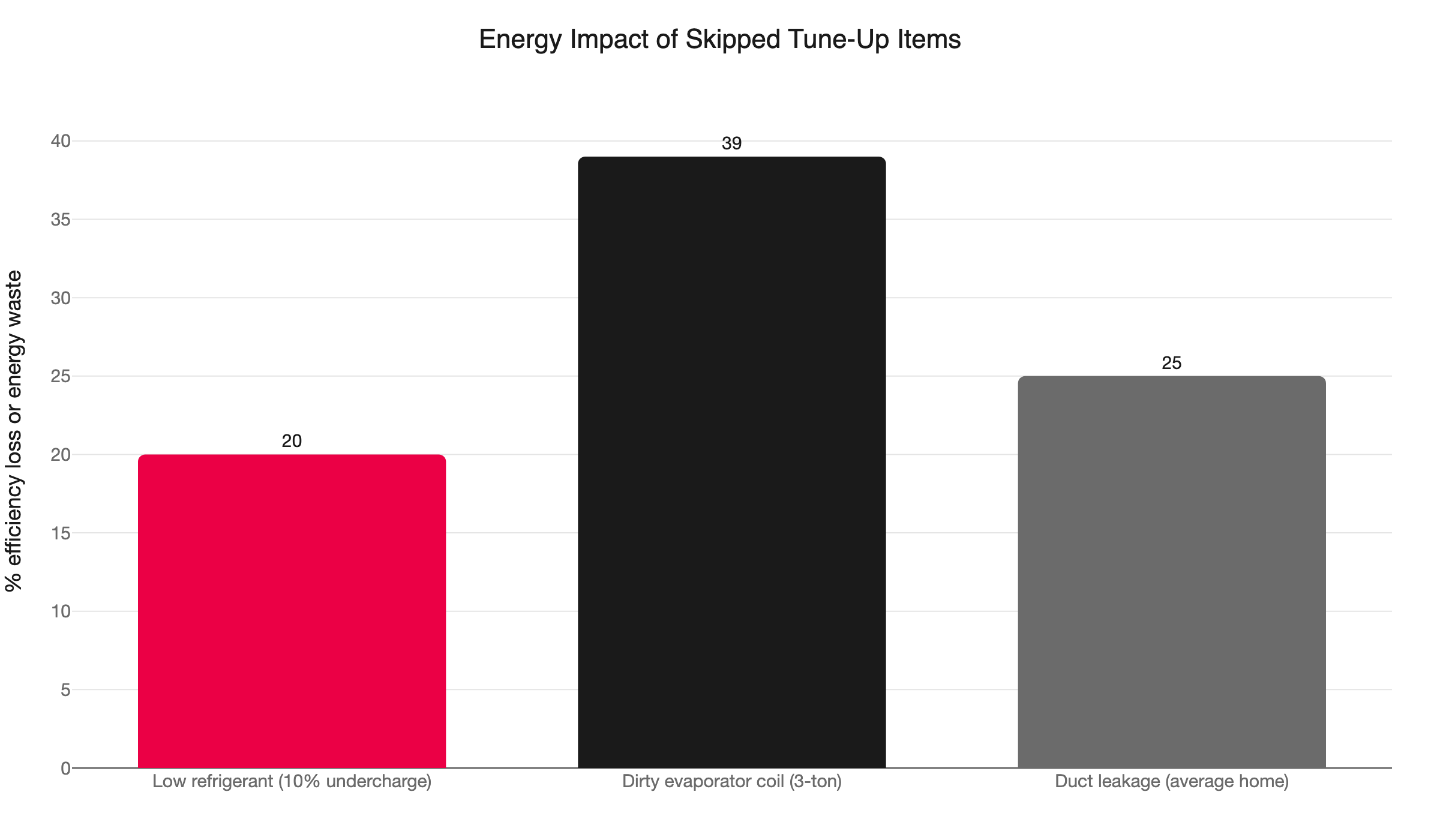
- A 10% refrigerant undercharge cuts efficiency by roughly 20%. A dirty evaporator coil raises a 3-ton unit’s electricity use by 39%.
- Manufacturer warranties require documented annual service. A written checklist with actual readings is documentation. A receipt is not.
- Schedule before late May in the Twin Cities. Cottonwood seeds and maple helicopters clog condenser coils quickly once the season peaks.
What Does an AC Tune-Up Include?
A real AC tune-up covers 20 or more checkpoints. These include refrigerant charge verification, capacitor and contactor testing, coil inspection, condensate drain clearing, blower motor assessment, airflow measurement, thermostat calibration, and a written record of all readings. Plan for 60 to 90 minutes on site.
What a $29 filter-swap special covers: a new filter, a rinse of the outdoor condenser coil, and a quick visual. Those three steps are real. They are just not a tune-up.
The gap between the two is not only effort. Part of it is federal law. Technicians without EPA Section 608 certification cannot legally handle refrigerant. That single fact removes the most important checkpoints from the list. This post maps every item side by side so you know exactly what you are getting and what you are not.
The Real Tune-Up vs. the Filter-Swap: A Side-by-Side Look
Nobody publishes this comparison side by side. Here it is.
| Service item | Real 20-point tune-up | $29 filter-swap special |
|---|---|---|
| Replace or inspect air filter | Yes | Yes |
| Clean condenser coil and inspect fins | Yes | Rinse only |
| Test run capacitor (microfarad reading) | Yes | No |
| Test start capacitor (microfarad reading) | Yes | No |
| Inspect contactor for pitting and wear | Yes | No |
| Check voltage and amperage at compressor | Yes | No |
| Check amperage at condenser fan motor | Yes | No |
| Verify refrigerant charge (superheat/subcooling) | Yes - EPA 608 required | No - legally cannot |
| Inspect for refrigerant leaks | Yes - EPA 608 required | No - legally cannot |
| Inspect refrigerant line insulation | Yes | No |
| Inspect evaporator coil | Yes | No |
| Clear and flush condensate drain line | Yes | No |
| Check condensate pan for algae and cracks | Yes | No |
| Test blower motor amperage | Yes | No |
| Inspect blower wheel for buildup | Yes | No |
| Measure supply and return temperature differential | Yes | No |
| Lubricate motor bearings where applicable | Yes | No |
| Check electrical connections for corrosion | Yes | No |
| Inspect disconnect and breaker | Yes | No |
| Test thermostat calibration and staging | Yes | No |
| Record all readings for documentation | Yes | No |
The refrigerant rows carry the most legal weight. Under EPA Section 608 of the Clean Air Act, any technician who handles refrigerant during maintenance, service, repair, or disposal must hold EPA 608 certification. R-410A and R-454B both fall under this rule. A technician without that certification cannot legally open the refrigerant circuit, add charge, or perform a leak test. That is federal law, not an opinion about quality.
A real tune-up takes 60 to 90 minutes. A filter-swap takes about 20. There is not enough time in 20 minutes to run the electrical checks, pull the air handler access panel, and document the readings. If the technician is gone before your coffee finishes brewing, the refrigerant was never touched.
Why Can’t a $29 Special Touch the Refrigerant?
Federal law requires EPA Section 608 certification to handle refrigerants such as R-410A and R-454B during AC service. Without that credential, a technician cannot legally check charge, add refrigerant, or inspect for leaks. Those are not optional steps. They address the most common source of residential AC efficiency loss.
DOE/OSTI research tested more than 4,000 residential cooling systems and found only 38% had correct refrigerant charge. A 15% undercharge is common in the field. The EPA estimates residential systems lose 5 to 11% of their charge through normal leakage every year.
A Purdue/IRACC study found that a 10% refrigerant undercharge cuts efficiency by roughly 20%. That is not gradual creep. It is a persistent energy penalty every hour the system runs.
Starting point matters, too. Many systems are installed undercharged. Refrigerant charge is factory-set for a standard line set length. When an installer runs a longer line set to reach a difficult location, the factory charge is short from the first day of operation. The only way to know is to measure, and the only technician who can measure it legally is one holding EPA 608 certification with calibrated gauges.
Our team verifies refrigerant charge on every tune-up visit. For more on what refrigerant undercharge looks like from inside the house, see how AC refrigerant recharge works and what it costs in the Twin Cities.
What Does a Dirty Evaporator Coil Actually Cost You?
A moderately dirty evaporator coil forces a 3-ton unit to use 39% more electricity to achieve the same cooling. For a 5-ton system, the penalty reaches 47%. The evaporator coil sits inside the air handler and is invisible without removing the access panel, which a filter-swap visit never opens.
The evaporator coil is where warm return air transfers its heat to the refrigerant. When dust, pollen, and debris coat those fins, heat transfer slows. The compressor works harder. Run times grow longer. Your Xcel bill shows every extra minute of that effort.
The EPA notes that most forced-air systems do not bring fresh outdoor air into the house mechanically. The filter and the evaporator coil are the two main levers a homeowner has over what the system circulates. A coil that is never inspected degrades both air quality and efficiency through the entire cooling season.
A tune-up does not always include a deep evaporator coil cleaning, which is a separate service. But it always includes an inspection. When a technician opens the air handler and finds heavy buildup, you get the information you need to make a call. A filter-swap visit never generates that information.
For more on what a dirty coil produces inside the house, see dirty evaporator coil symptoms in Twin Cities homes.
Why Does Timing Matter for Twin Cities Homeowners?
In the Twin Cities, schedule your tune-up in April or early May. Cottonwood seeds and maple helicopters settle directly on condenser coils from late May through early June, blocking airflow like a blanket. A June appointment finds a coil already impaired. Scheduling early gives you time to fix what the tune-up finds before the first serious heat.
Minnesota’s winters add wear that warmer markets never face. Freeze-thaw cycles shift the condenser pad and stress refrigerant line connections. Rodents nesting in equipment over winter chew through wiring and insulation. A thorough spring tune-up checks both. The electrical inspection finds damaged wire before it arcs. The refrigerant line check finds stress damage before it becomes a leak.
The refrigerant picture has also shifted in 2026. New AC equipment installed in Minnesota now uses R-454B or R-32. Systems already running R-410A can still be serviced. But supply will tighten the same way R-22 supply did a decade ago. Knowing your current charge level and whether it is holding from year to year is more valuable now than it was five years ago. Our post on the AC refrigerant transition to R-454B covers what Minnesota homeowners with existing equipment need to know.
What Do Capacitors and Electrical Checks Have to Do With AC Tune-Ups?
Capacitors are the leading cause of summer AC failures. They weaken under heat and electrical surges, and a microfarad test catches the decline before the failure happens. A filter-swap visit does not test capacitors. By the time a weak capacitor shows visible symptoms outside the unit, it has usually already tripped the system.
Every central AC system has at least two capacitors: one to help start the compressor and one to keep it running. Each is rated in microfarads. A new capacitor reads close to its rating. A weakening one reads lower. A certified technician with the right meter sees that trend at a scheduled tune-up, before it becomes a breakdown on a peak-demand afternoon.
The contactor is the second common failure point. It is the high-voltage switch that connects the compressor and condenser fan to incoming power. Every start cycle arcs across the contact surfaces, leaving microscopic pits over time. A pitted contactor sticks, draws excess current, and eventually fails. It tends to fail when the system has been cycling hard on the hottest days of the year.
A real tune-up tests capacitor microfarad values and inspects the contactor for pitting and wear. Both are in the electrical section of the comparison table above. Neither appears on a filter-swap checklist.
For more on what a failing capacitor looks like and what replacement costs in the Twin Cities, see bad AC capacitor symptoms and replacement cost.
How Do Manufacturers Handle Warranty Documentation?
Most manufacturers require documented annual maintenance to keep the warranty valid. Documented means a signed service report with dated readings, not a receipt. A folder of filter-swap receipts typically fails a warranty dispute, because a manufacturer needs actual measurements, not proof that someone visited.
That distinction matters when a compressor fails in year five of a 10-year warranty. The manufacturer’s first question is whether the unit received annual documented service. A report showing refrigerant charge values, capacitor microfarad readings, temperature differential measurements, and a dated technician signature is documentation. A receipt is not.
Tune-up records also create a year-over-year trend line that shows more than current condition. A capacitor at 38 microfarads one spring and 31 microfarads the next is trending toward failure. A refrigerant charge that drops year over year points to a slow leak. Both are better caught at a scheduled tune-up than when the system stops cooling mid-July.
Our service reports record every reading and are tied to your service address. That paper trail is part of what you are paying for when you schedule with us.
What Happens When a Tune-Up Finds a Bigger Problem?
If a tune-up finds a failing compressor, a dropping refrigerant charge, or electrical damage beyond safe repair, the next conversation is replacement. That is actually the best outcome: you found the problem before an emergency, with time to plan instead of calling for help on a Sunday in August.
The dollar difference between a planned repair and an emergency call is real. A capacitor replaced at a scheduled tune-up runs $195 to $500 parts and labor. The same capacitor failing on a Saturday afternoon in peak summer triggers an after-hours call. Emergency service carries a premium of $180 to $270 per hour on top of standard rates. One tune-up that catches a weak capacitor pays for itself.
If the tune-up points toward a full system replacement, the rebate picture is worth reviewing before you decide. Xcel Energy offers up to $500 on qualifying central AC (SEER2 16+) and up to $1,500 on cold-climate heat pumps for Minnesota customers. These require a participating contractor and a completed Trade Ally form. Rebate checks arrive 6 to 10 weeks after installation. For current details and how to layer other available incentives, see Xcel and CenterPoint HVAC rebates for Minnesota homeowners.
The IRS 25C Energy Efficient Home Improvement Credit listed up to $600 for qualifying central AC and up to $2,000 for qualifying heat pumps as of the IRS page last reviewed April 28, 2026. Credit eligibility can change. Verify current status at irs.gov before counting on it.
Book Your AC Tune-Up with Northern One Hour
Northern One Hour is locally owned and operated in Ramsey, MN. We serve Minneapolis, St. Paul, Blaine, Maple Grove, Plymouth, Brooklyn Park, Woodbury, Bloomington, and the surrounding Twin Cities metro.
We show up when we say we will. That commitment runs through every service we offer: “Always On Time… Or You Don’t Pay a Dime!(R).” When a tune-up finds something worth addressing, we show you the reading, explain what it means in plain language, and give you the options without pressure.
A single tune-up visit runs $95 to $250. Our annual maintenance plan covers your spring AC tune-up and fall furnace tune-up for $195 to $390 per year. For most homeowners, the plan is the better value. The first visit often identifies repairs that save several times the plan cost in avoided breakdowns and lower monthly utility bills.
Call (763) 260-6662 or schedule your AC maintenance online. Book before late May to get ahead of the cottonwood season and lock in the date you want.
Frequently Asked Questions
How long does a real AC tune-up take? +
Can any HVAC technician check my refrigerant? +
How much does an AC tune-up cost in the Twin Cities? +
Does skipping annual maintenance affect my warranty? +
When should Twin Cities homeowners schedule their AC tune-up? +
Need a technician now?