
Evaporator Coil Cleaning Cost Minnesota: Is It Worth It?
Key Takeaways
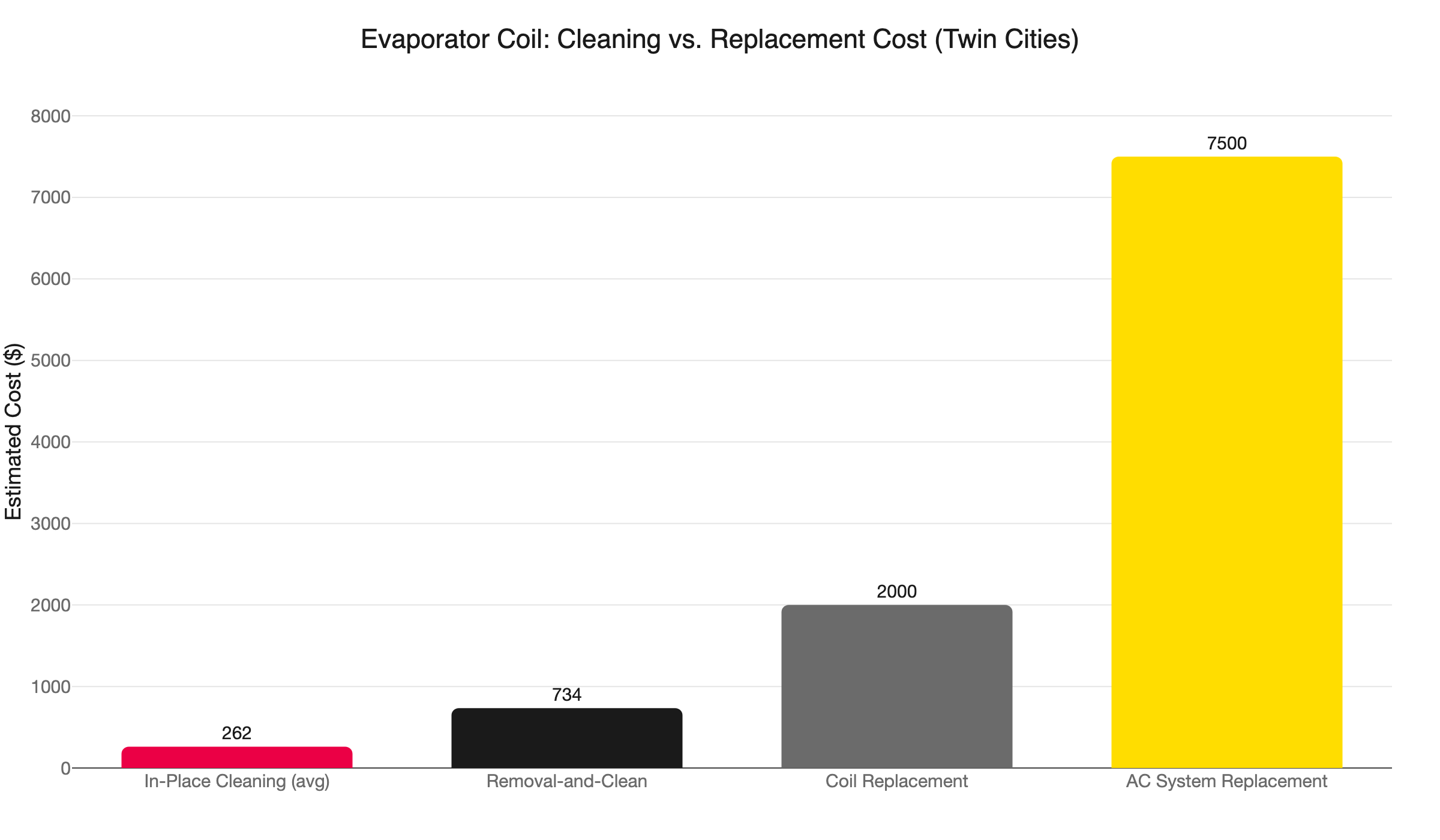
- Evaporator coil cleaning in the Twin Cities typically costs $105-$419 in-place, with an average near $262. Removal-and-clean jobs run up to $734.
- Dirty coils add an estimated $200-$436 per year in avoidable energy costs, per ASHRAE research.
- Cleaning is the right call when your system is under 8-12 years old, has no refrigerant leak, and shows no physical coil damage.
- Replace the coil alone when it is leaking or damaged but the system is still young.
- Replace the whole system when it is 12+ years old, runs R-22, or when coil replacement alone approaches 50% of a new system’s price.
- Northern One Hour is locally owned and operated in Ramsey, MN. We back every appointment with our “Always On Time… Or You Don’t Pay a Dime!(R)” promise.
How Much Does Evaporator Coil Cleaning Cost in Minnesota?
In the Twin Cities, in-place coil cleaning typically runs $105-$419, with an average near $262. Removal-and-clean jobs run up to $734. Labor usually falls between $95-$130 per hour.
AC coil cleaning costs in Minneapolis vary by system size and contractor. The upper end applies to removal jobs, systems with limited cabinet access, and heavy fouling that takes more labor time. One local Minnesota provider lists a standalone A-coil cleaning at $179.
The two main service types:
In-place cleaning ($100-$400). The technician opens the air handler cabinet and accesses the coil without removing it. A foaming coil cleaner is applied, allowed to dwell, then flushes through the drain pan. This handles mild to moderate fouling and takes 45-90 minutes.
Removal-and-clean (up to $734). The technician disconnects and removes the coil entirely. This allows a more thorough clean and is required for heavy fouling. Expect 2-3 hours, possibly longer for tight access situations.
What affects your specific price:
- Fouling severity. A coil serviced within the past two years costs less to clean than one ignored for five.
- Cabinet access. Older systems often have less clearance. More disassembly means more labor time.
- Unit location. Attic air handlers require more setup time and physical effort.
- Add-on findings. A clogged drain line or other issue discovered during the visit adds to the total.
Bundling a coil cleaning into an annual AC tune-up typically brings cost toward the low end of the range. Emergency or standalone visits run higher.
Is Evaporator Coil Cleaning Worth It?
Yes, for most systems under 8-12 years old with no refrigerant leak or physical damage. ASHRAE-cited research links dirty coils to $200-$436 per year in avoidable energy costs. A cleaning that runs $100-$400 typically pays for itself within one cooling season.
The math is direct. ENERGY STAR estimates that nearly half of a home’s energy use goes to heating and cooling. A 10-25% efficiency loss from fouled coils, which ASHRAE research documents, shows up on your monthly bill.
ENERGY STAR’s maintenance checklist states it plainly: “Dirty coils reduce the system’s ability to cool your home and cause the system to run longer, increasing energy costs and reducing the life of the equipment.” The same checklist notes that airflow problems can cut system efficiency by up to 15 percent.
DOE-cited research from a Southern California Edison study found that heavily fouled coils cut cooling capacity by roughly 40%. Supply airflow dropped by 75%, and evaporator fan power fell by 40%. Those are extreme-fouling numbers. The direction holds at every stage of buildup.
There is a local factor, too. Angi notes that Minneapolis’s long winters and shorter, humid summers mean AC systems sit idle for months, allowing dust and debris to accumulate inside the cabinet undetected. When the first hot day arrives in late May or June, a fouled coil is already working against itself.
Two situations where cleaning is not worth it: the coil has an active refrigerant leak (cleaning the surface does not fix it), or the system is old enough that maintenance spending no longer makes financial sense. The decision framework below covers the age threshold.
How Often Do AC Evaporator Coils Need to Be Cleaned?
Most HVAC technicians recommend cleaning every 1-3 years, timed to an annual tune-up. Homes near cottonwood trees, homes with pets, or systems running lower-MERV filters often need it every year.
LBNL research found that without professional cleaning, coils can double their pressure drop within 7-11 years. A coil that was clean at installation can be generating twice the airflow resistance by year 10. Regular cleaning resets that progression before it shows up on your energy bills.
Your filter is the first line of defense. A properly-rated filter, changed on schedule, slows coil fouling significantly. When filter changes are skipped, debris reaches the coil instead. The coil is much harder to service than a filter. Our guide on how often to change your HVAC filter covers the schedule by filter type.
Annual maintenance is also the right time to catch other components before they fail. The same visit that covers your evaporator coil and drain line is a good time to check ignition parts like the flame sensor. Our furnace flame sensor guide shows how that plays out on the heating side and why the same maintenance discipline applies.
What the Service Visit Looks Like From Your Side
No competitor article explains this from the homeowner’s perspective. Here is what actually happens at a coil cleaning appointment.
Booking and arrival. You choose a service window that works for your day. Our team arrives within that window. If we do not show up on time, you do not pay for the service.
Access. The technician opens the air handler cabinet. On most Twin Cities homes, this is a furnace or air handler in the basement, utility room, or attic. Attic air handlers have specific access and heat-stress considerations that can extend service time.
What the tech checks beyond the coil surface:
- Drain pan. Standing water, rust, algae, or debris. Standing water means the drain line is at least partially blocked.
- Condensate drain line. A blocked line causes water to overflow inside the house. It is a common and preventable failure. Our condensate drain line guide covers what happens when this is missed.
- Refrigerant charge. Oily residue, frost patterns, or signs of an active leak around the coil connections and line set.
- Fin condition. Bent or corroded fins reduce airflow independent of surface fouling. Minor damage can be corrected with a fin comb during the visit.
- Blower wheel condition. Coil fouling and blower fouling often track together. The same air carries dust to both components. If the blower is overdue for service, it affects the system’s airflow in ways that can mirror a dirty coil.
The cleaning process. For an in-place job, the tech applies foaming coil cleaner, lets it dwell, and flushes it through the drain pan. For a removal job, the coil comes out, is cleaned on a work surface, inspected on all sides, then reinstalled and tested.
At the end of the visit. Before-and-after documentation, any findings logged, and a direct recommendation if the inspection reveals something that changes the picture. Three findings shift the conversation from cleaning to replacement: an active refrigerant leak, significant physical coil damage, or an R-22 system.
When Should You Replace Instead of Clean?
Replace the coil alone when it is physically damaged or leaking but the system is still under 8-12 years old. Replace the whole system when it is 12+ years old, runs R-22, or when coil replacement alone approaches 50% of what a new system costs.
Coil replacement in Minnesota typically costs $1,200-$2,000, up to $2,700 without manufacturer warranty coverage. With an active warranty, the out-of-pocket drops to $400-$1,200 (labor only). Compare that to cleaning costs of $100-$734. At those numbers, the age of the system becomes the deciding variable.
The decision framework:
Clean the coil if:
- System is under 8 years old
- No refrigerant leak present
- No physical coil damage
- Fouling is the only issue
Replace the coil only if:
- Active refrigerant leak or physical damage confirmed
- System is under 8-12 years old with real useful life remaining
- A properly matched replacement coil is available
- Coil replacement cost does not approach half the price of a new system
Replace the whole system if:
- System is 12+ years old
- Runs R-22 refrigerant
- A mismatched coil would cut efficiency 20-30%
- Multiple components are approaching end of life
The DOE recommends evaluating HVAC equipment more than 10 years old for potential replacement. That is not a mandate. It is a signal to run the math differently. A coil swap at $2,000+ on a 14-year-old system carries different risk than the same repair on a 5-year-old unit under warranty. That older system may also need a compressor or blower motor within the next two seasons, changing the total picture considerably.
Our AC replacement cost guide for Minnesota covers what a new central AC system costs in the Twin Cities, including high-efficiency and heat pump options.
What About R-22 Systems?
If your AC uses R-22 refrigerant, full system replacement is almost always the better financial decision. R-22 is no longer manufactured in the U.S., and the refrigerant itself now costs multiples of pre-phaseout prices. A minor leak on an R-22 system shifts the math decisively toward replacement.
R-22 systems are typically 15+ years old. That age alone puts them past the DOE’s 10-year evaluation threshold. Add the refrigerant cost premium, the efficiency gap versus modern 16-20+ SEER2 equipment, and the fact that utility rebates only apply to qualifying new installations.
A coil cleaning on an R-22 system may still make sense if there is no refrigerant leak. The system needs to be otherwise stable. But if a refrigerant leak surfaces during the visit, replacement is the honest recommendation.
Our R-22 phase-out guide for Minnesota homeowners covers what the refrigerant market looks like today and what your options are if you are still running older equipment.
Rebates When Replacement Is the Call
Rebates do not apply to coil cleaning or standalone coil replacement. They apply when you replace the full central AC system or move to a heat pump.
Xcel Energy offers a rebate for a qualifying central AC installation at 16.0+ SEER / 13.0+ EER with a qualifying install. Cold-climate heat pump replacements can qualify for up to $2,000 from Xcel. Both programs require a licensed contractor, AHRI-listed equipment, and application within 90 days of installation.
The federal 25C tax credit ended December 31, 2025. It does not apply to 2026 installations. Our HVAC rebate stacking guide has the current Minnesota picture in one place, including utility-specific programs for Xcel and CenterPoint customers.
Financing is available for larger replacement jobs. Ask our team about current options when you call.
Book Your Coil Cleaning
A $100-$400 coil cleaning that restores your system’s efficiency is one of the more direct investments in home comfort. You can estimate the payback yourself: compare your current cooling-season energy bills to what they looked like before performance dropped. Most of the difference is recoverable.
Northern One Hour is locally owned and operated in Ramsey, MN. We serve homeowners across the Twin Cities metro, from Blaine and Brooklyn Park to Plymouth, Woodbury, and Bloomington. Our team shows up within the window you choose. If we do not, you do not pay for the service.
Call (763) 260-6662 or book online to schedule your coil cleaning or AC tune-up.
Need a technician now?