
AC Refrigerant Recharge Cost Twin Cities: What to Expect
Key Takeaways
- A simple recharge with no leak found is generally the lower-cost refrigerant service outcome.
- Low refrigerant almost always means a leak. Recharging without fixing the leak is a temporary fix, not a solution.
- R-410A refrigerant prices are rising sharply because of the EPA AIM Act phase-down. Your recharge costs more in 2026 than it did three years ago.
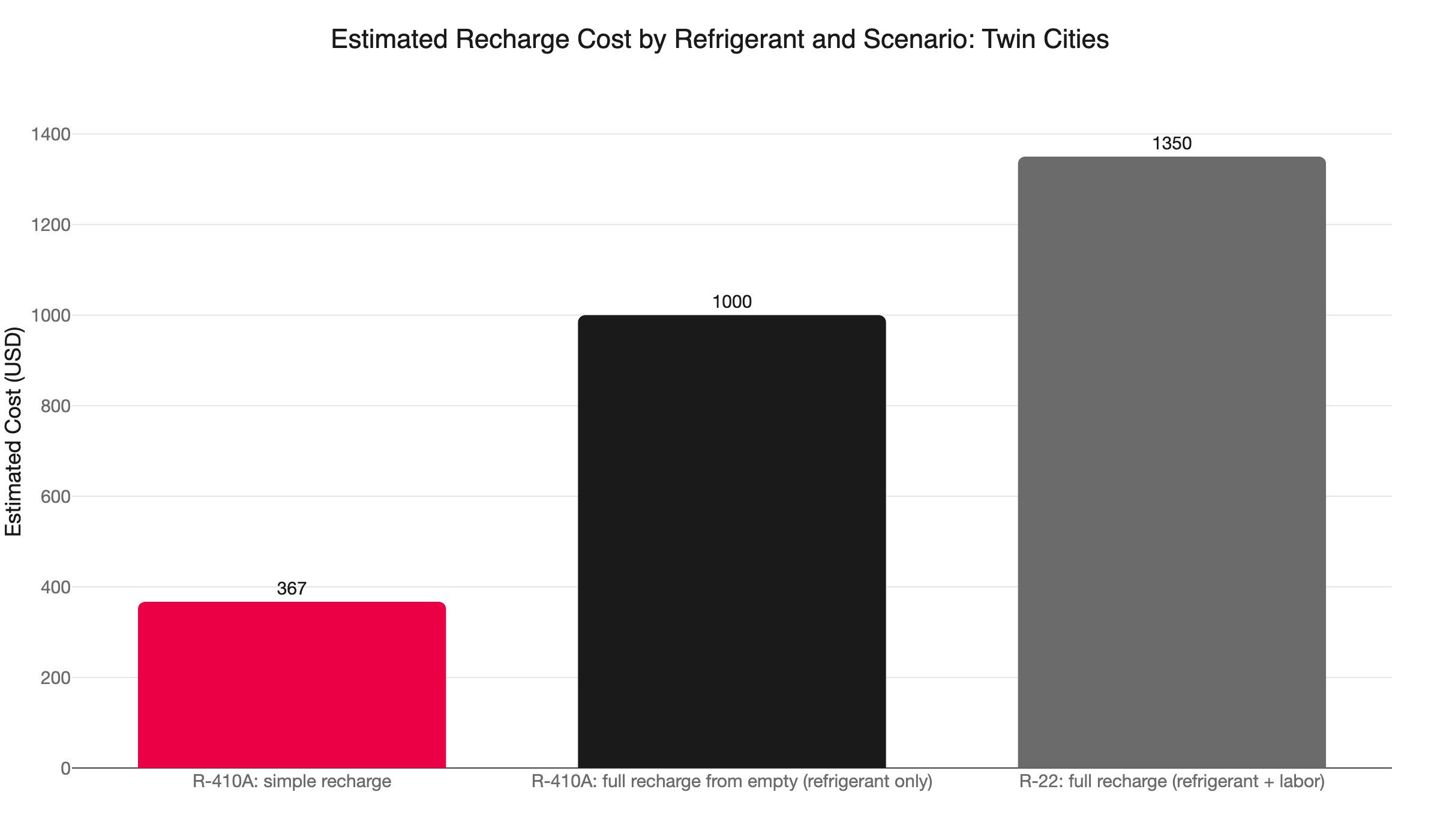
- R-22 systems (pre-2010) face reclaimed refrigerant at $100-$150 per pound. A full recharge can run $900-$1,800 in refrigerant and labor alone.
- Federal law requires EPA Section 608 certification to purchase or handle any refrigerant. Homeowners cannot legally recharge their own AC.
- Xcel Energy offers up to $500 for a qualifying central AC replacement. The 25C federal tax credit expired December 31, 2025.
- A refrigerant recharge call does not require a Minnesota mechanical permit. A full system replacement does.
AC Refrigerant Recharge Cost in the Twin Cities: What to Expect
Low refrigerant is one of the most common summer AC calls we see across Minneapolis, St. Paul, Blaine, Maple Grove, and the rest of the Twin Cities metro. The ac refrigerant recharge cost in the Twin Cities is not a single number. It depends on why the refrigerant is low. This post walks you through the three scenarios a homeowner actually faces, what a recharge visit involves, and how rising R-410A prices and the Xcel rebate have shifted the math in 2026.
What Does a Refrigerant Recharge Cost in the Twin Cities?
A simple recharge with no leak found typically runs $210-$524 in Minneapolis, averaging around $314. If a leak is found and repaired, total costs reach $200-$1,600 or more, depending on where the leak is and how extensive the repair is.
That spread is wide because “recharge” covers very different jobs. A slightly undercharged system with no leak found is a one-visit fix. A corroded evaporator coil is a different conversation entirely. The section below explains which situation you are likely facing before you commit to a service call.
Which Scenario Are You In? Three Situations That Drive Very Different Costs
Before our technicians add a pound of refrigerant, they run a leak check. That result puts you in one of three buckets. Each bucket has a different correct answer.
Scenario 1: No leak found, system was undercharged
This happens occasionally on older systems or after a previous repair where the charge was not set precisely. If a thorough leak check comes back clean, a top-off is appropriate. Budget $210-$524 for a typical 2-3 ton residential system, including current R-410A service rates and labor.
Scenario 2: Small, repairable external leak
A Schrader valve, service valve, or line fitting is leaking. These are surface-level, external leaks. They are often fixable in the same visit. Leak detection in Minneapolis and external leak repair each add to the service cost. Add the recharge and the total for this scenario adds up quickly.
Scenario 3: Internal leak - evaporator coil or refrigerant line inside the air handler
This is the expensive path. Evaporator coil repair or replacement in Minneapolis runs $800-$2,500, not counting the refrigerant recharge. Add those together and the total reaches $1,100-$3,000 or more. At that cost level, the system’s age becomes a critical variable.
A 12-year-old R-410A system facing a coil repair plus climbing refrigerant prices may cost less over the next five years to replace than to repair. That is not a pitch for a new system. It is math worth running before you write the check.
What Does a Technician Actually Do During a Recharge Visit?
A proper recharge includes recovery of remaining refrigerant, a leak check, a deep vacuum pull to remove moisture, and a precise charge added by weight. It takes 60-90 minutes on a typical residential system. Labor runs $100-$250 per hour before refrigerant cost.
Most price guides skip straight to the table. Here is what should actually happen on a legitimate recharge call.
Recovery. Any refrigerant left in the system is recovered into a certified tank before the system is opened. Knowingly venting refrigerant while servicing equipment is prohibited under Section 608 of the Clean Air Act. A contractor who skips recovery is violating federal law and cutting corners.
Leak detection. The system is pressurized with nitrogen or swept with an electronic leak detector. A technician who skips this step and adds refrigerant anyway is giving you a temporary result. The leak will cause the same call again, usually by next summer.
Evacuation. A vacuum pump pulls the system into a deep vacuum. This removes moisture and non-condensables - air and residual nitrogen - that would degrade compressor performance and shorten equipment life.
Charge by weight. Refrigerant is weighed in to match the manufacturer’s nameplate specification. Overcharging damages the compressor and wastes expensive refrigerant. The goal is the spec, nothing more.
Verification. Suction and discharge pressures are checked. Superheat and subcooling are measured to confirm the charge is correct. A good technician shows you those readings before leaving.
If a quote does not include a leak check and evacuation, ask why. Skipping those steps is how a one-time recharge turns into an annual expense.
Why Is R-410A Getting More Expensive in Minnesota Right Now?
The EPA’s AIM Act phased out new R-410A equipment as of January 1, 2026. Service refrigerant for existing systems now comes from reclaimed supply only, and reclaimed costs significantly more than virgin refrigerant did.
Wholesale refrigerant cost much less per pound five years ago than it does now at the contractor level. At the retail service rate, what you pay per pound depends on the market and the contractor.
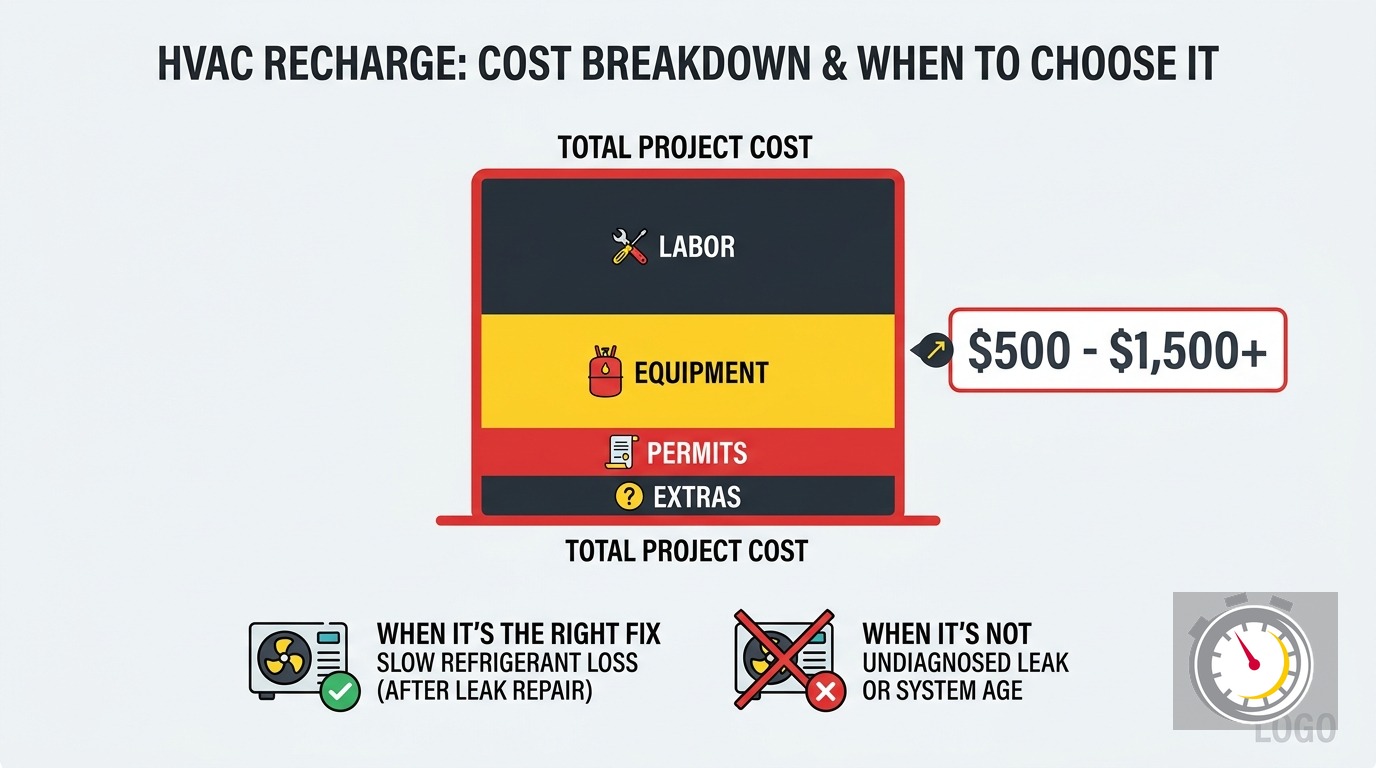
For a 3-ton system holding 6-12 lbs, a full recharge from empty - worst case - runs $500-$1,500 in refrigerant alone, before labor. That is higher than most national guides reflect, and it is higher than what local contractors quoted three years ago.
The AIM Act also requires that reclaimed HFC refrigerant sold for service use contain no more than 15% virgin HFCs by weight as of January 1, 2026. That purity standard tightens supply and raises cost at the same time.
For Twin Cities homeowners, this has a specific implication. Our cooling season runs roughly June through August and brings high humidity. A system that cannot hold charge will underperform exactly when Minnesota heat and humidity peak. And the cost of recharging that system will be higher next summer than it is today.
Is a Recharge Worth It on an R-22 System?
Only if the refrigerant needed is small. R-22 runs $100-$150 per pound in reclaimed supply. A full recharge on a pre-2010 system can cost $900-$1,800 in refrigerant and labor. On a 15-year-old system, that math rarely works in the homeowner’s favor.
New R-22 production was banned by the EPA as of January 1, 2020. Only reclaimed R-22 remains on the market. The supply shrinks each year as old systems are retired and that refrigerant is recovered. The EPA does not require you to replace an existing R-22 system. You can keep servicing it as long as reclaimed refrigerant is available.
Here is what a pre-2010 system needing a full recharge typically faces:
- Refrigerant: $600-$1,200+ (4-8 lbs at $100-$150 per lb)
- Labor, leak check, and recovery: $300-$600
- Total: $900-$1,800 or more, before any leak repair work
If that system holds charge for two more summers, you break even on the service call. If it leaks again by next July, you paid for borrowed time. We cover the R-22 decision in more detail in our post on R-22 phase-out and what it means for older Minnesota AC systems.
Can You Buy Refrigerant and Recharge Your Own AC?
No. Federal law requires EPA Section 608 certification to purchase or handle refrigerant. This applies to R-22, R-410A, and all HFC substitutes. Homeowners cannot legally buy or charge refrigerant themselves.
This is not a gray area. The EPA requires Section 608 certification to purchase and handle refrigerants used in stationary refrigeration and air conditioning equipment. When you hire a technician, ask if they hold that certification. Every legitimate HVAC contractor has it.
One specific warning: products marketed as “R-22a” or “22a” refrigerant are typically propane-based substitutes. They are not approved for use in existing AC systems. They are a fire hazard. The EPA has taken enforcement actions against companies selling these products. If a contractor or online seller offers you a cheap “drop-in replacement” for R-22, decline and find someone else.
Does the EPA Require You to Fix a Leak Before Recharging?
For most residential systems, no. The formal EPA leak-repair mandate covers appliances with a full charge of 15 lbs or more. A standard home central AC holds 6-12 lbs. Most residential systems fall below that threshold.
The EPA is explicit: the commercial leak-repair requirement does not apply to “appliances used in the residential and light commercial air conditioning and heat pumps subsector.” No federal rule requires a technician to repair a leak in your home AC before recharging it.
But the absence of a legal requirement does not make skipping the repair smart. The EPA’s own guidance says it plainly: “Repairing leaks will keep your system operating at its best, while reducing refrigerant emissions and energy use.” A system that leaks today will lose that charge again. You will face another service call, another round of refrigerant at current prices, and the leak will typically be worse the second time.
We will not top off a leaking system without telling you the leak is there and what it will take to fix it. That is the only honest way to handle the job.
How Does the Xcel Energy Rebate Change the Replacement Math?
Xcel Energy offers up to $500 for a qualifying central AC replacement (16+ SEER2) and up to $1,500 for a qualifying cold-climate heat pump. The Section 25C federal tax credit expired December 31, 2025. The Xcel rebate is now the primary financial incentive for Twin Cities homeowners replacing equipment in 2026.
If you are weighing a major repair - coil replacement plus recharge, or a third recharge in as many summers - run the replacement numbers before committing.
A qualifying central AC replacement earns up to $500 from Xcel Energy, with an additional $100 rebate for a qualifying smart thermostat. These require installation by a participating contractor and a Trade Ally form filed at installation.
A mid-tier central AC replacement in the Twin Cities runs $7,500-$10,400 installed. After the Xcel rebate, net cost comes to roughly $7,000-$9,900. Compare that to a $1,500-$2,500 coil repair plus ongoing refrigerant costs on an aging system. The gap closes faster than most homeowners expect.
We have a full cost breakdown in our AC replacement cost guide for Minnesota.
One procedural note: full system replacement in Minnesota requires a local mechanical permit. A refrigerant recharge service call does not. Any contractor who installs a new system without pulling a permit is a serious red flag.
Warning Signs That Mean the Problem Goes Beyond a Recharge
A recharge adds refrigerant. It does not fix whatever caused the level to drop. If you are seeing any of the following signs, call us for a diagnostic before authorizing refrigerant cost.
- Ice on the refrigerant line or evaporator coil. Low refrigerant can cause ice buildup, but so can a dirty coil or restricted airflow. A dirty coil compounds a low-charge problem. See our post on dirty evaporator coil symptoms in Twin Cities homes.
- Hissing or bubbling sounds near the refrigerant lines or indoor unit. These often indicate refrigerant escaping under pressure.
- Weak cooling that returns within weeks of a recharge. If the system cooled normally after a top-off and now does not, the refrigerant leaked out. There is an active leak.
- Oil staining around fittings, coil connections, or the outdoor unit. Refrigerant and compressor oil travel together. Oil marks a leak point.
- Warm air blowing despite the system running continuously. Low refrigerant is one cause. Compressor failure is another. Refrigerant will not fix a compressor problem.
- Rising electricity bills with no change in usage pattern. A low-charge system works harder for the same cooling result. Efficiency drops sharply when refrigerant levels are off.
If these signs are stacking up, the underlying problem almost certainly goes past a simple recharge. Our post on AC refrigerant leak signs in Minnesota walks through the full diagnostic picture and what each sign typically means.
How Northern One Hour Handles Refrigerant Service
We are locally owned and operated in Ramsey, serving Minneapolis, St. Paul, Blaine, Maple Grove, Plymouth, Brooklyn Park, and the broader Twin Cities metro. Refrigerant calls are part of every cooling season, and we handle each one the same way: diagnostic first, written quote before any work begins, no surprises.
Our technicians hold Section 608 certification. We use reclaimed-certified refrigerant and do not carry propane substitutes or uncertified drop-in products. If a leak check finds a problem, we tell you, quote the repair, and let you decide. We do not top off a leaking system and call the job done.
If a service call turns into a replacement conversation, we walk you through the Xcel rebate paperwork and pull the required mechanical permit. A written quote with options comes before any work begins. Financing is available on replacement installations. Ask about current terms when you call.
Schedule service at (763) 260-6662 or book online. “Always On Time… Or You Don’t Pay a Dime!(R)” - that is our promise on every call, refrigerant work included.
Frequently Asked Questions
Can I recharge my own AC with refrigerant from a hardware store? +
How much does a refrigerant recharge cost in Minneapolis? +
Is R-410A still available for my existing AC system? +
Should I fix a refrigerant leak or just top off my AC? +
Need a technician now?