
AC Refrigerant Line Sweating Outside: Normal or a Problem?
Key Takeaways
- Only the large insulated pipe (the suction line) sweats. The small bare pipe is intentional and correct.
- Light surface dampness on humid days is normal. Steady dripping that pools on the ground or runs down a wall is not.
- The wall penetration, where the line set enters your home, is the highest-risk point. Damage there is invisible until drywall is already wet.
- Closed-cell foam insulation begins degrading within 3-7 years without UV protection or protective wrapping.
- Twin Cities dew points hit 65-70°F in July and August. In that climate, line-set insulation is load-bearing, not optional.
- Minnesota code requires thicker outdoor pipe insulation than the standard IRC table.
- If you see heavy sweating, pooling water, or soft drywall near the line-set entry point, call a technician.
AC refrigerant line sweating outside is one of those issues that ranges from completely normal to a warning that moisture is collecting inside your wall. Here is how to tell the difference, what makes the Twin Cities climate a bigger factor than most of the country, and where to look when the real damage is invisible.
What Causes AC Refrigerant Line Sweating Outside?
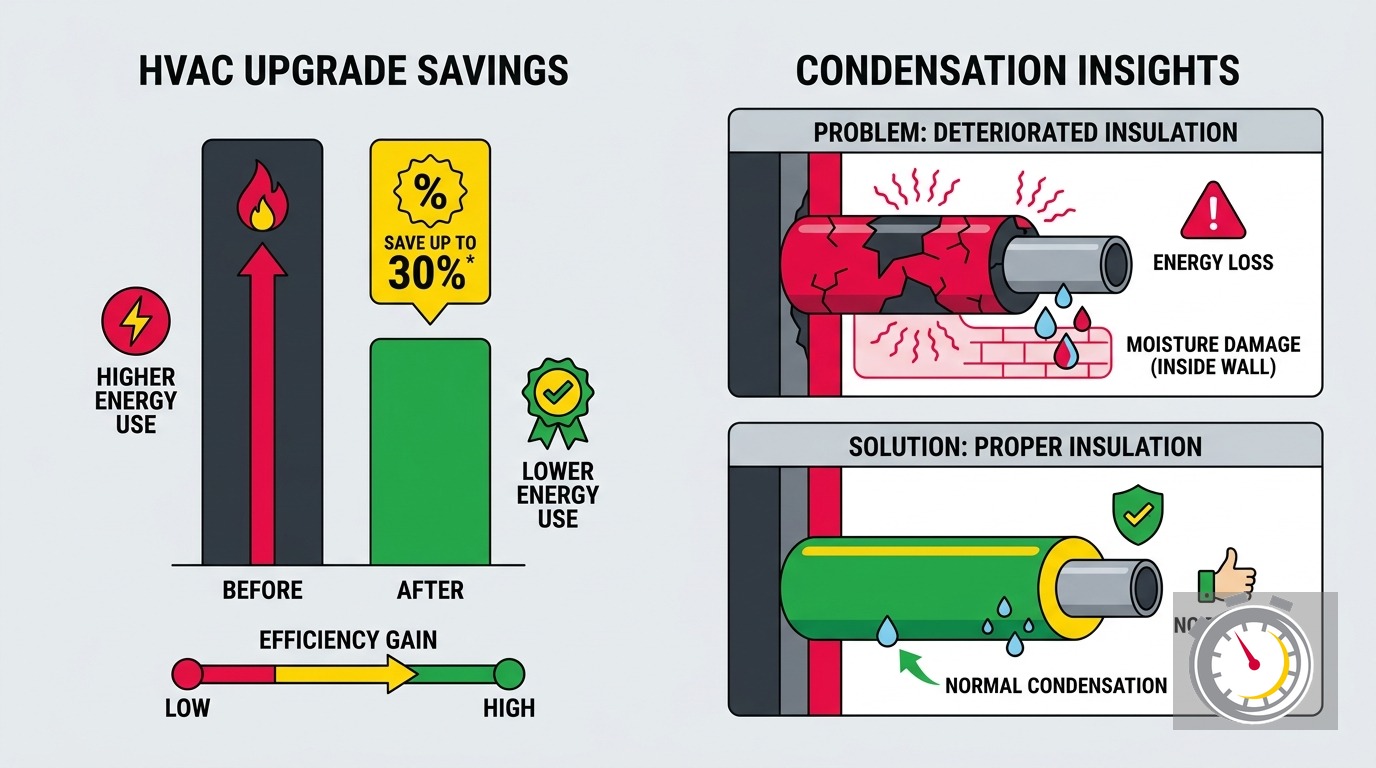
Short answer: The large insulated pipe carries refrigerant vapor at roughly 40°F. When humid outdoor air contacts that cold surface, moisture condenses, just as it does on a cold glass in summer. The foam sleeve prevents that contact when intact. When the sleeve degrades, condensation forms directly on the pipe.
Your AC system runs two refrigerant lines between the outdoor condenser and the indoor evaporator coil. One is large with a black foam jacket. The other is small and bare. Only the suction line, the large insulated one, runs cold enough to condense moisture. It carries refrigerant vapor at roughly 40°F back to the compressor after absorbing heat from your indoor air. The smaller liquid line carries warm, high-pressure refrigerant toward the house. Its temperature does not cause condensation, so it is intentionally bare.
The foam jacket on the suction line has one job: keep warm, humid outdoor air from reaching cold copper. When the jacket is intact and dry, it handles that job quietly. When it deteriorates, the physics take over, and water forms on the pipe surface.
This distinction matters before you do anything else. If the small bare line is dry and the large insulated line is lightly damp on a humid afternoon, that is normal system operation. If the large line is dripping heavily regardless of conditions, something has changed.
Why Does Only the Large Line Sweat?
Short answer: The suction line runs cold enough to fall below the dew point of summer air. When pipe temperature drops below dew point, condensation is unavoidable. The liquid line stays warm enough that this effect never occurs.
Dew point is the air temperature at which moisture condenses onto a surface. In the Twin Cities in July, dew points commonly reach 65°F or higher. A suction line running at 40°F sits 25 degrees below that threshold. Any warm, moist air that contacts the bare copper will immediately shed moisture onto it.
The foam jacket is a thermal break between ambient air and cold pipe. As long as the jacket is continuous and undamaged, the copper never contacts humid outdoor air, and no condensation forms at the surface.
This is also why a partially wrapped or patched line still sweats at every gap. The thermal break only works where it is complete.
Is AC Refrigerant Line Sweating Outside Normal?
Short answer: Light, surface-level condensation on the most humid days is normal and expected. Heavy, steady dripping that pools on the ground, soaks the insulation, or runs down an exterior wall points to insulation failure and needs attention.
Here is how to read what you see:
Normal:
- A faint dampness on the foam surface during high-humidity days
- Moisture that dries when humidity drops or the system cycles off
- No dripping below the line run, no pooling at the base of the outdoor unit
Not normal:
- Steady dripping that continues regardless of humidity levels
- Water pooling on the ground below the outdoor unit or along the wall
- Foam that feels soft, spongy, or wet when squeezed
- Visible cracks, gaps, or missing sections in the foam jacket
- Water staining on siding near where the line enters the house
The foam condition is a more reliable indicator than the dripping alone. A jacket that looks intact from across the yard may be saturated with moisture and thermally useless. The squeeze test is quick: if the foam compresses easily and feels damp inside, it has failed even if the exterior surface appears acceptable.
What’s Happening Inside Your Wall When Insulation Fails?
Short answer: The line set passes through your exterior wall via a 3-4 inch sleeve. If insulation has deteriorated at that transition, condensation forms on cold copper inside the wall cavity, wetting framing and drywall from the inside. There is no visible dripping outside until the damage is already done.
This is the piece most articles about AC refrigerant line sweating outside skip entirely, because it requires explaining what you cannot see.
The line set enters your house through a sleeve in the framing. That sleeve should contain continuous foam insulation, a proper vapor retarder seal, and no air gap between the jacket and the sleeve wall. When the foam cracks at or near the wall penetration, the insulation fails at the worst possible location.
Warm interior air enters the sleeve from inside the house. That air contacts cold copper at 40°F and immediately sheds moisture. Condensation forms on the pipe surface inside the wall cavity. Over days and weeks, that moisture migrates into the surrounding framing, the vapor retarder, and eventually the drywall.
The progression plays out like this:
- Insulation cracks at the wall penetration, often the first failure point because the pipe transitions from exterior to interior conditions here
- Interior air infiltrates the sleeve and contacts cold copper
- Condensation forms on the pipe inside the wall
- Moisture wets framing and vapor retarder
- Drywall softens, paint bubbles, or a musty smell develops near the baseboard
By the time you notice a soft spot, moisture damage has been accumulating for weeks. This is why the wall penetration needs its own inspection, not just a glance at the visible outdoor run.
Here is a quick field check. Go inside and find where the line set enters the house. Push gently on the drywall within a foot of the entry point. Check for softness, bubbling paint, or discoloration. If the entry point is in a utility closet, check along the baseboard as well. Then go outside and look at the siding or caulking at the penetration. Cracked caulk, gaps in the sleeve cover, or water staining on the siding below the line are all worth noting.
If you find any of those signs, call a technician before attempting a patch. Covering a deteriorated penetration with foam spray or caulk traps moisture inside and makes the underlying damage harder to assess later. A related form of the same problem, cold surfaces creating condensation damage in a different location, is covered in our post on ductwork sweating and condensation in basements.
How Foam Insulation Deteriorates: The Four Stages
Most standard pipe insulation sold at home improvement stores is not UV-rated. The DOE’s Building America Solution Center recommends annual inspection of refrigerant line insulation because outdoor exposure causes it to “degrade quickly.” Understanding the stages helps you catch the problem early.
Stage 1: New insulation (Years 1-3) The foam jacket is flexible, tightly fitted, and intact. Condensation may bead on the surface on the most humid days but does not penetrate. The insulation is doing its job correctly.
Stage 2: Early UV degradation (Years 3-5) The surface hardens and small cracks form, especially on south- and west-facing runs with direct sun. The BASC guide specifically warns that most home improvement store foam is not UV-rated and must be wrapped with line-set tape to extend its life. A technician who catches insulation at this stage can add UV-protective tape before moisture infiltrates. That detail is absent from nearly every DIY article on the subject.
Stage 3: Moisture infiltration (Years 5-7) Closed-cell elastomeric foam begins cracking and degrading within 3-7 years without UV-resistant coating or protective wrapping. Once surface cracks deepen enough to admit water, the foam absorbs moisture, swells, and loses its thermal resistance. The jacket may still look intact from a distance. Squeezing it reveals spongy, wet material inside. Thermal performance has collapsed.
Stage 4: Full thermal failure (Year 7+) The foam provides negligible insulation. Cold copper is exposed to humid air at every gap and seam. Condensation runs continuously during system operation. Deteriorated insulation is estimated to reduce system efficiency by 2-5%. That number compounds over time, because warmer refrigerant returning to the compressor increases compressor wear and shortens its working life.
At Stage 3 or beyond, patching does not work. Full replacement is the only effective repair.
Why Minnesota’s Summers Make This Worse Than Most States
Most of the country deals with moderate summer humidity. The Twin Cities is not most of the country.
Minneapolis summer dew points regularly reach 65-70°F in July and August. When outdoor air at a 70°F dew point contacts a suction line at 40°F, condensation is not a risk to manage. It is a physical certainty. The foam jacket is the only thing standing between humid ambient air and cold copper. In a moderate climate with lower dew points, marginal insulation can sometimes perform adequately. In Minnesota, there is no margin.
The freeze-thaw cycle compounds the problem. A line set on the exterior of a Minnesota home goes through roughly 150 freeze-thaw cycles per year. Each cycle creates small mechanical stress in the foam as the material expands and contracts. Combined with direct UV radiation during summer, this accelerates the transition from Stage 1 to Stage 3 faster than national averages suggest.
An installation that might last eight to ten years in a mild climate can reach Stage 3 failure in five to six years here. Annual inspection is not a suggestion in Minnesota. It is the minimum effective maintenance for line-set insulation.
This also changes how you should read the word “optional” on any installation quote. On a south-facing line set in the Twin Cities, UV-protective wrapping at installation is not an upgrade. It is the difference between five years and nine years of useful life.
Does Minnesota Have a Code Requirement for Refrigerant Line Insulation?
Short answer: Yes. Minnesota requires outdoor refrigerant piping insulation to be 0.5 inch thicker than the standard IRC table value, plus a vapor retarder. The Minnesota Mechanical Code adds minimum R-3 and low permeance requirements. Most of the country follows less stringent standards.
Two code sections govern this:
Minnesota Residential Energy Code (Chapter 1322, Section N1103): For piping exposed to outdoor air, insulation thickness must be 0.5 inch greater than the standard IRC table value. A vapor retarder is also required.
Minnesota Mechanical Code (Chapter 1346): Covers refrigerant suction line insulation directly. It requires minimum R-3, surface permeance not exceeding 0.05 perm, and conductivity in the 0.21-0.26 Btu·in/(h·ft²·°F) range.
These are not arbitrary numbers. They reflect what Climate Zone 6 demands from insulation that faces July dew points above 65°F and January temperatures below zero.
What this means for you: if a previous installation used off-the-shelf foam that does not meet the required thickness or permeance rating, it may have been non-compliant from the start. A replacement should bring the installation to current Minnesota code, not just swap like-for-like. When our team at Northern One Hour replaces refrigerant line insulation, we install to current code and pull permits where required.
When Should You Call a Tech?
Short answer: Call when you see steady dripping rather than surface dampness, when the foam feels soft or saturated, when you spot cracks at or near the wall penetration, or when interior drywall near the line-set entry shows any sign of softness or moisture.
Here is a practical decision guide:
Watch it yourself if:
- The foam jacket looks and feels intact, no visible cracks or gaps
- Sweating is light and appears only on the most humid summer days
- No dripping reaches the ground
- The wall penetration area looks dry and properly sealed inside and out
Call a technician if:
- Dripping is steady and does not stop when humidity drops
- The foam sleeve feels soft, spongy, or wet when squeezed
- You see cracks or gaps in the foam, especially at the wall penetration or at fittings
- Drywall near the line-set entry feels soft, shows discoloration, or smells musty
- The insulation is more than seven years old and has never been inspected or replaced
- Your AC runs longer than usual but cools less effectively (deteriorated line insulation raises the heat load on the refrigerant circuit)
If low refrigerant is also a possibility, that is a separate diagnostic path. Our AC refrigerant leak signs guide for Minnesota homeowners covers what a refrigerant leak looks and sounds like and how it overlaps with insulation symptoms. If your system is also forming ice on the indoor coil, read our post on why AC coils freeze in the Twin Cities before assuming the outdoor line is the whole story.
Insulation failure and low refrigerant can coexist. A diagnostic visit gives you a clear picture of which problem you are actually solving.
Getting It Fixed Right
Replacing refrigerant line insulation is a straightforward repair when caught before moisture damage occurs. A technician will:
- Remove the old foam jacket completely rather than installing new insulation over saturated material
- Inspect the bare copper for pitting, corrosion, or signs of moisture contact
- Check the wall penetration sleeve and clear any deteriorated material or debris
- Install closed-cell elastomeric foam in the thickness required by current Minnesota code
- Wrap the outdoor run with UV-resistant line-set tape
- Seal the wall penetration with a proper vapor retarder
If moisture has already reached the wall cavity, the honest step is a full assessment before any insulation work begins. Our team tells you exactly what we found and what it will take to correct it. That is what transparent pricing looks like in practice.
For ongoing protection, an annual AC tune-up includes a line-set inspection and catches Stage 2 degradation before moisture infiltrates. Catching it at Stage 2 is a tape wrap. Catching it at Stage 4 is a full replacement plus a moisture remediation assessment. The earlier visit costs less on every measure.
Northern One Hour is locally owned and operated in Ramsey, MN. We serve the full Twin Cities metro, and we back every visit with our on-time guarantee: “Always On Time… Or You Don’t Pay a Dime!(R)” Call us at (763) 260-6662 or schedule a service visit online. We will inspect the line set, check the wall penetration, and give you a straight answer on what needs to happen next.
Frequently Asked Questions
Why is my AC line sweating outside? +
Is it dangerous if my AC refrigerant line is sweating heavily? +
How do I stop my AC line from sweating? +
Does Minnesota code require insulation on AC refrigerant lines? +
Need a technician now?