
AC Line Set Replacement Cost: When to Reuse or Replace
Key Takeaways
- A copper line set can be reused when a new AC is installed, but only after your technician confirms correct sizing, interior cleanliness, and physical condition.
- New residential AC systems run on R-454B, a mildly flammable A2L refrigerant. Old or corroded line sets carry a fire hazard with that chemistry that did not exist with R-410A.
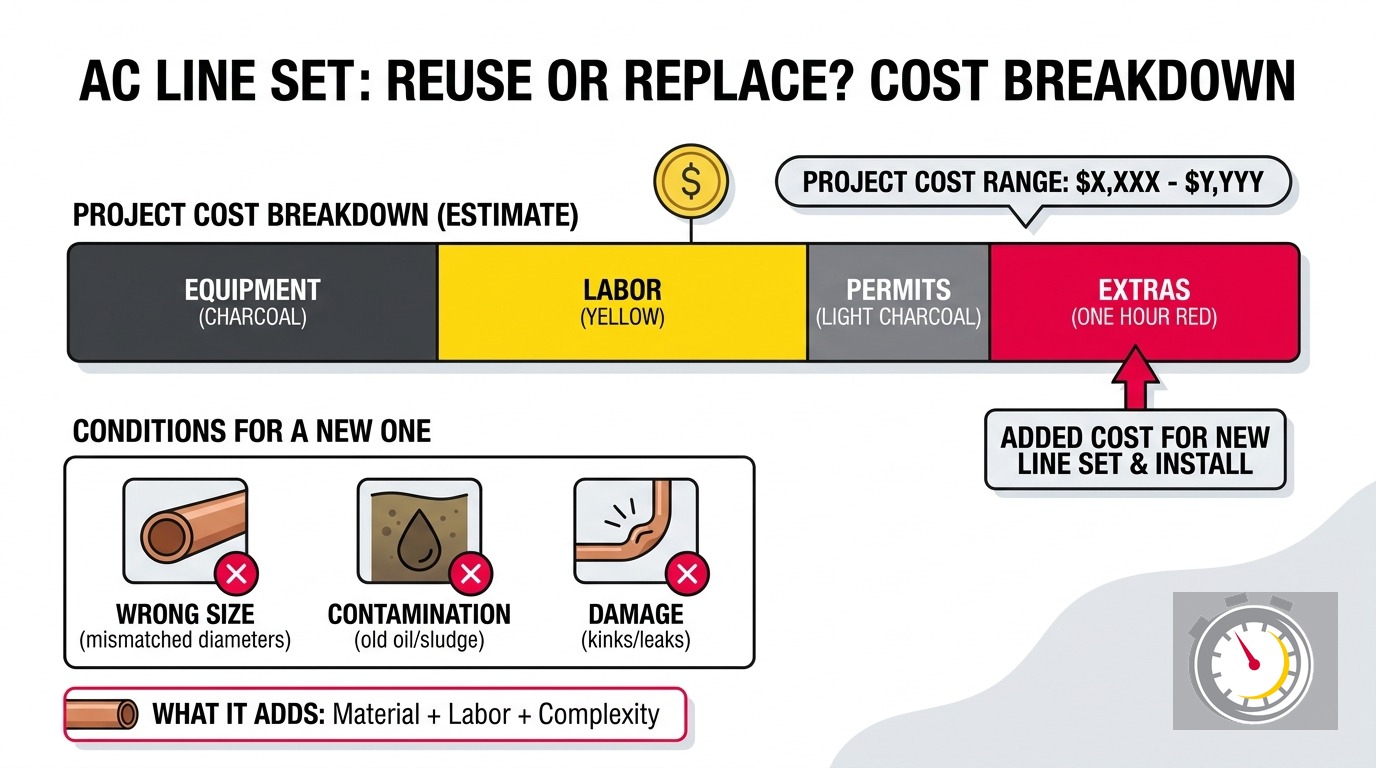
- Five conditions require replacement: compressor burnout contamination, moisture or acid damage, wrong sizing for the new unit, physical damage from age or freeze-thaw stress, and corrosion on a line set being transitioned to R-454B.
- AC line set replacement adds $600-$1,500 to a Twin Cities project, depending on run length and access difficulty.
- Minnesota requires a mechanical permit for line set work. Only a licensed contractor may pull it.
- A compromised line set can disqualify a Xcel Energy Quality Install rebate worth $150-$450.
When the Line Set Conversation Comes Up
AC line set replacement cost is not a question most homeowners think about until an HVAC technician raises it mid-estimate. You are planning an air conditioner replacement, and now you are looking at a line item you did not budget for.
Here is what you need to know upfront: the existing copper line set is sometimes reusable. Whether it is depends on inspection. In 2026, the stakes for getting that decision right are higher than they were even two years ago. The refrigerant chemistry on new AC equipment changed at the start of this year, and that change affects how your technician should evaluate your line set before any new unit gets connected.
This guide covers what drives the reuse-or-replace decision, what ac line set replacement cost looks like in the Twin Cities market, and what Minnesota homeowners specifically need to know before they sign off.
What Is an AC Line Set?
A line set is the pair of insulated copper tubes connecting your outdoor condenser to your indoor evaporator coil. The two tubes carry refrigerant in opposite directions, forming the continuous loop that makes cooling possible.
The larger tube - the suction line, wrapped in foam insulation - carries refrigerant vapor from the indoor coil back to the outdoor compressor. The smaller liquid line carries high-pressure refrigerant liquid from the condenser back indoors to the evaporator coil.
Most residential line sets run 25 to 50 feet. After installation they typically disappear inside walls, through crawl spaces, or along the exterior of the house. You rarely see them. But they affect system efficiency, equipment longevity, and now - with the 2026 refrigerant transition - refrigerant safety in ways that make the inspection before any new installation more consequential than it used to be.
Does Every New AC Need a New Line Set?
No. A line set that is correctly sized, clean inside, physically sound, and compatible with the new refrigerant can be reused. Inspection drives the decision, not age alone.
A 15-year-old line set on a well-maintained system with no leak history may pass. A 6-year-old line set from a system that had a compressor burnout will not. Your technician is answering one question: can this copper tube safely carry the new refrigerant at the correct pressures, without contaminating the new equipment?
Why Does the 2026 Refrigerant Shift Change the Line Set Decision?
As of January 1, 2026, new residential AC systems must use refrigerants with a global warming potential below 750. The dominant replacement is R-454B. Unlike R-410A, R-454B is mildly flammable, and that changes the safety calculus for old or corroded line sets.
The EPA AIM Act Technology Transitions Rule established this requirement. R-454B carries a GWP of 466, roughly 78% lower than R-410A’s 2,088.
What this does NOT mean: the EPA does not require replacing a working R-410A system. As the EPA’s FAQ on HFC phasedown confirms, existing systems can still be serviced while R-410A supply lasts. A May 2026 final rule also allows continued installation of R-410A equipment manufactured before January 1, 2025, until existing inventory is depleted. The regulatory picture is still settling.
But when your system reaches end of life and you replace it, the new unit is almost certainly running R-454B.
That changes the line set question. R-410A and R-22 are not flammable. R-454B is classified A2L - mildly flammable under ASHRAE 34. A refrigerant leak from a corroded or compromised line set near an ignition source - a gas water heater, a furnace burner - carries fire risk with R-454B. With R-410A, the same leak was a refrigerant loss. With R-454B, it is a potential ignition hazard.
Mechanically, the transition is workable. R-454B operates at slightly lower pressures than R-410A: roughly 674 psia versus 711 psia. Copper tube diameters are identical. A clean, intact R-410A line set is often mechanically compatible with the new refrigerant.
But the industry checklist for A2L line set transitions is explicit: corroded or aging line sets should be replaced when the refrigerant type changes. Even for a line set that passes inspection, the reconnection procedure is more involved than a standard R-410A hookup. Your technician must perform a triple evacuation, replace the filter-drier, flush mineral oil and replace it with POE oil, and swap all service ports and Schrader fittings with A2L-compatible versions. None of those steps are optional. Skipping them voids the equipment warranty and risks contaminating the new compressor from day one.
For a broader look at what the R-454B shift means for Twin Cities homeowners, see our guide on the R-454B refrigerant transition and your AC system.
When Does AC Line Set Replacement Become Necessary?
Five conditions make reusing the existing line set unsafe. Each has a different root cause, and knowing which applies to your system helps you evaluate your technician’s recommendation before you approve the work.
Compressor burnout contamination. When a compressor fails by burning out, it does not fail cleanly. It leaves acid, carbon, and metal debris inside the refrigerant circuit. Those contaminants travel through the line set tubing. Connect a new compressor to a contaminated line set, and the debris migrates directly into the replacement equipment. Flushing is unreliable at removing all of it. Replacement is the safe answer after a burnout event.
If your system failed through burnout rather than gradual wear, plan on the line set going with it. For what compressor failure looks and sounds like before it happens, see our post on AC compressor symptoms and repair costs in the Twin Cities.
Moisture or acid damage. Moisture inside the refrigerant circuit reacts with refrigerant to form hydrofluoric acid. That acid destroys compressor motor windings from the inside. Any system that lost refrigerant to a slow leak is at elevated risk. When refrigerant escapes through a breach, atmospheric moisture can enter the same way. Full dehydration via triple evacuation is required before the line set is safe to reuse. If the technician cannot confirm the interior is dry, the risk to the new compressor outweighs any savings on materials.
Wrong sizing for the replacement unit. Liquid and suction line diameters are specified per unit in the installation manual. A line set sized for a 2-ton system may be undersized or oversized for a 3-ton replacement. Wrong-sized tubing reduces efficiency and stresses the compressor from day one. If the replacement unit is a different tonnage than the original, sizing must be confirmed against the new equipment specs before assuming the existing line set works.
Physical damage from age or Minnesota freeze-thaw cycles. Line sets running along exterior walls, through uninsulated crawl spaces, or underground face repeated thermal stress from Minnesota’s freeze-thaw cycles. That stress causes micro-cracks in copper, deteriorated foam insulation, and eventual pinhole leaks. Visible kinks, dents, or damaged insulation are immediate disqualifiers. Copper line sets typically last 15 to 20 years depending on environment. A 20-year-old line set in a refrigerant-transition scenario is always a close inspection candidate, regardless of how it looks from the outside.
Corrosion that makes A2L reuse unsafe. A line set that would have been fine for another R-410A system may not meet the bar for R-454B. Corrosion at fittings, discolored braze joints, or scale buildup inside the tube create potential leak points. With A2L refrigerant and a nearby ignition source, a leak point is a fire hazard. When an inspector finds corrosion on a line set being transitioned to R-454B, replacement is the right call.
How Long Does a Copper Line Set Last?
Most copper line sets last 15 to 20 years depending on environment and installation quality. In Minnesota, the range skews lower for exposed outdoor runs.
Indoor runs through conditioned space face minimal thermal stress and typically reach the upper end of that range. Outdoor runs along the house exterior or through uninsulated crawl spaces face repeated freeze-thaw cycles, UV degradation on foam insulation, and occasional physical contact from landscaping or maintenance work. Those age faster.
What shortens a line set’s life: refrigerant leaks that allow moisture ingress, corrosion from standing water around buried sections, and insulation damage that exposes copper to oxidation. What extends it: fully enclosed interior runs, quality braze joints at installation, and maintenance visits that catch small leaks before they grow.
For a system past 15 years, the line set should always be evaluated rather than assumed reusable when the AC is replaced. That inspection takes 15 minutes and can prevent a failed compressor in year two.
What Does AC Line Set Replacement Cost?
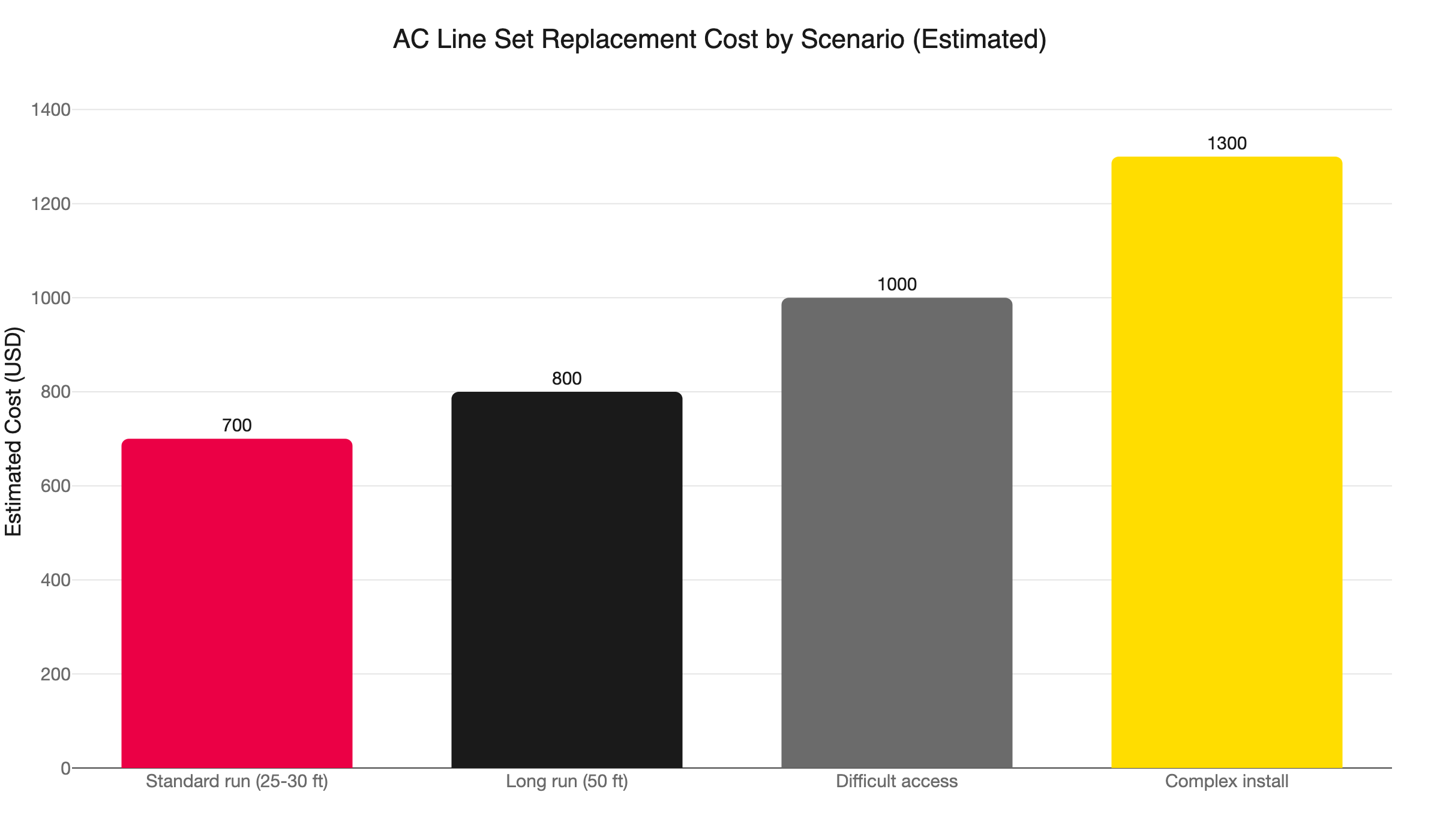
Replacing a line set adds $600-$1,500 to an AC installation project in the Twin Cities, depending on run length and access difficulty.
Here is what drives that range:
Standard run, easy access ($600-$800). A 25-30 ft line set running along an exterior wall or through an open, unfinished basement. Labor is straightforward, access is clean, and the total stays toward the low end.
Difficult access add-on ($100-$300 more). Buried runs, finished-wall penetrations, and multi-story routing all add labor time. Labor runs roughly $75-$150 per hour in the Twin Cities and makes up 40-60% of the total line set job cost. Complex access can push a standard job well above the baseline range.
Longer runs ($3-$5 per additional foot). A 50-foot run adds $60-$100 in copper materials alone, before labor. Long runs through difficult spaces compound both material and labor costs.
Complex installations ($1,500 or more). Long run plus difficult access plus extra fittings or replacement insulation puts a project at the top of the range.
One number to ignore: the $200-$750 figures that appear frequently in online searches. Those come from automotive AC line replacement data - a smaller-diameter, lower-pressure, unlicensed application with nothing in common with residential central HVAC. Do not use them when budgeting.
These costs are add-ons to the AC installation itself. For the full picture of what a new central air conditioner costs in the Twin Cities, our AC replacement cost guide for Minnesota covers the complete project range.
Does Line Set Replacement Require a Permit in Minnesota?
Yes. Line set replacement requires a mechanical permit from the local building authority. Minnesota law does not treat it as a minor part swap.
Minnesota Rule 1346.0105 classifies line set work as requiring a permit from the authority having jurisdiction - your city or county building department. Only a contractor holding a valid DLI-licensed mechanical contractor credential may pull it. Minnesota also requires a $25,000 mechanical contractor bond filed with DLI to contract HVAC work of this kind.
Practically, that means:
- Unpermitted work creates liability that follows the home, not the contractor.
- Equipment manufacturers may void warranties on unpermitted installations.
- An unpermitted HVAC modification can surface during a home sale inspection and delay or complicate closing.
- Ask any contractor whether the permit is included in the quote. A reputable company pulls it as part of the job, without prompting.
For a full breakdown of which HVAC jobs trigger the permit requirement in our state, see our post on when HVAC work requires a permit in Minnesota.
Will a Poor Line Set Condition Affect My Xcel Energy Rebate?
Yes. A compromised line set can cause the system to run below its rated efficiency, which can fail Xcel Energy’s Quality Install verification and cost you the rebate.
Xcel Energy’s 2026 residential rebates for central AC run $150-$450 for qualifying installations. Qualification requires a Quality Install verification by a participating contractor, confirming the system is operating at rated efficiency. A contaminated or wrong-sized line set pulls measured performance below the equipment’s nameplate rating. That check fails, and the rebate goes with it.
The Xcel rebate can stack with the federal 25C tax credit: 30% of qualified equipment cost, up to $600 for central AC or up to $2,000 for a qualifying heat pump. Getting the line set right is worth more than the replacement cost when it is the difference between collecting both credits and collecting neither.
The reverse is equally true: a clean, properly sized, and correctly evacuated line set lets the system perform as rated. Quality Install verification goes smoothly, and you collect what you are entitled to.
What to Ask Before the New AC Goes In
When your technician recommends replacing the line set, ask these questions before approving:
- What specifically failed inspection? Contamination, corrosion, wrong sizing, or physical damage?
- Is the mechanical permit included in the quoted price?
- For an R-454B installation: are you replacing all service ports and Schrader fittings with A2L-compatible versions, replacing the filter-drier, and performing a full triple evacuation?
- How will this affect Xcel Energy Quality Install qualification?
A technician who answers those questions clearly is doing the job correctly. Vague answers are worth pressing on before any equipment is ordered.
Our team is locally owned and operated in Ramsey. When we replace an AC system, we inspect the line set, give you a straight yes-or-no on reuse, and pull the permit. We back every installation with a 100% satisfaction guarantee. We live by “Always On Time… Or You Don’t Pay a Dime!(R)” - not as a slogan, but as what you should expect from a company that shows up when it says it will.
Call (763) 260-6662 or book online to schedule your AC assessment. If your system is aging or you are already planning a replacement this season, start the line set conversation now, before summer heat puts you on a deadline.
Frequently Asked Questions
How much does it cost to replace an AC line set? +
Can I reuse my old line set with a new R-454B air conditioner? +
Does replacing a line set require a permit in Minnesota? +
Will a bad line set affect my Xcel Energy rebate? +
Need a technician now?