
AC Refrigerant Leak Signs: Slow Leak vs. Other Failures
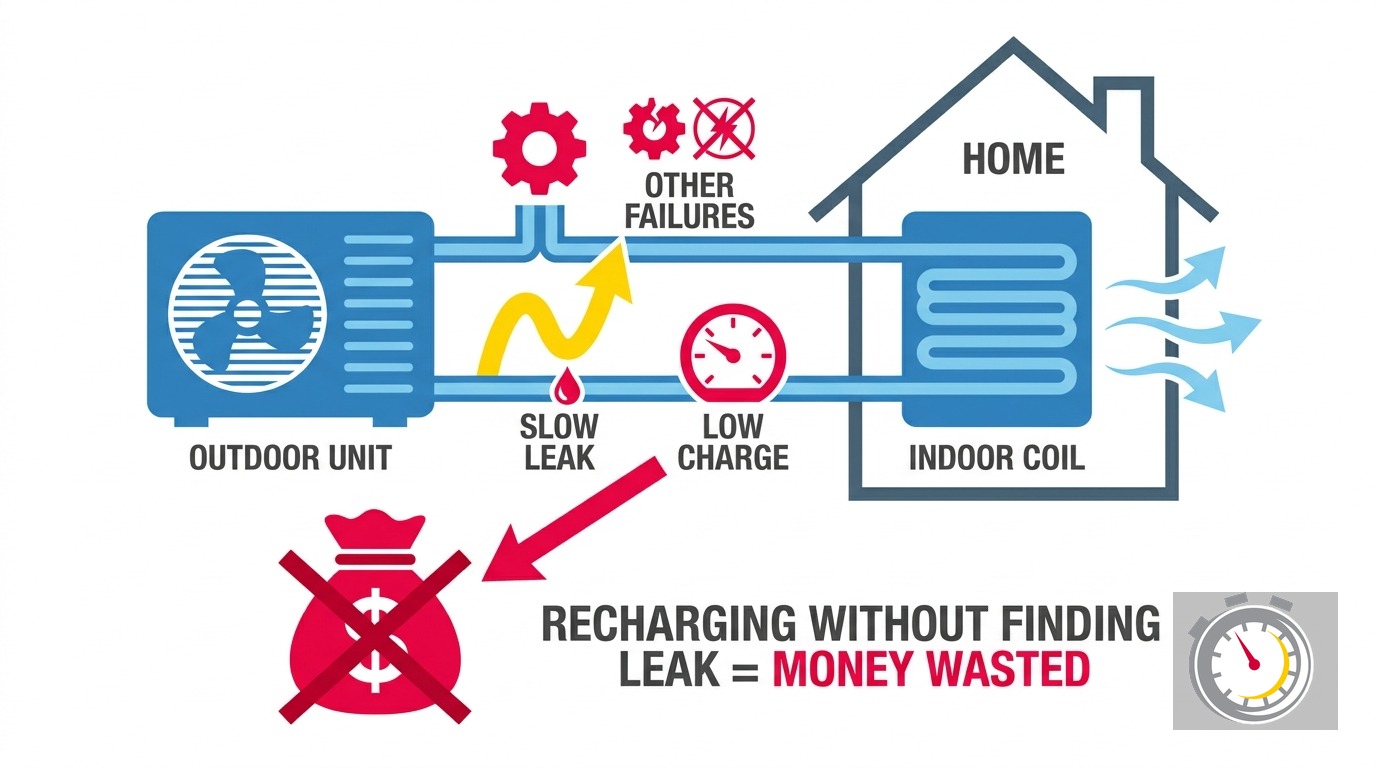
Key Takeaways
- Refrigerant circulates in a closed loop and does not get used up. Low refrigerant means a leak.
- Slow leaks and sudden charge loss produce different symptom timelines. The pattern tells you which you are dealing with before a technician arrives.
- A dirty air filter is the single most common cause of frozen evaporator coils in Minnesota - the same surface symptom as low refrigerant.
- A full R-410A recharge now costs $500-$1,500. Paying for a recharge without sealing the leak source means paying for it again.
- EPA law requires technicians to locate the actual leak before adding refrigerant. A pressure test alone does not satisfy this requirement.
- If your system is 12-15 years old and needs a full recharge, the replacement math is worth running before you commit to repair.
- Xcel Energy offers up to $500 in rebates on qualifying high-efficiency cooling equipment through September 30, 2026.
The AC refrigerant leak signs that send Twin Cities homeowners to Google are familiar: warm air from the vents, ice on the lines, higher bills, and a system that runs without cooling the house. What the search results often skip is everything that matters next. How do you tell a slow leak from a sudden charge loss? How do you know it is refrigerant and not a $12 filter causing the same symptoms? And why does the repair-before-recharge argument hit differently in 2026 than it did three summers ago?
This post answers all three.
What are the real AC refrigerant leak signs?
Short answer: The clearest AC refrigerant leak signs are warm air from the vents despite the system running, ice on the copper refrigerant lines or indoor coil, a hissing or bubbling sound near the unit, and rising energy bills. The key pattern: these symptoms appear first on your hottest days and worsen gradually over weeks.
Refrigerant circulates in a closed loop. It does not get consumed like fuel. If the level is low, something let it out. That opening is still there.
Each symptom on the list below is real. But every one of them can also come from something other than refrigerant. Pattern matters as much as any individual sign.
Warm or lukewarm air from the vents. The system runs but never reaches the set temperature. This is the most common complaint from low refrigerant and from several other failures.
Ice on the copper refrigerant lines or indoor coil. When charge is low, the remaining refrigerant expands too aggressively inside the evaporator coil. The coil surface drops below 32°F. Ice forms.
A hissing or bubbling sound near the unit. Refrigerant escaping through a small opening makes noise. Hissing usually means a gaseous leak at a pinhole. Bubbling or gurgling suggests a mixture of gas and liquid escaping.
Short cycling. The system kicks on, runs for a few minutes, and shuts off before the house cools. It repeats this pattern. Short cycling from low refrigerant happens because pressure across the compressor becomes abnormal, tripping a safety cutoff.
Higher electric bills with no change in usage. A system working harder and longer to cool costs more to run. The bill climbs month over month without a weather explanation.
Higher indoor humidity. A properly charged system dehumidifies the air as it cools it. A struggling system does less of both. If the house starts feeling clammy even with the AC running, that is a signal worth noting.
How does a slow refrigerant leak differ from a sudden charge loss?
Short answer: A slow leak bleeds the charge over weeks or months. The system cools fine on mild days but struggles first on the hottest afternoons, then more often, then continuously. A sudden charge loss from a cracked line produces near-total cooling failure within hours or a day. The timeline is the tell.
Pinhole leaks form when formic acid from Volatile Organic Compounds corrodes copper coils over months or years. Air fresheners, paints, and adhesives are common VOC sources. The acid eats microscopic holes. The charge bleeds out slowly.
A slow leak typically follows this progression:
- The system handles mild summer days without issue.
- On days above 90°F, the house climbs a few degrees above the thermostat setting.
- Over weeks, the system struggles on more days - not just extreme heat days.
- The system runs continuously through the afternoon without catching up.
- Ice appears on the lines or on the coil inside the air handler.
A cracked refrigerant line is a different failure entirely. The charge can be gone within a day or two. The house goes from comfortable to uncoolable fast. There is no gradual progression to work through.
A Minnesota-specific wrinkle: Our cooling season runs about 90 days. A slow leak that starts in September often goes undetected through fall and winter. The following June, the homeowner fires up the AC and says it worked fine last year. It did not. It was leaking for eight months. By the time the first hot week arrives, the charge is already low enough to cause immediate problems.
What other problems cause the same symptoms?
Short answer: A dirty air filter, a weak run capacitor, a blocked condenser coil, and a failing blower motor can all produce warm air, ice on the coil, short cycling, or continuous running without adequate cooling. A certified technician can separate these from a refrigerant issue in minutes using a manifold gauge set.
Dirty air filters are the single most common cause of frozen evaporator coils in Minnesota. When airflow across the coil drops, the coil gets too cold. Ice forms. You see the ice and assume refrigerant. The fix is a new filter, not a $500-$1,500 recharge.
Here are the other most common look-alikes:
Weak run capacitor. The capacitor gives the compressor and fan motors the torque they need to start and run. A weak or failed capacitor causes the compressor to struggle, short cycle, or draw excessive current. The symptoms mirror low refrigerant closely. A failing capacitor is a relatively inexpensive repair compared to a full refrigerant service.
Blocked condenser coil. The outdoor unit dumps heat collected from inside your home. If cottonwood, grass clippings, or debris have packed the condenser fins, the unit cannot shed that heat. The system overheats internally. The house warms. Bills climb. The indoor coil may ice over from the resulting pressure imbalance.
Failing blower motor. The blower moves air across the evaporator coil and into the duct system. A failing blower reduces airflow. Less air across the coil means lower coil temperatures. Ice forms. Less conditioned air reaches the rooms. From a symptom standpoint, this looks identical to a refrigerant problem.
Before calling for a refrigerant check, replace the air filter if it is visibly gray and clogged. Wait 24-48 hours for any ice to thaw and the system to restabilize before drawing further conclusions.
Why does ice on the coils need a filter check first?
Short answer: Ice on the evaporator coil has two common causes: low refrigerant and restricted airflow. Restricted airflow from a dirty filter is more common and costs almost nothing to fix. Confirming the filter is not the problem before calling a technician is always the right first step.
The evaporator coil is designed to run cold, not frozen. Under normal operation, warm humid air flows across it. The refrigerant inside absorbs the heat. Moisture in the air condenses and drains into the condensate pan. That is how your AC both cools and dehumidifies.
When the coil surface drops below 32°F - whether from low refrigerant or restricted airflow - ice builds on the coil surface. The ice then blocks further airflow. Less airflow means more ice. More ice means less airflow. Eventually the system trips a safety or the compressor overheats.
The Minnesota water damage problem: Our summers are humid enough that a central AC system pulls gallons of water from the air daily. When a frozen coil thaws, that melt volume can overflow the condensate pan. Water can damage basement floors and drop ceilings. In a drier climate, a frozen coil is an inconvenience. In Minnesota, it can become a restoration bill.
If you see ice: turn the system off. Switch the fan to “fan only” mode to circulate air across the coil and speed the thaw. Wait two to four hours before restarting. Running a frozen system risks compressor damage. For a deeper look at what causes this and how to address it, see our guide to frozen evaporator coils and AC ice in the Twin Cities.
Why is recharging without fixing the leak a bad bet in 2026?
Short answer: Refrigerant exits through the same path it entered. A recharge without sealing the source is a delay, not a repair. The charge bleeds out again, often before next cooling season. In 2026, a full R-410A recharge costs $500-$1,500. Without a repair, you pay that again.
The mechanic analogy is direct. If your radiator has a crack, topping off the coolant does not fix the crack. The coolant exits. You top it off again. Eventually the engine overheats.
The same logic applies here. A pinhole leak does not seal itself. A cracked line does not weld itself back together. The refrigerant that goes in exits through the same opening.
On a system with a slow pinhole leak, that process might take one full cooling season. On a system with a larger crack, it could be a matter of weeks. Either way, you are back where you started - except now you have spent $500-$1,500 with no lasting benefit.
There is also a legal dimension. Under EPA Section 608, mandatory leak repair requirements apply to systems that lose more than 10% of their charge in a 12-month period. The regulation requires finding the actual leak, not just restoring the charge. “We topped it off and pressure-tested the system” does not satisfy the requirement.
What does an R-410A recharge actually cost right now?
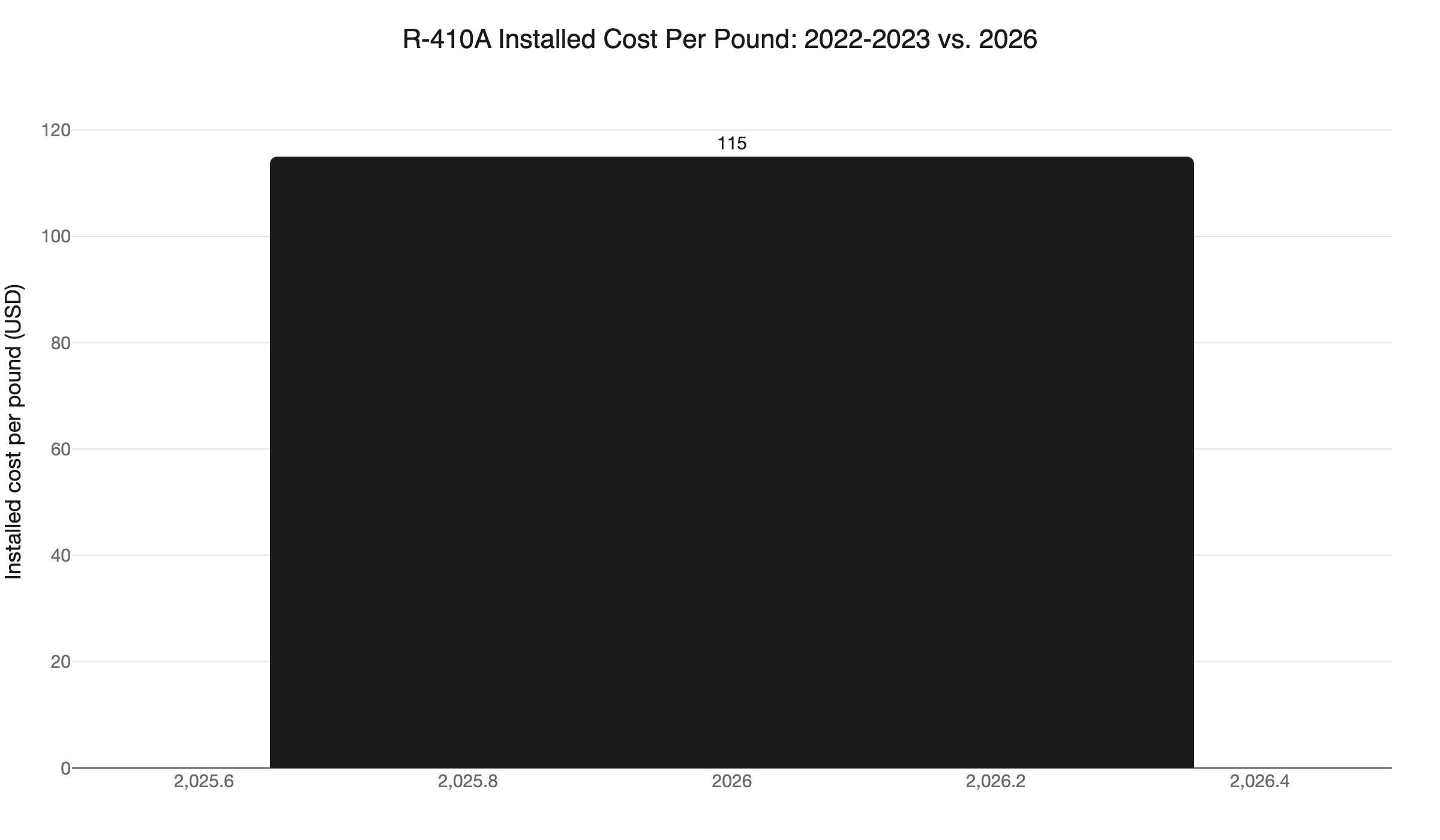
Short answer: R-410A installed cost has risen from roughly $40-70 per pound in 2022-2023 to $80-150 per pound in 2026, driven by EPA AIM Act production cuts. A standard 3-ton system holds 6-12 pounds. A full recharge now runs $500-$1,500 depending on how much charge was lost.
The price is rising for a structural reason, not a temporary supply blip. The EPA’s AIM Act banned manufacture and import of new R-410A residential split-system equipment starting January 1, 2025. Production allocations for the refrigerant itself are being cut 15-25% each year. Supply tightens. Price follows.
This is the R-22 pattern playing out again. R-22 refrigerant went from roughly $40 per pound to over $120 per pound as supply dried up. Homeowners with R-22 systems faced the same choice: pay escalating recharge costs to keep an aging system alive, or replace it. R-410A is following that same trajectory.
New equipment uses R-454B or R-32, both with significantly lower global warming potential than R-410A. If your system still runs R-410A and is facing a significant recharge, now is the right time to run replacement math alongside the repair estimate. Our post on R-454B and what the refrigerant transition means for Twin Cities homeowners has the full picture.
What does EPA law require when your AC has a refrigerant leak?
Short answer: EPA Section 608 mandates repair at the actual leak location. Any system losing more than 10% of its charge per year triggers this requirement. A technician must find the leak using a detector, ultrasonic tool, or bubble test. A pressure test alone does not count.
This matters for homeowners because it defines what a compliant refrigerant service looks like. If a technician offers to add refrigerant and check system pressure without locating the leak, that service is not compliant with EPA Section 608 stationary refrigeration leak repair requirements.
Only Section 608-certified technicians can legally purchase and handle refrigerants. A proper leak inspection uses electronic detectors, ultrasonic equipment, or bubble solutions applied to joints and fittings. Some technicians also use fluorescent dye traced under UV light. The dye method takes a follow-up visit with a UV lamp, but it confirms the exact leak path with certainty.
When you call us, ask one direct question: “Will you locate the leak before adding refrigerant?” If the answer is no, look for a different contractor. That step is what turns a temporary recharge into a lasting repair.
When should a leak tip toward replacement instead of repair?
Short answer: When the combined cost of leak detection, repair, and recharge approaches or exceeds a new system’s cost, and the unit is already 12-15 years old, replacement usually wins on a cost-per-year basis. A near-full recharge on an aging R-410A system at current prices is often the trigger for that conversation.
Run two numbers side by side:
- Repair path: Add up leak detection, the repair, and the recharge. Estimate the remaining useful life of the system. Divide the repair cost by those remaining years to get a cost-per-year figure.
- Replacement path: Equipment and installation cost, minus available rebates, divided by a 15-20 year expected lifespan.
Xcel Energy currently offers Minnesota residential customers up to $500 in rebates on qualifying high-efficiency cooling equipment through September 30, 2026. A new high-efficiency system also lowers monthly operating costs. That savings compounds over the system’s life and changes the math in favor of replacement faster than most homeowners expect.
If your system is under 10 years old and otherwise healthy, repair makes sense. If it is 15 years old, running R-410A, and needs a near-full recharge at current prices, the honest answer is that repair buys one more season at escalating cost. See our full breakdown of AC replacement costs in Minnesota to put real numbers on both sides before deciding.
Steps to take when you notice AC refrigerant leak signs
Step one: If you see ice on the refrigerant lines or indoor coil, turn the system off. Running a frozen system can damage the compressor - one of the most expensive repairs on a central AC. Switch the fan to “fan only” to move air across the coil and speed the thaw. Allow two to four hours before restarting.
Step two: Check and replace the air filter. If it is visibly dirty, swap it. Restart the system and give it 24-48 hours before drawing conclusions about refrigerant.
Step three: If the filter was clean and the symptoms persist, call a certified technician. Do not let anyone add refrigerant without performing a proper leak search first. Ask directly: “Will you locate the leak before adding refrigerant?” A contractor who skips this step is selling you a temporary fix at a full repair price.
When our team comes out, we follow the EPA-required process: locate the leak before any refrigerant goes in. We walk you through the repair options in plain numbers, including the repair-versus-replace comparison if the system’s age makes that conversation worth having.
We are locally owned and operated in Ramsey, Minnesota. We serve the Twin Cities metro including Minneapolis, St. Paul, Blaine, Maple Grove, Plymouth, Brooklyn Park, Woodbury, and Bloomington. When you schedule with us, we show up when we say we will. “Always On Time… Or You Don’t Pay a Dime!(R)” is not a marketing line. It is a guarantee we back up on every call.
Call (763) 260-6662 or schedule an AC diagnostic online. If your system is icing up, short cycling, or not keeping up on hot days, do not wait until fall. Refrigerant issues left unaddressed through the off-season are more expensive to diagnose and fix the following June.
Frequently Asked Questions
What are the first signs of an AC refrigerant leak? +
Can I just add refrigerant to my AC without fixing the leak? +
How much does fixing an AC refrigerant leak cost in Minnesota? +
Is ice on my AC always caused by low refrigerant? +
Need a technician now?