
Water Dripping From Outside AC Unit: Normal or a Leak?
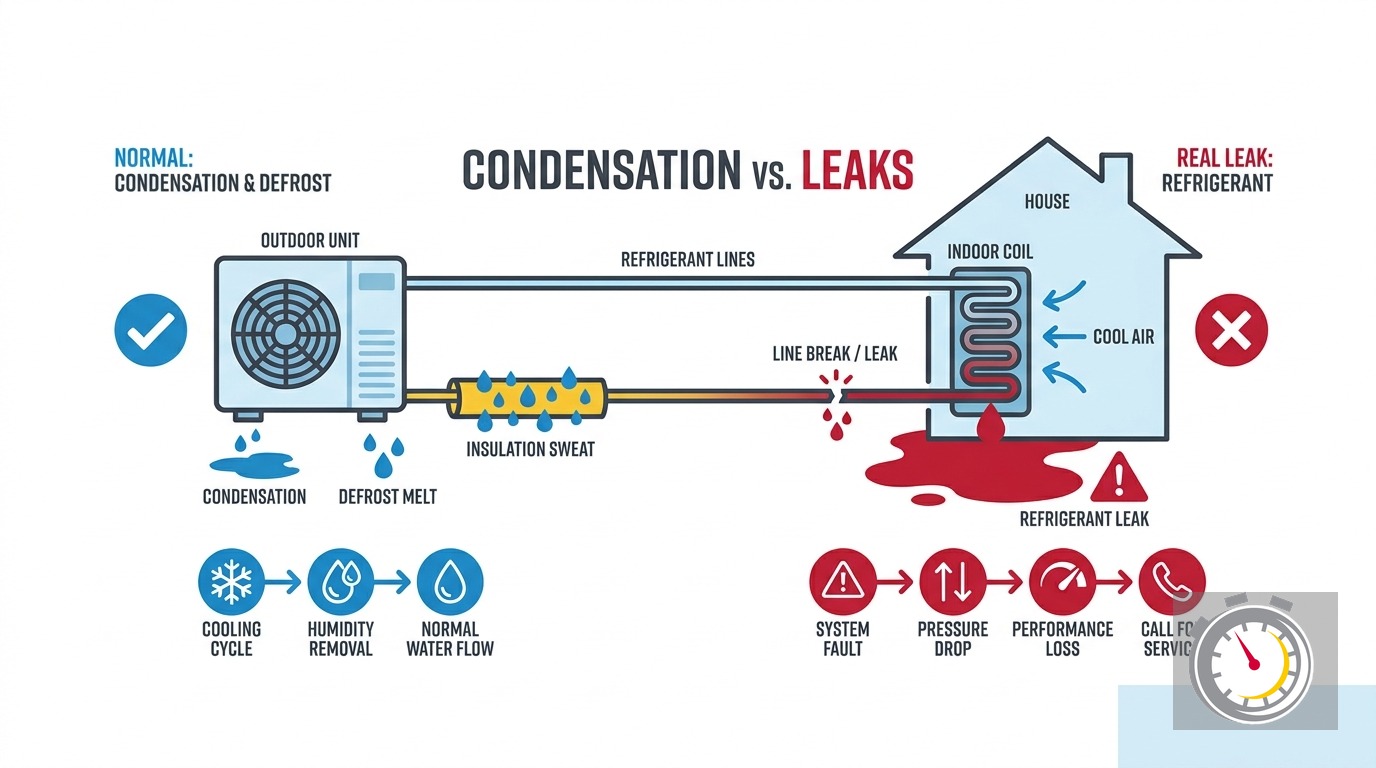
Key Takeaways
- A damp suction line in humid summer weather is usually normal condensation.
- Heat pumps melt frost in winter, so meltwater near the outdoor unit can be normal.
- Meltwater that refreezes into an ice pad is a Minnesota problem worth fixing.
- Missing or sun-damaged line insulation causes sweating and wastes energy.
- Oily residue on a line, or dripping with the system off, can mean a refrigerant leak.
- A drip near the house may come from the indoor condensate line, not the outdoor unit.
- Do not “top off” refrigerant. Find and repair the leak.
- Call (763) 260-6662 if you are unsure. We back our visits with our on-time promise.
Is it normal to see water dripping from an outside AC unit?
Sometimes, yes. A little water near the outdoor unit can be normal condensation on a cold refrigerant line in humid weather. On a heat pump in winter, it can be defrost meltwater. Steady dripping with the system off, oily residue, or ice that keeps growing points to a real problem.
Most online advice about a leaking AC covers the indoor unit. That makes sense, because a clogged drain line is the usual cause. One manufacturer guide says AC leaks are “most often caused by a clogged condensate drain line.” Another manufacturer guide puts it this way: “Condensation is normal, but excess water signals clogged drains or coil icing.”
Those pages help if water is pooling inside your home. They don’t help if you’re standing in the yard looking at a wet pad. Here, outdoor drips are sorted by season so you can tell normal from not normal.
We are Northern One Hour Heating & Air Conditioning, a locally owned and operated Twin Cities company. We see these calls every year. Many of them end with “that is normal, and here is why.”
Why does my AC line sweat in summer?
The larger, insulated copper line leaving your outdoor unit runs cold. Warm, humid air touches it, and moisture forms on the surface. That is condensation, the same thing that beads on a cold glass of lemonade. Light sweating on a humid day is normal.
Your outdoor unit connects to the house through two copper lines. The thicker one is the suction line, sometimes called the return or vapor line. According to the Building America Solution Center at PNNL, the thicker line carries cool gas refrigerant. The same page says pipe insulation “prevents condensation.”
The foam sleeve on that line has a job. It stops the sweating and keeps the refrigerant at the right temperature. With the sleeve intact, you should see little or no dripping.
Normal summer sweating looks like this:
- The thick, insulated line feels cool and slightly damp.
- The water is clear and has no oily feel.
- It happens on humid days and while the AC runs.
- It stops, or slows, when the system shuts off.
- The ground below is damp, not soaked or sudden-puddle wet.
The service valve, where the line meets the unit, can sweat too. That is also common in humid weather.
For more on this one topic, read our post on suction line sweating and refrigerant pipe insulation.
Which insulation problems turn normal sweating into a real drip?
Bare, cracked, or missing foam turns light sweating into steady dripping. Sun, weather, and animals break down line insulation over time. Once the copper is exposed, it sweats heavily and loses cooling energy. The fix is usually new insulation, and sometimes a closer look at the line set.
The PNNL page gives a clear rule: “The condition of the pipe insulation should be examined annually.” That is easy to do. Walk outside in spring before you start the AC and look at the line.
Check for these problems:
- Foam that is cracked, flaking, or crumbling in the sun
- Bare copper where the sleeve has split or fallen off
- Gaps at the wall, where the line enters the house
- Foam chewed by rodents or birds
- Tape that has dried out and come loose
Sizing matters too. The PNNL page notes that refrigerant lines come in sizes such as ¼”, 3/8”, 5/8”, and 7/8”. Common water-pipe insulation comes in ½-inch, ¾-inch, and 1-inch sizes. A loose, wrong-size sleeve leaves gaps where moisture forms. Hardware store pipe wrap is not always the right match.
Ductless mini-splits work a little differently. The PNNL page says central systems with an indoor expansion valve “only need the thicker pipe insulated.” Mini-splits with an outdoor expansion valve “need to have both the thicker pipe and the narrow pipe insulated.” If you have a mini-split, wrap both lines.
If the line itself is damaged, not just the foam, you may be looking at a bigger repair. Our guide to AC line set replacement cost and when to reuse or replace explains how that decision works.
What do winter drips mean on a heat pump?
If you have a heat pump, winter drips are often defrost meltwater. In cold, damp weather, frost builds up on the outdoor coil. The system briefly reverses to melt it. The outdoor fan usually stops during that cycle, and water runs off the coil and out the bottom of the unit.
This surprises many Twin Cities homeowners. You may see steam, hear a whoosh, or notice the fan stop for a few minutes. Then it starts again. That pattern is normal heat pump behavior.
A traditional central AC does not run in winter, so it should not drip in January. If a standard AC sits wet and dripping in deep winter, the water likely came from snow melt, roof runoff, or another source.
Normal defrost looks like this:
- The outdoor fan pauses for a short time.
- You may see vapor or steam rising from the unit.
- Water drips from the base of the coil for a while.
- The unit returns to normal heating afterward.
- The frost clears and does not return right away.
We cover the steam and ice side in more depth in our posts on heat pump defrost cycles and ice and steam or fog from the outdoor unit.
One caution. A coil that stays frosted all day, or a unit that never seems to finish defrosting, needs a technician. Normal defrost clears the frost. A stuck cycle leaves it.
Why does refrigerant line insulation matter in the Twin Cities?
Our climate swings from humid summers to sub-zero winters, and line insulation has to handle both. In summer it blocks condensation. In winter, it helps protect the line from temperature extremes. Sun and weather break it down faster than most people expect, so a yearly look pays off.
A sleeve that looked fine at install can crack after several summers of UV exposure. Then freeze-thaw cycles go to work. Moisture gets into small cracks, freezes, and widens them.
Damaged insulation costs you in three ways:
- More condensation and dripping near the pad
- Lost cooling, because the suction line picks up heat from outside air
- Possible water stains or wet spots where the line enters the wall
Fixing the sleeve is often simple. We inspect it during every tune-up. For a routine check you can do yourself, start with our AC maintenance tips.
Why does meltwater refreezing matter in winter?
Meltwater is harmless while it is liquid. When it runs onto a cold pad or into the base of the unit and freezes again, ice builds up. That ice can block drainage, trap more water, and keep growing through repeated cycles.
Treat it as a drainage and placement problem. The heat pump did its job and melted the frost. The water had nowhere good to go.
Watch for these warning signs:
- A thick ice sheet on the pad, under or around the unit
- Ice building up in the base pan of the outdoor unit
- Ice that rises higher each day instead of clearing
- Meltwater running toward walkways, where it can freeze and create a slip hazard
- Water that drains toward the foundation
Some causes can be fixed without replacing anything. A pad that has settled can trap water. A unit sitting too low in a snow-drift area has trouble draining. Gutters or roof runoff dumping onto the unit can add to the problem.
Snow and ice around the unit also block airflow. Our guide on snow clearance for heat pump outdoor units explains how much space to keep clear.
If ice is building in the base pan, don’t chip it out with a screwdriver or hammer. You can puncture the coil or a line. Call us instead.
How to read your outdoor unit by season
Match the season, the look, and your system type to find where your drip fits.
Summer, usually normal:
- Light sweating on the thick suction line or service valve
- Humid day, system running
- Water is clear, with no oily residue
Winter, usually normal on a heat pump:
- Meltwater under the unit during or after defrost
- Fan stops during the cycle
- Frost clears and the unit goes back to heating
Winter, a real problem:
- Meltwater refreezing into an ice pad
- Ice building in the base pan
- Ice that grows instead of clearing
Any season, a real leak or damage:
- Missing, cracked, or sun-damaged line insulation
- Oily residue on a line or fitting
- Dripping while the system is off
Not the outdoor unit at all:
- A drip from the indoor condensate line that ends outside
- Roof runoff, a gutter, or a sprinkler hitting the unit
If the pattern fits none of these, take a photo and call us. A picture helps our technician plan the visit.
What signs point to a real refrigerant leak?
An oily film on a copper line or fitting is the clearest sign. Hissing, poor cooling, and ice on the lines can also point to a leak. A drip that continues with the system off is another red flag. Water alone is not refrigerant, but oily residue should get a technician’s attention.
Water from condensation is clear and clean. Refrigerant oil leaves a greasy, dirty film where it escapes, and dust sticks to it. If you wipe a joint and your finger comes away oily, treat that as a warning.
Other signs to watch for:
- Your AC runs but the house does not cool well
- Ice forms on the lines or the indoor coil
- A hissing or bubbling sound near the lines
- Your cooling bills climb without a reason
The EPA says “Major leaks rarely develop in properly installed and regularly maintained units.” That is good news, and a reason to keep up with maintenance. The EPA homeowner FAQ also says to “ask your service technicians to locate and repair the leak” instead of “topping off.”
Topping off hides the problem. The leak stays, the charge drops again, and you pay twice. The same EPA page notes it is “illegal to intentionally release any refrigerant when maintaining, servicing, repairing or disposing of AC equipment.” So refrigerant work belongs to a licensed professional.
For a closer look at the symptoms, see our guide on refrigerant leak signs in Minnesota.
Where is the most common place for an AC leak to occur?
Most AC water leaks happen indoors, not at the outdoor unit. The usual spots are the condensate drain line, the drain pan under the indoor coil, and the coil itself when it ices up. Refrigerant leaks more often show up at joints, fittings, and the coil.
That is why so much online advice points inside. A clogged drain line is the top cause of water around an AC, and manufacturer guidance agrees. One manufacturer page lists clogged condensate drain lines first.
Here are the usual suspects for water, from most to least common:
- Clogged condensate drain line: Algae and debris block the flow.
- Overflowing drain pan: The pan cracks, rusts, or fills past capacity.
- Frozen evaporator coil: Ice melts and overwhelms the drain.
- Failed condensate pump: Common in basements and lower levels.
Refrigerant has different weak points. Joints, valve connections, and coils are the usual places. A leak there won’t look like a puddle. You’ll notice weak cooling and possibly oily residue.
If your problem is indoors, these posts can help: AC drain pan overflow causes and fixes and frozen evaporator coil causes.
Is that drip really coming from the outdoor unit?
Often it is not. The indoor unit has its own condensate drain line, and many homes route it outside through a wall. Water from that line can land near the outdoor unit and look like a leak. Trace the drip back to its source before you blame the outdoor unit.
We could not point to a published source for this one, so take it as general guidance from our field experience.
Here is how to tell the difference:
- Look for a small PVC pipe, usually white, coming through the wall near the unit.
- Run the AC and watch the pipe’s end. Steady dripping is normal.
- Notice whether the outdoor unit itself is wet or just the ground below the pipe.
- Check whether roof runoff or a sprinkler is hitting the unit.
A drain line that drips steadily is not a problem by itself. If it stops dripping, or if water backs up indoors, the line may be clogged. Our step-by-step guide to clearing a clogged AC drain line covers the fix.
A clogged line can also freeze in colder weather or shoulder seasons. If you see a frozen drip tube, have someone take a closer look.
What can you check yourself safely?
You can do a visual check without tools. Look at the line insulation, the pad, and the area around the unit. Note when the water appears and whether the system is running. Do not open panels, touch electrical parts, or handle refrigerant lines. Leave those jobs to a licensed technician.
Here is a safe, five-minute routine:
- Look at the thick line. Is the foam intact, or is bare copper showing?
- Feel for oily residue. Wipe a fitting with a paper towel from a safe distance. Do not touch moving parts.
- Note the timing. Does the water appear while the system runs or after it stops?
- Check the pad. Is the unit level? Does water pool or drain away?
- Look at the surroundings. Check gutters, downspouts, sprinklers, and plants.
- Trace the indoor drain line. See where it ends and whether it drips there.
Keep the area around the unit clear too. Leaves, grass, and shrubs trap moisture and block airflow. Our post on clearance and landscaping around the AC unit shows how much room to leave.
If ice is building on the lines or the unit, turn the system off at the thermostat. Running a frozen system can damage the compressor. Then call us, and we will help you decide what to do next.
Does homeowners insurance cover HVAC leaks?
Usually it depends on the cause. Many policies cover sudden, accidental water damage, such as a burst pipe. They often exclude wear and tear, lack of maintenance, and the cost to repair the HVAC unit itself. Read your policy, and ask your agent before you file.
A slow drip from a worn line or a clogged drain is typically a maintenance matter. Damage that results, like a stained ceiling, may fall under a different part of your policy. The rules vary a lot between insurers.
Keep records of your maintenance. They can help show you cared for the system. Photos help too, so take pictures of any damage before you clean up.
We cover the topic in more depth in our guide to homeowners insurance and HVAC coverage in Minnesota. We are not insurance advisers, so confirm details with your insurer.
A note on heat pump rebates in Minnesota
If a repeat winter drip has you thinking about a new heat pump, don’t count on a state rebate yet. The Minnesota Commerce Department page says it has not launched. Its latest update was October 12, 2026.
The Minnesota Commerce heat pump page says “Save Energy Minnesota has not launched yet,” with no estimated launch date. It also lists the rules for when the program opens:
- The rebate is capped at $4,000.
- Prior HEAR approval is required.
- An energy audit within the last 18 months is required.
- The unit must be an ENERGY STAR certified cold climate air-source heat pump.
The page is blunt on timing: “HEAR cannot approve retroactive rebates.” In plain terms, don’t install first and hope to claim later.
For utility rebates, check your utility’s current rebate page for the latest details. Our guide to Xcel and CenterPoint HVAC rebates points you to the right places. If you plan a larger project, ask us about financing options too.
When should you call Northern One Hour?
Call when you see oily residue, ice that keeps growing, dripping with the system off, or damaged line insulation. Call too if you cannot tell where the water comes from. A short visit can save you from a bigger repair and an unneeded guess.
Our technicians will check the lines, the insulation, the pad, the drain, and the refrigerant charge. We explain what we find in plain language. You get a price before work begins, and the choice is yours.
We are locally owned and operated, and we serve homeowners across the Twin Cities. Time matters when your cooling or heating is in question. Our promise is “Always On Time… Or You Don’t Pay a Dime!(R)” In practice, we arrive within the time window you select. If your technician does not show up on time, you do not pay for the service.
You can reach us two ways:
- Call (763) 260-6662.
- Book online and pick the time that works for you.
Not sure whether your drip is normal? Send us the photo and tell us the season. We will help you sort it out. A yearly look at your line insulation, plus a tune-up before cooling season, heads off most of these surprises.
Frequently Asked Questions
How do I unclog my AC condensate drain line? +
How much does it cost to replace an AC drain line? +
Need a technician now?