
Heat Pump Outdoor Unit Snow Clearance: Winter Guide
Key Takeaways
- Heat pump defrost cycles run every 30-90 minutes in cold, wet conditions. Steam from the unit is normal. Ice that persists after one full defrost cycle is not.
- Defrost meltwater refreezes under the unit in sustained cold weather. Each cycle adds more. Over weeks, a growing ice pedestal can tilt the unit, block the drain pan, and cut seasonal efficiency by up to 12.7%.
- Ground clearance requirements are 16-18 inches in snow regions. The Twin Cities averages 51.2 inches of annual snowfall, with snowpack regularly reaching 10-20 inches. Minimum clearance is tight in an average Minnesota winter.
- If you have a dual-fuel system programmed to switch to gas at 40°F, the heat pump sits idle during the coldest, snowiest stretches. It can wake up facing a packed drift when temps climb back above threshold.
- Safe clearing: switch to emergency heat first, use a soft-bristle brush, start at the top, never use a metal tool against the coil fins.
- A unit that stays iced over after one defrost cycle, tilts, or makes new grinding sounds on startup needs a technician - not a wait-and-see.
Your heat pump is designed to run all winter in Minnesota. It handles frost on its own. It handles light snow accumulation on its own. What it does not handle well is a growing ice pedestal underneath it, a packed drift against the coil face after a week of sub-40°F weather, or a drainage problem that compounds with every defrost cycle from November to March. This post covers all three.
Why Does Ice Form on an Outdoor Heat Pump Unit?
The outdoor coil runs about 10°F colder than the surrounding air. That means the coil surface hits freezing when outdoor temperatures are still in the low 40s, well above 32°F. Frost accumulates in those conditions, and the heat pump’s control board handles it automatically with timed defrost cycles.
According to Energy Vanguard’s explanation of heat pump frost physics, refrigerant temperature in the coil is cold enough to cause surface frost even when ambient air is above freezing. This is expected behavior, not a malfunction.
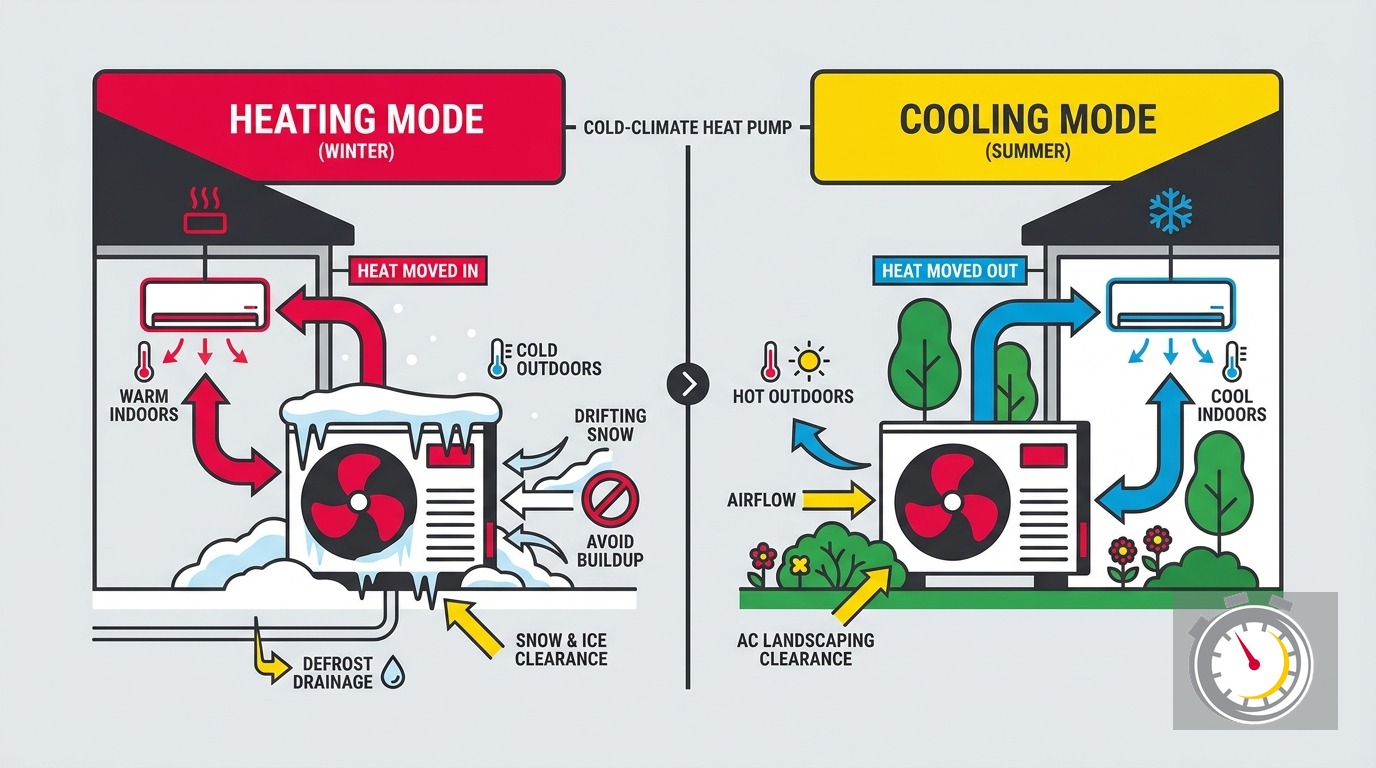
When the defrost cycle runs, the reversing valve briefly switches the unit into cooling mode. Warm refrigerant flows to the outdoor coil. The outdoor fan stops so generated heat concentrates on melting the frost rather than escaping into the air. Steam rises from the unit as ice vaporizes. The cycle lasts a few minutes, then the unit returns to heating mode.
The frost itself is not the problem. The problem is what happens to the water that melt creates - and what happens when snow accumulation exceeds the defrost cycle’s ability to manage it without help.
How Much Ground Clearance Does a Heat Pump Need in Minnesota?
Cold-climate contractor guidance calls for 16-18 inches between the bottom of the outdoor unit and grade level. That is a minimum for snow regions, not a target. It assumes open, undrifted ground, and it leaves almost no margin in a heavy Minnesota winter.
IRC 2018 §M1411.1 and the manufacturer clearance specs compiled by JaspeCtory require outdoor units to be installed per manufacturer instructions. Snow-region manufacturer specs typically call for 16-18 inches from grade, 18-24 inches on inlet sides, and 60 inches of clear space above the unit. IRC 2021 added explicit elevation language beyond the 2018 version.
Minneapolis averages 51.2 inches of annual snowfall (1991-2020 30-year normal at MSP Airport), with snowpack of 10 to 20-plus inches persisting November through March. A unit installed at 16-inch clearance is effectively near grade level during a heavy-pack stretch. In a year with sustained deep pack, it can be buried entirely.
If your unit was installed at a standard warm-climate height of 4-6 inches, a snow-region elevation platform is worth discussing at your next service call. A 12-14-inch stand gets the unit above typical pack depth and makes drainage easier to manage. It is a much cheaper fix before the unit is buried than after.
Also check the inlet-side clearance after major storms. Most manufacturers require 18-24 inches on the sides where air enters the coil. A drift packed against the coil face restricts airflow the same way a dirty air filter does. The unit works harder, heat transfer drops, and defrost cycles run longer.
Why Defrost Drainage Is the Real Winter Risk
Every defrost cycle pushes liquid water onto the ground beneath and around the unit. In sustained cold weather, that water refreezes before the next cycle runs. Each cycle adds more: melt, drain, refreeze. Over weeks, the ice accumulates into a pedestal under the unit.
Three things go wrong as that pedestal grows.
The unit tilts off level. Refrigerant lines and electrical connections are not designed to flex under a shifting unit. A tilt puts lateral stress on both.
The drain pan fills. The base pan is supposed to direct meltwater away from the unit. An ice pedestal lifts the unit into contact with pooled water. The next defrost has nowhere to drain. Water sits against the coil fins. The following cycle must melt contact ice before it can address the frost, which reduces efficiency further each time.
Efficiency drops measurably. DOE-funded research on defrost energy use found that defrost-related seasonal efficiency losses range from 1.5% to 12.7% depending on climate and operating conditions. A unit fighting a drainage ice problem on every cycle trends toward the high end of that range.
The fix is structural and is mostly a decision made at installation: a gravel bed under the unit allows meltwater to percolate rather than pool; a drainage slope under the pad routes water away from the unit; some cold-climate installs include a base pan heater for the most severe conditions. If your unit sits on a flat concrete pad with no visible drainage slope, note it the next time a technician visits.
In the meantime, you can monitor the situation. Look under and around the unit after each sustained cold stretch. A flat ice sheet that was not there three weeks ago is worth flagging at your next service call.
Does Drifting Snow Hit Harder Than Open-Ground Snow Depth?
Yes, significantly. Twin Cities prevailing winter winds come from the northwest. Units on north- or west-facing walls accumulate drifted snow at 2-3 times the open-ground depth. A unit that clears a typical winter on the south side of the house may be buried by the same storm on the north side.
Standard clearance guidance assumes open, undrifted conditions. If your unit is tucked near a wall corner, a fence line, a garage wall, or under a roofline that sheds snow, you are in drift territory. Open-ground snowpack depth and your unit’s actual buried status can be very different numbers.
Check the unit after any significant northwest wind event, not just after high-accumulation storms. A drifting wind on a dry day can pile snow against a coil face with no new accumulation on the ground in front of your house.
Check above the unit too. A roof or deck overhead can collect snow load that drips or slides onto the coil as temperatures change. That drip water refreezes on the fins. The defrost cycle handles frost that forms from inside out - it does not manage ice deposited from above. The 60-inch overhead clearance requirement addresses this. If something was installed in that overhead zone after the original setup, that is worth a look.
The Dual-Fuel Idle Problem: When Your Unit Sits Out a Cold Snap
Most Twin Cities heat pump installations are dual-fuel setups: a cold-climate heat pump paired with a gas furnace. CenterPoint Energy’s MN ducted air-source heat pump rebate requires programming the unit to switch over to gas heat at 40°F or lower. That means the heat pump is fully off during the coldest, snowiest stretches of a Minnesota winter.
A running heat pump sheds snow naturally. The coil radiates heat during operation. The compressor produces warmth. The defrost cycle runs on its own schedule. When the unit sits idle for a week-long sub-40°F cold snap, none of that happens. Snow packs against the unit undisturbed.
When temperatures climb back above the switchover threshold and the heat pump re-engages, it can start against a loaded drift on the coil face. Compressor startup under restricted airflow stresses the refrigerant loop and can trigger a safety lockout before the unit gets up to temperature.
The fix takes about two minutes. Before temps climb back through 40°F on the recovery side of a cold snap, walk out and check the unit. If there is significant snow or ice against the coil face, clear it before the system kicks on. You often have a full day or two as temperatures gradually rise. Use it.
For more on how dual-fuel systems manage the balance between heat pump and furnace operation in Minnesota winters, see our post on dual-fuel heat pump and gas furnace hybrid systems.
How Do You Safely Clear Snow From a Heat Pump?
Use a soft-bristle brush or your gloved hand to gently sweep snow from the sides and top of the unit. Switch to emergency heat first. Never use a metal scraper, ice chipper, or garden hose on the coil. Aluminum fins bend and stay bent on first contact - the damage is permanent.
Step-by-step:
- Switch the thermostat to emergency heat. This takes the heat pump offline and routes heating through the gas furnace or electric backup strips. You do not want a defrost cycle starting while you are reaching into the cabinet.
- Clear the top first. The fan discharge on most ducted heat pumps is at the top. Snow sitting on the top panel restricts the discharge airflow and can hold heat against the cabinet. Clear it before working the sides.
- Brush the coil faces gently from top to bottom. Work with a soft-bristle brush - a car snow brush works well. Brush away from the fins, not into them. If snow is frozen to the fins and does not release with light pressure, stop. Do not force it.
- Check the base for ice accumulation. Look under and around the unit for a growing mound. Note its size. If it is large enough to visibly tilt the unit, that is a service call item. Do not chip at it with a metal tool - refrigerant lines run close to the base.
- Clear a perimeter path. Shovel a clear walkway around the unit so you can inspect it easily after future storms.
- Return the thermostat to normal heat pump operation. Let the unit run through one complete defrost cycle before deciding whether an ice problem remains.
For situations where ice rather than packed snow is the main issue, see our guide to what to do when a heat pump is covered in ice.
What About Ice Building Up at the Base?
A thin, even frost coat on the coil is normal and clears on its own. Ice that covers more than two-thirds of the coil after defrost, persists for multiple cycles, or forms a thick block at the base is a problem that needs a technician - not more waiting.
Normal: light frost on the coil that clears during each defrost cycle. Steam rising from the unit during defrost. A small puddle under the unit during and after defrost. Some condensation on the cabinet in cold, humid conditions.
Not normal: ice that encases more than two-thirds of the coil after defrost has run. A growing ice block at the base that is visibly lifting the unit. Ice that contacts or restricts the fan blade. Water pooling inside the cabinet rather than draining underneath.
A fully iced coil kills heat transfer. ENERGY STAR-certified cold-climate heat pumps are tested to perform efficiently even in very cold temperatures, and top-performing units deliver close to 3 times the heat output per unit of electricity consumed in moderate conditions. An iced unit can fall to a COP near 1.0 before the safety lockout trips - the same efficiency as straight electric resistance heat, at straight electric resistance cost.
If the unit locks out and will not restart on its own, that is not a reset situation. It is a call-a-tech situation.
Mini-split owners face related winter challenges with a different unit profile. See our guide to mini-split outdoor unit snow and ice in winter for model-specific notes on clearance and coil access.
When Should You Call an HVAC Technician?
Call when ice persists after one full defrost cycle, when the unit is visibly tilting, when you hear new mechanical sounds on startup, or when the system keeps switching to emergency heat on its own.
Specific signs to act on:
- Ice covers the entire unit and does not clear after 30-45 minutes of operation
- The outdoor unit is visibly tilted or has shifted off its pad
- New grinding, shrieking, or clanking sounds during startup or operation
- The system has locked out on safety and will not restart
- The thermostat keeps reverting to emergency heat automatically, without you setting it
- The indoor air handler is running but the outdoor unit is not
Emergency heat is a fallback for a short outage, not a heating strategy for a Minnesota winter. Electric resistance strips draw significantly more power than a heat pump for the same heat output. Running on emergency heat for more than a day or two will show up clearly on your utility bill.
We are locally owned and operated in Ramsey, and our team serves Minneapolis, St. Paul, Blaine, Maple Grove, Plymouth, Brooklyn Park, Woodbury, Bloomington, and the surrounding Twin Cities area. We show up in the window you select - “Always On Time… Or You Don’t Pay a Dime!(R)”. Call (763) 260-6662 or book online to get a technician out quickly.
Rebates Worth Knowing If You’re Installing a New Cold-Climate Heat Pump
If you are evaluating a new heat pump installation - or replacing a unit that has reached end of life - current utility incentives can take a meaningful bite out of the upfront cost.
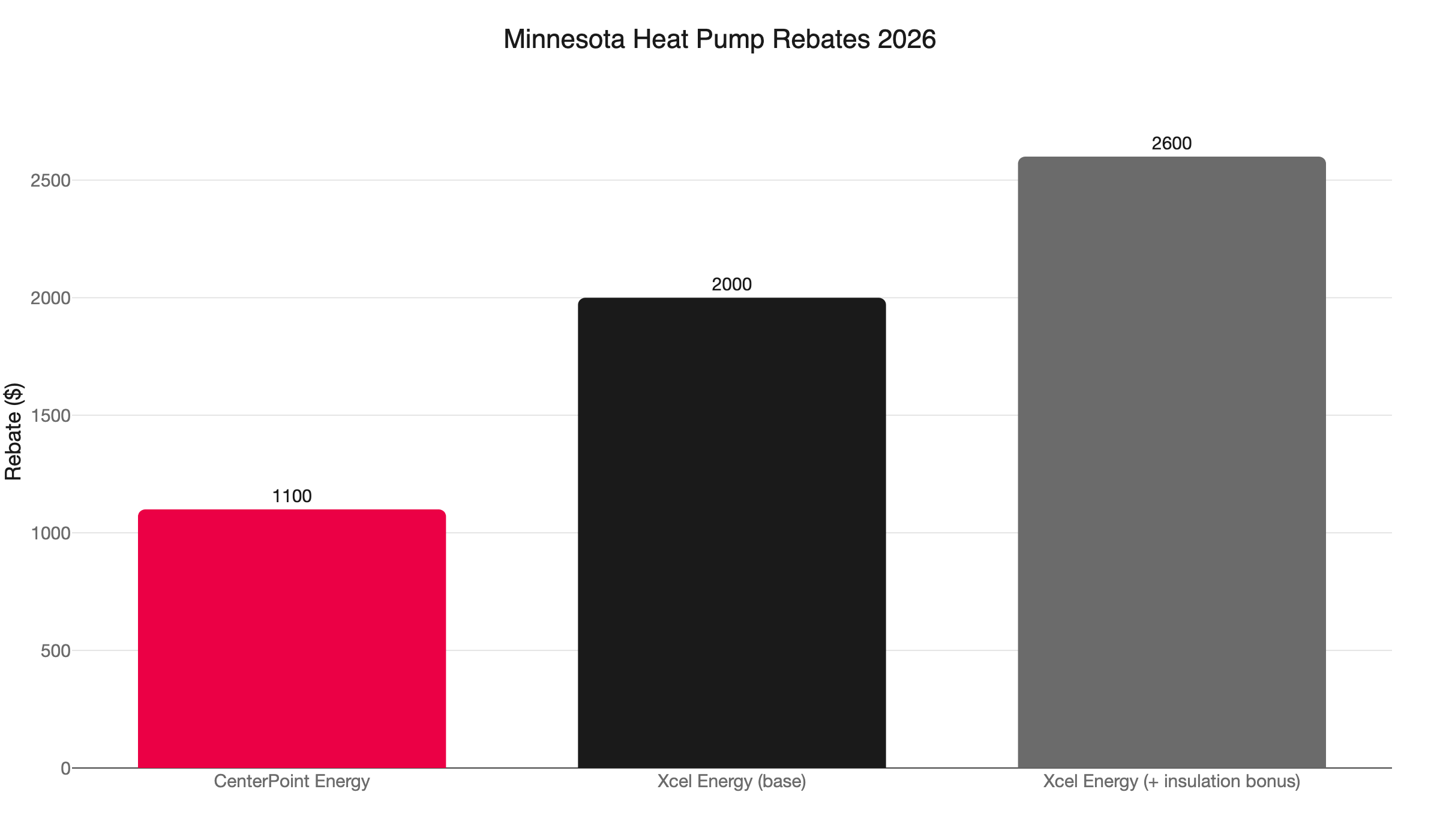
CenterPoint Energy (2026): $1,100 for a ducted air-source heat pump installed in an existing home, for natural gas customers. Requires HSPF2 rating of at least 7.8 and pairing with a 92%-plus AFUE furnace. The rebate also requires programming the 40°F switchover point - the same idle-unit scenario covered earlier in this post. It is still worth claiming; just know what it means for how the system operates in deep cold.
Xcel Energy (2026): $2,000 for a cold-climate air-source heat pump. A $600 bonus is available when the installation is bundled with insulation and air-sealing improvements, for a potential total of $2,600. The program closes December 31, 2026, with applications accepted through September 30, 2027. Verify current amounts at xcelenergy.com/rebates before committing to a timeline.
Federal Section 25C tax credit: Multiple sources from early 2026 report the 25C credit expired December 31, 2025 and is not available for installations in 2026. Confirm current status with your tax advisor before factoring it into a budget. This area has changed quickly.
For a full breakdown of how to stack utility rebates and any remaining federal credits, see our guide to Minnesota heat pump rebates and tax credits.
If you want honest, transparent pricing and help navigating the rebate paperwork, we handle that as part of the installation process. Financing is available for qualifying installations - ask when you call. Reach our locally owned and operated team at (763) 260-6662 or book online to get started.
Frequently Asked Questions
How much snow is too much for a heat pump outdoor unit? +
Should I cover my outdoor heat pump unit in winter? +
What causes the ice mound building under my heat pump? +
Need a technician now?