
How Much Clearance Around AC Condenser Unit Do You Need?
Key Takeaways
- Most manufacturers require 18-24 inches on non-service sides and 24-36 inches on the service access side.
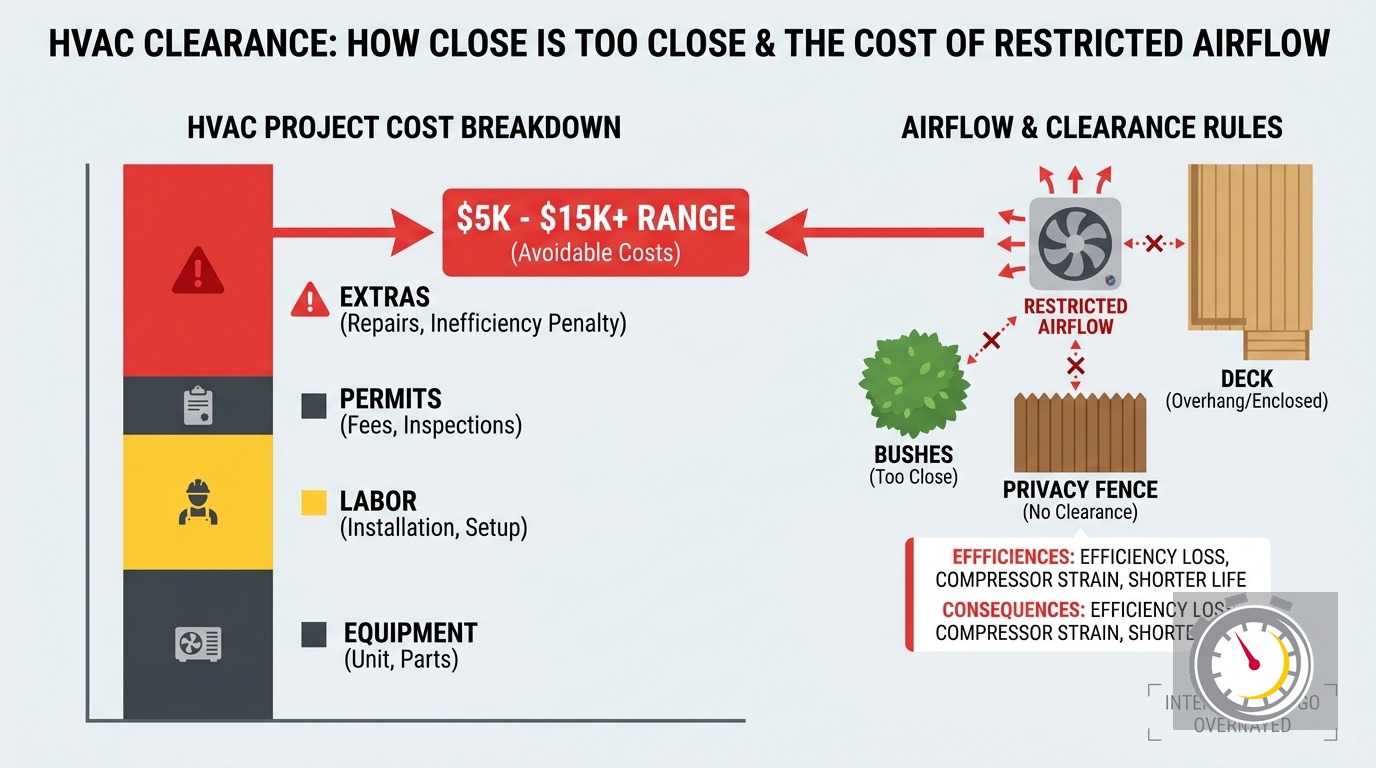
- Overhead clearance is the most critical: keep at least 48-60 inches above the fan discharge. A deck or low overhang causes more damage than a side fence.
- A solid fence within 12 inches of any side creates measurable airflow restriction and high-pressure risk.
- Shrubs need 24-36 inches of clearance - and they keep growing, so that distance requires ongoing maintenance.
- Restricted airflow can cut system efficiency by approximately 15%, raising cooling costs every month the condition continues.
- Compressor replacement costs $1,950-$4,500 installed. Most clearance-driven failures are preventable.
- Clearance violations can void manufacturer warranties and disqualify Xcel Energy rebates of up to $450.
- Minnesota’s 2020 Mechanical Code defers clearance requirements to the manufacturer’s installation manual. There is no single state-prescribed distance.
How Much Clearance Around AC Condenser Unit Actually Matters?
How much clearance around your AC condenser unit do you actually have? Most Twin Cities homeowners never measure. They plant arborvitaes, build decks, and put up privacy fences. Everything seems fine - until the first hot week of July.
That is when the calls come in. The unit trips a safety shutoff on a 95-degree afternoon. The house stops cooling. When our technician arrives, the problem is not low refrigerant or a failed capacitor. It is a shrub pressed against the coil, or a cedar deck sitting 38 inches above the fan discharge.
Clearance is not a technicality buried in a manual. It is what allows the condenser to do its one job: pull heat out of your home and dump it outside. When the space around it shrinks, the unit works harder, runs hotter, and wears out faster.
This guide gives you the real clearance numbers, explains why overhead obstructions cause the worst damage, and puts a dollar figure on what a clearance problem actually costs.
What Does “Clearance” Mean for Your Outdoor AC Unit?
The short answer: Clearance is the open air space around and above your condenser. It lets the unit draw ambient air across the coil, transfer heat into that air, and exhaust the hot air straight up - without recirculating its own exhaust back into the intake.
Your outdoor condenser has one job: move heat from inside your home to outside. Refrigerant carries that heat out to the condenser coil. The coil transfers the heat into outdoor air. A fan drives that hot air straight up and out.
For that process to work, the unit needs two things. First, a clean supply of cooler ambient air on its intake sides. Second, enough unobstructed space above the fan discharge so the hot exhaust escapes rather than curling back down.
When a fence, deck, or shrub blocks either of those - intake or exhaust - the unit begins working against itself. It is trying to cool refrigerant using air that is already warm from the previous cycle. Refrigerant pressure climbs. The system runs longer. And the components that bear that extra load start wearing out ahead of schedule.
How Much Clearance Around AC Condenser Unit Does the Code Require?
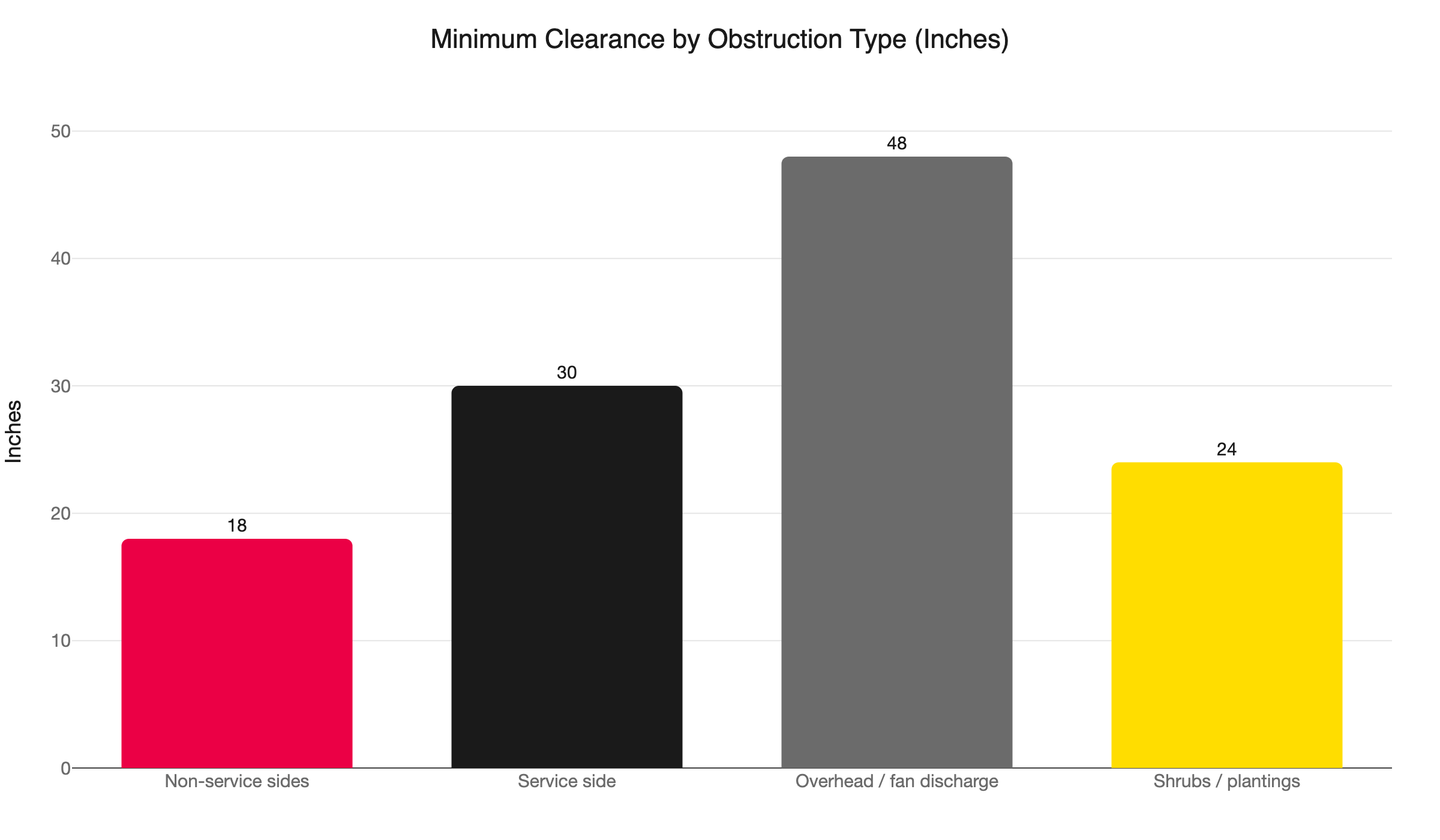
The short answer: Minnesota defers to the manufacturer’s installation manual, not a fixed state distance. Most manufacturers require 18-24 inches on non-service sides, 24-36 inches on the service access side, and 48-60 inches above the fan discharge. The absolute minimum to any solid surface, when no manufacturer spec is available, is 12 inches.
Under IRC 2024 §M1411, clearance requirements defer to the manufacturer’s installation instructions. Minnesota’s 2020 Mechanical Code follows the same approach. All mechanical cooling installations require a permit. The AHJ (authority having jurisdiction) verifies clearances at the final inspection against the installation manual - not against a state-prescribed number.
That distinction matters in practice. If your neighbor says their contractor left 12 inches and passed inspection, they may be right - for their unit’s manual. Your unit’s manual may require more.
InspectAPedia’s HVAC clearance reference cites specific manufacturer examples, including the Carrier 24ANA Infinity and the Lennox Elite XC13. Both publish detailed clearance tables by obstruction type. The numbers vary by model. Pulling your unit’s manual and verifying is the right move - not assuming a neighbor’s approval applies to your unit.
Here is a practical working guide by obstruction type:
| Obstruction | Minimum clearance |
|---|---|
| Solid fence or wall (non-service side) | 18-24 inches |
| Service access side | 30-36 inches |
| Overhead, above fan discharge | 48-60 inches |
| Shrubs or plantings | 24-36 inches |
| Open-lattice screen | Permissible only if open area equals or exceeds the unit’s venting area |
The working clearance on the service side matters beyond airflow. It is what allows a technician to safely reach the electrical disconnect, access refrigerant ports, inspect the contactor, and clean the coil. Service costs go up when the technician cannot get to the unit without moving structures first.
Why Is Overhead Clearance More Damaging Than Side Clearance?
The short answer: A fence on the side limits how much air the condenser can pull in. A low deck or overhang traps the hot air the fan just discharged and feeds it directly back into the intake. Those are different failure modes. Side restriction reduces airflow volume. Overhead obstruction raises the temperature of every cubic foot of air the unit processes.
The overhead clearance minimum is 48-60 inches above the fan discharge. A deck sitting 36 or 40 inches above the fan does not meet that threshold. The fan pushes 105-115°F air straight up. If a deck ceiling is there to catch it, that hot air bounces back down and re-enters the intake.
The unit is now trying to cool refrigerant against air that is 10-20°F hotter than the true outdoor temperature. Refrigerant head pressure climbs above safe operating limits. The high-pressure safety switch trips. The system shuts off - on the hottest day of the year, when the demand is highest.
The practical issue: most decks are designed around outdoor furniture, grills, and shade. Condenser clearance rarely appears in the contractor’s plans. If a deck passes over your outdoor unit, measure the height above the fan before assuming it clears the 48-inch minimum. It is a 90-second check that can prevent a compressor replacement.
What Does a Privacy Fence Do to Your AC Unit?
The short answer: A solid privacy fence within 12 inches of any condenser side restricts airflow and forces the unit to work harder on every cooling cycle. Closer is worse. The service access side needs 30-36 inches of clear working space regardless of fence type.
A cedar or vinyl privacy fence is solid on every face it presents to the condenser. For the intake sides, that restriction reduces how much ambient air crosses the coil each minute. The unit compensates by running longer and pushing head pressure higher.
A fence at 18-24 inches is generally within manufacturer spec. A fence at 10 inches creates measurable restriction. A fence built flush against the unit is close to a blockage.
Open-lattice and decorative screens are permissible - with a condition. The open area in square inches must equal or exceed the unit’s intake and exhaust venting area. A decorative lattice with 30% open area placed around a large-capacity unit may still fail that test. If a screen enclosure is in the plan, confirm the open-area calculation before construction starts.
One more thing the fence affects: service access. Even a fence that does not cause airflow issues can make service difficult. If the technician cannot reach the electrical disconnect or the refrigerant ports without dismantling something, your service appointments take longer and cost more. That 30-36 inch clearance on the service side is not an arbitrary comfort zone.
What Happens When Shrubs Grow Too Close?
The short answer: Shrubs that press against the coil block airflow and push debris into the fins. Even a thin layer of embedded debris reduces heat-transfer efficiency by approximately 15%. Shrubs also continue to grow, so a compliant clearance at planting time can become a violation by the following summer - with no decision ever made to let it happen.
Vegetation against the coil creates two problems at once. First, it restricts the airflow the unit draws across the coil. Second, leaves, seeds, and fine debris are pulled into the coil fins and embed there. That layer acts as insulation between the refrigerant and the outdoor air.
Even a thin debris layer on the condenser coil can reduce system efficiency by approximately 15%. That is a 15% increase in the energy required for every cooling cycle. Compounded over a full cooling season, it is a meaningful addition to your utility bill - and the coil still needs cleaning after the shrubs are trimmed back.
The fix is routine but requires ongoing attention: maintain shrubs at 24-36 inches of clearance year-round. If landscaping has grown in since the unit was installed, measure it before next summer. If shrubs have been pressing against the unit for a season or more, a coil cleaning at the same time as the clearance correction will restore full heat-transfer efficiency.
The Minnesota Summer Problem
Most clearance violations do not surface in spring. They surface in late July.
The Twin Cities average 15-20 days per year above 90°F. On a 95-degree afternoon with high humidity, the condenser already has less margin than on a mild day. The difference in temperature between the refrigerant and the outdoor air compresses. The unit has to work harder to push heat into already-hot air.
Add a recirculation loop from a low deck, or restricted airflow from a fence at 10 inches, and the unit that ran without trouble through May now trips a high-pressure safety shutoff during the worst heat of the season.
It restarts, runs for a while, and trips again. Each cycle of restart and shutoff compounds the wear on the compressor. And our team is responding to those calls while other Twin Cities homeowners are waiting for the same service window on the same hot days.
A unit that “runs fine in May” is not proof that clearance is adequate. May temperatures give the system margin to absorb problems that July will not tolerate. If you have any doubt about clearance, check it in spring - not during a heat wave.
Our post on AC struggling on extreme heat days in the Twin Cities covers the full range of what stresses an AC system when temperatures spike. Clearance is one piece of a larger picture.
What Does Restricted Airflow Actually Cost You?
The short answer: Chronic restricted airflow raises energy bills and shortens the life of the compressor, capacitors, and contactor. A compressor replacement runs $1,950-$4,500 installed. The fan motor, capacitor, and contactor add up separately on top of that. All of it is preventable if the clearance issue is caught early.
Systems with chronic airflow restriction run longer cycles, which increases cumulative compressor hours and accelerates wear on capacitors, contactors, and fan motors. Those components fail first. If you are seeing a pattern of repeated summer repairs on the same system, restricted airflow is worth investigating before the next failure occurs.
Sustained high-pressure cycles can trigger liquid refrigerant slugging - where liquid refrigerant returns to the compressor instead of vapor. Slugging destroys internal compressor components. It is not a recoverable failure: replacement is the only path forward.
Cost reference for the components most often damaged by clearance-driven stress:
- Compressor replacement: $1,950-$4,500 installed
- Condenser fan motor: $375-$900 installed
- Capacitor repair (part and labor): $195-$500
See our post on AC condenser fan motor failure symptoms and cost for what that failure looks like before it becomes a full replacement. And for the compressor - the most expensive repair on this list - our guide on AC compressor failure signs and repair cost in the Twin Cities covers when repair still makes sense and when replacement is the better call.
Does a Clearance Violation Affect Your Warranty or Xcel Rebate?
The short answer: Yes to both. Manufacturer warranties require installation within published clearance specs. A violation documented at a service call gives the manufacturer grounds to deny a compressor warranty claim. Xcel Energy’s rebate is tied to the system reaching its rated SEER2 efficiency - which a clearance violation prevents.
Warranty language from most major brands states that the unit must be installed per the published installation manual. A technician who finds a clearance violation during a service call on a failed compressor has grounds to document it. The manufacturer uses that documentation to deny the claim. A repair that should have been covered becomes a $1,950-$4,500 cost paid out of pocket.
On the utility side: Xcel Energy’s 2026 rebate offers up to $450 for qualifying central AC installations. It requires AHRI certification and proper installation by a participating contractor. A unit blocked from reaching its rated SEER2 by an airflow restriction has not been properly installed. The rebate is at risk.
The federal 25C tax credit adds 30% of qualifying project cost up to $600 and stacks with the Xcel rebate. Both credits assume the system performs as rated. A clearance violation disrupts that assumption.
These are not edge-case scenarios. They come up when a homeowner files a warranty claim on a unit that spent three summers in a tight fence enclosure - and learns the hard way that the installation condition voids the coverage.
What to Do If Your Unit Is Already Too Close to Something
If you measure and find your condenser is within the clearance minimums, the fix depends on what is causing the problem.
Shrubs and plantings. Trim back to 24-36 inches and commit to maintaining that distance each season. If vegetation has been pressing against the unit, schedule a coil cleaning at the same time. Debris embedded in the fins will continue reducing efficiency even after the shrubs are cut back.
Solid fencing. A fence within 12 inches on any side, or within 30 inches on the service access side, is a structural problem. Options include relocating that section of fence, replacing the fence with an open-lattice design that meets the venting area requirement, or relocating the condenser unit. A licensed HVAC technician can evaluate which option is practical for your installation.
Decks and overhangs. Overhead clearance violations are the hardest to fix after the fact. If the deck is already built, options include cutting a ventilation opening directly above the fan discharge, relocating the condenser, or modifying the deck structure. If a deck addition is in the planning stage and it will pass over the unit, confirm the height against the 48-60 inch minimum before framing starts - not after the concrete is poured.
Before any landscaping or deck project. Run the clearance numbers before the contractor finalizes the design. Moving a condenser unit before construction costs far less than relocating it after the fact. It takes one conversation and a tape measure.
For AC maintenance questions or a clearance evaluation, our air conditioning maintenance service is the right starting point.
Not Sure If Your Unit Has Enough Room? Here’s What to Do.
Clearance problems are not always obvious from a visual check. A fence that looks compliant may be 11 inches on the side that counts. A deck that appears high enough may be 42 inches above the fan discharge instead of the required 48. Shrubs that looked fine last fall may be significantly closer after one growing season.
If you are not certain your unit has the clearance it needs - or if your system has been tripping on hot days and airflow restriction is a possible cause - our locally owned team can evaluate it. We serve Ramsey, Blaine, Maple Grove, Plymouth, Brooklyn Park, and the broader Twin Cities metro.
When we say we will be there, we mean it: “Always On Time… Or You Don’t Pay a Dime!(R)”
Call (763) 260-6662 or schedule online to set up an inspection.
Sources: Netr Inc - How Much Clearance Should My Outdoor AC Unit Have? | InspectAPedia - HVAC Clearance Distances | Jaspector - IRC 2024 AC Condenser Installation | MN DLI - 2020 Mechanical Code | Cielo Wigle - AC Compressor Failure Causes | Meyer & Depew - Restricted Airflow Shortens AC Life | Central MN Heating & Cooling - Xcel Rebates 2026
Frequently Asked Questions
How much clearance does an outdoor AC condenser need on each side? +
Can I put a privacy fence close to my AC condenser? +
Why is a deck over an AC unit worse than a fence on the side? +
Does a clearance violation affect my Xcel Energy rebate or manufacturer warranty? +
Need a technician now?