
Can You Hose Off AC Condenser Coils? A Minnesota Guide
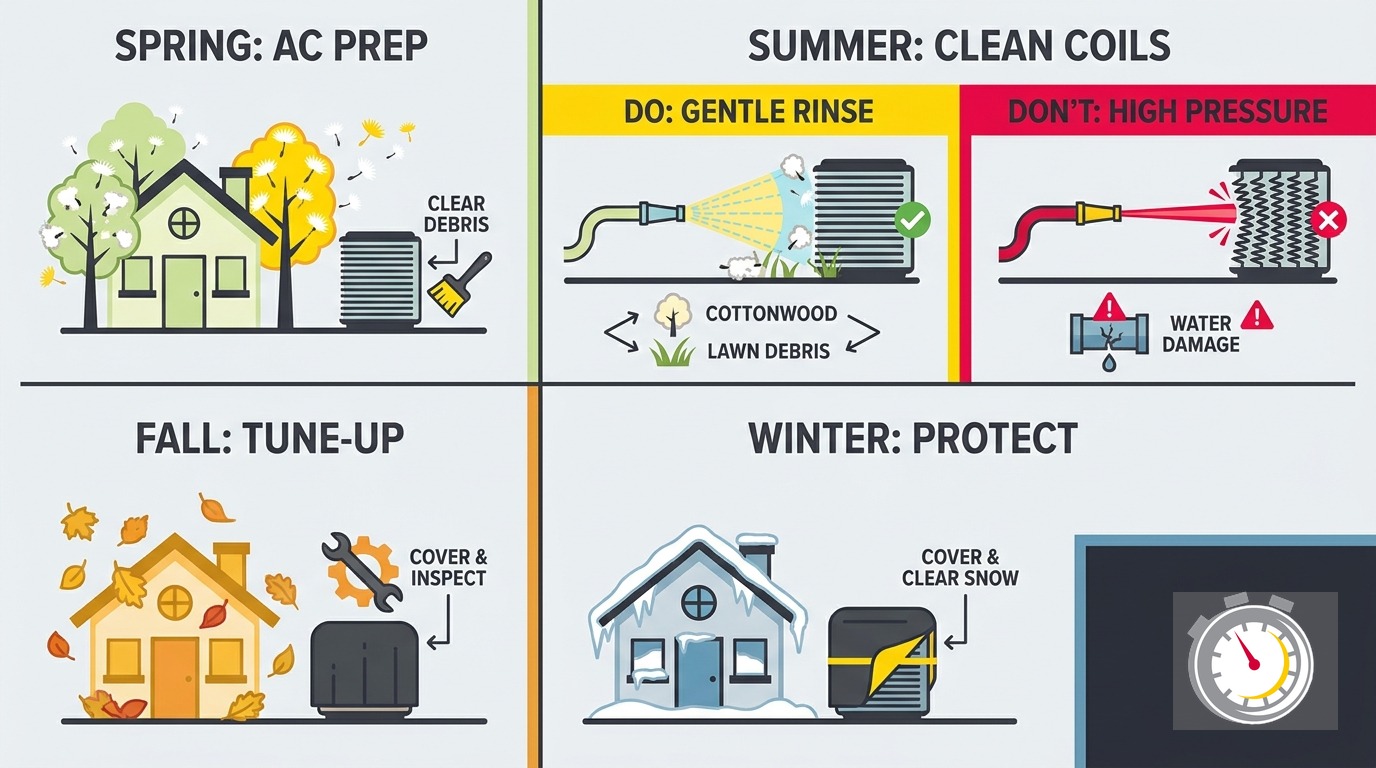
Key Takeaways
- A garden hose is fine for rinsing condenser coils. A pressure washer is not.
- Turn the thermostat off and pull the outdoor disconnect before you start.
- Remove cottonwood fluff, grass clippings, and leaves dry first. Rinse second.
- Spray from the inside of the coil out, not from the outside in.
- Keep water off the electrical compartment and the wiring.
- Let the unit dry fully before you restore power.
- Bent fins across a large area, wet electrical parts, or a unit that still runs hot after cleaning all call for a pro.
- Clean in spring, again after cottonwood season, and once more in fall.
Can You Hose Off AC Condenser Coils?
Yes, you can hose off AC condenser coils with a garden hose, as long as the power is off. Use a gentle spray and rinse from the inside out. Never use a pressure washer. The fins bend easily, and water belongs on the coil, not in the electrical compartment.
Minnesota adds a few wrinkles to that short answer.
We are a locally owned and operated Twin Cities HVAC company. Every summer we see the same outdoor unit problems. Most trace back to dirt, fluff, and well-meant cleaning mistakes.
Most damage from DIY rinsing comes from three habits:
- Spraying with the power still on.
- Using too much pressure.
- Soaking matted fluff into the fins instead of removing it dry first.
How Does a Condenser Unit Work?
The condenser is the outdoor unit of your central air conditioner. It moves heat from inside your home to the outdoor air. Hot refrigerant gas flows through the coil while a fan pulls air across the fins. The refrigerant cools and turns back into a liquid, ready to absorb more heat indoors.
Think of the coil as a radiator for your house. It only works when air moves freely across it.
The coil is a set of metal tubes wrapped in thousands of thin aluminum fins. The fins give the heat more surface to escape from. They are also very soft. A fingernail can bend one.
Three main parts do the work outside:
- The compressor pumps refrigerant through the system.
- The coil releases the heat into the air.
- The fan pulls air through the coil and pushes it out the top.
When dirt coats the fins, heat cannot escape well. ENERGY STAR says to clean evaporator and condenser air conditioning coils. It notes that dirty coils reduce the system’s ability to cool your home and make it run longer.
Longer run times mean higher bills and more wear on the compressor. That is why a clean coil pays off.
Why Does Cottonwood Season Clog Minnesota AC Units?
Cottonwood trees release fluffy seeds in late spring and early summer. The fluff drifts through the air, sticks to damp surfaces, and gets pulled into your outdoor unit by the fan. It mats against the fins and blocks airflow. A heavy week of cottonwood can clog a coil faster than a whole summer of ordinary dust.
Twin Cities residents know the sight. MPR News calls cottonwood “snow” an annual late spring-early summer tradition. The same report says the cotton can clog up air vents and air conditioning units.
Most online guides skip this part. They list dirt, grass clippings, leaves, and pollen, but say nothing about what wet cottonwood does.
Dry cottonwood is light and fluffy. A soft brush or a shop vacuum lifts it off. Wet cottonwood turns into a felt-like mat. A hose pushes that mat deeper into the fins instead of rinsing it out.
So we recommend a dry-first sequence. Remove the fluff before you add water.
Lawn debris causes similar trouble. Mowing near the unit throws clippings at the coil. Wet clippings stick to the fins and dry into a crust. Fall leaves do the same job in October.
One safety note applies here. Fire officials warn that cottonwood seeds are highly flammable, particularly when they accumulate in piles or drifts. Do not burn the fluff you collect. Do not blow it into piles beside your house or along a fence. Bag it and put it in the trash.
Plantings can add to the problem. If shrubs crowd your unit, read our guide on how much clearance your AC condenser needs. Good clearance keeps fluff from piling up and gives you room to work.
Does a Condenser Need a Disconnect?
Yes. Most outdoor condensers have a disconnect, usually a small box mounted on the wall near the unit. Pull the handle or switch it off before you rinse. Then set the thermostat to off. This cuts power at the unit and keeps water away from live electrical parts.
Many homeowners miss this step, and some guides never mention it.
The outdoor unit runs on high-voltage power. Water and live wiring do not mix. Even a small splash into the control area can trip a breaker or damage a part.
Follow this order every time:
- Set the thermostat to off.
- Open the disconnect box and pull the handle or switch.
- If you are unsure, also switch off the dedicated breaker at your panel.
- Wait a few minutes before you touch the unit.
Do not rely on the thermostat alone. It only tells the system when to run. It does not isolate the outdoor unit from power.
If you cannot find the disconnect, stop. Do not guess. Call us, and we will show you where it is on your next visit. We are happy to answer that kind of question.
What Do You Need to Rinse a Condenser Safely?
You need only a few basic tools. A garden hose with a gentle spray nozzle, a soft brush, and a shop vacuum cover most jobs. A fin comb helps if a few fins have bent. Gloves and eye protection round out the list.
Here is the kit we suggest:
- Garden hose with a spray nozzle. Choose a shower or gentle fan setting. Avoid jet and cone settings.
- Soft-bristle brush. A paintbrush or a soft car-wash brush works well.
- Shop vacuum with a brush attachment. This pulls dry fluff off without pushing it in.
- Fin comb. This inexpensive tool straightens bent fins. Match the comb to the fin spacing on your coil.
- Work gloves and safety glasses. Fins are sharp, and debris flies.
- Trash bags. Collect the fluff. Do not leave it in a pile.
- Screwdriver or nut driver. Only needed if you remove the top grille.
Skip the pressure washer, the wire brush, and any household cleaner you have not checked. Harsh chemicals can corrode aluminum fins and copper tubing.
How to Clean Your Condenser: Dry First, Then Rinse
The safest method has two parts. First, remove debris dry with a brush and vacuum. Second, rinse the coil gently from the inside out. This order stops wet fluff from matting into the fins and keeps pressure low on a very delicate part.
Step 1: Shut off the power
Set the thermostat to off. Pull the outdoor disconnect. Confirm the fan is not spinning.
Step 2: Clear the area
Remove leaves, sticks, and grass clippings from the base and the top of the unit. Pull weeds near the sides. Trim plants back so air can flow.
Step 3: Remove fluff and debris dry
Run the vacuum brush gently over the outside of the coil. Always move with the fins, not across them. Fins run vertically on most units, so brush up and down.
Pick off any thick mats of cottonwood by hand. Use the soft brush on stubborn spots. Finish all of this before the hose comes out.
Step 4: Protect the electrical compartment
Find the access panel where the wires connect. Keep the hose pointed away from it. If you worry about splash, cover the panel with a plastic sheet. Tape the edges so water cannot run behind it.
Step 5: Rinse from the inside out
Many guides get this step confusing. Debris gets pulled into the coil from the outside. To push it back out the way it came in, spray from the inside.
If you can safely remove the top grille and fan, spray down through the coil from the inside. Many homeowners cannot do this without risk to the fan wiring. If that describes you, rinse the outside gently at a slight angle and stop there. Do not force the issue.
Use a soft spray. Hold the nozzle a foot or two from the fins. Work from the top to the bottom, and keep the stream moving.
Step 6: Check the results
Look through the fins from the side. You should see light. If you still see gray felt, repeat the dry brushing, then rinse again.
Step 7: Let it dry
Leave the unit off for at least an hour, and longer if the day is cool or humid. Check that the control panel is dry. Then restore the disconnect and set the thermostat.
Do not leave the unit off through a heat wave out of caution. Dry it, restore power, and watch it run for a few minutes. If it hums but will not start, our post on an AC fan that runs while the compressor hums can help you sort out what you are hearing.
DIY Condenser Rinsing: Dos and Don’ts
Most rinsing problems come down to pressure, angle, and water placement. These lists cover the habits that protect your fins and your electrical parts.
Do
- Do turn off the thermostat and the outdoor disconnect first.
- Do remove cottonwood fluff, leaves, and clippings dry.
- Do use a garden hose on a gentle setting.
- Do spray from the inside out when you can do so safely.
- Do keep the spray at a slight downward angle.
- Do straighten small bent areas with a fin comb.
- Do let the unit dry before you restore power.
- Do bag the debris and throw it away.
Don’t
- Don’t use a pressure washer. It flattens fins in seconds.
- Don’t spray directly into the electrical panel or wiring.
- Don’t use a hard stream straight at the coil from close range.
- Don’t scrub with a wire brush or a scraper.
- Don’t use harsh cleaners that you have not checked for coil safety.
- Don’t burn cottonwood fluff or blow it into piles.
- Don’t force a bent fin with a screwdriver or a knife.
- Don’t wrap or cover the unit while it is wet.
Some guides say to use a “hard stream” outside and a “moderate” one on the fins. That is confusing. Use this rule instead: if the spray stings your skin, it is too strong for the fins.
Fin damage is more than cosmetic. Flattened fins block airflow just like dirt does. A few bent fins are normal. Large flattened sections are a problem, and a fin comb will not always fix them.
Can a Bad Condenser Fan Cause Overheating?
Yes. The fan pulls air across the coil so heat can escape. If the motor fails or runs slowly, heat stays in the system. Pressure and temperature climb, the compressor works harder, and it may shut itself off to protect itself. A failing fan can quickly turn into a costly repair.
Cleaning the coil does not fix a weak fan. It only removes one cause of poor heat release.
Watch for these signs:
- The fan does not spin, or it spins slowly.
- You hear a grinding, squealing, or rattling sound.
- The fan spins only after you give the blades a nudge.
- The unit runs, but the air from your vents is warm.
- The unit shuts off, then restarts after a cooldown.
Never reach into a fan to test it. Even with power off, move the blades only with a stick or tool, and only after you have confirmed the disconnect is open.
A failed capacitor often looks like a fan problem. It is a small part that gives the motor a boost to start. Capacitor repair, part and labor, typically runs about $195-$500. A condenser fan motor replacement typically runs about $375-$900.
Our guide to condenser fan motor failure symptoms and costs walks through the signs in more detail.
Can AC Coils Freeze in the Summer?
Yes. AC coils can freeze in summer, and the indoor evaporator coil is the usual victim. Low airflow, a dirty filter, or low refrigerant makes the coil too cold, and moisture turns to ice. A dirty outdoor coil can add to the problem by making the whole system run out of balance.
Many people mix up the two coils:
- The evaporator coil sits indoors, near the furnace or air handler. It absorbs heat from your air.
- The condenser coil sits outdoors. It releases that heat.
Ice usually forms on the indoor coil and the larger refrigerant line. Sometimes you see frost on the outdoor lines too. Our post on ice on the outdoor unit and refrigerant lines explains what you are seeing.
If you see ice, do not hose it off. Do not chip it away either.
Instead, follow these steps:
- Turn the AC off at the thermostat.
- Set the fan to on to help the ice melt.
- Replace a dirty filter.
- Wait several hours until the ice is gone.
- Restart the system and watch for the ice to return.
If ice comes back, you likely have a refrigerant or airflow issue. That needs a technician. Running a frozen system can damage the compressor.
When Is the Best Time to Rinse Your Condenser in Minnesota?
Plan three cleanings a year: spring before cooling season, early summer after cottonwood season, and fall after the leaves drop. Pick a mild, dry day. In Minnesota you do not need to wait for a warm one, because you will be running the system only briefly to test it.
ENERGY STAR recommends having a contractor do annual pre-season check-ups, with cooling checked in spring. That fits Minnesota well. A spring visit catches problems before the first heat wave.
Here is a simple local calendar:
- April to early May: Clear winter debris. Check for bent fins. Remove any cover.
- Late May and June: Watch for cottonwood. Brush it off dry as it builds.
- Late June or July: Do your full rinse once the fluff has stopped falling.
- October: Clear fallen leaves and clippings before you shut down for winter.
Some guides say to wait for a day of at least 60°F. That advice breaks down in our shoulder seasons. A spring day may stay cool for weeks, and waiting for warmth means waiting too long.
You do not need a hot day to rinse. You need a day above freezing, so water does not turn to ice on the coil. Morning or midday works best, which gives the unit time to dry before evening.
Do not run the AC when the outdoor temperature is low just to test it. Our post on the minimum outdoor temperature to run AC explains why.
For a full startup routine, see our AC first start-up checklist after winter.
When Should You Stop and Call a Pro?
Call a pro if fins are bent across a large area, if water reached the electrical parts, or if the unit still runs hot after cleaning. Also call if you hear grinding, smell burning, or see ice. A professional cleaning checks the whole system, not only the coil.
Stop DIY work in these cases:
- Large bent areas. A fin comb handles small spots. It cannot fix a flattened section the size of your hand.
- Water in the control area. Leave the power off. Let a technician inspect it.
- A unit that runs hot. If the air from your vents is still warm after a clean coil, something else is wrong.
- Tripped breakers. Repeated trips point to an electrical fault, not dirt.
- Refrigerant oil stains. Oily residue near the lines can mean a leak.
- You are not sure. Asking first is cheaper than guessing wrong.
A single tune-up visit typically runs about $95-$250. An annual maintenance plan typically runs about $195-$390. A tune-up includes a coil check, electrical checks, and a look at the refrigerant side. Our AC maintenance service covers all of it.
A cleaner coil cannot fix an aging system. If your outdoor unit is old and repair bills keep climbing, replacement may make more sense. Ask us for an honest opinion. We will tell you if a repair is worth it.
Schedule Your AC Cleaning With Northern One Hour
Rinsing your coil is a good habit when you do it right: power off, gentle spray, dry first, no pressure washer. Add a spring tune-up from a pro, and your system will be ready for the Twin Cities cooling season.
Northern One Hour is locally owned and operated. We serve homeowners across the Twin Cities, including Minneapolis, St. Paul, Ramsey, Blaine, Maple Grove, Plymouth, Brooklyn Park, Woodbury, and Bloomington.
We back our work with our on-time promise: “Always On Time… Or You Don’t Pay a Dime!(R)” In plain terms, we arrive within the time window you select. If our technician does not show up on time, you do not pay for the service.
Our team can also advise on next steps. If your AC is aging, we can talk through options and financing for larger jobs. We never push a repair or a replacement you do not need.
Call (763) 260-6662 or book online to schedule your AC tune-up today. Beat the cottonwood rush.
Frequently Asked Questions
Can I use a pressure washer on my AC condenser? +
How often should I rinse my outdoor AC unit in Minnesota? +
Should I turn off the AC before I hose off the condenser? +
Need a technician now?