
AC Unit Humming but Not Starting: Causes and Fixes
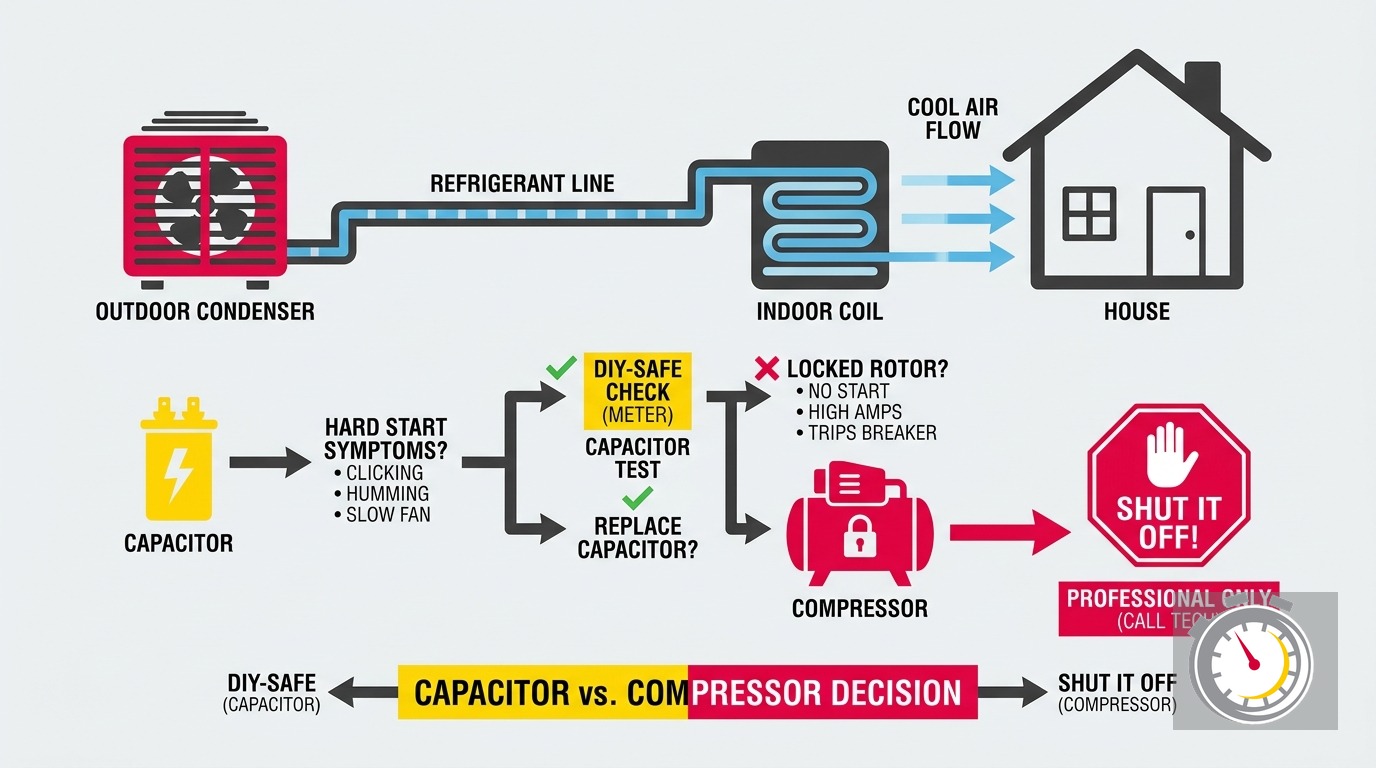
Key Takeaways
- A hum means power is reaching the unit, but a motor is not turning.
- A weak or failed capacitor is the most common cause, and it is a modest repair.
- “Locked rotor” means the compressor tries to start, draws high current, and trips its overload.
- Look and listen from a distance. Do not spin the fan by hand or open the access panel.
- Stop retrying. Repeated starts and breaker resets can damage the compressor.
- A hard-start kit can be a stopgap, but it can also delay a compressor replacement.
- Call (763) 260-6662 or book online. We arrive within the window you select.
Why Your AC Hums but Won’t Start
Short answer: the outdoor unit is getting power, but a motor cannot turn. The most common cause is a failed run or start capacitor. Next most likely is a stuck fan motor or compressor.
Do three things right now. Set the thermostat to “off.” Shut off the outdoor disconnect or breaker. Then stop trying to restart it.
That last step matters most. A humming unit is trying to start and failing. Every retry sends heavy current into a motor that cannot move. We see small problems turn into big ones this way.
Northern One Hour is locally owned and operated. We serve homeowners across the Twin Cities, from Blaine to Bloomington.
What Does It Mean When an AC Unit Hums but Won’t Start?
A hum means the outdoor unit is receiving power, but the fan motor or compressor cannot begin turning. Usually a capacitor is too weak to give the motor its starting push. Less often, the motor is mechanically stuck or the compressor has seized.
Think of the hum as a motor that wants to work. Electricity flows into the windings, and the windings create a magnetic pull. The rotor does not move.
Your outdoor unit has two main motors. One spins the fan. The other drives the compressor. Either one can hum and fail to start.
The pattern tells you a lot. Listen for these clues:
- Hum with a still fan: The fan motor or its capacitor is the likely culprit.
- Hum, then a click, then silence: The compressor may be trying to start and tripping its overload.
- Fan spins, but no cooling and a hum from the cabinet: The compressor may be the one in trouble.
- Hum and a breaker trip: Stop right there. The motor is drawing too much current.
We cover the fan-running version of this problem in a separate guide. If your fan runs but the unit does not cool, read about an outside AC unit that is not running while the inside fan works.
Why Is My Capacitor Not Working?
A capacitor stores a small electrical charge and releases it to help a motor start and run. Heat, age, power surges, and constant cycling wear it out. Once it weakens, the motor hums but cannot turn.
Your AC typically uses a dual run capacitor. It serves the fan motor and the compressor in one can. A start capacitor, where present, gives extra kick during startup.
Capacitors fail for a few common reasons:
- Heat: Summer sun on a dark cabinet bakes the internal film over the years.
- Age: The part wears out with each start cycle.
- Surges: Lightning and utility swings can damage it quickly.
- Short cycling: Constant starting is the hardest work a capacitor does.
Signs of a failing capacitor often show up before total failure. Your AC may take a long time to start or cool weakly. The fan may spin slowly. The outdoor unit may hum for a moment before it kicks on.
A bad capacitor can also swell or leak. The top of the can may look domed instead of flat. You can sometimes see this from outside the unit, but do not open the panel to look.
Why not? Capacitors can hold a charge after power is off. This is a general electrical rule, not an HVAC opinion. OSHA’s electrical standard says capacitors generally must have an automatic means of draining the stored charge after they are disconnected from the supply. Not every part follows that design, and a failed one may not drain.
A shock from a run capacitor can injure a trained technician. An OSHA accident report describes a technician shocked by a run capacitor inside a residential AC unit. If a professional can be hurt, a homeowner should not poke around in there.
For warning signs and pricing, see our guide to bad AC capacitor symptoms and repair cost.
What Is a Locked Rotor, and Why Does the Compressor Hum?
A locked rotor is a motor that cannot turn when power arrives. In a compressor, it draws very high current for a few seconds. Then its internal overload trips to protect the windings. You hear a hum, then a click, then quiet.
The rotor is the spinning part inside the motor. “Locked” means it is stuck in place.
A stuck motor cannot build the electrical balance that a spinning motor does. So it pulls far more current than normal. That current becomes heat. The compressor has an overload device that shuts the motor down before the heat does damage.
After a cool-down period, the overload resets and the compressor tries again. You hear the hum, the click, and the quiet once more. This loop can repeat all afternoon.
Several things can lock a compressor rotor:
- A weak start capacitor. The motor never gets its starting push. This is the best-case cause.
- A failing contactor or low voltage. The motor does not get steady power.
- High head pressure. A dirty coil or restricted airflow can make starting harder.
- Internal mechanical failure. Worn parts or a seized piston can lock the compressor for good.
- Electrical winding damage. Heat or moisture inside the sealed system can break down the windings.
The first three are fixable at a modest cost. The last two usually mean a new compressor, or a conversation about replacing the system.
That is why we do not guess. A technician measures the electrical readings first. The U.S. Department of Energy’s Building America guidance on air conditioner diagnostics points to measuring the compressor’s current draw and comparing it with manufacturer data. Measured numbers beat hunches.
How Can You Tell a Bad Capacitor From a Bad Compressor?
Look at the pattern. A fan that stays still and a hum point to the fan motor or capacitor. A running fan with a hum, click, and breaker trip points to the compressor. Only electrical testing confirms which part has failed.
This decision path needs only your eyes, your ears, and the thermostat. You do not need to touch the unit.
Step 1: Did it fail suddenly or get worse over time?
- Gradual decline usually points to a weakening capacitor. You may have noticed slow starts, weak cooling, or a fan that spun lazily.
- Sudden failure can be a capacitor, a contactor, a tripped safety, or a seized motor. It needs a test.
Step 2: What does the fan do?
- Fan is still, and the unit hums. The fan capacitor or motor is a strong suspect.
- Fan spins, but there is no cooling. The compressor side may be at fault.
- Fan spins slowly, then speeds up on its own. The capacitor is weak.
Step 3: What happens at the breaker?
- Breaker holds. That is a good sign, but it does not clear the compressor.
- Breaker trips when the unit tries to start. The motor is drawing too much current. Stop all attempts.
Step 4: How old is the unit?
Age shapes the repair decision. ENERGY STAR says to consider replacing a heat pump or air conditioner that is “more than 10 years old.” It also lists a clear warning sign: “Your equipment needs frequent repairs and your energy bills are going up.”
Treat that as a guide. A 12-year-old unit with a failed capacitor can still be a smart repair. A 14-year-old unit with a seized compressor is a different story.
The difference matters because a capacitor repair is small and a compressor replacement is not. Our price floors in the Twin Cities look like this:
- Capacitor repair, part and labor: $195-$500.
- AC compressor replacement: $1,950-$4,500.
- Central AC replacement, mid-tier, installed: $7,500-$10,400.
If you suspect a failing compressor, read our guide on AC compressor failure signs and repair cost.
What Can You Safely Check Yourself?
You can safely check the thermostat, the indoor filter, the breaker, and the outside of the unit. Look and listen only. Do not open panels, touch wiring, or spin the fan blade. Those steps belong to a trained technician.
Some websites tell homeowners to poke a stick into the fan. Others say never to do it. We take a clear side: do not.
The fan can start suddenly and injure your hand. The capacitor may be holding a charge. And a hand spin can make a bad capacitor look fixed for a few minutes. Then the unit fails again, often at the worst time.
Here is the safe checklist:
- Check the thermostat. Set it to “cool” and lower the temperature a few degrees. Confirm that it has power and fresh batteries, if it uses them.
- Check the indoor air filter. A badly clogged filter can cause other cooling problems. Replace it if it is dirty.
- Check the breaker once. Look at the main panel for a tripped breaker. Reset it one time only. If it trips again, leave it off.
- Look at the outdoor unit from a distance. Check for leaves, cottonwood fluff, or snow and ice packed around it. Do not stick anything into the fan guard.
- Listen. Note whether you hear a hum, a click, a buzz, or silence. That detail helps us.
- Check for a burning smell. A hot, electrical smell means off, now.
Then stop. Write down what you saw and heard, and share it when you call.
Do not do these things:
- Do not remove the access panel.
- Do not touch the capacitor, contactor, or wires.
- Do not spin the fan blade by hand or with a stick.
- Do not keep cycling the thermostat to “try again.”
- Do not hose down a humming unit.
What Should I Do If My Air Conditioner Isn’t Turning On?
Start at the thermostat, then check the breaker once and the filter. If the outdoor unit stays silent, hums, or trips the breaker, shut the system off and call a technician. Keep the unit off until it is tested.
Not every dead AC is a humming AC. Some units sit completely silent, and the cause may be simpler.
Work through the list in order:
- Thermostat settings: Confirm “cool” mode and a set temperature below room temperature.
- Thermostat power: A blank screen may mean dead batteries or a wiring issue. Our thermostat troubleshooting guide can help.
- Breaker and disconnect: Check the panel and the outdoor disconnect box. Confirm the pull-out block is seated.
- Safety switches: A full condensate drain pan can shut the system off. Our guide to a full AC drain pan explains what to look for.
- Filter: A very dirty filter can cause freezing and shutdowns.
If none of that turns up a cause, the issue is probably electrical or mechanical. That is a job for a trained technician.
When Should You Shut It Off and Stop Retrying?
Shut the system off right away if the unit hums, clicks, trips the breaker, smells hot, or shows smoke. Do not retry. Repeated start attempts force high current through a stuck motor and can burn out the compressor.
Every homeowner should remember this rule. A humming AC is asking for help, so do not answer by pressing the button again.
Here is what happens when you keep trying:
- The motor heats up. Each failed start produces a burst of heat.
- Insulation breaks down. Winding insulation weakens with repeated overheating.
- The overload cycles. It trips and resets, over and over, wearing out its protection.
- A small repair grows. A $195-$500 capacitor job can become a $1,950-$4,500 compressor job.
Shut down in this order:
- Set the thermostat to “off.”
- Turn off the breaker for the outdoor unit.
- Pull the outdoor disconnect, if you have one and can reach it safely.
- Open windows and use fans at night if the house is hot.
- Call us.
If you smell burning, see smoke, or see sparks, stay away from the unit. Call 911 if you see flames.
Tripping breakers can have other causes too. Our guide to why an AC keeps tripping the breaker covers them in detail.
Do Hard-Start Kits Fix the Problem?
A hard-start kit adds a boost of starting power to a compressor. It can help a struggling but healthy motor start. It does not repair a failing compressor, and it can hide worsening wear. Treat it as a stopgap.
A hard-start kit is a small add-on, often sold online, that gives the compressor an extra jolt at startup. In the right case, it helps.
A kit may be reasonable when:
- The compressor tests healthy but starts hard.
- The unit is older and otherwise in good shape.
- The system has low-voltage or long-run issues that cannot be fixed easily.
- You need to buy time while you plan a replacement.
A kit is a poor choice when:
- The compressor is mechanically seized.
- The windings are damaged.
- The real problem is a bad capacitor, which is cheaper to replace.
- The unit is old and failing, so you are only delaying the inevitable.
A kit can also be a diagnostic clue. If it makes a hard-starting compressor run, the compressor was struggling to start, which tells us the motor is wearing. If it does not help, the compressor is likely done.
We do not push add-ons. We test first. Then we tell you plainly whether a kit makes sense or whether you are throwing money at a failing part.
Why Isn’t My Heat Pump Fan Spinning?
A heat pump fan that will not spin often has the same causes as an AC fan: a failed capacitor, a bad fan motor, or a tripped safety. In winter, ice or snow can also block the fan. Shut the system off and call for service.
A heat pump works like an AC in summer, so everything above applies in cooling mode. A humming outdoor unit with a still fan points to the capacitor or fan motor.
Winter adds a few more possibilities:
- Defrost mode: The fan often stops during a defrost cycle. This is normal for a short time. Our guide to a heat pump covered in ice explains it.
- Snow and ice: Heavy buildup can block the fan and the coil.
- Reversing valve problems: These can cause odd operation in heating mode.
- Control or contactor faults: The fan may not get the signal to run.
If the fan has stayed still for more than a defrost cycle, do not wait. A stuck fan in heat mode can leave you without heat on a cold night. Our heat pump repair team can help.
Why Does This Happen After a Minnesota Winter or a Heat Wave?
Months of sitting idle, then a sudden heat wave, put extra stress on a cold AC. Cold weather can stiffen parts, and the first hot days demand a hard start. A weak capacitor often fails right then.
This is our observation from working in the Twin Cities, not a sourced statistic. But our technicians see the same pattern every year.
Your AC sits through a long Minnesota winter. Then the first 90-degree days arrive, and the system must start up and run hard. A capacitor that was marginal in October may fail in June.
Other seasonal stress points include:
- Cottonwood and debris: Spring fluff clogs the outdoor coil, which raises head pressure.
- Lightning and storms: Summer storms bring power surges.
- Heat waves: Long runs at high load wear weak parts fast.
- Rodents and nesting: Critters can chew wires or jam a fan over winter.
A spring start-up routine can reduce the odds. Our first start-up after winter checklist walks through it. A tune-up also lets a technician test the capacitor before it fails.
Our air conditioning maintenance visits include electrical checks for this reason.
Should You Repair or Replace a Humming AC?
Repair a capacitor or contactor on almost any healthy unit. Consider replacement when the compressor has failed, the system is older than 10 years, or repairs keep stacking up. A technician can show you the numbers.
Behind every humming call is one question: is this a small fix or the start of a bigger bill?
Use this simple framework:
- Capacitor or contactor failure: Repair it. The cost is modest, and the unit usually has years left.
- Fan motor failure: Repair it if the unit is in good shape. Our price floors for a condenser fan motor run $375-$900.
- Compressor failure on a newer unit: Check the warranty first. Then weigh repair against replacement.
- Compressor failure on an older unit: Replacement often makes more sense.
Age and repair history break the tie. ENERGY STAR’s guidance applies: consider replacing a unit that is more than 10 years old, especially with frequent repairs and rising bills. A compressor repair at $1,950-$4,500 on a 13-year-old system is a hard call.
If you do replace, a mid-tier central AC runs $7,500-$10,400 installed. High-efficiency 18-20+ SEER2 systems start at $11,000 and run to $15,600. We offer financing on larger jobs, so you can spread the cost. Our guide to AC replacement cost in Minnesota breaks down the choices.
We never push a replacement when a repair makes sense. We show you the test results and explain the options. You decide.
What Happens When You Call Northern One Hour?
You reach a locally owned team. We ask what you saw and heard, schedule a window, and send a technician who tests the capacitor, motors, and electrical readings. You get a clear price before any work begins.
Here is what to expect.
1. A short phone call. Tell us what you heard. Did it hum? Click? Trip the breaker? Those clues help us prepare.
2. A scheduled arrival window. You choose the time window that works for you, and we arrive within it. If our technician does not show up on time, you do not pay for the service. That is our promise: “Always On Time… Or You Don’t Pay a Dime!(R)”
3. Safe, careful testing. Our technician measures voltage, tests the capacitor, and checks the motors. They compare the readings with manufacturer data. They do not guess.
4. Honest options. We explain what failed, what it costs, and whether repair or replacement fits. You get transparent pricing, and our work carries a 100% satisfaction guarantee.
5. A clean fix. If the part is on the truck, we often repair the unit the same visit.
We are your neighbors. Northern One Hour is locally owned and operated in Ramsey, and we serve homeowners across the Twin Cities. We know our heat waves, our storms, and how our systems wear.
You can also read more about why on-time service matters for your home in the Twin Cities.
Next Steps: Get Your AC Running Again
A humming AC that will not start is a warning, and often a fixable problem. Stop, shut the system down, and call.
Until we arrive, keep to this routine:
- Turn the thermostat off.
- Shut off the breaker.
- Look and listen from a distance.
- Do not spin the fan or open the panel.
- Do not keep retrying.
Call (763) 260-6662 or book online to schedule a visit. Our air conditioning repair technicians will find the cause, explain it plainly, and get your home cool again.
Frequently Asked Questions
Is it safe to spin the fan blade by hand to start the unit? +
Can I keep resetting the breaker until the AC starts? +
Will the AC hum when the thermostat is off? +
Does a humming AC always need a new compressor? +
Need a technician now?