
AC Outside Unit Not Running but Inside Fan Works: Fixes
Key Takeaways
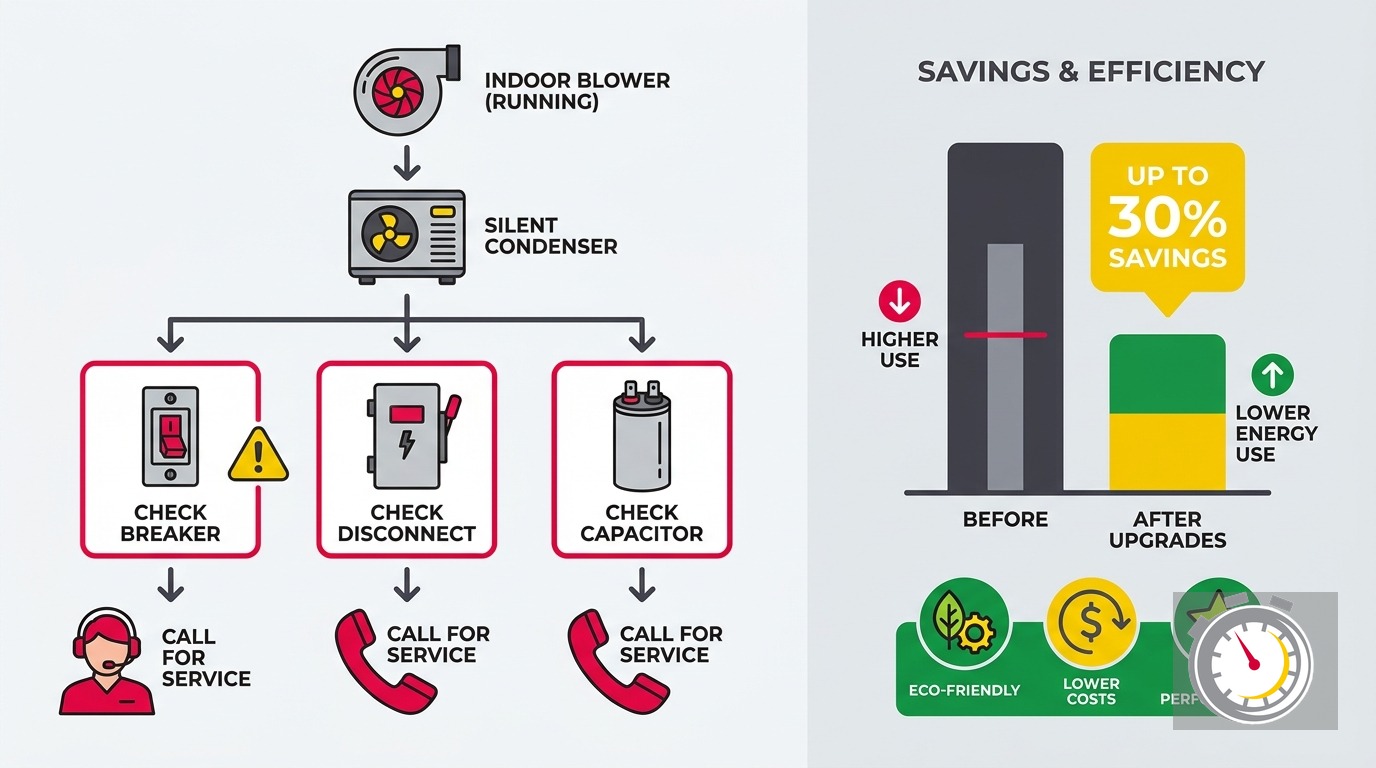
- The indoor fan and the outdoor unit run on separate parts. One can work while the other is dead.
- Safe homeowner checks are the thermostat, the outdoor breaker, the disconnect, and listening for sounds.
- Reset a tripped breaker once. If it trips again, stop and call a technician.
- A humming unit with a fan that will not spin often points to the capacitor.
- Clicking from the outdoor unit often points to the contactor.
- Do not open the unit or discharge a capacitor yourself. Capacitors can hold an electrical charge, even after the system is turned off.
- Do not run the indoor fan alone for long. It adds heat without cooling.
- Report what you saw and heard. It speeds up the repair.
Quick Answer: What It Means When Only the Indoor Fan Runs
If your AC outside unit is not running but the inside fan works, the cooling half of your system has lost power or failed to start. The indoor blower sits on a separate circuit. It keeps moving air while the outdoor condenser sits silent.
Start with the safe checks. Confirm the thermostat is set to Cool. Check the outdoor breaker. Look at the disconnect box near the unit. Then listen for a hum or a click.
Stop there. Capacitors, contactors, and relays are not homeowner parts. A technician should handle those repairs.
We are Northern One Hour Heating & Air Conditioning, a locally owned and operated company serving the Twin Cities. We get this call every cooling season.
Why Is My AC Fan Blowing but the Outside Unit Not Running?
Short answer: The indoor blower and the outdoor condenser run on separate circuits and parts. Your blower can keep working while the condenser has lost power or cannot start. Common causes include a tripped breaker, an open disconnect, a failed capacitor, a worn contactor, or a dead fan motor.
Think of your AC as two teams. The indoor team is the air handler or furnace blower, which pushes air through your ducts. The outdoor team is the condenser. It holds the compressor and a large fan, and it moves heat out of your home.
Both teams take their commands from the same thermostat. They do not share a power path. Your furnace blower might draw from one breaker and the outdoor unit from another. A problem on one side does not stop the other.
When the thermostat calls for cooling, it signals both teams. The blower starts. The outdoor unit gets its signal through a switch called a contactor. Then it needs a boost from a capacitor to get the fan and compressor spinning.
If any link in that chain fails, you get the classic symptom. Air blows from the vents, but it is not cold. The outdoor unit sits still.
One national HVAC guide lists eight common causes:
- Thermostat settings
- Breaker or power problems
- A worn fan motor
- A bad capacitor
- A contactor or relay fault
- A dirty outdoor unit
- Compressor failure
- Airflow blockage
Some are easy to check. Others need a trained technician. We sort them below.
What Can You Safely Check Before Calling for Service?
Short answer: You can safely check four things without opening any panel: the thermostat, the outdoor breaker, the outdoor disconnect, and what you see and hear at the unit. Anything beyond that, including the capacitor, contactor, and wiring, should be left to a licensed HVAC technician.
Work through them in this order. It takes about ten minutes, and you need no tools.
Step 1: Check the thermostat
Start at the wall. Many “dead outdoor unit” calls come down to settings.
- Confirm the mode says Cool, not Fan or Off.
- Set the temperature at least three degrees below the room temperature.
- Check for a blank screen or low battery warning.
- Wait a few minutes. Some systems delay the outdoor unit’s start.
If the screen is blank, replace the batteries. Our thermostat troubleshooting guide covers dead screens in more detail.
Step 2: Check the outdoor breaker
Go to your main electrical panel. Look for the breaker labeled AC, condenser, or air conditioner. A tripped breaker often sits in the middle position, not fully On or Off.
If it is tripped, you can reset it once. Push it fully to Off first, then firmly to On. The reset section below has the full steps.
Do not hold the breaker or force it. If it will not stay On, stop.
Step 3: Check the outdoor disconnect
Look near the outdoor unit for a small gray box on the wall. This is the disconnect. It lets a technician cut power to the unit during work.
Open the cover only if it opens easily by hand. Do not remove screws or panels. Look for a pull-out handle or block.
If the handle is out or in the Off position, the unit has no power. Someone may have pulled it over winter or while mowing. If you see burn marks, melted plastic, or water inside, do not reinsert it. Call us instead.
If it looks clean and dry, push the handle in firmly. Wait a few minutes, then check the unit.
Step 4: Look and listen
Stand a few feet from the outdoor unit with the thermostat set to Cool. Do not touch it. Watch and listen for a full minute.
Ask yourself:
- Is the big fan on top spinning?
- Do you hear a hum?
- Do you hear a click?
- Do you hear nothing at all?
- Is there ice, snow, leaves, or debris around the unit?
Write down what you notice. A technician can use this more than almost anything else you tell them.
How Do You Reset an AC That Is Not Cooling?
Short answer: Turn the thermostat to Off, then reset the outdoor breaker once by pushing it fully Off and then On. Wait a few minutes and try Cool again. If the breaker trips a second time, stop. A repeat trip signals an electrical problem that needs a professional.
A reset clears a one-time trip. It will not fix a failing part. Try it once, and do not make it a habit.
Follow this order:
- Set the thermostat to Off.
- Go to the panel and find the AC breaker.
- Push it fully to Off, then firmly to On.
- Wait at least five minutes. This protects the compressor from a hard restart.
- Return to the thermostat and set it to Cool.
- Watch the outdoor unit for a minute.
The national HVAC guide cited above says to reset the breaker once and treat a repeat trip as a sign of an underlying electrical problem. A manufacturer guide agrees that a breaker that trips again right after a reset may point to an overloaded circuit or an electrical hazard.
A breaker is a safety device. It trips to protect wires and equipment from heat. Forcing it back On again and again can turn a repair into a fire risk.
If your breaker keeps tripping, read our guide on why an AC keeps tripping the breaker. Then call us.
Should you keep the indoor fan running?
No. Do not leave the system in a mode where the indoor fan runs without cooling. A manufacturer guide advises against running the indoor fan alone because it adds heat without cooling. Set the thermostat to Off until help arrives.
Ceiling fans and closed blinds still help. So do open windows at night if the air outside is cooler. Our guide on when to open windows versus run the AC can help you decide.
Why Won’t My AC Unit Turn On, Inside or Outside?
Short answer: If neither the indoor nor outdoor unit starts, look for a power or control problem first. Common causes include a tripped main or furnace breaker, a dead thermostat, a blown fuse or board, a clogged condensate switch, or a closed service switch at the air handler.
When the whole system is dead, the problem usually sits upstream. Something is blocking power or the call for cooling.
Check these in order:
- Thermostat: Replace batteries and confirm the mode.
- Furnace or air handler breaker: Many homes have a separate breaker for the indoor unit. Check it.
- Furnace service switch: This looks like a light switch on or near the furnace. Make sure it is On.
- Furnace door: Many units will not run if the blower door is not seated.
- Condensate drain: A full drain pan can trip a safety switch and shut the system down. See our guide on clogged AC condensate drain lines.
If all of these look fine and nothing runs, call us. A failed control board or transformer needs a technician.
Decode the Sound: What Humming, Clicking, and Silence Mean
The sound at the outdoor unit tells a technician a lot. Treat each sound as a symptom to report, not a reason to open the unit.
A hum with a fan that will not spin
This points to the capacitor. A failed capacitor can cause a buzzing or humming unit whose fan will not spin. The motor gets power but lacks the boost to start.
Switch the thermostat to Off right away. A humming motor that cannot turn gets hot. Letting it run can damage the motor or compressor.
Clicking at the outdoor unit
Clicking often points to the contactor, the switch that sends power to the compressor and fan. Its contacts can stick or weld shut from heat and arcing.
You might hear one click, then nothing. Or you might hear repeated clicking as the switch tries to close. Our guide to contactor failure symptoms explains more.
Complete silence
Silence usually means no power or no call for cooling. Go back to the breaker and disconnect, then recheck the thermostat.
If power is fine and the unit is still silent, a control wire, transformer, or safety switch may be at fault. Finding it takes a meter.
Fan spins but no cooling
If the outdoor fan runs but the air stays warm, the cause may be the compressor, refrigerant, or a frozen coil. That is a different problem. Our AC not blowing cold air guide covers it.
Why Is the Capacitor Off Limits for Homeowners?
Short answer: A capacitor stores electrical energy and can keep a charge after the power is off. Touching the wrong terminals can cause a severe shock. Discharging one safely takes insulated tools and training. We recommend that homeowners never open the unit to reach it.
Some online guides show how to discharge a capacitor yourself. We disagree. The sources split on this point, and we take the cautious side.
One national guide says plainly that capacitors can hold an electrical charge, even after the system is turned off. It tells readers to leave capacitor, contactor, and relay work to a technician.
Another source advises turning off the AC and furnace breakers and pulling the outdoor disconnect. Even then, it notes that a unit can sometimes carry lingering charge.
Put those together and the risk is clear. Cutting power does not make the capacitor safe.
A technician works differently:
- Cuts power at the disconnect and the breaker.
- Uses insulated tools.
- Discharges the capacitor in a controlled way.
- Tests it with a meter for correct capacity.
- Checks the contactor and wiring while the panel is open.
A capacitor with the wrong rating can also damage the motor. The part must match the unit.
If you think you have a bad capacitor, read our guide on bad AC capacitor symptoms and cost. Then call us. In the Twin Cities, capacitor repair, including the part and labor, typically runs $195-$500.
Can an AC Fan Motor Be Repaired?
Short answer: Sometimes. A fan motor that only needs a new capacitor can often start working again after that cheap fix. A motor with worn bearings or burned windings usually needs replacement. A technician tests the motor first so you do not pay for the wrong part.
Many “dead fan motor” calls turn out to be capacitor problems. The motor looks dead because it cannot start. A new capacitor may bring it back.
Here is how it breaks down:
- Motor is fine, capacitor failed: Replace the capacitor. This is the lowest cost fix.
- Motor spins freely by hand but still will not start: The motor may still need replacement, even if the capacitor tests good.
- Motor is seized, noisy, or burned: Replace the motor.
- Blades are bent or loose: Replace or repair the blade assembly.
A technician checks the capacitor first, then tests the motor windings and spin. They tell you what failed before they replace anything.
If the motor does need replacement, a condenser fan motor in the Twin Cities typically runs $375-$900 installed. Our guide on condenser fan motor failure explains the signs.
A failed compressor costs more. Replacement typically runs $1,950-$4,500. On an older system, that is a good time to compare repair and replacement. Our AC compressor failing signs guide walks through the decision.
What Does Repair Cost in the Twin Cities?
These ranges reflect typical Twin Cities work, including parts and labor. Your exact price depends on the unit, the part, and the access.
- Capacitor repair: $195-$500
- Condenser fan motor: $375-$900
- Compressor replacement: $1,950-$4,500
- Single tune-up visit: $95-$250
A contactor repair is a smaller job. We quote it on site after testing, because the cost depends on the unit and what else the technician finds.
You should hear the number before work starts. Ask for the full price, not just a diagnostic fee.
If a repair bill climbs while your system is more than 12 to 15 years old, ask about replacement. Our AC replacement cost guide shows what to expect. We also offer financing for larger jobs.
Minnesota Factors That Cause a Silent Condenser
Minnesota weather adds its own causes. National guides rarely cover them.
A unit idle through winter
Your AC sits unused for five or six months. Then the first heat wave hits and you ask it to run all day. Weak parts fail at that moment.
A capacitor that was marginal in September may be dead by June. A contactor may stick after a long rest. That makes the first start-up worth doing carefully. Our AC first start-up checklist for Minnesota can help.
Snow, ice, and debris
Ice can pack around the base and fins. Leaves, cottonwood seeds, and grass clippings can clog the coil. Heavy debris makes the unit run hot, which stresses the motor and capacitor.
Keep the area clear. Our guide to cleaning your outdoor AC unit shows what is safe to do. In short, clear loose debris by hand and leave the coil and electrical parts alone.
A disconnect that was pulled
Some homeowners pull the disconnect in fall to protect the unit, then forget in spring. Check it first.
Storm and surge damage
Summer storms bring lightning and power surges. A surge can damage a capacitor, contactor, or control board. Ask us about surge and lightning protection for HVAC.
When Should You Stop and Call a Technician?
Call us right away if you notice any of these:
- The breaker trips a second time after one reset.
- You hear humming and the fan does not spin.
- You hear clicking with no start.
- You see burn marks, melted wire, or water in the disconnect.
- You smell burning or hot plastic.
- You see oily residue on the unit or lines. Refrigerant work is for EPA-certified professionals only.
- The unit is old and has failed more than once.
If you smell burning, switch off the system at the thermostat and the breaker. Keep everyone away from the unit.
A few things to avoid:
- Do not open the panel on the outdoor unit.
- Do not touch the capacitor, contactor, or wires.
- Do not spray the unit with water while it has power.
- Do not keep resetting the breaker.
- Do not leave the indoor fan running alone.
What to Tell the Technician When You Call
A clear report speeds the repair. It also lets us bring the right parts on the first trip. Have these ready:
- What the thermostat is set to.
- Whether the outdoor breaker was tripped, and whether you reset it once.
- Whether the disconnect was in place.
- What you heard: hum, click, or silence.
- Whether the outdoor fan was spinning.
- When the problem started, and whether a storm came first.
- The age and brand of the unit, if you know them.
The model and serial plate on the unit shows the age. Our guide on finding your HVAC system age can help.
How Regular Maintenance Prevents a Silent Condenser
Most outdoor unit failures start small. A weak capacitor tests low long before it dies. A contactor shows pitting before it welds shut. A technician can catch both during a tune-up.
A manufacturer guide also recommends a yearly professional tune-up. We agree. Schedule it in spring, before the first hot week.
A good tune-up includes:
- Testing the capacitor and contactor.
- Checking voltage and amp draw.
- Inspecting wiring and connections.
- Cleaning the coil.
- Checking the condensate drain.
- Reviewing refrigerant pressure by trained staff.
A single visit runs about $95-$250. An annual maintenance plan runs $195-$390. Both cost far less than an emergency repair in a July heat wave. See our guide on what a tune-up includes and whether a maintenance plan is worth it.
Why Homeowners Call Northern One Hour
We are locally owned and operated, and we are backed by the national One Hour Heating & Air Conditioning franchise. Our team lives and works in the Twin Cities. We know how our winters and humid summers wear on equipment.
Your time matters when the house is hot. That is why we stand behind our on-time promise: “Always On Time… Or You Don’t Pay a Dime!(R)”
In practice, we arrive within the time window you select. If the technician does not show up on time, you do not pay for the service.
You also get honest, transparent pricing and a 100% satisfaction guarantee. Our technicians tell you what failed, what it costs, and what your options are. We do not push replacement when a repair will do.
Learn more about our air conditioning repair service or why on-time service matters.
The Bottom Line
Do not open the unit, discharge a capacitor, or run the indoor fan alone. If the breaker trips again after one reset, stop there too.
Your home should not stay hot while you guess. Call Northern One Hour at (763) 260-6662 or book online to schedule fast. We will find the failed part, quote the price up front, and get your cooling running again.
Frequently Asked Questions
Is it bad to leave the indoor fan running when the outdoor unit is dead? +
Can I open the outdoor unit to look at the capacitor? +
How do I know if the problem is the capacitor or the contactor? +
Should I turn the AC off while I wait for the technician? +
Will a tune-up prevent this problem? +
Need a technician now?