
Is an HVAC Surge Protector Worth It? The Twin Cities Math
Key Takeaways
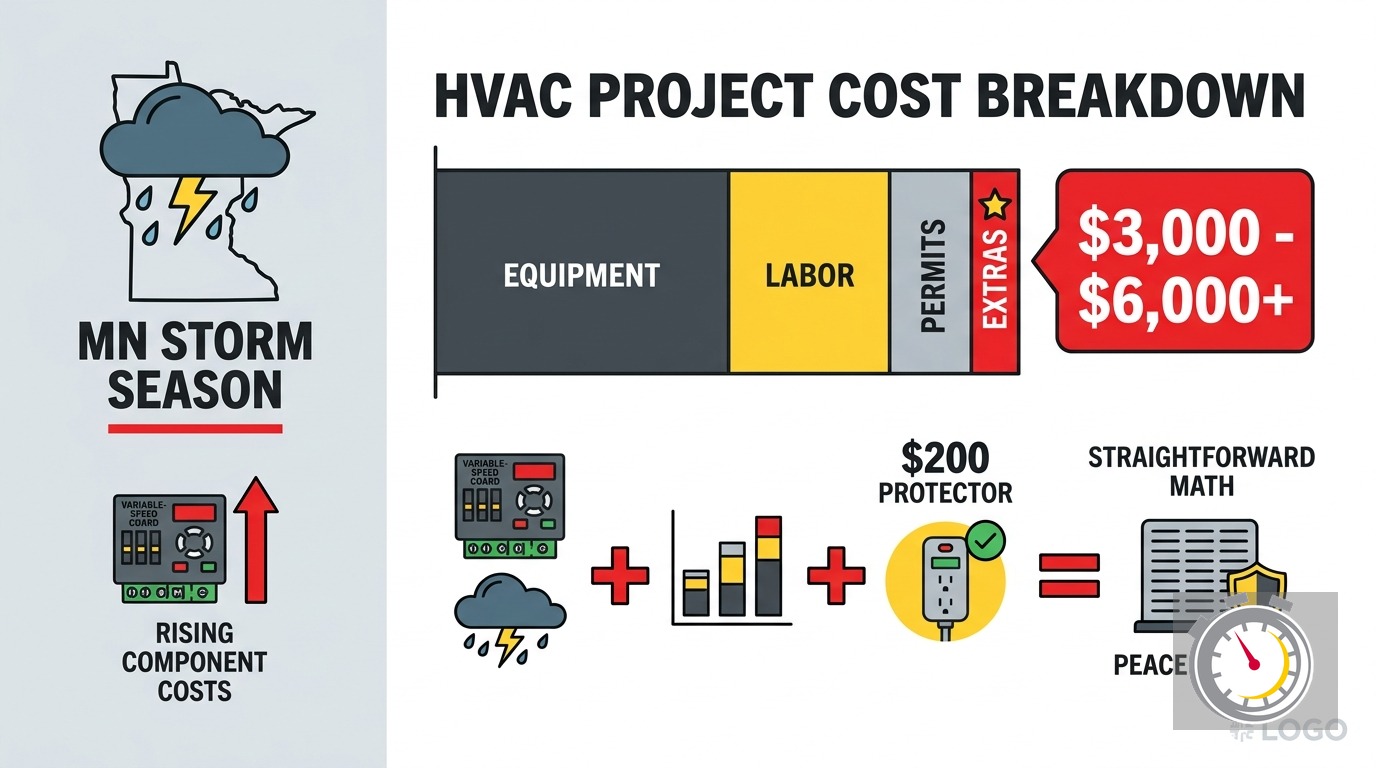
- A Type 2 HVAC surge protector costs $150-$400 installed. No rebates are available through Xcel Energy or CenterPoint in 2026.
- Replacing a variable-speed or communicating control board carries a higher repair cost. One avoided repair pays for the protector two to five times over.
- NEMA research shows that damaging power transients frequently originate inside the building, not from lightning.
- Residential HVAC claims rarely trace to verified lightning as the root cause. Internal transients and grid restoration surges cause the rest.
- Standard homeowners insurance often classifies surge damage as mechanical breakdown. Most HO policies exclude it.
- Manufacturer HVAC warranties do not cover surge, brownout, or other electrical damage, even on a brand-new system.
- Minnesota’s peak surge season runs May through September, the same months your AC works its hardest.
What Is an HVAC Surge Protector?
A Type 2 surge protection device (SPD) installs at your outdoor disconnect panel. It absorbs excess voltage before it reaches your system’s electronics, including the control board, ECM blower motor, and inverter compressor. Installation takes 30-60 minutes and does not require a permit in Minnesota for an existing disconnect.
An HVAC surge protector works through components called metal oxide varistors, or MOVs. When voltage spikes above the safe threshold, the MOV absorbs the excess energy and diverts it to ground. The MOV takes the hit so your control board does not.
This device is different from a whole-home surge protector at the main panel. A panel protector provides broad building-level protection. A dedicated SPD at the outdoor disconnect sits right at the point where power enters your AC unit. The two can work together for layered protection.
Modern HVAC systems are built around sensitive electronics. A variable-speed compressor runs off an inverter board that manages precise voltage levels. A communicating control system monitors sensors, modulates output, and stores diagnostic data. These components are capable and efficient. They are also less forgiving of dirty power than the single-stage systems they replaced.
The more equipment you run and the older your home’s wiring, the more electrical noise circulates through your circuits. A surge protector removes the voltage spikes that do damage.
Is an HVAC Surge Protector Worth It?
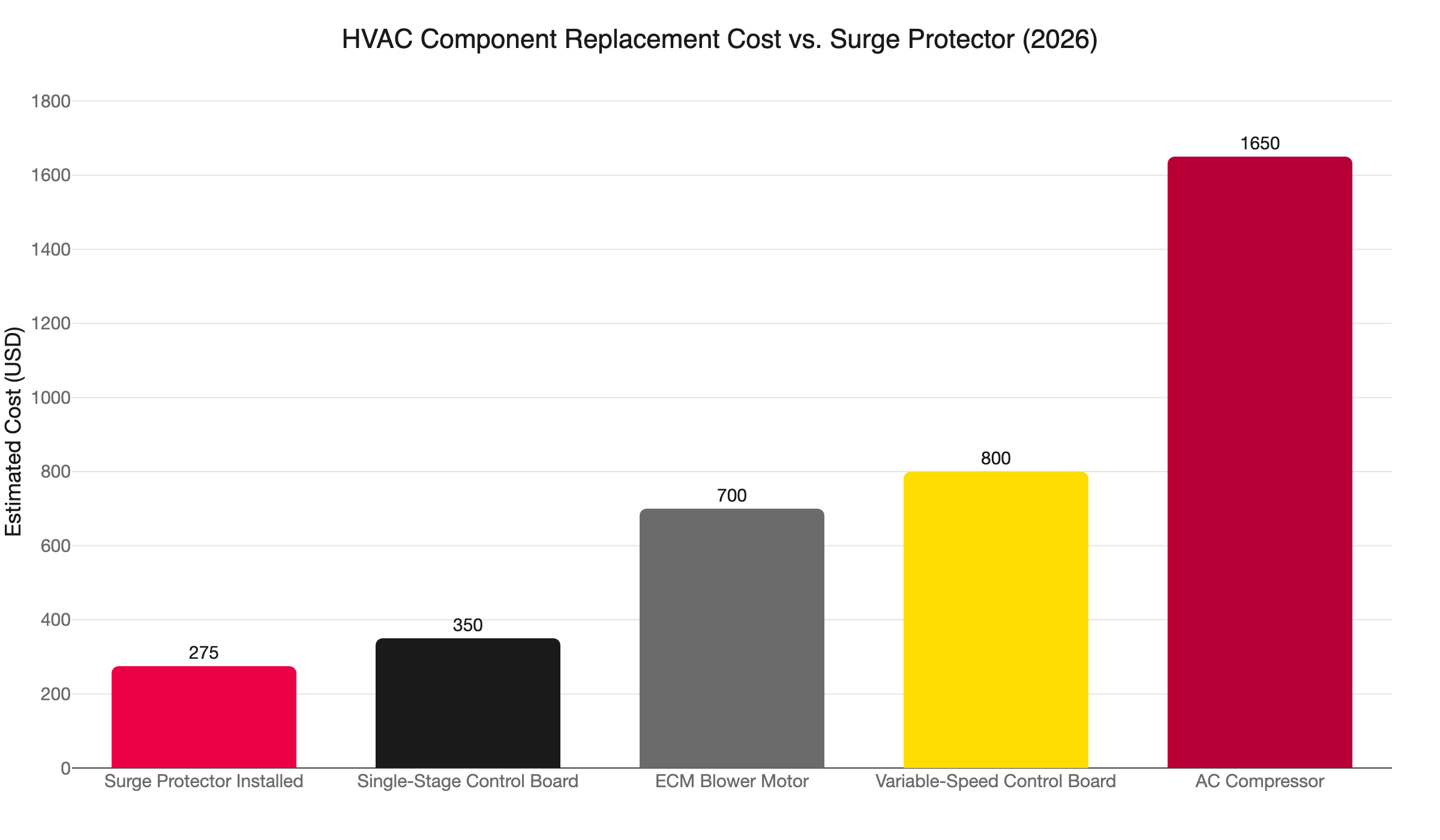
Yes, for most Twin Cities homeowners with equipment less than 15 years old. The installed cost of a protector ($150-$400) is a fraction of the most common repairs it prevents. Replacing a variable-speed control board carries a higher repair cost. One avoided repair pays for the protector two to five times over.
Here is the repair cost landscape in 2026:
- ECM blower motor: $400-$1,000 installed
Now compare those figures to $150-$400 for a surge protector.
If you have a variable-speed system, the break-even is a single avoided board replacement. At the high end of repair costs, one event returns five times the protector’s price. If you have an older single-stage unit, the math is still favorable, though the stakes per component are lower.
One number sharpens the case further. HVACi’s Annual Claims Report found that residential HVAC surge claims rarely have verified lightning as the root cause. The threats behind the other 98% include grid restoration surges, utility switching events, and the compressor’s own startup transients. These events happen throughout the year, not just during storms.
A critical point many homeowners miss: manufacturer HVAC warranties explicitly exclude surge damage, brownouts, and other electrical events. That exclusion applies to a system that is one year old just as much as one that is ten years old. If a surge takes out your control board, you pay for the repair regardless of the remaining warranty period.
Why Minnesota Storms Make the Math More Urgent
Minnesota sits on the north edge of Tornado Alley. The state averages 46 tornadoes per year using the 1991-2020 climate normal. Severe thunderstorms regularly produce winds of 58 mph and higher. The National Weather Service Twin Cities office identifies July through August as peak thunderstorm season, with hail contributing to significant annual U.S. damage.
Storms knock out power. When the grid restores after an outage, the restoration event pushes a surge through every connected circuit in the neighborhood. One Minnesota summer storm left approximately 136,000 customers without power. The causes included toppled trees, downed power lines, golf-ball hail, and flash flooding. Every unprotected HVAC unit in that service territory took the restoration surge the moment power came back.
That pattern repeats throughout the summer, not just during exceptional events. Localized outages affect neighborhoods across the metro multiple times each season. Each restoration is a surge event for every connected unit.
There is a secondary consequence beyond the electrical spike. When tens of thousands of homes restore power on the same day, HVAC repair calls spike across the region simultaneously. Contractors are suddenly fielding emergency calls from multiple neighborhoods at once. Parts go on back order. If your system fails on the hottest week of July, you may be waiting for both a technician and parts.
A surge protector does not prevent the storm. It prevents the storm from becoming a $1,300 repair during the busiest stretch of the cooling season.
Does Homeowners Insurance Cover HVAC Surge Damage?
Usually not through a standard policy. Insurers frequently reclassify surge damage to HVAC equipment as mechanical breakdown, which most HO policies exclude without a specific endorsement. Progressive and Allstate both note that surge damage coverage depends on the specific cause and the policy’s terms. Without a mechanical breakdown rider, you are likely paying out of pocket.
This gap catches homeowners off guard. The intuitive assumption is that a storm surge is a weather event, covered the same way wind or hail damage is. In practice, the insurer looks at what component failed. A failed control board inside a machine gets classified as a mechanical or electrical breakdown. Standard HO coverage does not extend to those failures.
There is also a documentation problem. Surge damage to electronics can appear days or weeks after the triggering event. Slow degradation from repeated smaller surges can take months to produce a visible failure. By the time the technician diagnoses a failed control board, you cannot reliably tie it to a specific storm. The insurer has grounds to deny the claim.
The surge protector creates a cleaner situation. If the MOV has absorbed a large spike, it may show visible signs of stress or failure. That is evidence of protection. If the board fails for a different reason, the cause is separable from surge damage. Either outcome is cleaner than a long dispute with an adjuster.
The $250 protector is also the only hedge that works without a claims process, a deductible, or proof of a specific triggering event. It is the straightforward path.
What Does an HVAC Surge Protector Actually Cost?
Expect to pay $150-$400 installed for a Type 2 SPD at your outdoor disconnect. Parts range from $15-$80 for a basic unit to $100-$150 for an HVAC-rated device with a higher joule rating. Labor is usually under an hour. No permit is required in Minnesota to add an SPD to an existing disconnect.
The cost range reflects two variables: the device specification and the labor situation. A basic MOV-based unit handles most residential applications. A higher-joule-rated device provides more protection headroom for larger variable-speed systems with higher startup current draws. Your technician can recommend the right rating for your specific equipment model.
No rebates are available through Xcel Energy or CenterPoint for surge protectors as of 2026. There is no program to apply to, no form to file, and no deadline to track. It is a fully out-of-pocket expense. The ROI argument does not depend on any external program, which actually makes the decision simpler.
If you are already scheduling a maintenance visit or a repair call, adding a surge protector to that appointment reduces the incremental labor cost to nearly zero. The technician is already at the unit. Adding 30 minutes to the visit is the most cost-efficient way to get protection in place.
The Internal Surge Problem Most Homeowners Don’t Know About
Most people associate power surges with lightning. That framing is almost entirely wrong, and it leads homeowners to underestimate risk on clear summer days.
NEMA Surge Protection Institute research shows that damaging power transients frequently originate inside the building, not from external sources. Your HVAC compressor is one of the largest contributors. When a compressor starts, it draws roughly six to eight times its normal running current for a fraction of a second. That startup spike creates a voltage transient that travels back through the circuit and stresses the connected electronics.
On a single-stage system that starts once or twice per hour, the cumulative effect over years is manageable. On a variable-speed system, the compressor modulates its output continuously in response to conditions. The individual transients are smaller in magnitude. But they are more frequent, and the inverter board managing those adjustments absorbs each one.
HVACi found that lightning is rarely the verified cause of residential HVAC surge claims. The board failure that looks like a random breakdown three years into a system’s life is often the result of hundreds of grid restoration events and thousands of startup transients accumulating slowly.
Variable-speed systems are more efficient and more comfortable than single-stage units. They are also more sensitive to power quality. The inverter board that makes them efficient is precisely the component most vulnerable to electrical stress. Adding a surge protector addresses both external grid events and helps buffer the circuit from the unit’s own startup behavior. It does not eliminate all electrical stress. It removes the worst spikes from the equation.
How Is an HVAC Surge Protector Installed?
A licensed technician mounts the SPD at your outdoor disconnect panel. The work takes 30-60 minutes. The device wires in parallel with the power feed. Installation requires a brief system shutdown and then immediate restoration to full operation.
The disconnect panel is the metal box mounted on the exterior wall near your outdoor AC unit or heat pump. It houses the shutoff switch and, in newer installations, may already have a slot for an SPD. The technician opens the panel, connects the device’s leads, secures the housing, and restores power. The result is a small device mounted inside or adjacent to the disconnect.
The most cost-efficient time to add a surge protector is during a scheduled visit. If you are booking a new AC installation, that is the ideal moment. The disconnect is open, the technician is already orienting to the unit, and adding the SPD is a natural extension of the work. If you have an existing system, ask during your next maintenance appointment.
If your home has both a furnace and an outdoor AC unit, protection at the outdoor disconnect covers the AC-side components. Your furnace’s control board draws power from a separate circuit. Your technician can evaluate whether that circuit warrants a second device during the same visit.
Which Systems Need This Most?
Not every home has the same risk profile. Here is how to think about priority.
Higher priority:
- Variable-speed or communicating systems (Carrier Infinity, Lennox iComfort, Trane S8X2, or similar). These carry $500-$1,100 control boards and inverter-driven compressors. The ROI is clearest here.
- Systems in their first ten years. Manufacturer warranties exclude surge damage. A new system is the largest HVAC investment you will make in a decade. Protect it.
- Homes in neighborhoods with older distribution infrastructure or multiple power outages each summer.
- Homes without whole-home surge protection at the main panel.
- Heat pumps. A modern cold-climate heat pump uses the same inverter-drive technology and carries similar board replacement costs as a variable-speed AC. See how cold-climate heat pump technology performs in Minnesota winters for context on what these systems contain under the hood.
Lower priority, though still worth a conversation:
- Single-stage systems older than 12-15 years. If the system is near end of life, a conversation about replacement may be more valuable than added protection on aging equipment. See how long HVAC systems typically last in Minnesota for the age benchmarks that help you decide.
The simplest test: if your control board failed next week, would the repair cost be painful? If yes, the protector is worth it.
When Should You Add a Surge Protector?
The best time is before peak storm season. The second-best time is your next service visit.
Minnesota’s surge risk window runs May through September. That window aligns directly with cooling season, when your system logs the most run hours and when thunderstorm activity is highest. A surge protector added before July is in place for the highest-risk months of the year.
If you are reading this during cooling season, the most convenient path is your next scheduled service call. Ask the technician to assess your system’s surge protection status during the visit. In most cases, a compatible SPD can be sourced and installed the same day.
If you have a new variable-speed system without protection already in place, there is no benefit to waiting. Board degradation from internal transients is cumulative. Earlier protection means more protection over the system’s full service life.
Protect Your System Before the Next Storm
Our team is locally owned and operated in Ramsey, Minnesota. We serve Minneapolis, St. Paul, Maple Grove, Plymouth, Brooklyn Park, Blaine, Bloomington, Woodbury, and the full Twin Cities metro.
We show up when we say we will. That is the foundation of everything we do, backed by our guarantee: “Always On Time… Or You Don’t Pay a Dime!(R)”
Call us at (763) 260-6662 or book online to schedule surge protector installation, an AC maintenance visit, or a full system assessment. If you are not sure whether your system warrants a protector, ask during your next appointment. It is a short conversation that can prevent a large, unplanned repair bill in the middle of July.
Frequently Asked Questions
Is an HVAC surge protector worth it? +
Does homeowners insurance cover HVAC surge damage? +
What causes most HVAC power surges — is it lightning? +
How long does an HVAC surge protector last? +
Need a technician now?