
Best Heat Pump Brand for Minnesota Cold Weather (2026)
Key Takeaways
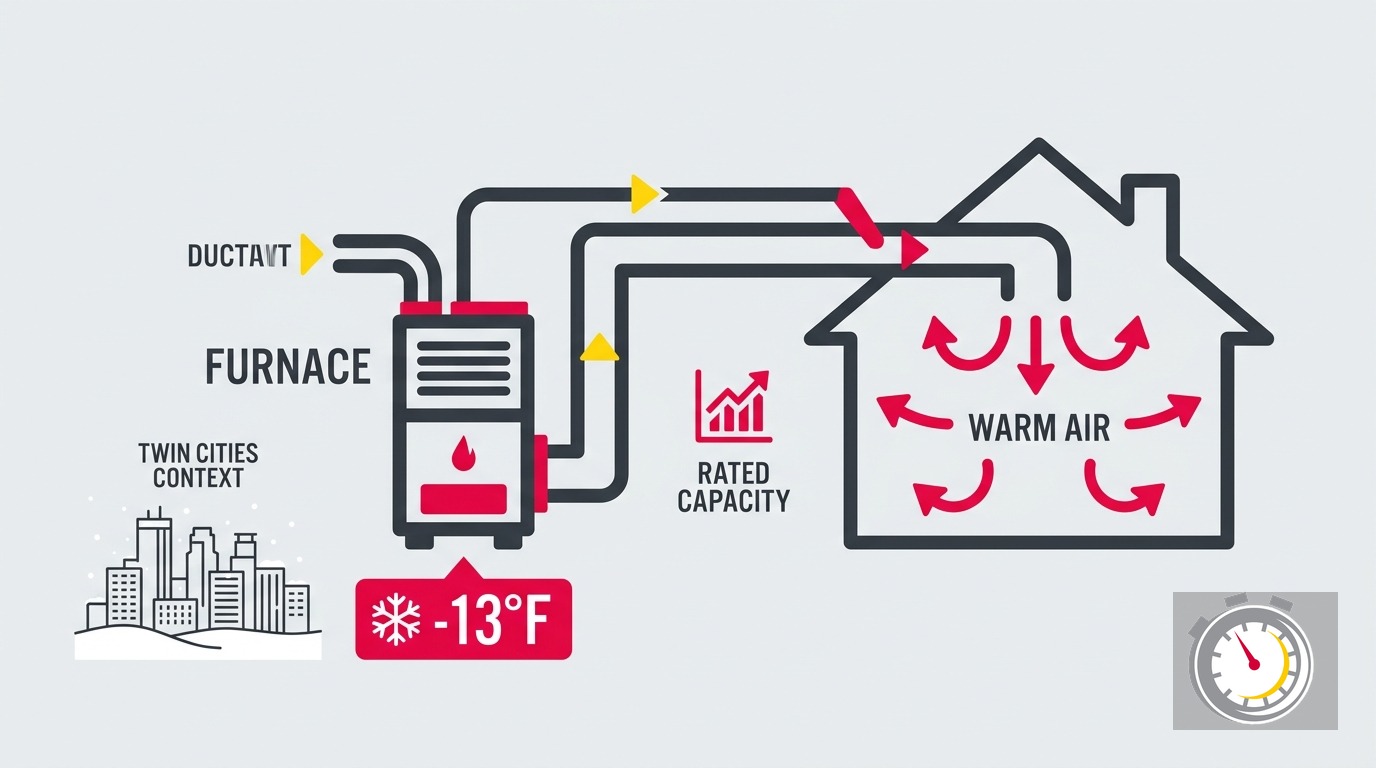
- Cold-climate certification requires maintaining rated output and COP at or below -13°F, per the NEEP standard.
- Minnesota field research from MNCEE confirmed cold-climate heat pumps matched manufacturer specs in real homes.
- Minneapolis uses 5°F as its Manual J design temperature. A system must hold full output there without backup assistance.
- Polar vortex events push temps to -20°F and below. Backup heat is not optional in Minnesota.
- Xcel Energy rebates reach $2,000 for qualifying units. City and federal incentives can stack on top.
- The 25C federal tax credit expired December 31, 2025. Competitors still citing it are working from outdated information.
- See our Minnesota heat pump rebates guide for a full breakdown by utility and city.
What Does “Cold Climate Rated” Actually Mean?
Cold-climate certification means a heat pump maintains its rated heating capacity and COP at or below -13°F (-25°C). This is the Northeast Energy Efficiency Partnerships standard, not a marketing term. A unit that “operates at -13°F” at 25% of rated output does not qualify.
That distinction matters because most homeowners never hear it. A manufacturer can say their unit “runs down to -22°F.” That sounds like solid protection for a Minnesota winter. Running at a fraction of rated capacity at -22°F is not protection. Your gas backup is carrying the load.
The -13°F threshold comes from the NEEP cold-climate ASHP specification. A unit must maintain rated heating output and a minimum COP at or below that temperature to earn the designation. The specification does not ask whether the unit can run. It asks whether the unit can carry your load.
“Operates at -13°F” is a marketing floor. “Rated capacity at -13°F” is a verified performance standard. The difference determines whether your home stays warm on a January night in the Twin Cities.
How Do You Verify a Heat Pump’s Cold-Climate Rating?
Pull the unit’s AHRI certificate for the specific indoor/outdoor pair being quoted. Look it up at ahridirectory.org. If the certificate shows rated heating capacity and COP at -13°F, the unit qualifies. A manufacturer spec sheet does not replace this step.
The AHRI certificate is the third-party verification document that matters. Manufacturers submit matched indoor/outdoor pairs for independent testing. The certificate lists capacity and efficiency at multiple outdoor temperature points. That is where the real number lives.
One complication worth knowing: NEEP transitioned its Cold Climate ASHP Product List to pull directly from AHRI data starting April 1, 2026. During the transition, some eligible products temporarily dropped off the list at ashp.neep.org. If a unit you are researching does not appear on the NEEP list, check the AHRI directory directly. Do not conclude it fails to qualify without that second check.
Your installer should pull this certificate for every unit they propose. If they hand you a brochure instead, ask again. The data is public and it is the only document that settles the question.
Why Minnesota Cold Weather Demands a Different Standard
Minnesota sits in IECC Climate Zone 6. The ACCA Manual J design temperature for Minneapolis is 5°F. That is the outdoor threshold a system must handle without leaning on backup heat.
The MNCEE field assessment monitored cold-climate ASHPs in six Minnesota homes. The result was direct: inverter-driven cold-climate ASHPs performed in line with manufacturer specifications. Real Minnesota homes, real Minnesota winters, and the spec sheets held up.
MNCEE recommends sizing the heat pump to meet 100% of the heating load at outdoor temps at or below 10°F. Backup heat should engage only below the metro design temperature of -11°F. The heat pump should be prioritized over backup down to that threshold.
A correctly sized system handles most of a Minnesota heating season on its own. It hands off to backup only during the deepest cold. That is where the real efficiency gains land, and where the right brand choice matters most.
Which Brands Perform Best in Minnesota Cold Weather?
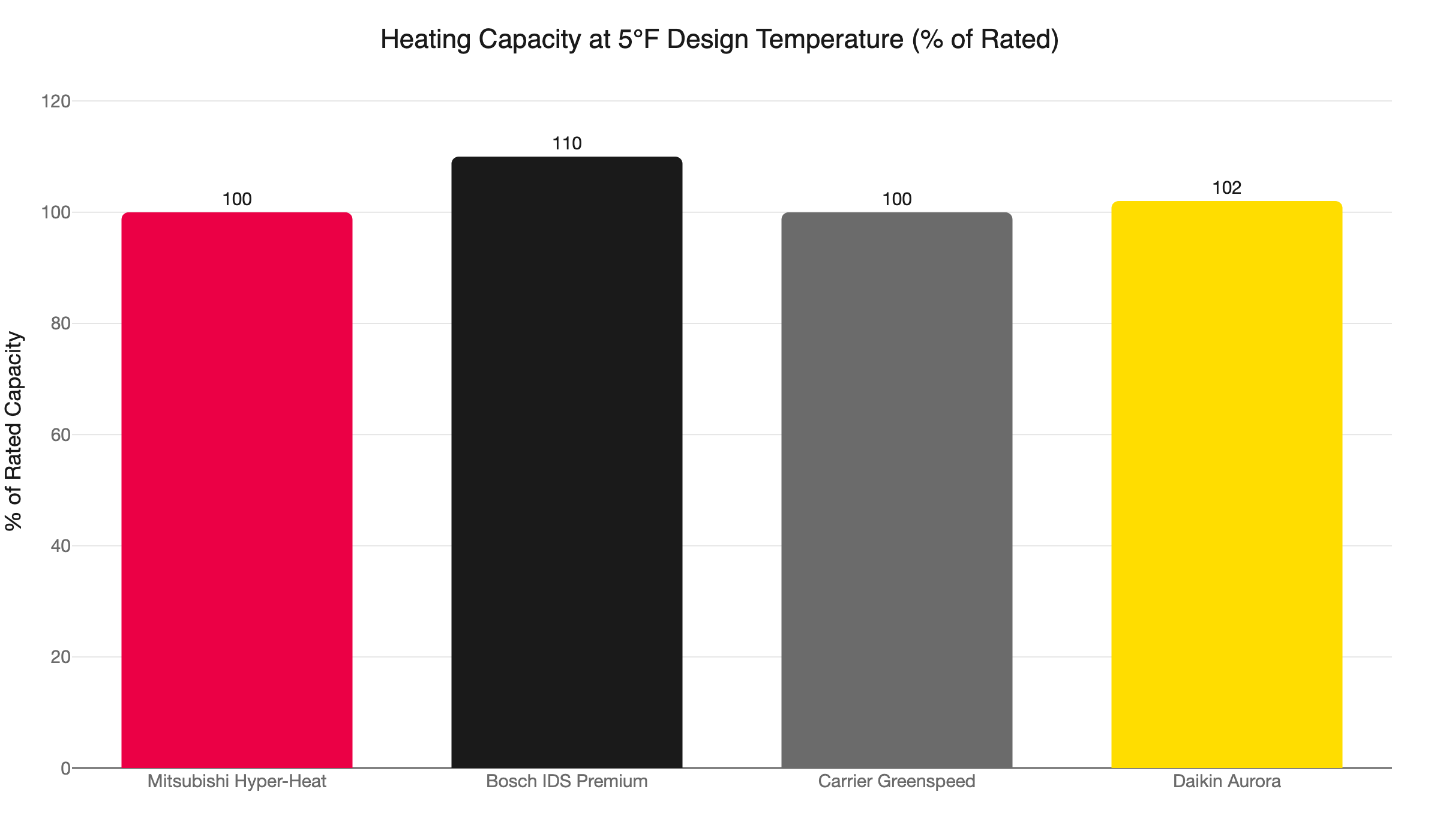
Bosch IDS Premium, Mitsubishi Hyper-Heat, Carrier Greenspeed Infinity, and Daikin Aurora all publish cold-climate-qualifying capacity data and meet the Xcel Energy rebate threshold. Bosch leads on raw output at 5°F. Mitsubishi leads on Twin Cities installer depth. Lennox SL25XPV also qualifies but should be confirmed via AHRI certificate for your specific quoted pair.
Here is what the published data shows for each brand at the Minneapolis design temperature. Figures come from a Twin Cities contractor analysis and should be confirmed against the AHRI certificate for the specific pair you are quoted.
[chart: brand-capacity-at-5f]
Mitsubishi Hyper-Heat H2i
The Hyper-Heat line holds 100% of rated capacity at 5°F and delivers meaningful heating output at -13°F and below. More practically, it has the deepest installer base in the Twin Cities. Warranty service requires an authorized dealer. A brand with thin local coverage becomes a real problem in February when you need a part quickly.
Bosch IDS Premium
Bosch publishes 110% of rated capacity at 5°F. The inverter compressor ramps above nameplate as outdoor temps approach the design point. That is the behavior you want on a cold Minneapolis design day. At -15°F, output stays in the 75-85% range. That is the strongest cold-weather capacity spec among the five brands reviewed here.
Carrier Greenspeed Infinity
Carrier holds 100% of rated capacity at 5°F and around 65-75% at -15°F. Its primary advantage is dealer network depth. Carrier has one of the broadest warranty-service footprints in the Twin Cities. Parts availability three winters from now is a real factor in total cost of ownership.
Daikin Aurora
Daikin publishes 100-105% at 5°F and 65-75% at -15°F. The Aurora continues operating down to -22°F at reduced capacity. Its 12-year compressor warranty leads the category. CenterPoint Energy’s Home Service Plus program offers Daikin, which may simplify financing or service coordination for CenterPoint customers.
Lennox SL25XPV
Lennox qualifies on the cold-climate specification and carries a dealer warranty network comparable to Carrier. Pull the AHRI certificate for the specific pair before signing. Confirm the -13°F capacity data is on the certificate, not just implied by the marketing.
The capacity data above is sourced from a published Twin Cities installation comparison. Confirm the specific matched pair you are being quoted at ahridirectory.org before you commit.
For a deeper look at how these systems perform below zero, see our post on heat pump performance below zero in Minnesota.
Why Brand Is Only Half the Decision
The best heat pump brand for Minnesota cold weather is the one backed by an installer who will service it correctly for 15 years. Every brand on this list performs when installed right. Not every installer installs it right.
Before signing any contract, ask:
- How many of this brand’s systems has your team installed in the past two years?
- Do you stock common parts locally, or do you order when a call comes in?
- Who handles the warranty claim if the compressor fails at year four?
- Is your company authorized by the manufacturer for warranty work?
- Will you pull the required permits for this installation?
These questions tell you more about your future service experience than the logo on the outdoor unit does. You are buying a 15-year service relationship, not just equipment.
What Happens During a Polar Vortex?
Every cold-climate heat pump loses significant output below -20°F. At -25°F, most units run at 30-50% of rated capacity. Minnesota polar vortex events are not rare. A backup heat source is not optional in our climate. Plan for a gas furnace in a dual-fuel setup or electric resistance strips as the backup.
IECC Climate Zone 6 means our worst nights regularly hit -25°F. No unit on the market today maintains full rated output at those temperatures. The brands that earn the -13°F designation do so because that is the NEEP standard. Below that point, every unit operates in reduced-capacity mode.
That is not a product failure. It is physics. Correct system design accounts for it. You size the heat pump to carry the full load at the design day. You keep backup heat integrated for the nights that go colder.
MNCEE field data recommends prioritizing the heat pump over backup down to -11°F metro design conditions. That captures the efficiency gains through most of the heating season. Below that threshold, backup carries the load and the heat pump recovers as temps rise.
Not sure whether a heat pump fits your home at all? Read Heat Pumps in Minnesota: Are They a Good Fit? before you decide.
What Minnesota Rebates Are Available Right Now?
Xcel Energy pays up to $2,000 for qualifying cold-climate heat pumps. Minneapolis residents can stack up to $1,000 on top. The federal HEAR program is coming and may add up to $8,000 for income-qualifying households. The 25C tax credit expired December 31, 2025.
Here is the current incentive stack for Twin Cities homeowners.
Xcel Energy
The current program pays up to $2,000 for cold-climate heat pumps meeting these thresholds:
- COP at 5°F at or above 1.75
- HSPF2 at or above 8.5
- Listed in the AHRI directory
- Heating capacity at 5°F at least 70% of capacity at 47°F
- Applies to single-family through fourplex properties only
An additional $600 is available for insulation and air-sealing work done at the same time. A tighter envelope reduces the heat pump’s daily workload. That stack pays back over time. Full criteria are in the Xcel Energy rebate summary.
City Incentives
Minneapolis residents can add up to $1,000 on top of the Xcel rebate. In designated Green Zones, that rises to $5,000. Equipment must meet the Xcel cold-climate specification to qualify.
Hopkins offers up to $1,500 for all residents through the Climate Solutions Fund. Income-qualified Hopkins households can receive up to $2,500.
Federal HEAR Program
The HEAR program has not launched yet, but funding is allocated. Households below 80% of area median income can receive up to $8,000. Those at 80-150% AMI qualify for up to $4,000. Equipment must be ENERGY STAR certified and cold-climate rated.
Several competitors still cite the 25C federal tax credit. That credit expired December 31, 2025. Do not budget for it.
Current incentive listings by utility and city are at mnashp.org/incentives-rates-financing.
Is a Dual-Fuel System the Right Call?
For most Twin Cities homeowners with an existing gas furnace, dual-fuel is the practical path. The heat pump carries the load efficiently through most of the heating season. The furnace handles the polar vortex days. You get efficiency gains without giving up cold-weather coverage.
A dual-fuel setup pairs a cold-climate heat pump with your existing gas furnace. The heat pump runs whenever it is efficient to do so, typically down to -10°F to -15°F. The furnace takes over below the balance point. You set the switchover in the thermostat or control system.
The efficiency case is straightforward. A cold-climate heat pump delivers two to three units of heat per unit of electricity consumed. A 96% efficient gas furnace converts fuel to heat at roughly 1:1. The heat pump wins on efficiency for most of the Minnesota heating season. The furnace wins during the coldest stretches when heat pump output drops significantly.
This is not a compromise. It is how these systems are designed to work in our climate.
What to Ask Before You Sign
Pin down your installer on these questions before the contract goes through:
- What is the AHRI certificate number for this specific indoor/outdoor pair?
- What is the rated heating capacity at 5°F and at -13°F on that certificate?
- Does this unit qualify for the current Xcel cold-climate rebate?
- How will backup heat integrate with the new system?
- Who handles warranty service if there is a compressor issue at year four?
- Will you pull the required permits for this installation?
An installer who answers without hesitation knows the product. One who deflects is worth a follow-up conversation before you commit.
Schedule a Heat Pump Assessment
Northern One Hour is locally owned and operated in Ramsey, MN. We serve Minneapolis, St. Paul, Blaine, Maple Grove, Plymouth, Brooklyn Park, Woodbury, Bloomington, and the surrounding Twin Cities metro.
We size every system with Manual J load calculations. We identify which brands qualify for current Xcel and city rebates. We walk through the AHRI certificate with you before you decide. We back every installation with our satisfaction guarantee and the promise that drives everything we do: “Always On Time… Or You Don’t Pay a Dime!(R)”
Call (763) 260-6662 or schedule a consultation online to get started. Financing is available for heat pump installations.
Frequently Asked Questions
What is the best heat pump brand for Minnesota cold weather? +
Does a heat pump work at -20°F in Minnesota? +
How much is the Xcel Energy heat pump rebate? +
What does cold-climate certified mean for a heat pump? +
Need a technician now?