
AC Blown Low Voltage Fuse Symptoms: Signs and Causes
Key Takeaways
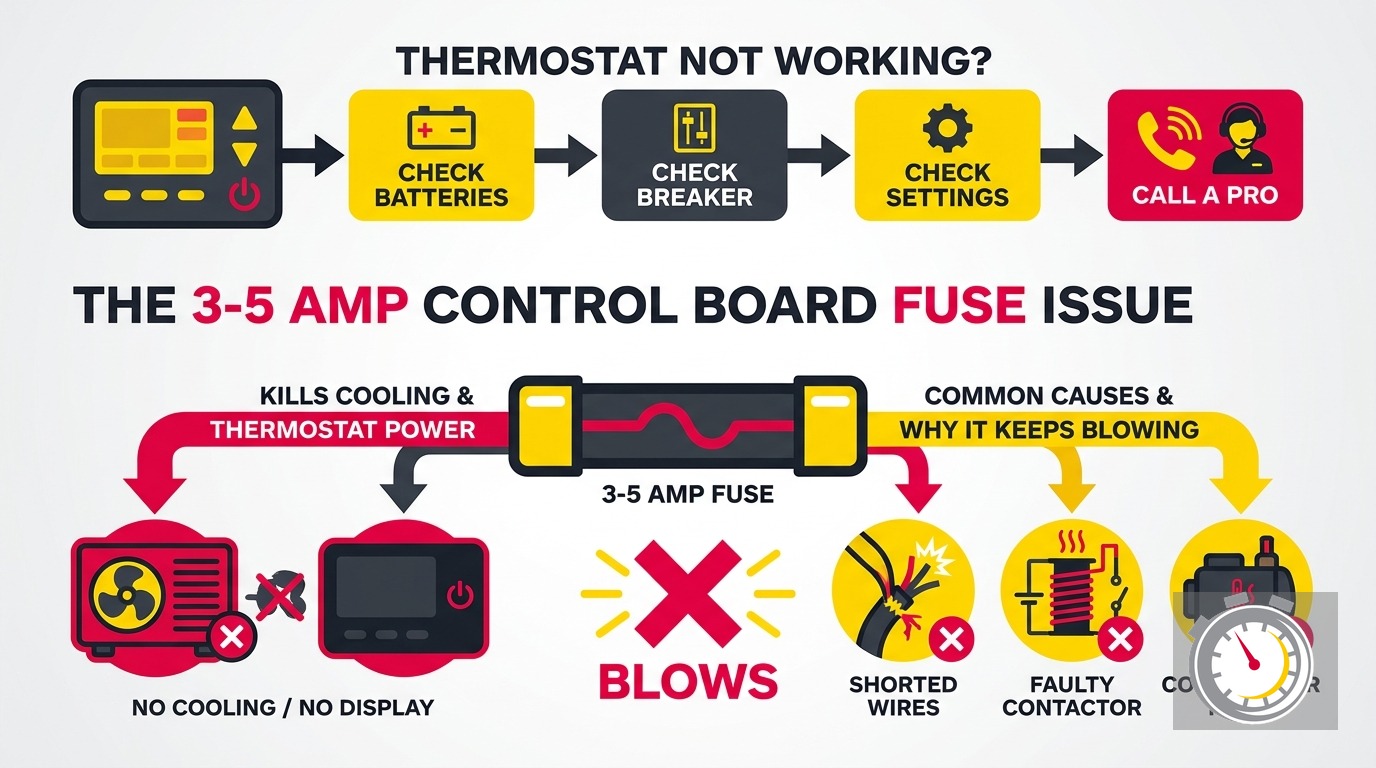
- The most common AC blown low voltage fuse symptoms are a blank thermostat, no cooling, and a silent indoor blower, all at the same moment.
- The fuse is a small 3 to 5 amp automotive-style fuse on the furnace or air handler control board.
- A fuse does not wear out on its own. If it blows again, a short is still in the 24-volt wiring.
- Chewed, pinched, or rubbed wires, a shorted outdoor contactor, and recent thermostat work are the usual culprits.
- Never install a bigger fuse. It can damage the transformer or the control board.
- Call us when a fuse blows twice. We find the short instead of feeding fuses into the board.
What the Low Voltage Fuse Does in Your AC System
Your AC runs on two kinds of power. The compressor and fans use high-voltage power, 240 volts for the outdoor unit. The controls use a much smaller circuit, 24 volts.
A small transformer inside the furnace or air handler makes that 24-volt power. It feeds the thermostat and every control wire in the system. The thermostat sends signals down thin wires to ask for cooling, heat, or fan. Those signals pull in relays and the contactor at your outdoor unit.
The low voltage fuse protects that transformer. It is a small, flat, automotive-style fuse, usually rated 3 to 5 amps. It sits on the control board inside your indoor equipment. According to hvac.com, a blown fuse is typically located on the unit’s control board.
Many “blown AC fuse” pages describe a different fuse. They cover the 240-volt disconnect fuses or the breaker panel. Those protect the big motors. They fail for other reasons, such as a bad compressor or a power surge.
The 24-volt fuse is a different animal. When it opens, the compressor and fans are usually fine. The brain of the system has simply lost power.
Think of a car. The engine can be perfect, but a blown fuse can still leave the dash dead. The fix depends on why the fuse blew.
How Do You Know If an AC Low Voltage Fuse Is Blown?
A blown low voltage fuse usually kills the thermostat display, the cooling, and the indoor blower all at once. The breaker stays on, and the outdoor unit stays quiet. Power reaches the equipment, but the 24-volt control circuit that tells it what to do has gone dead.
Watch for these symptoms:
- A blank thermostat. The screen is dark, even with fresh batteries in a battery-powered model.
- No response to settings. You change the temperature and nothing clicks, hums, or starts.
- A silent blower. The fan does not start, even when you switch it to “On.”
- A quiet outdoor unit. The condenser fan and compressor never start.
- A dead furnace too. The heat may be dead as well, since many homes share one transformer.
- A normal breaker panel. Nothing has tripped, and the lights in the room still work.
The pattern matters most. A failed capacitor or compressor usually leaves the thermostat working. The indoor unit may run while the outdoor unit hums or stays off. A blown control fuse takes out the signals themselves.
Trane notes that a blank thermostat display indicates no power to the thermostat. Chase that clue. Your thermostat gets its power from the same 24-volt circuit.
Other problems can look similar. Dead batteries, a tripped float switch, or a loose thermostat wire can all stop cooling. Our guide to a blank or dead thermostat screen walks through the simple checks to run first.
How Can You Tell If a Fuse Is Blown?
You can tell a fuse is blown by looking at it or testing it with a meter. A good fuse has an intact metal strip inside. A blown one shows a broken strip, a gap, or a darkened window. A meter reading of no continuity confirms it.
Start with safety. Turn the equipment off at its service switch. That switch often looks like a light switch on or near the furnace or air handler. Then follow these steps:
- Remove the service panel. Set it aside where it will not get bumped.
- Find the control board. It is the circuit board with the thin thermostat wires attached.
- Look for the small fuse. It is often near the wire terminals and labeled with its amp rating.
- Read the rating. The number is stamped on the fuse and printed near the holder.
- Inspect the fuse. Look for a broken strip or dark smudging.
A visual check is not perfect. Some fuses fail with no visible mark. A technician uses a meter to test for continuity, which shows whether current can pass through. The HVACR School fuse video page covers how a low voltage fuse protects the circuit and how to test it with a volt and ohm meter.
Be honest about your comfort level. The panel holds line-voltage parts too. If you do not feel sure, stop at the thermostat and call us.
If you replace the fuse, match the amp rating exactly. Do not guess. The number printed on the board is the number you need.
Where Is the Low Voltage Fuse Located?
The low voltage fuse sits on the control board inside your furnace or air handler. It is not at the outdoor unit and not in the breaker panel. Look near the thermostat wire terminals for a small, flat, colored fuse, usually rated 3 to 5 amps.
Where you look depends on your equipment:
- Gas furnace with central AC. Open the lower blower compartment door. The board is often mounted on the side wall.
- Air handler in a closet or attic. The board sits behind the front panel, near the transformer.
- Basement or crawl space units. The same layout applies, but access can be tight.
Some boards hide the fuse under a plastic clip or close to the wire block. Others place it beside a diagnostic light. Many boards print the amp rating next to the holder.
If your air handler lives in an attic, think twice before climbing up there. Summer attic heat can be brutal. Our article on attic air handler problems explains why those spaces cause so many service calls.
Not every system has a fuse on the board. Some use a resettable breaker or a fuse inline with the transformer. A technician can tell you which style you own in a minute or two.
Why Is My Thermostat Blowing the Fuse?
The thermostat is rarely the part that blows the fuse. The short is usually in the wire that connects to it. A bare copper strand touching another wire, or a metal surface, sends too much current through the 24-volt circuit. The fuse opens to protect the transformer.
Picture the thermostat wiring as a bundle of thin, color-coded paths. Each one carries a signal to a different job. The R wire carries the 24-volt power. G calls for the fan, Y calls for cooling, and W calls for heat. The C wire returns the power so smart thermostats can stay lit.
A short happens when power finds a shortcut. Common causes are:
- Wires pinched behind a wall plate. Tightening a thermostat base can squeeze a wire against metal.
- Bare copper strands. A stray strand can bridge two terminals.
- Chewed insulation. Mice and other pests chew wire coverings.
- Rub points. Wire that rubs on a sharp edge slowly wears through its coating.
- Staples through the cable. A staple driven too tight can cut into the wire.
Trane says loose, corroded, or chewed thermostat wiring can cause a thermostat to stop working or work intermittently. It also advises calling a professional for bad wiring.
Recent thermostat work is another big clue. Did you or an installer swap a thermostat in the last few weeks? A single stray strand at the new base can blow the fuse the first time you set it to cool.
New smart thermostats add a wrinkle. Many need a C wire to work. A wrong connection or a spliced wire can short the circuit. Our guide to C-wire and smart thermostat compatibility explains what those wires do and why they matter.
Why Does the Fuse Keep Blowing After I Replace It?
A fuse that keeps blowing means a short is still present. A fuse is not a part that wears out. It opens to protect the circuit from too much current. Until someone finds and fixes the short, a new fuse will blow as soon as the short makes contact.
Many homeowners miss this. The fuse only reports the problem. It does not cause it.
The technician-focused site HVAC School makes the same point in its guide to isolation diagnosis. Its author uses a 3A low voltage fuse as the example and notes that fuses don’t just fail open on their own. The cause has to be found.
hvac.com agrees. It says replacing fuse after fuse will not correct the issue. It also says tracing a short is often a lengthy process.
A repeat short usually hides in one of these places:
- Thermostat wire. This is the most common spot, especially where wire passes through framing or around ducts.
- The outdoor wire run. Control wire travels from the furnace to the condenser, often through a wall, a basement, or an attic.
- The condenser contactor. A shorted coil in the outdoor unit can pull the fuse every time cooling starts.
- A safety device. A float switch or pressure switch with a damaged wire can short the circuit.
- The control board itself. A damaged board trace can create a short on the board.
A pattern helps your technician. Does the fuse blow the moment the power returns? That points to a hard short on the circuit. Does it blow only when the AC calls for cooling? That points to the Y wire, the contactor, or the outdoor wiring.
Our post on AC contactor failure explains that outdoor part and the signs it is going bad.
Can I Put In a Bigger Fuse?
No. A bigger fuse is the wrong fix. The fuse rating matches what the transformer and board can safely handle. A 5-amp fuse in a 3-amp slot lets too much current through. The fuse stops protecting, and the transformer or board can burn out instead.
It is tempting. You have a 5-amp fuse in the junk drawer, and the 3-amp one keeps blowing. Technicians in online forums warn that upsizing can damage the transformer or board. Those posts are anecdotal, but the engineering is simple.
A short draws more current than the circuit was built for. A properly sized fuse opens first. An oversized fuse holds on, and the heat goes into the nearest part that cannot take it.
That turns a small repair into a larger one. A wire fix becomes a transformer or control board replacement. Our post on furnace control board failure shows what that bigger repair looks like.
Skip the other shortcuts too. Never wrap a fuse in foil. Never bridge the holder with a wire. Those tricks remove the protection altogether.
How Does a Technician Find the Short?
A technician finds the short by isolating one circuit at a time. They remove the load, test each control wire, and watch whether the fuse holds. The method is patient. It saves the board and finds the true cause instead of guessing.
The HVAC School guide describes a common approach. The author swaps in a 3A resettable fuse or breaker and keeps the thermostat off, to avoid wasting fuses. He then jumpers each switch leg to R, one at a time, to find the circuit that trips the fuse. That includes G, Y, W, O, and the second-stage legs.
We do this work with the right tools and training. Do not copy it at home. Leave jumpers to the technician.
A typical visit follows these steps:
- Check the power. We confirm the transformer output and the incoming power.
- Inspect the visible wiring. We look at the thermostat base, the board, and any rub points.
- Test each circuit. We isolate G, Y, W, and the other legs one at a time.
- Split the outdoor run. We disconnect the control wire at the condenser.
- Repair the cause. We fix the wire, the contactor, or the failed part.
- Test the whole system. We run a full cooling cycle before we leave.
The outdoor split is a clever shortcut. According to HVAC School, if the outdoor-bound conductor is the culprit, you disconnect it at the condenser. If the short persists, it is in the condenser or contactor. If the short stops, it is in the wire between the condenser and furnace.
That one test cuts the search in half and saves hours.
HVAC School also draws a useful contrast with high-voltage breakers. A resettable breaker tripping is for a reason, and resetting it can cause a major arc. That is why you should never keep resetting a tripped breaker at your panel. Trane gives the same warning: flipping it back on and running the system could cause damage.
Twin Cities Cooling-Season Triggers
Our cooling season is short, but it is hard on equipment that sat idle all winter. Many fuse problems show up on the first hot days. The control wiring has been quiet for months, and anything that changed over winter now gets tested.
These are the triggers we see most often in Twin Cities homes. They come from our own experience in the field, not from a published study.
- Pests in attics, basements, and crawl spaces. Mice move indoors as temperatures drop. They chew insulation off thin wire.
- Recent thermostat upgrades. Many homeowners install a smart thermostat in spring. A pinched wire at the new base is a classic cause.
- Recent condenser or line set work. New outdoor work can disturb the control wire.
- Home projects. Drywall, insulation, and remodeling can nick or staple wiring.
- Window unit conversions. Homes that moved from window units to central air often have new wiring and new connections.
That last one deserves a closer look. If you just added central cooling, our article on replacing window air conditioners with central air covers what the project involves. New installs usually run smoothly. A rushed wire job from an unlicensed helper is a different story.
Humidity swings play a role too. Summer moisture can corrode a wire connection at the condenser. A corroded connection is a classic hiding spot for an intermittent short.
Dirty filters get blamed for everything, and they deserve some of it. They stress equipment and cause other failures. hvac.com recommends changing filters every 2-3 months. But a clogged filter does not usually blow a 24-volt fuse. Do not assume a filter swap fixes a dead thermostat.
What Does It Cost to Fix a Blown Low Voltage Fuse?
The fuse costs very little. The cost of the visit depends on how long it takes to find the short and what the short damaged. A simple wire repair is a small job. A burned control board is a bigger one, with installed replacement around $750 at the midpoint.
We will not quote a flat number for this problem. Two homes with the same symptom can have very different causes.
Here is how the range works:
- A fuse swap with no short found. This is rare, and it usually means a one-time event like a surge.
- A wire repair. This covers a pinched, chewed, or rubbed wire at the thermostat or along the run.
- A contactor replacement. This covers a shorted coil at the outdoor unit.
- A control board replacement. This applies when the board itself was damaged.
Your technician should tell you what they find, show you the cause, and give you the price before any work begins. That is how we work. We believe in honest, transparent pricing.
Do not rely on a national cost figure you read online. Prices vary by region and by the job. A number that fits a different market may not fit a Twin Cities home.
A fuse that keeps blowing can also be a sign that something else is aging out. If your system is old and the repairs are piling up, it may be time to weigh a repair against a replacement. Our guide on repairing or replacing a failing system can help you think it through. If you do replace, ask about financing. We offer options for larger jobs.
Your Next Step: Get the Short Found, Not Just the Fuse Replaced
If your AC and thermostat went dark together, check the control board fuse. Replace it once, with the exact amp rating, if you are comfortable doing so. If it blows again, stop. A short is still there, and more fuses will not fix it.
Run through this checklist before you call:
- Is the thermostat blank, with fresh batteries if it uses them?
- Is the breaker on, with no trip?
- Is the furnace dead too?
- Did anyone work on the thermostat or wiring recently?
- Has the fuse blown more than once?
Share those answers when you call. They help us send the right technician with the right parts.
We are a locally owned and operated Twin Cities company. We know how our summers, our older homes, and our attics treat HVAC wiring. Our air conditioning repair team diagnoses control circuit problems every cooling season. If your thermostat is the culprit, we can help with thermostat service and installation as well.
You also get our on-time promise: “Always On Time… Or You Don’t Pay a Dime!(R)” We arrive within the time window you select. If the technician does not show up on time, you do not pay for the service.
Call (763) 260-6662 or book online to schedule fast. We will find the short, fix the cause, and get your cooling back.
Frequently Asked Questions
Will a blown low voltage fuse stop my furnace too? +
Is it safe to touch a 24-volt fuse? +
Can a blown fuse make the AC work some days and not others? +
Need a technician now?