
Replace Window AC with Central Air in the Twin Cities
Key Takeaways
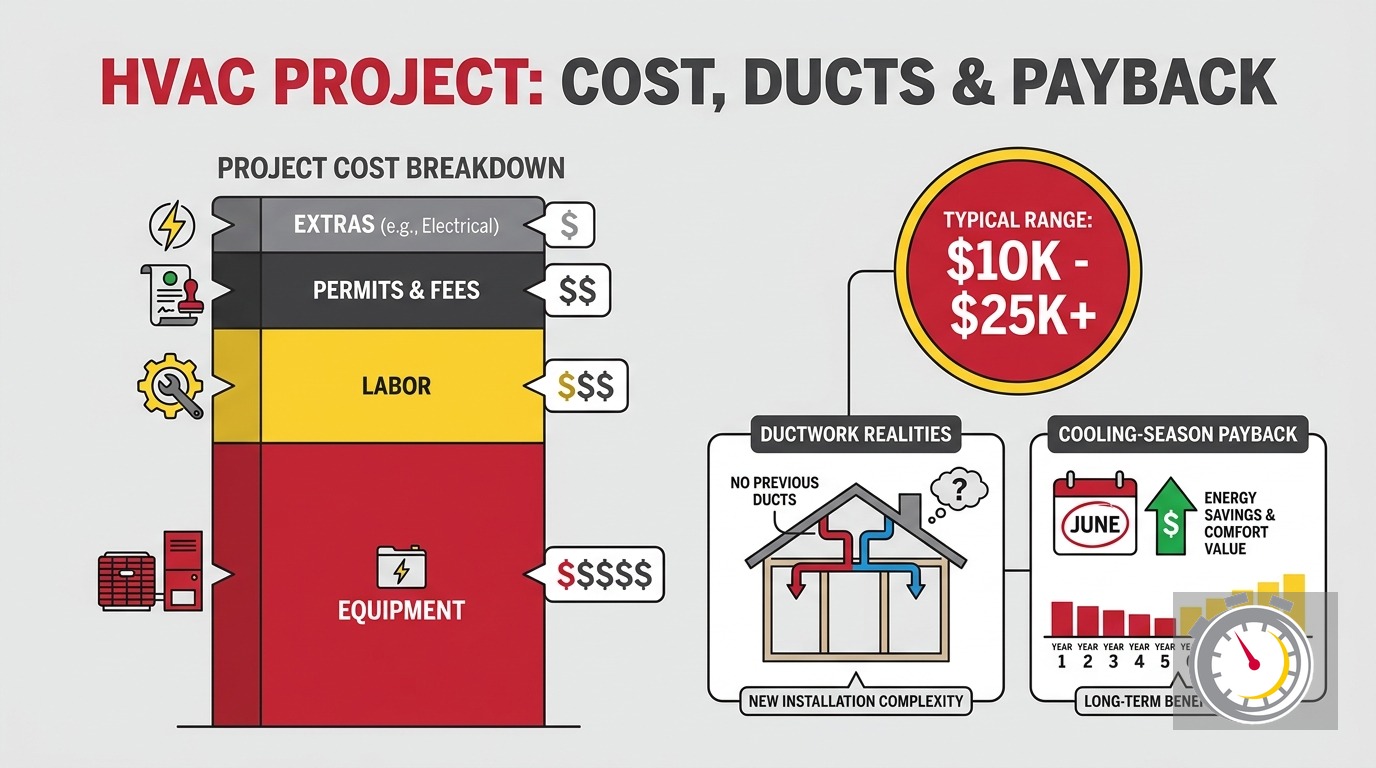
- Whether your home has existing ductwork is the single biggest cost variable. It determines whether this is a $9,000 upgrade or a $20,000-plus project.
- Homes with ductwork: central AC installed runs $7,500 to $10,400 for mid-tier equipment.
- Homes without ductwork: add $6,500 to $13,000 for duct installation, pushing totals to $14,000 or higher.
- The federal tax credit for central AC maxes at $600. Ductless mini-splits qualify for up to $2,000.
- Minneapolis has roughly 90 cooling days per year. Comfort and home value are the honest ROI drivers.
- Minnesota requires a mechanical permit for any HVAC installation. Your contractor pulls it.
- Check Xcel Energy and CenterPoint Energy for utility rebates on top of the federal credit.
Thinking about replacing window air conditioners with central AC in the Twin Cities? Start with one question: does your home have ductwork?
For homes already set up with a forced-air furnace, adding central AC is a direct upgrade. For older Minneapolis, St. Paul, or Ramsey-area homes heated by radiators or hot-water baseboard, the answer is more complicated. That single question determines whether this is a $9,000 project or a $20,000-plus one.
National home-improvement sites list duct installation as a $2,000 to $5,000 line item. In the Twin Cities, full duct installation in a pre-war home runs $6,500 to $13,000 or more. That can equal the cost of the equipment itself.
We’re Northern One Hour Heating & Air Conditioning, locally owned and operated in Ramsey, MN, serving the full Twin Cities metro. This guide covers what replacing window units with central AC actually costs here. It explains the cooling season math and when a ductless mini-split is the smarter call.
Is Central Air Conditioning Worth It in the Twin Cities?
Central AC delivers whole-home comfort, consistent temperatures, and better humidity control than a collection of window units. For homes with existing ductwork, the upgrade case is straightforward. For homes without it, the ductwork cost and our short cooling season both factor into whether the project makes sense on your timeline.
Window units are inexpensive to buy and easy to install. What they cannot do is cool a home evenly, manage humidity across multiple rooms, or run quietly enough to forget about. Every Twin Cities summer includes stretches of genuine heat and humidity. A whole-home system handles those weeks in a way that window units never will.
According to the U.S. Energy Information Administration, heating and cooling account for 52% of a household’s annual energy use. Midwest homes run on the high end because of heating demand. A properly sized central system can reduce the cooling load compared to running several undersized window units on separate circuits.
The key word is “properly sized.” An oversized system short-cycles. It shuts off before pulling humidity out of the air. A right-sized system runs longer cycles, dehumidifies effectively, and delivers even comfort. Our team performs load calculations before recommending a system size.
For Twin Cities homeowners, the honest case for central AC rests on comfort, humidity management, and resale value. Energy savings are real, but payback takes longer here than it does in a Sun Belt market running AC for 180 days a year.
Does Your Home Already Have Ductwork?
If your furnace pushes heated air through floor or wall registers, you have ductwork and central AC is a direct add-on. If your home heats with steam radiators, hot-water baseboard, or electric baseboard, you almost certainly have no ductwork. Many pre-1960 Twin Cities homes fall into this category. A visual check in the basement or attic confirms it quickly.
Minneapolis and St. Paul have a large stock of pre-World War II housing. Craftsman bungalows in South Minneapolis, Victorian two-stories in St. Paul, and post-war ranches across the inner-ring suburbs were often built with hydronic heating. These homes were never designed for forced-air systems.
Adding ductwork to an older home is not a simple line item. It means routing sheet metal through finished walls, floors, and ceilings. The layout may require soffits built into rooms or closets used as chase space. The cost reflects that labor, not just the materials.
Full duct installation in a 1,200 to 1,600 square foot Twin Cities home typically runs $6,500 to $13,000. Tighter homes with more finished space cost more. Homes with open, unfinished basements cost less. No estimate is accurate without a site visit.
If your home uses a boiler for heat, see our guide on adding central air to homes with radiator or hot-water heat. It walks through what duct installation actually looks like in these older structures, including the routing challenges that drive cost up.
If you have forced-air heat but suspect existing ductwork has leaks or needs significant work, our ductwork replacement cost guide for Twin Cities homeowners covers what drives the range.
What Does It Cost to Replace Window Units with Central AC in the Twin Cities?
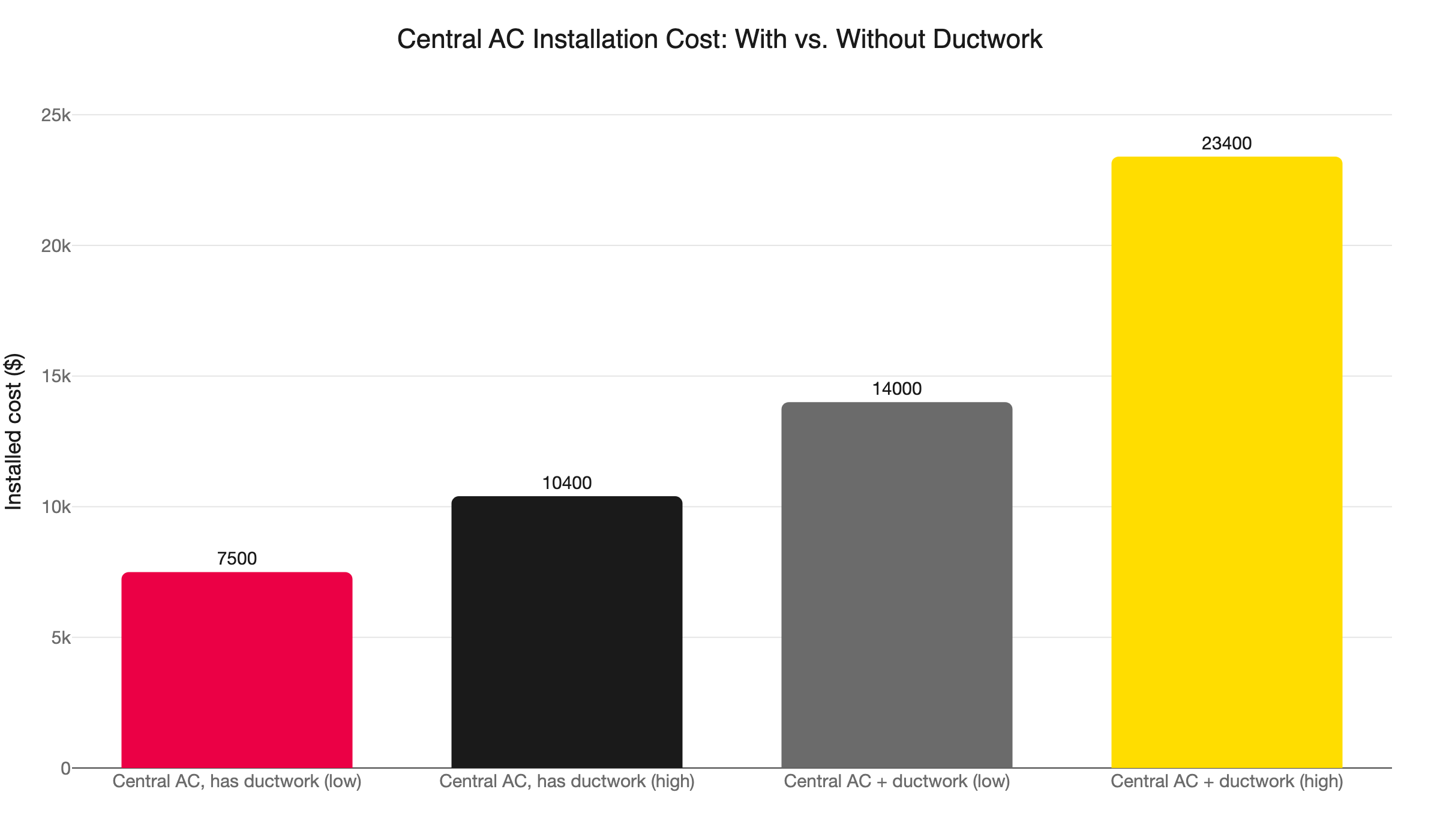
For a home with existing ductwork, expect $7,500 to $10,400 installed for a mid-tier central AC system. High-efficiency systems at 18 SEER2 or above run $11,000 to $15,600. Add $6,500 to $13,000 for full duct installation in a home with no existing ducts. The combined total for a no-ductwork home runs $14,000 to $23,400 or more.
Here is how the numbers break down by scenario:
Homes with existing, usable ductwork:
- Mid-tier central AC, installed: $7,500-$10,400
- High-efficiency (18 SEER2+), installed: $11,000-$15,600
- Duct sealing, if leaks are present: starting around $1,300
Homes with no existing ductwork:
- Mid-tier central AC, installed: $7,500-$10,400
- Full duct installation: $6,500-$13,000
- Combined project total: $14,000-$23,400+
These are installed prices for the Twin Cities, parts and labor included. They are not national averages. National figures blend Southern markets with lower labor rates and slab-foundation homes where duct runs are simpler than in a pre-war two-story with finished plaster walls.
A few additional costs to confirm before accepting any bid:
Electrical. Most central AC systems require a dedicated 240-volt circuit. If your panel lacks capacity or the circuit does not exist, that adds to the project cost.
Thermostat. Upgrading from a heating-only system may require a new thermostat wired for both heating and cooling.
Refrigerant line set. Adding AC to a forced-air system that never had it requires a new refrigerant line set from the air handler to the outdoor condenser. This is typically included in the installation cost, but confirm it in writing.
Financing is available for qualifying projects. Ask when you call.
How Short Is the Twin Cities Cooling Season?
Minneapolis averages a July high of 82.5°F with a peak near 91°F. The meaningful cooling season is roughly 90 days, compared to 150 to 180 days in Atlanta or Dallas. Comfort and home value are the stronger ROI drivers in this market. Energy savings are real but take longer to pay back here than in the Sun Belt.
Minneapolis climate data confirms what most Twin Cities homeowners already know: our summers are warm and occasionally very hot, but also short. Annual snowfall averages 55 inches. This is not a climate where AC runs eight months a year.
That does not make central AC a bad investment. It does mean the payback math from a national article written for Phoenix homeowners does not apply here. If the numbers only work on energy savings, the timeline may not satisfy you.
The honest case for Twin Cities central AC rests on four things:
Comfort during peak heat. Minneapolis hit 91°F in July 2024. On those days, a properly sized central system is the difference between sleeping well and not sleeping at all.
Humidity management. Minnesota summers can be genuinely muggy. Central AC removes moisture from the whole home. Window units handle only the room they occupy.
Home value. Buyers in the Twin Cities market expect central air. Window units read as a workaround, not a feature.
Health and air quality. A central system filters and circulates air across the whole home. That matters during pollen season and on high smoke-and-pollution days.
What Federal Tax Credits Apply to Central Air Conditioning?
A qualifying central AC system earns a 30% federal tax credit, capped at $600 per year. To qualify in 2025, a split-system must meet SEER2 ≥ 17.0 and EER2 ≥ 12.0. The credit is nonrefundable and counts toward the $1,200 annual cap for home energy improvements. Equipment must carry a Qualified Manufacturer Identification Number starting in 2025.
The IRS Section 25C credit is real money, but the ceiling is modest. On a $9,000 installation, 30% would be $2,700. The credit stops at $600. If you also installed new windows or insulation in the same year, those share the same $1,200 annual cap. Full qualifying thresholds are listed on the ENERGY STAR central AC tax credits page.
Here is where ductless mini-splits change the equation. Air source heat pumps qualify for a separate $2,000 annual credit under the ENERGY STAR air source heat pump program. That credit has its own $2,000 annual limit, separate from the $1,200 cap. The difference between $600 and $2,000 is $1,400 per year.
For a homeowner without existing ductwork who is already facing $6,500 to $13,000 in duct installation costs, that $1,400 incentive gap adds meaningful weight to the comparison.
Utility rebates stack on top of the federal credit. Both Xcel Energy and CenterPoint Energy offer rebates on qualifying cooling equipment. Check current offerings at the ENERGY STAR rebate finder using your Minnesota zip code. Our guide on Minnesota heat pump rebates and tax credits covers how to layer federal credits and utility rebates on a single project.
Should You Consider a Ductless Mini-Split Instead?
For homes without existing ductwork, a ductless mini-split is worth serious consideration. It eliminates the ductwork cost entirely. It qualifies for up to a $2,000 federal tax credit versus $600 for central AC. And it works as a heat source during Minnesota winters, which improves the total payback picture compared to a cooling-only system.
A ductless mini-split uses an outdoor compressor unit connected to one or more wall-mounted indoor air handlers. No duct runs. No soffits. No sheet metal routing through finished plaster walls. Installation is less invasive in older homes precisely because there is no forced-air infrastructure to tie into.
Modern cold-climate heat pumps operate efficiently well below 0°F. This is no longer a technology that struggles with Minnesota winters. Our guide to ductless mini-splits in older Twin Cities homes covers how to think about coverage, zone counts, and sizing for pre-war and post-war housing types.
For a home replacing two to four window units, a multi-zone mini-split often covers the same square footage. It manages humidity, runs quietly, and filters air. Because it also handles heating, the comparison shifts from “cooling system only” to “year-round comfort system.”
The comparison for a no-ductwork home:
- Central AC plus full duct installation: $14,000 to $23,400+, federal credit up to $600
- Ductless mini-split: installed cost varies by zone count; federal credit up to $2,000
We install both. If you want to compare them side by side before deciding, we will do that on the same visit.
Permits and Contractors: What Minnesota Requires
Minnesota requires a mechanical permit for any HVAC installation. The 2020 Minnesota State Building Code governs HVAC work statewide. This applies to central AC, ductless mini-splits, and full duct installation alike.
A permit is not a formality. It triggers an inspection confirming the installation meets code. Without it, the manufacturer warranty may be void. Homeowner insurance claims related to an unpermitted installation can be denied. When you sell the home, unpermitted mechanical work can surface during the buyer’s inspection and complicate the sale.
Any contractor you hire should pull the permit as part of the job scope. If a bid omits it or leaves the answer unclear, ask directly before signing anything.
Our team is licensed in Minnesota, based in Ramsey, and serves Minneapolis, St. Paul, Blaine, Maple Grove, Plymouth, Brooklyn Park, Woodbury, and Bloomington. We back every installation with a 100% satisfaction guarantee. “Always On Time… Or You Don’t Pay a Dime!(R)” is how we show up on every job, start to finish.
Ready to Replace Your Window Air Conditioners with Central AC?
Replacing window air conditioners with central AC in the Twin Cities is a real investment. The right call depends on your home’s existing infrastructure, your cooling goals, and your timeline. Some homes are strong candidates for central air. Others are better served by ductless. A few need a site assessment before the answer is clear.
Our team works across the metro every summer. We will check your home, measure the load, and give you honest pricing on both options before you make any decision.
Call us at (763) 260-6662 or schedule your appointment online. We show up when we say we will. That is the promise.
Frequently Asked Questions
How much does it cost to add central AC to a Twin Cities home with no ductwork? +
Is a ductless mini-split cheaper than central AC for a Twin Cities home with no ductwork? +
Does Minnesota require a permit to install central air conditioning? +
Need a technician now?