
Ductless Mini Splits for Older Homes: A Twin Cities Guide
Key Takeaways
- A ductless mini split is a two-part heat pump: one outdoor compressor and one or more indoor air handlers. No ductwork needed.
- Cold-climate certified models operate down to -13°F and hold full heating capacity at 5°F. Standard models do not meet that bar.
- Older home install obstacles include limited electrical panel capacity, line-set routing through plaster walls, and snow-aware outdoor unit placement.
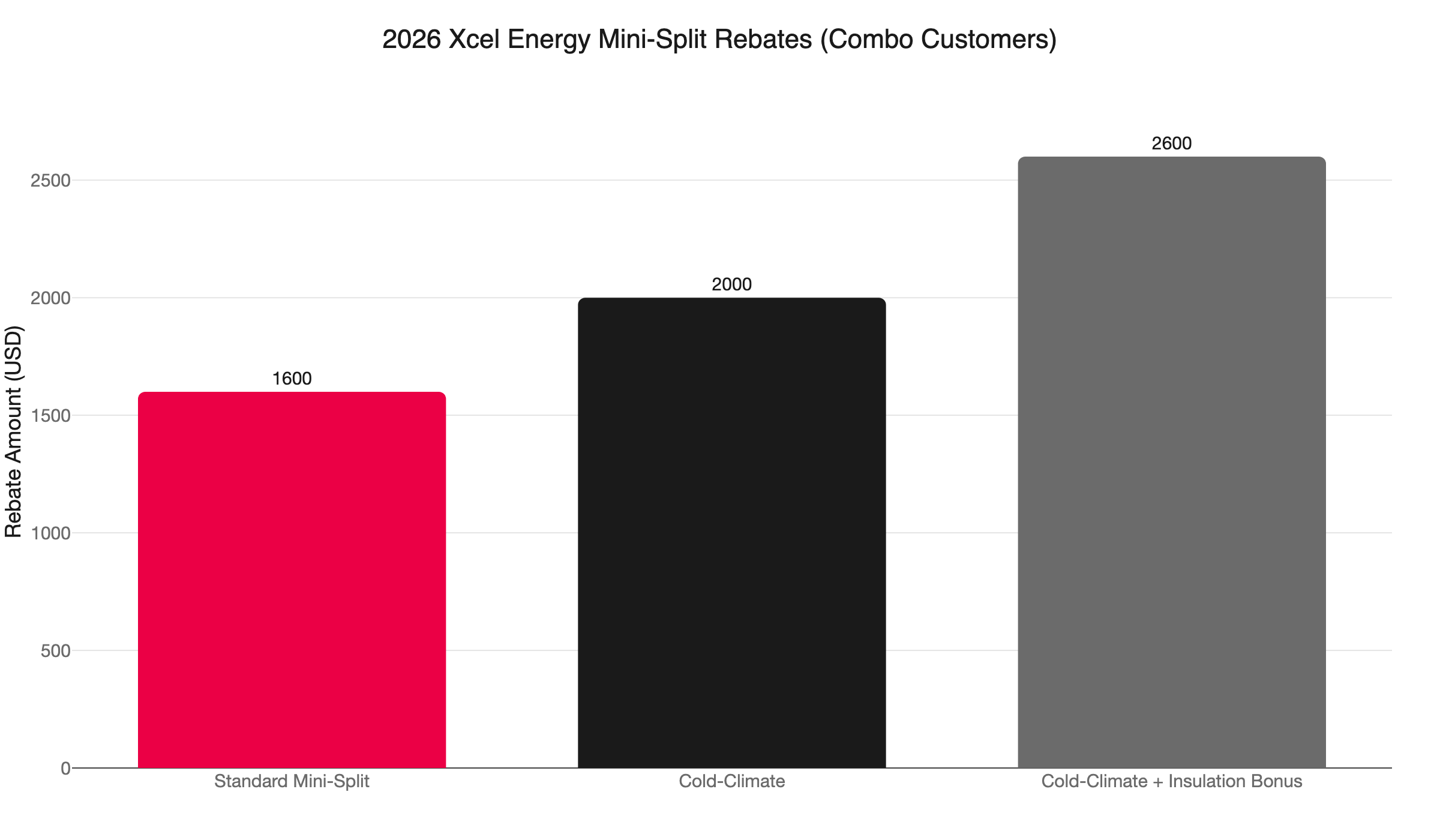
- Xcel Energy’s 2026 cold-climate rebate is $2,000 for combo gas+electric customers, rising to $2,600 with the insulation bonus.
- Minneapolis homeowners can stack the Minneapolis Green Cost Share on top of Xcel rebates: up to $14,000 in a designated Green Zone.
- The federal 25C heat pump tax credit expired December 31, 2025. Minnesota’s Save Energy MN rebate has not launched as of July 2026.
- Mechanical and electrical permits are required in virtually all Minnesota municipalities.
What Is a Ductless Mini Split, and How Does It Work?
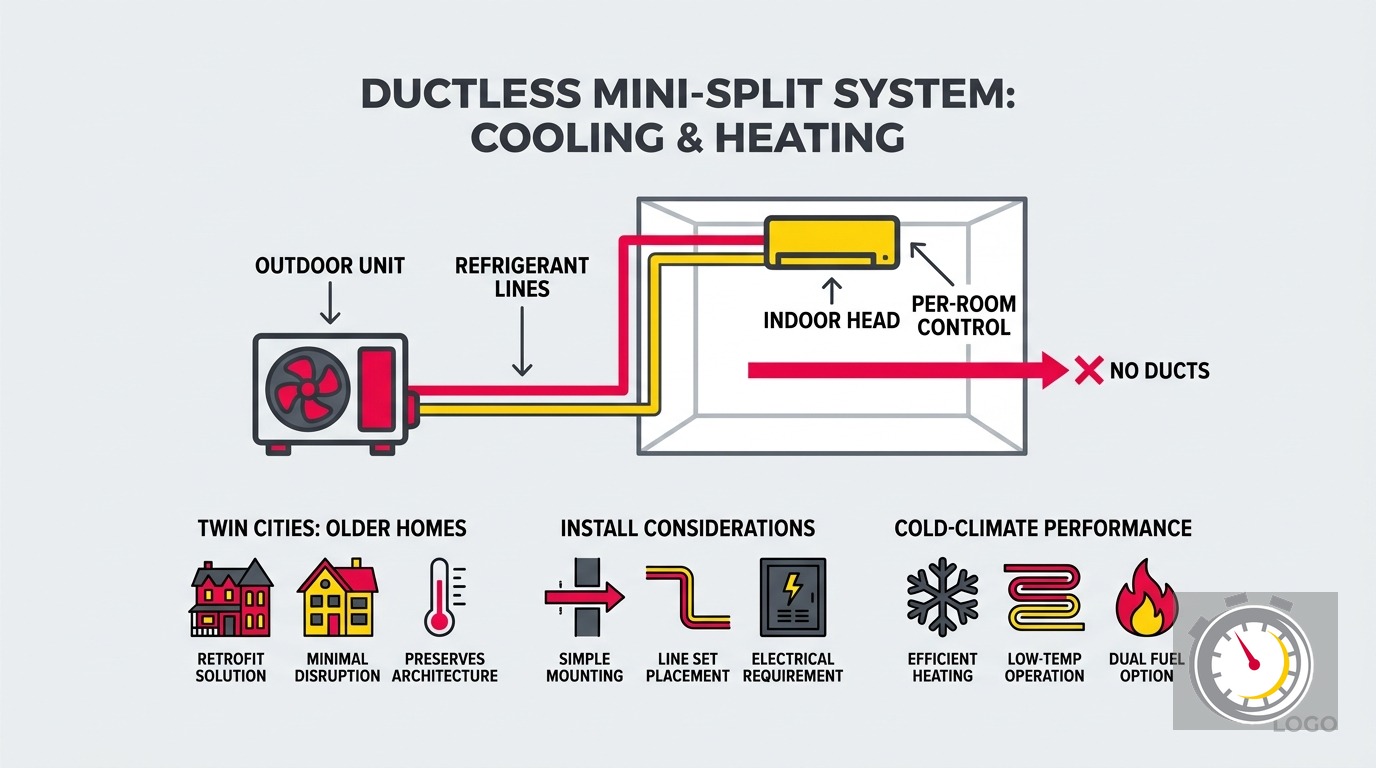
Short answer: A ductless mini split is a heat pump with two parts: an outdoor compressor and one or more indoor air handlers. A compact bundle of refrigerant tubing, a power cable, and a condensate drain connects them through roughly a 3-inch hole in the wall. No ductwork required.
In cooling mode, the system pulls heat from inside your home and releases it outside. In heating mode, the process reverses. It extracts heat from outdoor air and moves it inside. This is the core difference between a heat pump and a furnace: a heat pump moves existing heat rather than generating new heat by burning fuel.
Even cold outdoor air holds energy. A well-designed cold-climate heat pump extracts that energy at temperatures well below freezing. The qualifier “well-designed” matters more in Minnesota than in most states.
One outdoor compressor can support up to four indoor air handlers. Each handler has its own thermostat and independent temperature control. The second-floor bedroom runs at 68°F. The living room holds at 72°F. Each zone responds only to its own settings.
The indoor unit mounts high on a wall. The refrigerant line exits through the wall and runs to the outdoor compressor on a pad or elevated brackets outside. The wall penetration is small, roughly the size of a standard dryer vent outlet.
For a broader look at heat pumps in the Twin Cities climate, see our heat pump services page.
Why Are Ductless Mini Splits a Good Fit for an Older Home?
Short answer: Older homes were built without forced-air ductwork. Adding it later means opening ceilings, running metal trunk lines through finished spaces, and losing usable square footage. A mini split avoids all of that. The trade-off is a wall-mounted indoor unit and a refrigerant line through one exterior wall.
The efficiency case strengthens in an older home. The U.S. Department of Energy estimates that duct losses account for more than 30% of space-conditioning energy in many homes, especially when retrofit ductwork runs through unconditioned attics or crawl spaces. Older homes often have exactly that problem. A ductless system sidesteps it entirely. There is no attic trunk, no leaky plenum, no supply boot to lose air from.
Pre-war Twin Cities homes tend to share several traits that make a mini split particularly practical:
- Plaster-and-lathe walls with no insulation cavities large enough for ductwork
- Finished third floors or converted attics outside the reach of any existing system
- Steam or hot-water radiators that handle heat reasonably well but leave cooling entirely to window units
- Open floor plans with tall ceilings that a single window unit cools unevenly
A mini split solves the cooling problem in all four cases. A cold-climate model solves the heating problem too.
For more on how older construction creates year-round comfort challenges, see our post on why older Twin Cities homes struggle more with winter comfort.
The Standard vs. Cold-Climate Distinction: What It Means for a Ductless Mini Split in an Older Home
This is where low bids create real problems. Not all mini splits perform equally in a Minnesota winter. A standard mini split can cool your house in summer and provide useful heat down to about 10-15°F. Below that, heating output drops sharply. Below zero, many standard units lock out entirely.
ENERGY STAR’s Cold Climate designation sets a specific performance bar. A qualifying unit must:
- Maintain a COP (coefficient of performance) of at least 1.75 at 5°F
- Retain at least 70% of its rated heating capacity at 5°F versus its rated capacity at 47°F
- For non-ducted (ductless) systems: reach HSPF2 of 8.5 or higher and SEER2 of 15.2 or higher
To appear on the NEEP Cold Climate ASHP Product List and qualify for Xcel Energy’s top rebate tier, a unit must also meet a COP of at least 1.7 at 5°F. A unit not on the NEEP list gets a lower rebate and may not deliver adequate heat on the coldest Minnesota days.
Some current cold-climate models go further. Certain Mitsubishi Hyper-Heat units deliver 100% of their rated capacity at 5°F and operate down to -13°F. The Minneapolis-St. Paul 99% design temperature is around -12°F. A backup heat source is still smart for those extreme hours. But the performance gap between a standard and a cold-climate unit shows most clearly in the 0°F to 10°F range - a temperature window Twin Cities winters hit for weeks at a time.
If a quote comes in noticeably cheaper than others, look at the spec sheet. Ask whether the unit carries ENERGY STAR Cold Climate certification. Ask whether it appears on the NEEP list. If the answer to either question is no, ask why.
What Does Installing a Ductless Mini Split in an Older Home Actually Involve?
Short answer: Three obstacles come up consistently in older Twin Cities homes: limited electrical panel capacity, line-set routing through plaster-and-lathe walls, and outdoor unit placement relative to snow accumulation. None are deal-breakers, but each affects cost and timeline. A complete quote addresses all three.
Electrical panel capacity
A single-zone mini split typically requires a dedicated 15-30A circuit at 208-240V. Many older Minneapolis and St. Paul homes were wired for 100-amp service. Those panels often have limited open slots. Homes that have added kitchen circuits, garage outlets, or EV chargers over the years may already be at capacity.
An electrician should assess panel capacity before the install begins. If the panel cannot support a new dedicated circuit, a subpanel or full panel upgrade adds cost and lead time. Budget for it upfront. A quote that does not address electrical is an incomplete quote.
Line-set routing
The refrigerant line bundle - power cable, refrigerant tubing, suction tubing, and condensate drain - passes through roughly a 3-inch penetration in the building envelope. From there, it runs from the indoor unit to the outdoor compressor.
In older homes, two routing approaches are common. Interior runs look cleanest but require opening plaster walls, chasing lines through framing cavities, and patching plaster at finish. Exterior raceways mount the line set along the outside of the house in a surface cover. They are visible from outside but avoid touching plaster entirely. Most installers in older Twin Cities homes use exterior raceways by default. If you want an interior run, say so early so the contractor can plan the plaster work and price it accurately.
Outdoor unit placement
The outdoor compressor needs to stay clear of snow accumulation. In Minnesota, that means elevated mounting brackets or a pad positioned away from roof drip edges and prevailing drift paths. The unit needs clearance on all sides for airflow and enough space for a technician to reach it in January. Avoid placing it directly under a roof valley or below a low deck where ice can fall onto the cabinet.
One room or whole house?
A single-zone system is the right fit for a problem room: a finished attic, a room addition, a sunroom, or a garage the main system does not reach. For whole-home replacement of window units and electric space heaters, a multi-zone system with two to four indoor units on one outdoor compressor gives better efficiency. Each zone still operates independently.
What Rebates Are Available for Mini Splits in the Twin Cities Right Now?
Short answer: Xcel Energy’s 2026 cold-climate rebate is $2,000 for combo customers, rising to $2,600 with the insulation bonus. Minneapolis homeowners can stack the Green Cost Share on top, up to $14,000 in a Green Zone. The federal 25C credit expired and the state HEAR rebate has not launched.
Xcel Energy (2026)
For gas-and-electric Xcel customers, the current rebate structure breaks down like this:
- Cold-climate mini split (ENERGY STAR Cold Climate certified): $2,000
- Standard mini split: $1,600
- Insulation or air-sealing bonus (within two years of the heat pump install): +$600
The insulation bonus brings a cold-climate system to $2,600 for qualifying combo customers. Electric-only Xcel customers receive $1,500 for a qualifying cold-climate system. There is no participating-contractor requirement for mini-splits. Any licensed installer qualifies.
Full rebate details are in Xcel’s MN residential rebate summary.
CenterPoint Energy
CenterPoint’s heat pump rebate is $1,100, but it applies only to ducted dual-fuel systems paired with a 92%+ AFUE gas furnace that locks to gas at or below 40°F. CenterPoint does not rebate standalone ductless mini-splits. If you are a CenterPoint-only customer, a utility rebate for a mini-split is not available at this time.
Minneapolis Green Cost Share
Minneapolis homeowners may qualify for the Minneapolis Green Cost Share program, which stacks directly on top of a utility rebate:
- Properties in a designated Green Zone: up to $14,000
- Properties outside a Green Zone: up to $5,000
Your property must be a 1-4 unit residential building in Minneapolis. You need a qualifying Xcel or CenterPoint rebate to apply first. The Minnesota Center for Energy and Environment administers the program. Check whether your address falls inside a Green Zone before finalizing your project budget.
What is no longer available in 2026
The IRS Section 25C heat pump tax credit under the Inflation Reduction Act expired December 31, 2025. No federal credit applies to work done in 2026.
The Minnesota Save Energy MN program - which would have included a $4,000 state heat pump rebate and HEAR income-based rebates - has not launched as of July 2026 and has no announced start date. Federal rules prohibit retroactive rebates. Income-qualifying households below 150% of area median income should watch mn.gov/commerce for updates.
For a broader look at incentives, see our Minnesota heat pump rebates and tax credits guide.
Can a Ductless Mini Split Actually Heat a Minnesota Home Through Winter?
Short answer: A cold-climate certified mini split can carry primary heating duty for most of a Minnesota winter. You still need backup heat for the coldest nights near -12°F. A standard mini split should not be your primary heat source in the Twin Cities.
The key number is heating capacity at low temperature. An ENERGY STAR Cold Climate unit must retain at least 70% of its rated BTU output at 5°F. A system rated at 18,000 BTU at 47°F must still deliver at least 12,600 BTU when it is 5°F outside. For a well-insulated room or zone in an older home, that output holds the space comfortably through most of the winter.
The 99% design temperature for Minneapolis-St. Paul is around -12°F. That threshold represents roughly the coldest 87 hours the region sees each year. At those extremes, even a strong cold-climate unit runs at reduced capacity. An electric resistance heat strip (built into most units as emergency backup) or a gas furnace covers those hours.
Three configurations are common in older Twin Cities homes:
Supplemental only. The existing boiler or furnace covers the main house. The mini split handles a finished attic or room addition the main system does not reach. No backup heat concern for those spaces.
Primary heat with electric backup. A cold-climate mini split handles the house. The built-in resistance strip takes over for the coldest hours. This works best in a smaller, well-insulated older home.
Hybrid (mini split plus gas furnace). The mini split runs most of the heating season. The gas furnace takes over below a set switchover point, often between 10°F and 20°F. This is the most common path in older Minneapolis homes where owners want to cut gas use without eliminating backup heat entirely.
Do You Need a Permit to Install a Mini Split in Minnesota?
Short answer: Yes, in almost every case. Minnesota requires a mechanical permit for mini-split installation in virtually all municipalities. A separate electrical permit is needed when a new dedicated circuit is added, which is the typical situation in an older home.
Permit fees typically run $100-$300. Plan review takes one to three weeks, depending on the city. In St. Paul, the owner-occupant of a single-family home may pull their own mechanical permit, but must perform all the work themselves. In practice, most homeowners hire a licensed contractor who pulls permits as part of the project.
Skipping permits creates real downstream problems: resale complications, voided manufacturer warranties, and loss of Xcel rebate eligibility. Before work begins, ask your contractor which permits they will pull and when they plan to submit applications.
Ready to Stop Using Window Units?
A ductless mini split for an older home is one of the most practical HVAC upgrades available to Twin Cities homeowners. Zoned comfort without tearing into walls. Year-round heating and cooling from one system. Real rebate money in 2026 to offset the upfront cost.
Our team is locally owned and operated in Ramsey, MN. We size mini-split systems for Minnesota winters, handle permits, and show up when we say we will. “Always On Time… Or You Don’t Pay a Dime!(R)”
Call (763) 260-6662 or book through our ductless mini-split installation page. Financing is available for qualifying systems. Ask about it when you call.
Frequently Asked Questions
Will a cold-climate mini split work through a Minnesota winter? +
What is the difference between a standard and a cold-climate mini split? +
How much is the Xcel Energy mini-split rebate in 2026? +
Do I need a permit to install a mini split in Minnesota? +
Need a technician now?