
Mini Split Installation Cost Minnesota: Real 2026 Pricing
Key Takeaways
- A single-zone mini split in the Twin Cities costs $2,500 to $5,550 installed before any rebates.
- After Xcel’s cold-climate rebate ($2,000), net out-of-pocket on a qualifying single-zone install drops to roughly $1,250 to $3,250.
- The Section 25C federal tax credit expired December 31, 2025. It is not available for 2026 installs.
- Xcel’s rebate tops out at $2,600 when you stack the cold-climate tier with the insulation and air sealing bonus.
- Save Energy Minnesota (the HEAR and HOMES programs) has not launched as of August 2026. No timeline has been announced.
- CenterPoint does not rebate standalone mini splits. Their program covers ducted hybrid dual-fuel systems only.
- Minneapolis-St. Paul’s 99% design temperature is -12°F. Cold-climate equipment spec is not optional here.
- Minnesota requires a mechanical permit for all HVAC work. Permits typically run $150 to $500 depending on municipality.
Mini split installation cost in Minnesota varies by zone count, equipment tier, and how much you can recover through Xcel Energy’s rebate program. This guide runs the real numbers: Twin Cities labor rates, current rebates, permit costs, and what you will actually write a check for after applying everything available in 2026.
What Does Mini Split Installation Cost in Minnesota?
In short: A single-zone mini split runs $2,500 to $5,550 installed in the Twin Cities. Labor is $70 to $150 per hour. After Xcel’s cold-climate rebate, most homeowners net $1,250 to $3,250 out of pocket.
According to Angi’s Minneapolis cost data, the average installed cost for a single-zone system in Minneapolis runs about $3,500. The full range is $2,096 to $5,240. Twin Cities labor sits at the high end nationally: $70 to $150 per hour for a licensed Minnesota HVAC contractor.
The wide range comes from two main factors. First, equipment quality and capacity vary significantly. A basic 12,000 BTU unit costs far less than a variable-capacity cold-climate model built to run at -13°F. Second, installation complexity varies by home. Older Twin Cities homes with plaster walls, tight attic access, or long refrigerant line runs cost more to wire and route than newer open-concept builds.
Most national cost guides stop there. They hand you a price range and move on. What they miss is the rebate math. Once you subtract Xcel’s rebate from the gross price, the number looks very different. We will do that math below.
Single-Zone vs. Multi-Zone: What Are the Price Differences?
In short: A single-zone system runs $2,500 to $6,000 installed. Two zones cost $6,500 to $9,000. Three to four zones range from $9,000 to $15,000 or more. Each zone adds equipment and labor cost, but all zones share one outdoor unit.
HomeGuide documents the zone-count cost ladder at these ranges:
- 1 zone: $2,500 to $6,000 installed
- 2 zones: $6,500 to $9,000 installed
- 3 to 4 zones: $9,000 to $15,000+ installed
These are national baselines. Twin Cities labor rates push quotes toward the high end of each range.
Installation time scales with zone count. A single-zone job takes four to eight hours. A three-zone system runs eight to twelve hours. A five-zone whole-home install can stretch to two full days.
Each indoor head requires its own refrigerant line set run through the wall or ceiling. Complex routing through finished spaces, long line runs, or tight attic access adds hours and cost. Get a written quote after a walkthrough before you commit.
What Pushes the Quote Higher?
In short: Zone count, equipment tier, and installation complexity are the three biggest drivers. Cold-climate models cost more upfront but earn Xcel’s larger rebate. Older home construction and difficult refrigerant line routing add labor hours.
Factors that push a quote toward the top of its range:
- More indoor zones. Each head adds $1,300 to $3,900 in equipment plus labor.
- Cold-climate equipment. Variable-capacity models with higher HSPF2 ratings cost more than standard units. They also qualify for Xcel’s $2,000 rebate instead of $1,600.
- Refrigerant line routing. Long runs, tight spaces, finished walls, and attic routing all add time.
- Electrical work. Each outdoor unit needs a dedicated circuit. Some homes need a panel upgrade.
- Capacity and brand. A 9,000 BTU single-zone unit costs less than a 24,000 BTU cold-climate model.
Filterbuy notes that single-zone mini splits commonly reach SEER2 20 or higher. Multi-zone heads on the same outdoor unit average SEER2 17 to 18. The shared compressor cycles differently across zones, which costs some efficiency.
Why Does Minnesota’s -12°F Design Temperature Change What Mini Split You Need?
In short: Minneapolis-St. Paul’s 99% design temperature is -12°F. A standard mini split loses capacity sharply below 17°F. A cold-climate unit rated to -13°F keeps heating when it matters most. The wrong spec means no reliable heat on your coldest nights.
Minnesota sits in Climate Zone 6A, classified as cold and moist. MSP’s 99% design temperature is -12°F. Duluth reaches -21°F. These are not edge cases. They describe the real operating conditions your equipment must handle all winter long.
Cold-climate air-source heat pumps (ccASHPs) are designed to operate at or below -13°F (-25°C). The DOE Cold Climate Heat Pump Challenge set -13°F as the qualifying threshold. Participating manufacturers include Bosch, Carrier, Daikin, Johnson Controls, Lennox, Midea, Rheem, and Trane.
This matters for your rebate, too. Xcel draws a direct line between cold-climate certification and the size of your check. A unit on the NEEP cold-climate product list with a coefficient of performance (COP) of at least 1.75 at 5°F qualifies for Xcel’s $2,000 rebate. A standard unit qualifies for $1,600. That $400 gap is real money.
The NEEP check takes two minutes. Go to ashp.neep.org and look up the model before you buy. If it is not on the list, it does not qualify for the cold-climate rebate tier, regardless of what the spec sheet says.
What Rebates Can You Actually Use for a 2026 Mini Split Install?
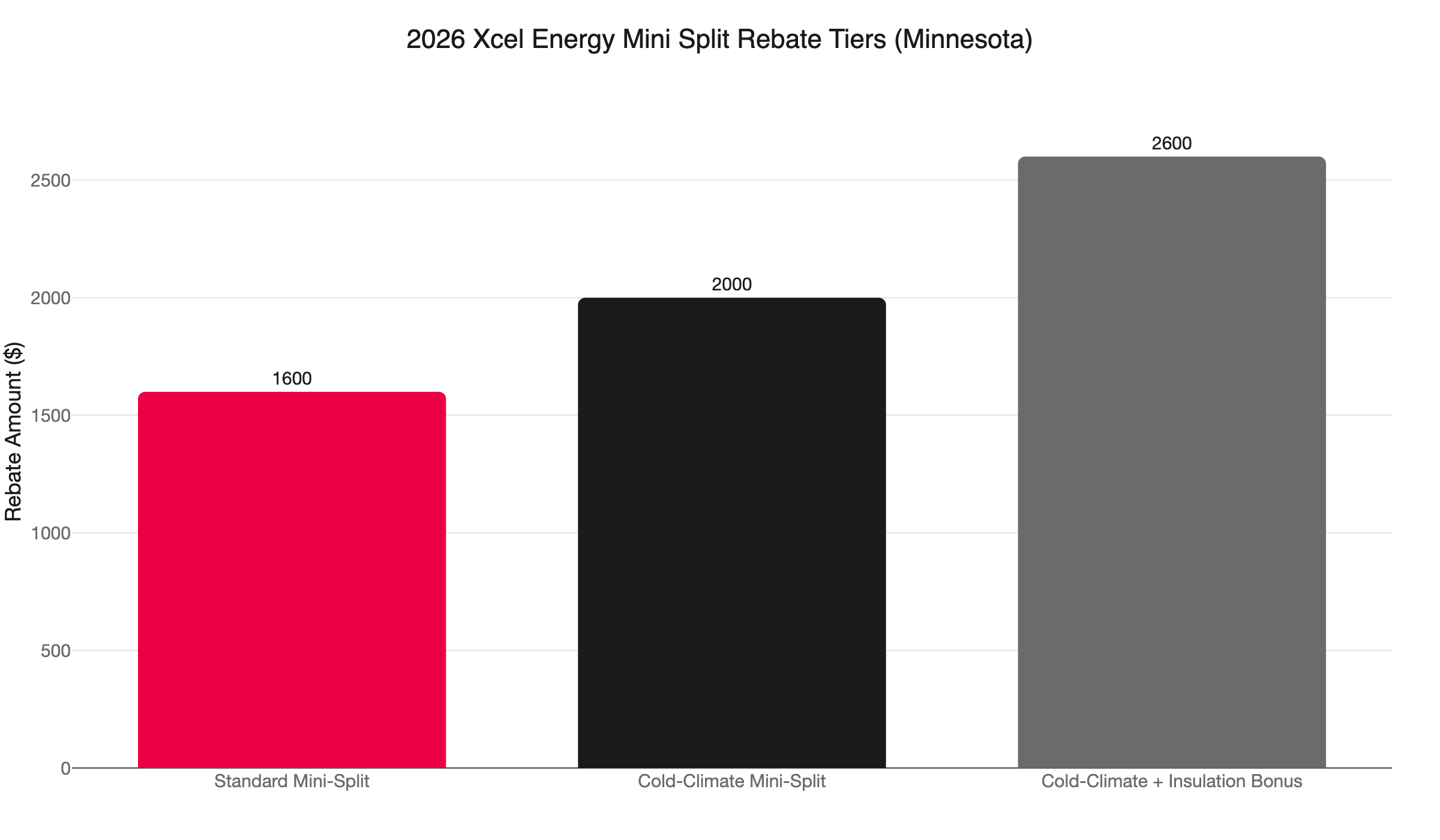
In short: Xcel Energy is your real rebate tool right now. Standard units qualify for $1,600. Cold-climate units on the NEEP list qualify for $2,000. Stack an insulation and air sealing bonus for up to $2,600 total. CenterPoint does not rebate standalone mini splits.
Here is the accurate 2026 rebate picture:
Xcel Energy (active now):
- Standard mini split (min 15.2 SEER2 / 9.3 EER2 / 8.5 HSPF2): $1,600
- Cold-climate mini split (min 16.0 SEER2 / 9.0 EER2 / 9.5 HSPF2, COP at or above 1.75 at 5°F, on NEEP list): $2,000
- Insulation and air sealing bonus (qualifying work within two years before the heat pump install): $600
- Maximum stacked Xcel rebate: $2,600
- Mini split rebates do not require a participating contractor.
- The program is active for 2026 installs. Applications for qualifying 2025 installs close September 30, 2026.
CenterPoint Energy: CenterPoint does not rebate standalone mini splits. Their program covers ducted heat pumps in a hybrid dual-fuel configuration only: a heat pump paired with a 92%-AFUE or better gas furnace, with a switchover temperature at or below 40°F. If your project involves pairing a mini split with a qualifying gas furnace, ask your contractor whether a hybrid setup applies. For a standalone ductless install, CenterPoint is not a factor.
Minnesota Power: A $1,000 cold-climate heat pump rebate is available for Minnesota Power electric customers in northern Minnesota. This does not apply to Twin Cities homeowners on Xcel.
For a full breakdown of every current Minnesota heat pump rebate, see our post on Minnesota heat pump rebates and tax credits.
Is the Federal 25C Tax Credit Still Available in 2026?
In short: No. The Section 25C heat pump tax credit, up to $2,000, expired December 31, 2025. Any article or contractor quote referencing a federal tax credit for a 2026 install is wrong. Budget without it.
This is where several national cost guides are actively misleading homeowners. The 25C credit was valuable: up to $2,000 back on your federal return for a qualifying heat pump. Congress did not extend it past 2025.
If you are planning a 2026 install, the 25C credit does not exist for your project. Factor it out of your budget entirely.
What About Save Energy Minnesota Rebates?
In short: Save Energy Minnesota has not launched as of August 2026. The state is waiting on DOE approval, with no estimated launch date. The up-to-$8,000 HEAR rebate exists in concept, but it is not available to Minnesota homeowners today.
You may have read about Inflation Reduction Act rebates offering up to $8,000 for heat pumps through the HOMES and HEAR programs. Those programs exist at the federal level. Minnesota’s version, Save Energy Minnesota, has not launched. The DOE required Minnesota to update its program documents, and no approval has been granted as of August 2026. No launch date has been announced.
When Save Energy Minnesota does launch, HEAR rebates will be income-tested:
- Below 80% of area median income (AMI): up to $8,000
- Between 80% and 150% AMI: up to $4,000
- Above 150% AMI: not eligible
Do not delay a purchase waiting for this program. Xcel’s program is live, has a clear rebate structure, and should be your planning baseline now.
How Much Does an HVAC Permit Cost in Minnesota?
In short: Mechanical permits for mini split installation run $150 to $500 in Minnesota, depending on the municipality. Minneapolis typically lands at $250 to $500. Electrical permits are separate and required for the outdoor unit’s dedicated circuit.
Minnesota requires a mechanical permit for all HVAC work. In Minneapolis, mechanical and electrical permits are separate processes. The mechanical permit goes through the city; the electrical permit goes through the Minnesota Department of Labor and Industry.
Budget $150 to $500 for the mechanical permit. Minneapolis typically sits toward the higher end of that range. Confirm the permit cost with your contractor before signing any agreement, and verify that they hold a valid Minnesota mechanical contractor license. You can check at dli.mn.gov.
Our post on when HVAC permits are required in Minnesota covers what to expect from start to sign-off.
Your Mini Split Installation Cost in Minnesota After Rebates
This is the math every competitor skips. Here is what you actually write a check for after you apply current rebates.
Single-zone cold-climate system, Twin Cities:
- Gross installed cost: $3,500 to $5,550
- Xcel cold-climate rebate: -$2,000
- Insulation and air sealing bonus (if applicable): -$600
- Permit (estimated): +$350
- Net out-of-pocket: approximately $1,250 to $3,300
Two-zone system, Twin Cities:
- Gross installed cost: $6,500 to $9,000
- Xcel cold-climate rebate: -$2,000 (one outdoor unit = one rebate)
- Net out-of-pocket: approximately $4,500 to $7,000
Three to four-zone system, Twin Cities:
- Gross installed cost: $9,000 to $15,000+
- Xcel cold-climate rebate: -$2,000
- Net out-of-pocket: approximately $7,000 to $13,000+
Three things to notice in these numbers.
First, Xcel’s rebate is per outdoor unit, not per indoor head. Adding zones increases gross cost without adding a second rebate. The rebate delivers the most relative impact on a single-zone install.
Second, the insulation and air sealing bonus adds $600 only if qualifying work was done within two years before the heat pump install. If you have done recent weatherization, ask your contractor to document it. That $600 is worth capturing.
Third, CenterPoint’s program is not in this math because it does not apply to standalone mini splits. If your project involves pairing the system with a qualifying gas furnace in a hybrid dual-fuel configuration, ask your contractor directly whether that changes the CenterPoint picture.
What Happens When a Multi-Zone System Fails?
In short: In a multi-zone mini split, all indoor heads share one outdoor compressor. If that compressor fails, every zone loses heating and cooling simultaneously. Multiple single-zone systems cost more upfront but fail independently of each other.
This is a detail no national cost guide mentions. When you install a three-zone or four-zone mini split, you are buying one outdoor compressor that serves all indoor heads. A compressor failure takes down every zone at once. In a Minnesota winter at -12°F, that is not a minor inconvenience.
Multiple single-zone systems cost more to install. But a failure in one unit does not affect the others. That tradeoff is worth weighing before you commit to a multi-zone layout, especially in a whole-home or primary-heating application.
Filterbuy notes that single-zone mini splits commonly reach SEER2 20 or higher. Multi-zone heads on the same outdoor unit average SEER2 17 to 18. The shared compressor architecture trades some efficiency for the convenience of a single outdoor unit.
Why Installation Quality Determines Long-Term Performance
The cold-climate spec only works if the installation is done correctly. Refrigerant charge errors, improperly sized line sets, and unsealed wall penetrations all degrade efficiency and shorten equipment life. In a city that hits -12°F, those errors surface fast and cost more to correct than to prevent.
We are locally owned and operated in Ramsey, MN. Our licensed HVAC technicians install and service mini splits throughout the Twin Cities: Minneapolis, St. Paul, Blaine, Maple Grove, Plymouth, Brooklyn Park, Woodbury, Bloomington, and the surrounding communities. Every install is permitted and backed by a 100% satisfaction guarantee.
And when we say we will be there, we will be there: “Always On Time… Or You Don’t Pay a Dime!(R).”
If you are weighing whether a mini split is the right fit for your home, our post on ductless mini splits for older Twin Cities homes walks through when they outperform central systems and when they do not. Our ductless mini split installation page covers what to expect from the full process, start to finish.
Get a Quote on Mini Split Installation
Call us at (763) 260-6662 or book online to get a written mini split installation quote.
We will confirm which equipment qualifies for Xcel’s cold-climate rebate tier, walk you through the net-cost math for your home and zone count, and give you a price in writing before any work begins. No guesswork. No surprises.
On time, every time.
Frequently Asked Questions
How much does a single-zone mini split cost installed in Minnesota? +
Is the federal 25C heat pump tax credit still available in 2026? +
What Xcel Energy rebate can I get for a mini split in Minnesota? +
Does CenterPoint Energy rebate mini splits? +
Need a technician now?