
Ductless vs. Ducted Heat Pump Minnesota: Which Fits Your Home?
Key Takeaways
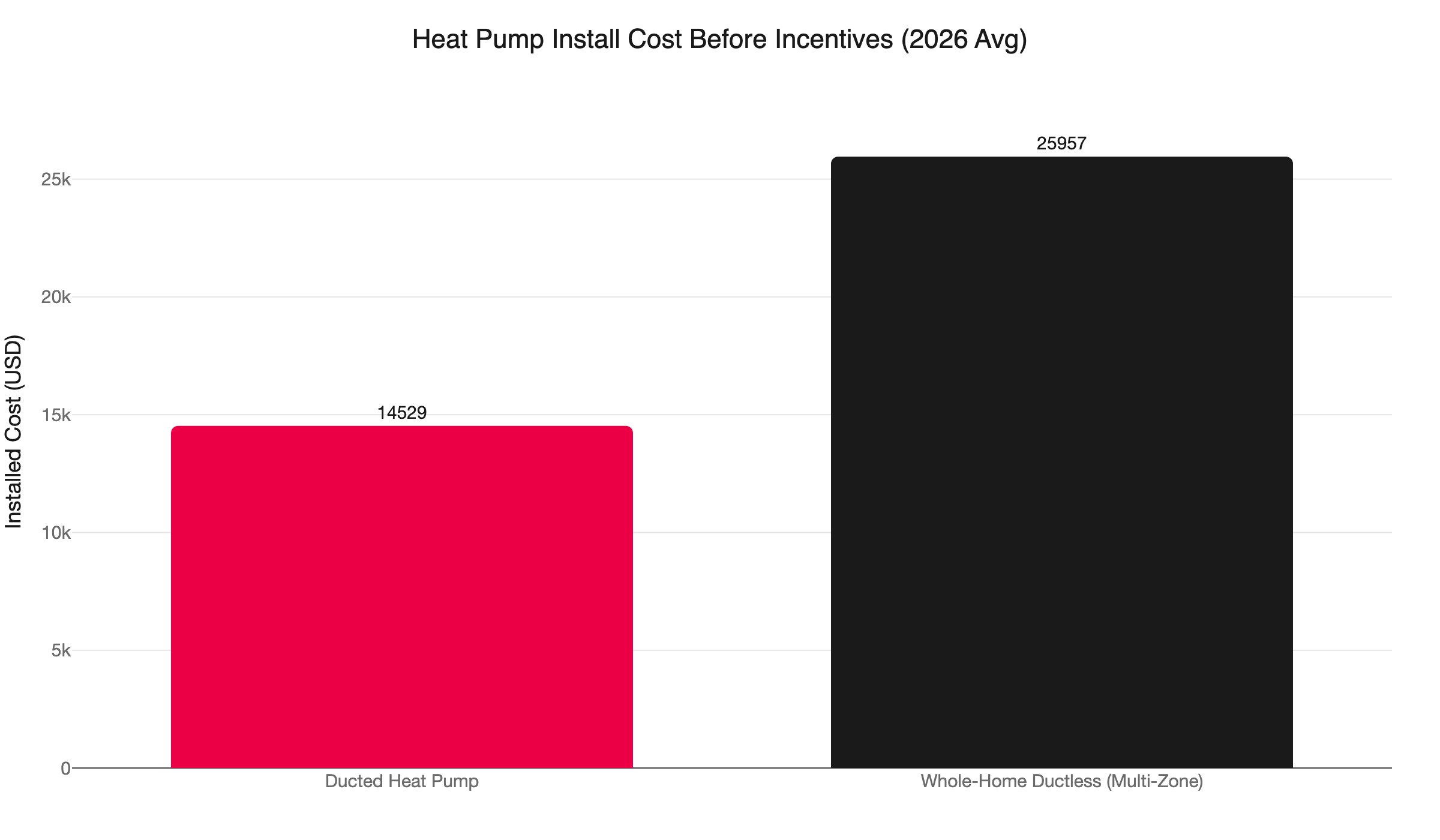
- Ducted heat pumps average $14,529 installed before incentives. Whole-home ductless multi-zone systems average $25,957. Adding new ductwork narrows the gap considerably for homes without existing duct infrastructure.
- Cold-climate heat pumps work in Minnesota winters. Certified systems maintain a COP of at least 1.75 at 5F. At -15F, they still outperform electric resistance heat by 30-80%.
- Xcel Energy offers $2,000 back on either system in 2026. CenterPoint’s $1,100 rebate applies only to ducted dual-fuel setups. Mini-splits do not qualify for CenterPoint’s rebate.
- The federal 25C tax credit expired December 31, 2025. There is no federal credit for 2026 heat pump installs.
- Your home’s existing ductwork and layout usually point to the right answer. A load calculation and duct assessment give you the data to decide.
- Both ducted and ductless systems require a mechanical permit in Minnesota.
The ductless vs. ducted heat pump Minnesota question comes up in nearly every heat pump conversation we have with Twin Cities homeowners. The answer affects install cost by as much as $11,000, determines which rebates you can collect, and shapes whether every room stays comfortable when it is -20F outside. This post covers the numbers, maps each system to the homes people actually live in here, and gives you a straight framework for making the call.
What Is the Difference Between a Ducted and a Ductless Heat Pump?
A ducted heat pump moves conditioned air through your home’s existing forced-air duct system. A ductless heat pump - also called a mini-split - delivers air directly through wall-mounted heads in each zone. Both heat and cool. Both run on electricity. The delivery method is what differs.
That difference has real consequences for cost, comfort, and how well the system performs in your specific home.
A ducted system pairs an outdoor unit with an air handler or furnace inside. The air handler pushes heated or cooled air through your supply and return ducts to every room. If your ductwork is in solid shape and well-sealed, this is usually the most cost-effective path for whole-home comfort. If your ducts are leaky, undersized, or missing in key areas, you lose conditioned air before it ever reaches the rooms that need it.
A ductless system pairs the outdoor unit with one or more wall-mounted indoor heads. Each head handles its own zone independently. You can heat the main bedroom without heating an empty guest room. That flexibility has real value in certain homes - but it comes at a price. Each additional indoor head adds approximately $8,000 to the installed cost, according to EnergySage’s 2026 marketplace data.
One note on terminology: “mini-split” and “ductless heat pump” mean the same thing. The “split” in the name refers to the split between the outdoor unit and the indoor heads, with no duct system connecting them. Both ducted and ductless systems use the same refrigerant-cycle technology. The distinction is in how they move air through your home.
How Much Does Each System Cost to Install in Minnesota?
Ducted heat pumps average $14,529 installed before incentives. Whole-home ductless multi-zone systems average $25,957. If your home needs all-new ductwork, that gap narrows: a full-home duct retrofit adds $2,600 to $13,000 or more to the ducted cost.
EnergySage’s 2026 marketplace data puts the national install averages at $14,529 for ducted and $25,957 for a whole-home multi-zone ductless system. These are averages with real variance based on home size, equipment tier, and number of zones. They give you the right order of magnitude, not a final quote for your specific home.
The ductwork variable is the biggest factor for homes built before the 1970s. Many ramblers, split-levels, and older two-story homes in the Twin Cities have duct systems with real problems: leaky joints, undersized returns, or uninsulated runs through cold crawlspaces. If your ductwork needs $8,000 in repairs and sealing before a heat pump can perform well in it, the cost gap between ducted and ductless compresses significantly.
Single-zone ductless is a different calculation entirely. One outdoor unit, one indoor head, one room or space. For a sunroom, a garage conversion, or an addition that was never connected to the main duct system, a single-zone unit is almost always the most cost-effective solution. You are solving a specific comfort problem in a specific space, not replacing whole-home heating and cooling.
Multi-zone ductless - one outdoor unit serving three or four indoor heads throughout the home - is the most expensive option upfront. It makes the most sense when the home has no existing duct infrastructure and installing new ductwork would require opening walls, ceilings, and finished spaces throughout the house.
Do Ductless Heat Pumps Work in Minnesota Winters?
Yes. Cold-climate certified heat pumps maintain a COP of at least 1.75 at 5F. At -15F, they still deliver 30-80% more heat per electricity dollar than electric resistance. Output does drop in extreme cold, which is why most Minnesota installs include a backup heat source.
NEEP’s cold-climate certification standard requires a minimum COP of 1.75 at 5F for a system to appear on the qualified product list. The field data behind that standard shows how these systems actually behave across a Minnesota winter.
Cold-climate field data from electrifyguide.com, citing NEEP and the Cold Climate Housing Research Center, shows real COP ranges at key outdoor temperatures:
- At 47F: COP 3.5-4.2
- At 17F: COP 2.2-2.8
- At 5F: COP 1.8-2.3
- At -15F: COP 1.3-1.8
A COP of 1.3-1.8 at -15F means the system is still generating more heat than it consumes in electricity, even on the coldest nights in the Twin Cities metro. Electric resistance heat sits at a flat COP of 1.0 at every temperature. The efficiency advantage holds all the way down.
Real-world confirmation comes from a Minnesota Department of Commerce-funded field study by MNCEE, which studied cold-climate heat pumps in six occupied Minnesota homes. Metro-area homes replacing a propane furnace with a ducted heat pump saw roughly 41% reductions in site energy use and roughly 30% reductions in energy cost. Homes replacing electric resistance heat with ductless systems saw roughly 56% reductions in both site energy and cost.
That said, heat pump output does fall at temperatures below -15F. For Minnesota, the practical approach is to include a backup heat source for the handful of nights per year that hit extreme cold. The dual-fuel ducted setup - heat pump runs down to around 40F, gas furnace handles below that - is popular here for good reason. It combines heat pump efficiency for most of the heating season with proven gas reliability on the coldest days.
See our post on heat pump performance below zero in Minnesota for a deeper look at the cold-weather data.
Which System Fits Your Twin Cities Home?
Your home’s existing ductwork is the clearest signal. Solid, well-sealed ducts point to a ducted system. Problem zones, missing duct runs, or no duct infrastructure at all point toward ductless or a hybrid of both. Home type is a useful starting framework.
No national content maps this choice to the specific housing stock of the Twin Cities metro. Here is how it breaks down for the homes people actually live in here.
1950s-1970s rambler with forced-air ducts
Single-story ramblers typically have simpler duct layouts that serve one level. If the ductwork is in reasonable shape, a ducted heat pump is usually the right call. The common caveat: many ramblers have duct runs in uninsulated crawlspaces. Those leaky ducts bleed conditioned air before it reaches the living space. Sealing them before adding a heat pump pays off twice: the heat pump works less hard, and more of the conditioned air reaches the rooms you use. Our post on duct sealing and energy loss covers what that process looks like.
Split-level
Split-levels are notoriously uneven. The main level usually gets adequate airflow. One of the other levels - often the lower level or the upper half-level - ends up with chronic comfort complaints year-round. A hybrid approach works well here: ducted system for the main level, one ductless head on the problem floor. You keep the cost efficiency of ducted coverage for most of the home while solving a comfort problem the duct system never handled well.
1.5-story craftsman or cape cod
The upper floor in these homes is the classic complaint. Duct runs to the knee-wall rooms are often undersized or nonexistent. A ductless head upstairs fixes a problem that has existed since the house was built. Pair it with the ducted system on the main level and you have a capable whole-home setup. We see this pattern regularly in older neighborhoods across Minneapolis, St. Paul, Ramsey, and the inner-ring suburbs.
Post-1990s two-story with good ductwork
If the ductwork was sized correctly when the home was built and has been maintained well, a ducted heat pump is the simplest and most cost-effective path. You replace the outdoor condenser and air handler. The duct infrastructure that already works stays in place. No additional indoor heads to manage, no extra wall penetrations, no added complexity.
Addition, sunroom, or garage conversion
Ductless is almost always the right answer here. Extending an existing duct run into a new addition is expensive and often impractical. A single-zone ductless unit covers the added space precisely and installs cleanly. Our ductless mini-split installation page walks through what that process looks like for a typical Twin Cities home.
What Rebates Are Available for Minnesota Heat Pumps in 2026?
Xcel Energy offers $2,000 for qualifying ducted or ductless heat pumps. CenterPoint’s $1,100 rebate is for ducted dual-fuel systems only - mini-splits do not qualify. The federal 25C tax credit expired December 31, 2025, and does not apply to 2026 installs.
This is the detail that catches the most homeowners off guard. Here are the specifics.
Xcel Energy (2026)
If you are an Xcel electric customer, the available rebates are:
- $2,000 for a cold-climate ducted ASHP (combo gas and electric customer)
- $1,500 for a cold-climate ducted ASHP (electric-only customer)
- $2,000 for a cold-climate ductless mini-split
- A $600 bonus when you also complete qualifying air sealing or insulation within two years, bringing the potential total to $2,600
The system must appear on NEEP’s qualified product list with a minimum COP of 1.7 to qualify for Xcel rebates.
CenterPoint Energy (2026)
CenterPoint’s $1,100 rebate applies only to ducted dual-fuel systems: an air-source heat pump paired with a 92%+ AFUE gas furnace, with a switchover point at 40F or lower. Ductless mini-splits do not qualify. Ground-source heat pumps do not qualify. Full-electric heat pump replacements do not qualify. New construction qualifies for only $400.
If you are a CenterPoint customer who was planning a ductless system and counting on a $1,100 rebate, that is the most important fact to confirm before signing a contract.
No federal tax credit in 2026
The Section 25C Energy Efficient Home Improvement Credit expired December 31, 2025. The One Big Beautiful Bill Act, signed July 4, 2025, ended the credit nine years ahead of schedule. No federal credit is available for heat pump installations in 2026.
Source: homeenergybasics.com/heat-pumps/states/mn
For homeowners on both Xcel and CenterPoint, a qualifying ducted dual-fuel system stacks the available rebates: $2,000 from Xcel plus $1,100 from CenterPoint, for a combined $3,100 offset against the $14,529 average install cost. That is a meaningful reduction. Our post on Minnesota heat pump rebates stays current with the incentive landscape if you want the full picture.
Do Both Systems Require Permits in Minnesota?
Yes. Both ducted and ductless heat pump installations require a mechanical permit in virtually all Minnesota jurisdictions. Ductwork modifications need a separate permit. Cold-climate installs may also trigger an energy code review.
Permits protect you. The installation gets inspected against Minnesota State Mechanical Code. An unpermitted heat pump installation creates problems at resale and with an insurance claim. Our licensed technicians pull all required permits as a standard part of every installation - you do not manage that separately.
Should You Go Ducted, Ductless, or a Hybrid?
For most Twin Cities homes with working forced-air ductwork, a ducted heat pump is the more cost-effective starting point. Ductless wins for spaces without duct access and for specific problem zones. The hybrid approach - ducted for the main system, ductless for the zones that need it - is underused and often the most practical fit for real Twin Cities homes.
The honest answer is that the right system depends on your home’s actual infrastructure and how you use the space. General rules only get you so far.
For a home with solid ductwork and no major comfort complaints, a ducted heat pump is the clear choice. You replace the outdoor unit and air handler. The duct system that already works stays in place. Whole-home heating and cooling through a single, central system, backed by years of cold-climate performance data.
For a home with a problem zone - the upstairs bedroom that never cools down, the addition the ducts do not reach, the bonus room above the garage that runs 10 degrees warmer than the main floor - a ductless head in that space solves the complaint without replacing the whole system. You add a zone where you need it.
For a home with no duct infrastructure, a multi-zone ductless system avoids the cost and disruption of running new ducts through finished walls and ceilings. More expensive upfront, but far less disruptive than a full duct retrofit in a home with plaster walls and finished spaces throughout.
The right answer starts with two things: a Manual J load calculation that sizes the system correctly to your home, and a duct assessment that tells you whether your existing ductwork is worth building on. Those two data points make the choice clear.
We are locally owned and operated, based in Ramsey and serving the Twin Cities metro: Minneapolis, St. Paul, Blaine, Maple Grove, Plymouth, Brooklyn Park, Woodbury, Bloomington, and the surrounding area. We give you a straight recommendation with honest, upfront pricing before any work begins.
Call us at (763) 260-6662 or book online to schedule your heat pump assessment. We show up when we say we will - “Always On Time… Or You Don’t Pay a Dime!(R)” - and financing is available for qualifying heat pump installations.
Frequently Asked Questions
Does a ductless heat pump work in Minnesota winters? +
Can I get a rebate for a ductless mini-split in Minnesota? +
Which is cheaper to install: ducted or ductless heat pump? +
Do I need a permit to install a heat pump in Minnesota? +
Need a technician now?