
Duct Sealing Energy Loss: What's Costing Twin Cities Homes
Key Takeaways
- Energy Star estimates the typical home loses 20-30% of conditioned air through duct leaks, holes, and poor connections before the air reaches the living space.
- Minneapolis logs roughly 8,300 heating degree-days annually. Every percent of duct leakage costs more here than the national average implies.
- Leaky ducts drive up whole-house air infiltration by up to four times while the system runs - not just within the duct runs themselves.
- The federal 25C tax credit for duct sealing was terminated July 4, 2025. It does not apply to 2026 work. CenterPoint and Xcel rebates remain active.
- Sealing costs range from $50-$150 for accessible DIY work to $1,300-$3,000 for Aeroseal. Payback ranges from months to five years depending on the method.
How Much Conditioned Air Are You Actually Losing?
Short answer: Most homes lose 20-30% of conditioned air through duct leaks before it reaches the living space. For homes with ducts in attics, crawlspaces, or unconditioned basements, combined losses from leakage and heat transfer can reach 30-40%.
Energy Star puts the leakage figure at 20-30% for a typical home. It also notes that leaky ducts alone can reduce system efficiency by as much as 20 percent. The Department of Energy adds the conduction piece: ducts running through unconditioned space also lose heat through their walls. Combined, that’s 30-40% of your furnace’s output disappearing before it heats your rooms.
Here’s what most homeowners miss. The losses compound, not add. A home with 10% supply-side leakage and 10% return-side leakage doesn’t lose a combined 20%. Research by LBNL’s Iain Walker, cited by Energy Vanguard, shows the real efficiency hit is closer to 30%. The two types of leakage interact and amplify each other rather than simply stacking.
The practical result: if your duct system has moderate leakage on both supply and return sides, your furnace is working nearly one-third harder than it needs to. In Minnesota, that math gets expensive over a five-month heating season.
Why Does Duct Sealing Energy Loss Hit Harder in Minnesota?
Short answer: Minneapolis logs approximately 8,300 heating degree-days annually - one of the highest totals for any major metro in the lower 48. Your furnace runs far more hours each year than a system in a milder climate. Every percent of duct leakage costs more here than national averages suggest.
Climate changes the math. Minneapolis records roughly 8,300 heating degree-days annually, base 65°F. Only a handful of metros in the continental United States run that number. Your heating system operates against that load every fall, winter, and early spring.
Energy Vanguard’s analysis of Climate Zone 6A homes makes the regional difference concrete. A Twin Cities home with 10% supply and 10% return duct leakage can see duct system efficiency drop into the low 70s. That same home in Miami, under identical leakage conditions, stays above 80% efficiency. Our -16°F winter design temperature is the multiplier. The colder the outdoor temperature, the more each percent of leakage costs.
Do the math simply. Say your January heating bill is $250. If 25% of your furnace’s output escapes through duct leaks, $62.50 that month is heating your attic. Over five months of Minnesota heating season, that’s over $300 gone. Add summer cooling losses and the annual waste grows. Across a decade of homeownership, the cumulative loss is significant.
What Are the Signs of Duct Leakage in a Twin Cities Home?
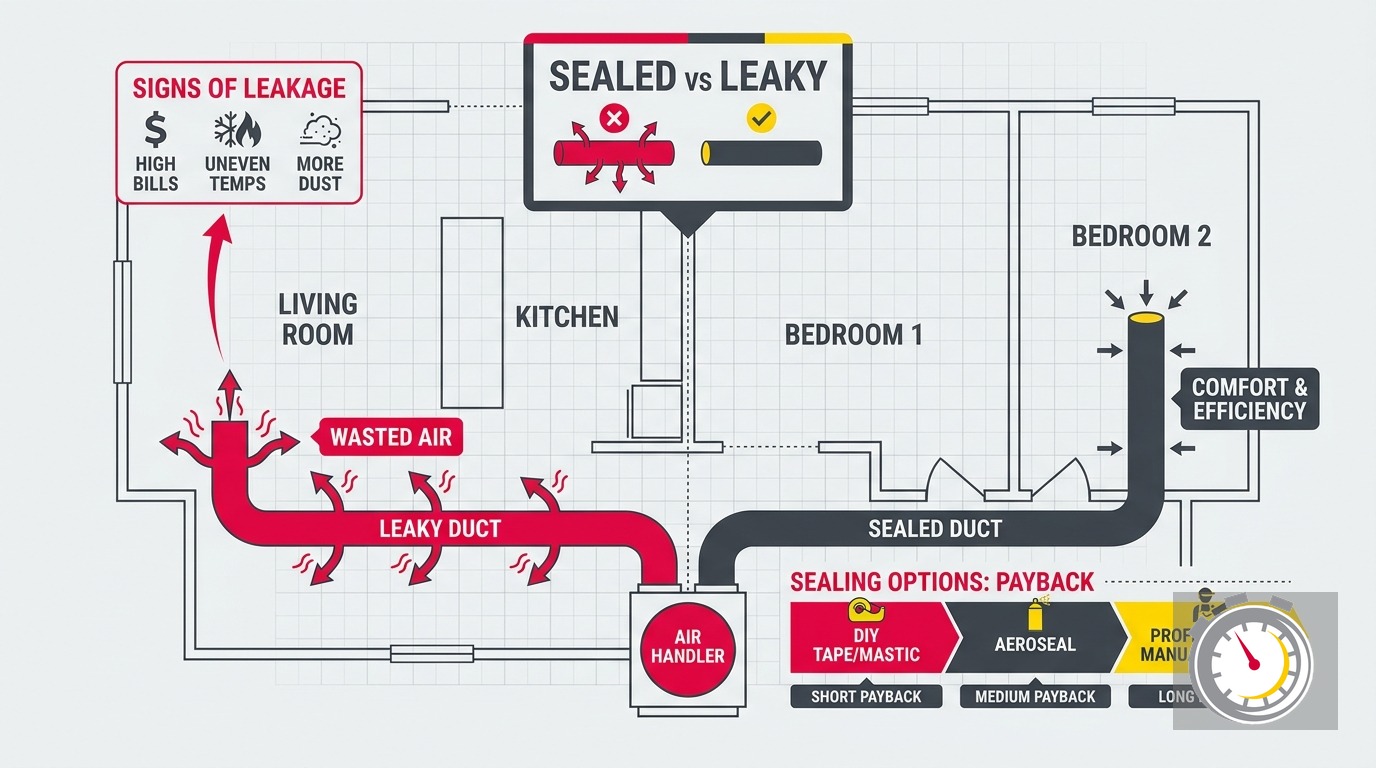
Short answer: The five clearest signs are rooms that never reach thermostat setpoint, utility bills that rise without explanation, excess dust near vents, hissing or whistling at registers, and your HVAC system cycling more often than it used to.
Here’s what to look for:
- Rooms that stay off-temperature. A bedroom that’s always cold in winter or stuffy in summer - no matter where you set the thermostat - is a classic supply-side leak signal. Conditioned air is escaping before it reaches that room’s register. If raising the thermostat doesn’t help, the air isn’t arriving.
- Bills that spike without explanation. If your utility bill rises and nothing changed - same usage patterns, no rate increase - energy is going somewhere. Duct leakage is one of the most common causes in older Minnesota homes.
- More dust than you can explain. Return duct leaks pull air from attics, crawlspaces, and wall cavities directly into the air handler, bypassing the filter. The result is unfiltered debris - dust, insulation particles, mold spores - circulating through your living space. If surfaces near vents dust faster than they used to, check the return duct connections.
- Hissing or whistling near registers. That sound is pressurized air escaping through a gap. It’s most audible near disconnected joints or damaged duct sections and tends to be louder when the system runs at full capacity.
- More frequent cycling. When the system turns on and off more often than normal, it’s usually struggling to reach setpoint because conditioned air is escaping before delivery. We cover the full range of causes in our furnace short cycling troubleshooting guide.
Two or more of these symptoms together is a strong signal. A professional duct assessment with pressurization testing removes the guesswork and tells you where the losses are concentrated.
The Infiltration Multiplier: Why Leaky Ducts Make Your Whole House Leak
This is the part most articles skip. Duct leakage doesn’t just waste the air inside your ducts. It also drives up air infiltration through your entire building envelope while the system runs.
A study at the Florida Solar Energy Center found that whole-house infiltration during system operation can be up to four times higher in homes with leaky ducts than when the system is off. Here’s the mechanism.
Supply duct leaks push conditioned air out of the duct runs and into unconditioned spaces - your attic, wall cavities, or crawlspace. That air has to be replaced. At the same time, return duct leaks pull air from those same unconditioned spaces into the air handler, instead of from your living area. Both effects create pressure imbalances across the building envelope. Outside air rushes in through every crack in your walls, windows, and foundation to equalize.
In a Minnesota winter, that means cold outdoor air infiltrates your home every time the furnace cycles. Your furnace fights duct losses and accelerated envelope infiltration at the same time. The two problems stack.
There’s also an indoor air quality dimension. When return ducts pull air from crawlspaces or attic cavities, that air carries what lives there: moisture, mold spores, insulation fibers, soil gases. Unexplained air quality problems - persistent dust, musty odors, respiratory irritants - sometimes trace directly to return duct leaks pulling contaminated air into the living space.
Duct Sealing Options Ranked by Payback
Not every home needs the same fix. The right approach depends on where your ducts run, how accessible they are, and how extensive the leakage is.
DIY mastic and UL 181 foil tape
For homes with accessible duct runs - open attics, finished basements, crawlspaces where you can see the joints - this is the right first move. Mastic sealant is a thick, brush-applied compound that bonds to sheet metal, flex duct, and duct board. It runs about $10-$15 per quart and covers 40-50 linear feet per quart. Pair it with UL 181-rated foil tape. Total materials: $50-$150. Payback on accessible leaks can be measured in months.
One warning worth repeating, from professional duct sealing guidance: standard cloth “duct tape” - the silver fabric kind in every hardware store - dries out and peels within two to three years. It is not a substitute for mastic. Mastic plus UL 181 foil tape is the correct combination, and it holds.
The hard ceiling on DIY: you can only seal what you can physically reach. Ducts inside finished walls, sealed ceiling cavities, or inaccessible attic runs are off-limits for hand application.
Professional mastic and tape sealing
Professional hand-sealing on a 2,000 sq ft home typically runs $750-$1,550. A technician can reach attic runs, basement connections, and collar joints more effectively than most homeowners can on their own. The system can be pressure-tested before and after to document the improvement.
Payback on the labor investment runs roughly 7-10 years. This option fits best when most duct runs are accessible and you want a verified, documented result.
Aeroseal
When ducts pass through finished walls or sealed ceiling spaces, Aeroseal is the option to consider. A technician pressurizes your duct system with a non-toxic polymer aerosol. The particles travel through the system and bond wherever air escapes - sealing leaks from the inside, including runs inside finished walls that no hand-sealing can reach.
Most single-family homes see 70-95% of leakage sealed, with the seal lasting 20-plus years. Cost for a typical single-family home: $1,300-$3,000. Payback runs 3-5 years - faster than professional hand-sealing despite the higher upfront cost, because Aeroseal reaches the inaccessible leaks that account for the largest share of total loss.
What Do Minnesota Rebates Actually Cover Right Now?
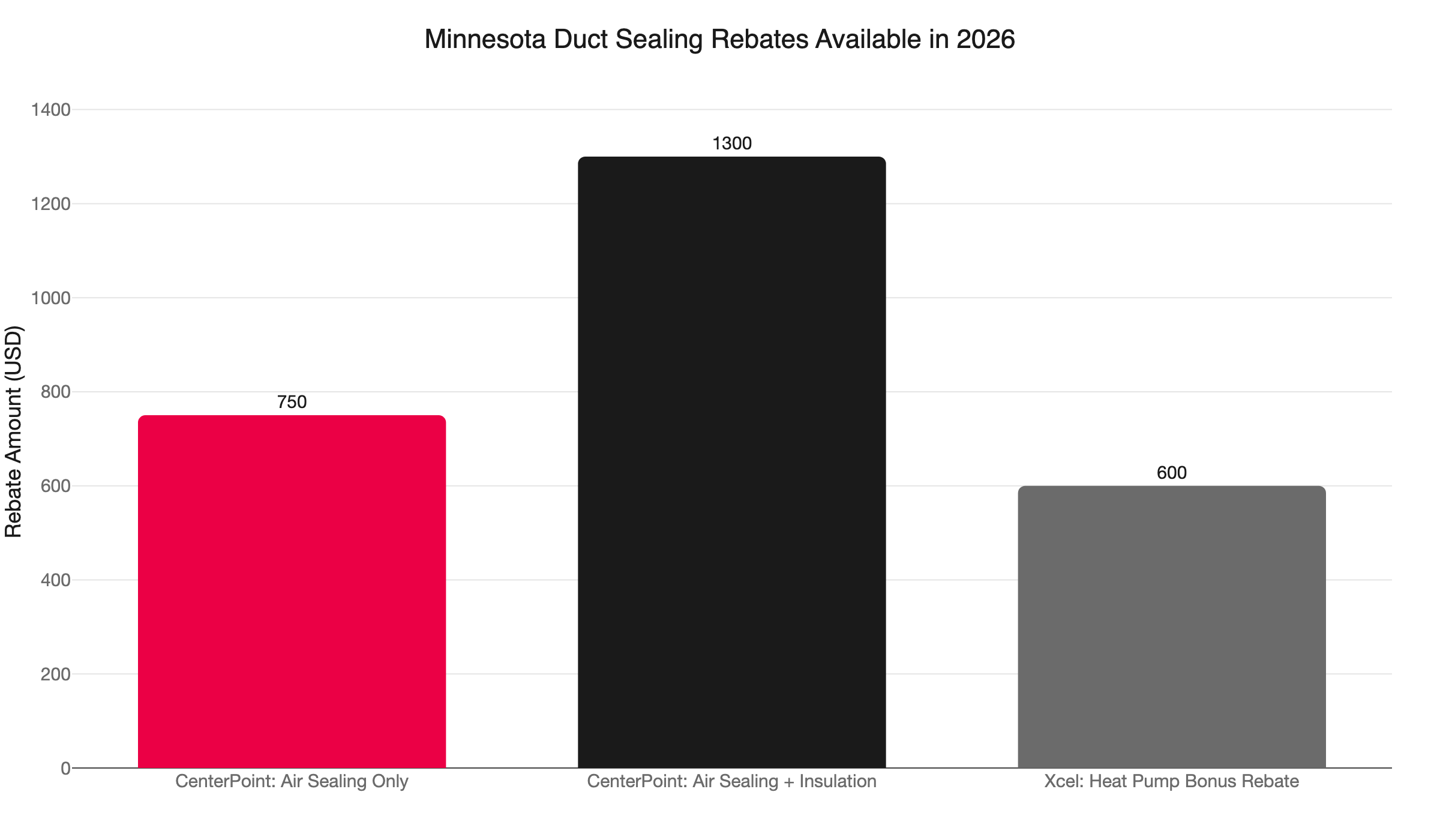
Short answer: CenterPoint Energy offers $750 for attic air sealing alone, or $1,300 if you combine it with a qualifying insulation upgrade. Xcel Energy customers have air sealing rebates available, plus a $600 bonus if a qualifying heat pump is installed within two years. Minneapolis homeowners may qualify for additional city-level incentives layered on top of both programs.
CenterPoint Energy (natural gas customers)
- $750 for attic air sealing
- $1,300 for attic air sealing combined with an insulation upgrade from below R-30 to above R-49
- Applications for 2026 work due by December 31, 2026
- First-come, first-served; there’s no guarantee of funds toward year-end
Full details at the CenterPoint air sealing and insulation rebate page.
Xcel Energy (MN electric and gas customers)
- Air sealing rebates available for qualifying work
- $600 bonus rebate if a qualifying heat pump is installed within two years of the air sealing project
Current figures in Xcel’s MN residential rebate summary.
Minneapolis homeowners
If your home is in the city of Minneapolis, additional incentives may be available through the Minneapolis Bonus Rebate Program via CEE. These layer on top of utility rebates and can meaningfully reduce out-of-pocket cost.
These programs can stack. A Minneapolis CenterPoint customer doing attic air sealing plus an insulation upgrade could see $1,300 from CenterPoint plus additional city incentives. If a heat pump follows within two years, the Xcel bonus adds to that total. Our guide to Minnesota heat pump rebates and tax credits covers how these programs layer for homeowners considering a heat pump upgrade alongside envelope improvements.
Can I Still Claim the Federal Tax Credit for Duct Sealing?
Short answer: No. The IRA Section 25C Energy Efficient Home Improvement Credit, which covered duct and air sealing at 30% up to $1,200 per year, was terminated on July 4, 2025. It does not apply to any work installed in 2026. Many articles in Google results still say it does - those articles are wrong for work done this year.
The One Big Beautiful Bill Act, signed into law July 4, 2025, ended the 25C credit. If you’re budgeting a duct sealing project right now, do not include a federal tax credit in your payback calculation. Claiming it for 2026 work would be incorrect on your return.
The utility rebates from CenterPoint and Xcel are real, current, and active. Those are the incentive programs worth building into your 2026 budget.
Does Duct Sealing Affect Your HVAC Equipment?
Short answer: Yes, positively. Sealing ducts reduces the workload on your furnace, air handler, and air conditioner. Systems that cycle less often and run shorter runs to reach setpoint experience less wear and fewer repair calls over time.
Your heating and cooling equipment is designed to move a specific volume of air at a specific static pressure. When ducts leak, pressure drops across the system. The blower compensates by running longer cycles. More frequent cycling is a visible symptom - and it also accelerates wear on the blower motor, heat exchanger, and compressor.
Restoring proper duct pressure lets the system hit setpoint faster and run normal cycles. Over 5-10 years, that’s real savings in maintenance costs and deferred component replacements. If your equipment is already showing age and you’re weighing repair against replacement, our heating and cooling repair-or-replace guide walks through that decision - and duct sealing is often a reason to favor extending equipment life rather than replacing it first.
What Does Minnesota Code Say About Duct Leakage?
Short answer: Minnesota’s code for new construction caps post-construction duct leakage at 4 CFM25 per 100 sq ft of conditioned floor area. Stud cavities and enclosed floor-joist spaces cannot serve as ducts or plenums under state code. Most homes built before 2010 were never tested to any standard.
Minnesota sits in Climate Zone 6A, one of the most demanding heating climates in the country. New residential construction requires duct leakage testing. The 4 CFM25 per 100 sq ft figure is the pass/fail line. Stud cavities and floor-joist spaces used as makeshift duct runs are explicitly prohibited.
For existing homes, code compliance isn’t enforced retroactively. But the standard gives you a useful benchmark. If your home is more than 15 years old and has never had a duct test, your leakage rate is almost certainly above that threshold. A blower door test paired with duct pressurization shows where you stand and quantifies the improvement after sealing - which is also what most utility rebate programs require as documentation before they write a check.
Where to Start
The right first move depends on your home.
If your ducts run through an accessible basement or open attic, walk the visible runs. Look for disconnected joints, gaps at register boots, and spots where flex duct has pulled away from the collar. These are immediate DIY candidates. About $100 in mastic and UL 181 tape can recover meaningful efficiency on accessible sections.
If your ducts pass through finished walls or sealed ceiling spaces, DIY misses the leaks that matter most. A professional assessment is the right next step.
If you’re seeing multiple symptoms - uneven temps, bills that don’t add up, excess dust, and frequent cycling - the leakage is likely widespread. Get an Aeroseal quote before committing to hand-sealing. The upfront cost is higher, but the payback is faster when leakage is severe or buried in finished spaces.
Start your utility rebate application before the work is done. Both CenterPoint and Xcel have 2026 deadlines, and some rebates require pre-approval or documentation tied to your contractor.
Northern One Hour is locally owned and operated in Ramsey, MN. We serve Minneapolis, St. Paul, Blaine, Maple Grove, Plymouth, Brooklyn Park, Woodbury, Bloomington, and the rest of the Twin Cities area. Our technicians give you straight answers on what they find. No invented problems, no pressure to spend more than the job requires. “Always On Time… Or You Don’t Pay a Dime!(R)” is how we’ve run this business from day one.
Ready to find out what your duct system is actually costing you? Call (763) 260-6662 or book online to schedule an assessment with our team.
Frequently Asked Questions
How much does duct sealing cost in Minnesota? +
Is the federal tax credit for duct sealing still available? +
What signs indicate my ducts are leaking? +
Need a technician now?