
Vents Whistling When Furnace or AC Runs: Causes & Fixes
Key Takeaways
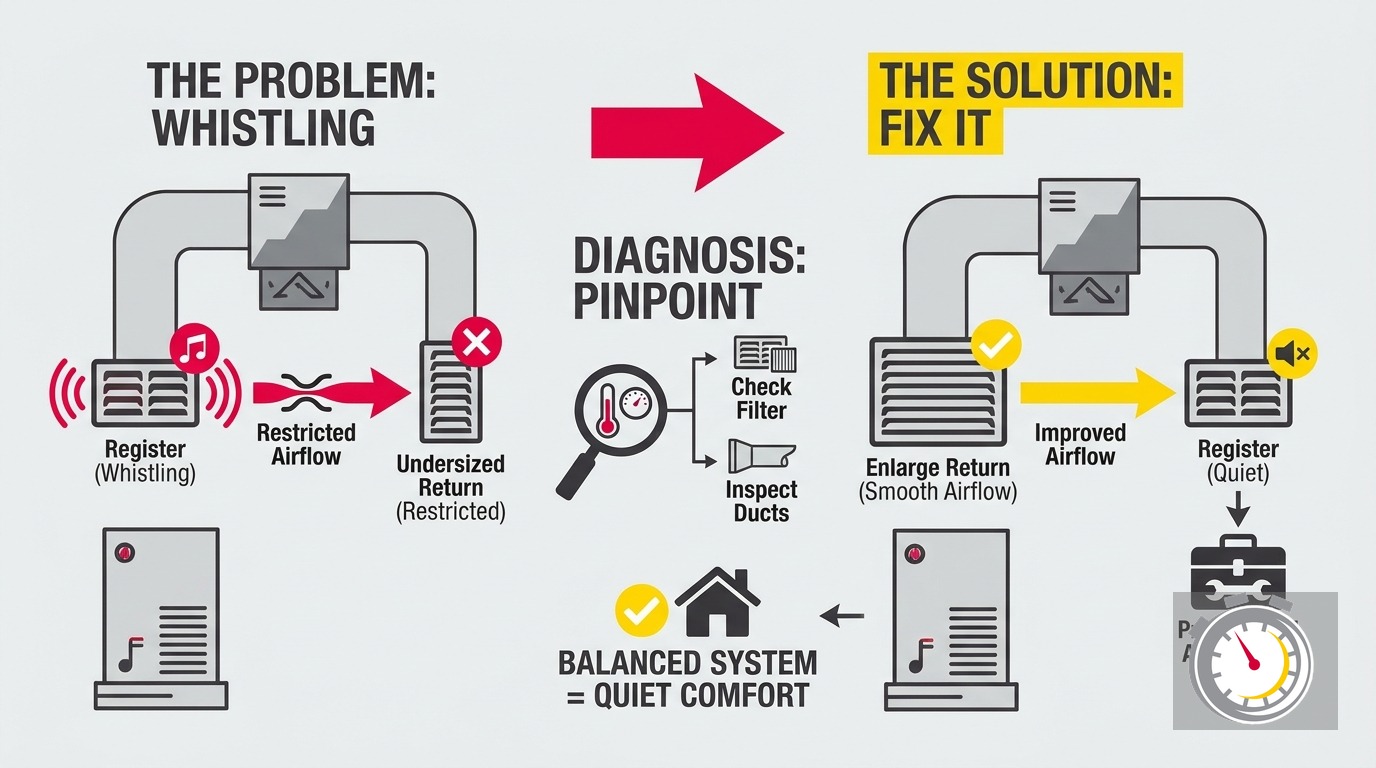
- A whistle from a register or return almost always means air is moving too fast through a small opening.
- The usual causes are a clogged or high-resistance filter, closed vents, an undersized return, or a duct leak.
- Find out where the sound lives first. A whistle at a supply register points one way. A whistle at the return points another.
- Start with the free checks: filter, vents, and return grilles. Do not close vents to quiet a room.
- Foil tape and duct tape are not permanent duct fixes. Mastic is the better material.
- A gas smell, a CO alarm, or a yellow flame is not an airflow problem. Treat it as a safety event.
- A technician can measure static pressure and tell you whether the system is breathing normally.
Why are my vents whistling when the furnace or AC runs?
Whistling vents usually mean air is squeezing through an opening that is too small for the amount of air the blower moves. The cause is often a clogged filter, closed vents, a leak, or an undersized return. The fix depends on which one you have.
Blowing through a straw is harder and louder than blowing through an open pipe. Push the same air through a smaller hole and it speeds up. A whistle is the sound of high air speed.
Your blower moves a set amount of air every minute. It needs a path in and a path out. When either path is too small, the air speeds up at the tightest point, and that point whistles.
Most whistles are fixable. Many start with something simple, like a filter. Others need a bigger return or sealed ducts.
A whistle is also a warning. The system may be working harder than it should, and that strain adds up over a Minnesota heating season and again over a cooling season.
We are a locally owned and operated Twin Cities HVAC company. We hear this complaint every fall, when the furnace first runs hard. We hear it again in July, when the AC takes over.
How can I tell if the whistle is on the supply side or the return side?
Stand near the noise and listen. A whistle at a supply register means air is leaving too fast or through a partly blocked opening. A whistle at the return grille or filter slot means air is entering too fast. Where you hear it tells you where to look.
Your duct system has two halves. The supply side pushes conditioned air out into rooms. The return side pulls room air back to the furnace or air handler.
Use this quick sorting guide:
- Whistle at a supply register: Look for a partly closed damper, a blocked register, a crushed flex duct, or a leak near the register boot.
- Whistle at a return grille: Look for an undersized grille, a dirty filter behind it, or a dense filter that the grille cannot feed.
- Whistle at the filter slot or furnace cabinet: Check for a poorly seated filter, a missing slot cover, or a gap where air sneaks in.
- Whistle in the ductwork between rooms: Suspect a small leak, a pinched section, or a damper set too far closed.
Try a simple test. Turn the system fan on and walk the house. Hold your hand near each register and return. Note where the air feels fast and where the sound peaks.
Then stand at the return with the system running and put your hand on the grille. Strong suction that pulls the grille toward the wall is a clue. The return is working hard.
Write down what you hear and where. That note saves time when a technician arrives and helps us trace the problem faster.
Pay attention if the whistle changes with the thermostat. A whistle only on high speed points to a restriction that the faster blower exposes. A whistle only in cooling mode often points to airflow across the cold coil.
Is a dirty or high-MERV filter making my vents whistle?
Yes, it can. A clogged filter starves the blower of air, and the air rushes through whatever gaps remain. A dense, high-MERV filter can do the same thing even when it is brand new. Check this first. It costs almost nothing.
MERV rates how fine a filter catches particles. Higher numbers catch smaller particles, but they also resist airflow more. Many systems were never built to pull air through a very dense filter.
A common story goes like this. A homeowner wants cleaner air and buys a high-MERV filter. The system now has to pull harder to get the same air. The return whistles, the blower works harder, and the house gets less airflow.
We cover this in detail in our guide on how thick, high-MERV filters restrict furnace airflow. Read it if you recently upgraded your filter and the noise started right after.
Check these filter points first:
- Look at the filter. Hold it up to a light. If you cannot see light through it, replace it.
- Check the size. A wrong-size filter leaves gaps or crushes into the slot. Our post on wrong-size filters and airflow damage explains the risks.
- Check the slot cover. A missing cover lets air bypass the filter and can whistle at the gap. See our note on missing filter slot covers.
- Check the direction. The arrow on the filter frame should point toward the blower.
- Try a lower-resistance filter. If the whistle stops, the filter was the limit.
If you want better filtration without the whistle, use a larger filter cabinet or a media filter with more surface area. More surface means less speed through each square inch. Our team can show you options.
How often should you change it? That depends on your home, pets, and filter type. Our guide on how often to change your HVAC filter lays out the schedule.
Can an undersized return cause whistling?
Yes. An undersized return is one of the most common hidden causes. The return grille or duct is too small for the air the blower moves, so air speeds up as it squeezes in. The result is a whistle at the grille, a hum in the wall, and weak airflow in distant rooms.
Return air gets less attention than supply air. Many homes have one big return, or a few small ones. Older Twin Cities homes were often built with minimal returns. Later upgrades added bigger furnaces and higher-efficiency blowers on the same old ductwork.
The math is simple. Air volume divided by opening area equals air speed. Raise the volume or shrink the opening, and the speed goes up. Noise rises quickly with speed.
Signs your return is the bottleneck:
- The whistle sits at one return grille, and it grows louder when the system runs.
- Doors slam or pull shut when the blower starts.
- Rooms far from the return stay too hot or too cold.
- The filter pulls inward or bows toward the blower.
- The whistle is worse with a clean, dense filter than a loose one.
Our full guide on return air problems in Twin Cities homes shows how these issues show up in real houses.
A technician can pick from a few fixes:
- Add a return. A second return gives the blower a bigger path in.
- Enlarge the existing return. A bigger grille and duct cut the air speed.
- Install a larger filter grille. More filter area means slower air through the media.
- Open up restrictive fittings. Tight elbows and pinched runs add resistance.
There is no shortcut. A return has to be sized to the air the system moves, and a technician who measures the system can size it correctly. A guess often leads to a second whistle.
Bedroom doors can matter too. A closed door can trap supply air in a room with no return path. Read our post on closed bedroom doors and HVAC pressure for how that works.
Could closed vents or leaky ducts cause the whistle?
Both can. Closed vents raise pressure inside the ducts and force air through the open registers at higher speed. Leaks can whistle at small gaps or pull in air that bypasses the return. Either one changes how the whole system breathes.
Start with closed vents. Many homeowners close vents in unused rooms, thinking it saves energy. It rarely does. The blower still moves the same air and has fewer places to put it. Pressure climbs, and air screams through the remaining registers.
Our post on the myth of closing vents in unused rooms explains why this backfires. If you closed vents for winter, open them all and listen again.
Dampers matter too. Many systems have manual dampers inside the ducts, and a damper set too far closed can whistle at the register. Minnesota’s mechanical code addresses this. Volume dampers must be adjusted to the required airflow of the system and locked in place. A technician sets them during balancing. If someone bumped one, it may have shifted.
To learn how balancing works, see our guide on how to balance HVAC registers.
Now leaks. A duct leak can whistle where air escapes through a small seam. A leak on the return side pulls unfiltered air from an attic, crawl space, or wall cavity. Both waste energy.
The U.S. Department of Energy notes that sealing and insulating ducts in unconditioned spaces is usually very cost effective. In Minnesota, that often means attic runs, basement trunk lines, and rim joist areas.
Our post on duct sealing and energy loss walks through what a proper seal looks like. For ducts in cold spaces, see also duct insulation in the attic.
What sealing material should be used?
Skip standard cloth duct tape. It dries out and lets go. For gaps, the DOE job aid on sealing ducts recommends mastic with fiberglass mesh tape and says to apply mastic over all of the mesh tape.
Mastic is a paste. It fills gaps and stays flexible, and it lasts far longer than tape. Foil tape rated for ducts can have a role at some seams, but it is not a cure-all.
Do not tape a duct and call it done. If you find a gap, mark it and tell us. We seal it the right way.
Is it safe to seal only one side?
Be careful. Sealing changes how air moves through the house. DOE building science material warns that sealing only the supply or return side can create a backdrafting risk, which can be checked with pressure mapping.
Backdrafting means exhaust gases get pulled back into the home instead of going up the flue. That matters in homes with gas appliances. Our post on gas fireplaces and furnaces sharing combustion air explains how pressure swings cause trouble. Have a pro look at the whole system before big sealing jobs.
Why is my air conditioning whistling?
An AC whistles for the same reason a furnace does: restricted airflow. A dirty filter, a frosted coil, closed vents, or a small return can all raise air speed. A cold coil adds one more cause. Ice or dirt on the coil blocks air and makes the supply registers whistle.
Air moves across the evaporator coil, which sits inside the air handler or on top of the furnace. When that coil is dirty or iced over, air struggles to pass. The blower pushes harder, and the registers whistle.
Look for these cooling clues:
- Weak airflow at the registers, along with the whistle.
- Ice on the indoor coil or the refrigerant line.
- Water around the air handler.
- Rooms that never cool down on hot days.
Our guides on a frozen evaporator coil and a dirty evaporator coil cover what to do next. If you see ice, shut the AC off and run only the fan so the ice can melt.
Minnesota summers bring humidity swings, and a coil that runs wet can collect dirt faster. That is one reason a yearly tune-up pays off. See what a visit covers in our post on what an AC tune-up includes.
You may read online that whistling plus an AC shutoff always means a refrigerant leak. That is not a safe rule. A whistle is an airflow sound. Refrigerant problems show up as poor cooling, ice, or hissing at the lines. A technician should check before anyone guesses.
If your AC runs but the house stays warm, our post on AC blowing warm air from the vents helps you sort it out. For a broader look at noise, see why your AC is so loud.
When should I worry about furnace noise?
Worry when the sound changes, grows louder, or comes with other symptoms. A steady airflow whistle is a nuisance and a hint of strain. A gas smell, a CO alarm, a yellow flame, or soot is an emergency. Know the difference before you decide.
Furnaces make many sounds. Some are normal and some are not.
Treat as a safety event right now:
- You smell gas. Leave the home and call your gas utility from outside. Our guide on what to do about a gas smell near the furnace lists the steps.
- Your carbon monoxide alarm sounds. Get everyone out and call 911. See our post on CO alarms going off near a furnace.
- The burner flame is yellow or orange instead of steady blue. Read yellow versus blue flame.
- You see soot, scorch marks, or smell burning plastic.
Call us soon, but it is not an emergency:
- A whistle that starts after a filter change.
- A whistle that grows over a few days.
- Weak airflow with a loud blower.
- The furnace shuts off and restarts on its own.
Usually normal:
- A brief sound as the blower starts and stops.
- Gentle ticking as ducts heat and cool. See our post on ductwork ticking and popping.
Banging, squealing, and booming are not airflow whistles. Our guides on banging, popping, and squealing and loud booms from delayed ignition help you tell them apart.
A furnace that overheats from poor airflow can trip its safety switches. It may short cycle or shut down. If your furnace turns on and off in short bursts along with the whistle, see our post on furnace short cycling.
What does high static pressure have to do with whistling?
Static pressure is the resistance your ducts, filter, and coil put against the blower. High static pressure means the blower is pushing against too much resistance. Whistling is one of the audible symptoms. A technician measures it to see how restricted your system really is.
Think of blood pressure for your ductwork. A doctor measures it instead of guessing. A technician does the same with a manometer, a small gauge that reads pressure.
A technician reads it this way:
- Measure on both sides of the blower. One reading comes from the return side and one from the supply side.
- Add the readings. The total is the external static pressure the blower works against.
- Compare to the equipment rating. The furnace or air handler has a rated limit on its data plate.
- Check pieces one by one. Measure the pressure drop across the filter and the coil to find the biggest restriction.
The measurement gives you the real answer. A guess might say “change the filter.” A measurement might say “the return is the problem, not the filter.”
The reading also separates supply-side from return-side trouble. A big drop across the filter and return points to the return. A high supply-side reading points to small ducts, a crushed run, or closed dampers.
Our guide on high static pressure symptoms and fixes goes deeper. If a new furnace was installed on old ducts, the numbers often tell the story.
Variable-speed blowers can hide some problems by ramping up to hold airflow. The whistle may then show only on some speeds. Read about variable-speed blower motors if you have one.
Why do Minnesota homes whistle more in winter?
Winter pushes the furnace to high duty, and Minnesota homes are often tight, older, or retrofitted. Longer run times mean faster, more sustained airflow. Add closed rooms, cold attic ducts, and dense filters, and small restrictions turn into noise you can hear.
Several local factors stack up:
- Long heating season. Our furnaces run for months. A marginal return that was quiet in October gets loud in January.
- Tight, retrofitted homes. Air sealing and new windows make a home tighter, and tight homes make return problems more obvious. Our post on air sealing before an HVAC upgrade covers the tradeoffs.
- Basement and attic duct runs. Ducts in cold spaces leak and sweat. They also get crushed or kinked in tight framing.
- Closing off rooms. Many families shut vents in guest rooms to save heat. That raises pressure and noise.
- Added fireplaces and exhaust fans. These change house pressure and can affect airflow. See our post on exhaust fans and furnace backdraft.
- Flex duct problems. Long, sagging flex runs choke airflow. Read about flex duct problems.
Your furnace may also be mismatched to the ducts. Replacing only one part of a system is a common cause. If you swapped an AC or furnace without checking the ductwork, our post on replacing just the AC or furnace explains why mismatches cause noise and poor comfort.
What can I fix myself, and what needs a technician?
You can handle the free checks: filter, vents, and visible grilles. A technician should handle anything that needs measurement, duct changes, sealing, or gas-side work. Do the simple steps first. Stop when the noise persists or a safety sign appears.
Do these yourself, in order:
- Replace the filter. Use the right size and a filter your system can breathe through.
- Open every vent. Check all supply registers and return grilles.
- Clear the returns. Move furniture, rugs, and curtains away from grilles.
- Check the filter slot. Make sure the cover is on and the filter sits flat.
- Listen again. Run the fan on its own and note any change.
- Take a quick look at exposed ducts. In a basement, look for crushed sections or disconnected joints.
Leave these to a technician:
- Measuring static pressure.
- Resizing or adding returns.
- Sealing ducts with mastic.
- Adjusting and locking dampers.
- Any work near the burner, flue, or gas valve.
- Cleaning the blower wheel or coil. See our note on dirty blower wheels.
Do not stuff foam or cloth into a grille to quiet it. That makes the restriction worse. Do not remove the filter to stop the whistle either. That lets dirt into the blower and coil.
If the DIY steps do not help, schedule a visit. Our furnace repair and air conditioning repair teams both diagnose airflow noise. A routine furnace tune-up is also a good time to have airflow measured.
What does fixing a whistling vent cost in the Twin Cities?
Cost depends on the cause. A filter swap is cheap. A tune-up visit often runs about $95 to $250. Duct sealing starts around $1,300, and a full ductwork replacement runs about $6,500 to $13,000. A technician can give you a firm number after measuring.
Here is how the common fixes line up:
| Fix | Typical cost |
|---|---|
| New filter | Low; you can do it yourself |
| Single tune-up visit with airflow check | $95-$250 |
| Annual maintenance plan | $195-$390 |
| Duct sealing | Starting around $1,300 |
| Full ductwork replacement | $6,500-$13,000 |
These are Twin Cities installed ranges, with parts and labor. Your home may fall outside them. A complex return addition or hard-to-reach duct run can cost more.
For bigger work, see our posts on ductwork replacement cost and HVAC air balancing after installation. If the whistle is a symptom of an old, mismatched system, the answer may be a full replacement. Our guide on the best time to buy an HVAC system in the Twin Cities helps you plan.
Larger jobs may qualify for financing. Ask us about options when you get a quote. Our post on HVAC financing options explains what to expect.
Rebates may also help with air sealing. Xcel Energy’s Minnesota residential rebate summary mentions air sealing rebates. Amounts and conditions change, so check Xcel’s current program before you count on one. Our guide to Xcel and CenterPoint HVAC rebates is a good starting point.
How do we find and fix the whistle?
We listen, measure, trace, and fix. We do not guess and swap parts. We find the point where air speeds up, then correct that point. Our goal is a quiet system that moves the air your home needs.
A visit goes like this:
- We listen with you. You show us where and when the whistle happens.
- We check the basics. Filter, vents, returns, and the filter slot.
- We measure static pressure. We read the system the way the manufacturer intended.
- We trace the noise. We follow it to a grille, damper, leak, or small run.
- We explain your options. You get plain language, honest pricing, and no pressure.
- We fix it and recheck. We measure again so you can hear and see the difference.
We are a locally owned and operated Twin Cities company, backed by the national One Hour Heating & Air Conditioning name. Our crews know Minnesota homes, from older Minneapolis bungalows to newer builds in Blaine and Maple Grove.
We also keep our word on timing. Our promise is “Always On Time… Or You Don’t Pay a Dime!(R)” We arrive within the time window you select. If the technician does not show up on time, you do not pay for the service. Read more about why that matters in our post on on-time service in the Twin Cities.
Next steps
A whistling vent is often a small problem. Sometimes it points to a deeper airflow problem. Either way, you do not have to live with the noise.
Start with the free checks today. Replace the filter, open the vents, and clear the returns. If the whistle stays, call us.
Call (763) 260-6662 or book online. We will find the restriction and fix it the right way.
Frequently Asked Questions
Will a whistling vent damage my furnace or AC? +
Why does the whistle get louder after I change the filter? +
Can I fix a whistling return grille with tape? +
Does closing vents in unused rooms stop the whistling? +
Is a whistling sound ever a gas or carbon monoxide problem? +
How long does a whistling diagnosis take? +
Need a technician now?