
Furnace Making Banging Noise? Five Sounds, Five Root Causes
Key Takeaways
- A startup boom means delayed ignition. Dirty burners let gas accumulate before lighting. Call the same day.
- Metal scraping while the furnace runs means shut it off now. A loose blower wheel can crack the heat exchanger.
- A continuous running knock points to worn blower motor bearings. It will escalate quickly if ignored.
- A high-pitched squeal signals dry bearings or a worn belt. Schedule service before it turns into a grind.
- Pops and creaks during heat-up or cooldown are usually harmless ductwork expansion. In Minnesota, they are louder than in mild climates because of extreme cold-start temperature swings.
- Any persistent startup bang on a furnace older than 15 years warrants a heat exchanger inspection.
- A cracked heat exchanger can leak carbon monoxide into your living space. Working CO detectors are non-negotiable.
- 2026 rebates from CenterPoint, Xcel, and the federal 25C program can meaningfully reduce the cost if replacement turns out to be the right call.
Is Your Furnace Making a Banging Noise?
When your furnace is making a banging noise, the specific sound matters more than the volume. A startup boom is not the same as a running knock. A metal scrape is not the same as an expansion creak. Each sound maps to a different root cause, a different part, and a different level of urgency.
Treating them all as one problem is how homeowners end up ignoring a shut-it-down situation or panicking over normal ductwork.
This guide covers five distinct furnace sounds. For each one, you get the root cause, the urgency level, and exactly what to do next.
Sound 1: What Causes a Banging Noise When Your Furnace Starts Up?
Delayed ignition. Dirty burners let gas build up before catching. When ignition finally happens, the accumulated gas fires all at once. The result is a boom. It is a gas safety risk and a heat exchanger threat. Call the same day.
This is the most common cause of a furnace making banging noise, and the one that deserves the most urgency.
Here is how it works. Your furnace opens the gas valve and waits for the burners to light. When the burners are coated with dust, dirt, or buildup, ignition takes longer. Gas keeps flowing while the system waits. When the burners finally catch, they ignite not just the current gas flow but the accumulated backlog. That is the boom.
Why this is more than a noise problem:
Repeated startup booms put thermal stress on the heat exchanger. The heat exchanger separates combustion gases from the air moving through your home. A crack in it creates a path for carbon monoxide to enter your living space. Heat exchangers are designed to last 15 to 20 years, but repeated ignition stress shortens that lifespan.
ENERGY STAR’s maintenance checklist includes inspecting the starting cycle for correct startup, operation, and shutoff. That check is specifically designed to catch dirty burners and ignition timing problems before they cause damage.
What to do:
Call for service the same day. A technician will clean the burners, check ignition timing, and inspect the heat exchanger for cracks. If you also smell gas after the boom, turn off the furnace, leave the house, and call your gas company first.
Do not wait for a tune-up appointment two weeks out. Delayed ignition is a gas safety issue. Our post on cracked heat exchanger signs in Minnesota explains what the follow-on risk looks like and what signs to watch for.
Sound 2: Metal Scrape or Grind - Should You Shut the Furnace Off?
Yes. Turn it off now. Metal scraping while the furnace runs means the blower wheel has shifted and is hitting the housing. If a fan blade breaks free, it can crack the heat exchanger wall. Shut off at the thermostat and call for service.
This is the most urgent sound on this list, and the one most articles underplay. They mention scraping and say “call a technician.” They do not explain the mechanism. Here is why the urgency is higher than everything else.
The blower wheel spins at high speed inside a housing. When the mounting comes loose, the wheel shifts toward the housing wall. The blade tips drag against metal. That contact wears the blades down and can snap one off entirely. A broken blade fragment, traveling at blower speed, can punch through the thin metal wall of the heat exchanger.
What started as a mechanical problem becomes a carbon monoxide risk. What might have been a $375 repair becomes a $1,950 heat exchanger job, or full unit condemnation if the damage is severe enough.
What to do:
Turn off the furnace at the thermostat. If there is a service shutoff switch or disconnect near the unit, use that too. Do not restart the furnace until a technician has cleared it.
Call Northern One Hour at (763) 260-6662. We are locally owned and operated in Ramsey, Minnesota, and we take same-day calls seriously when safety is involved. Our post on carbon monoxide safety during furnace season covers what to watch for after an event like this.
Sound 3: Furnace Making a Banging Noise While Running - What Does a Running Knock Mean?
Worn blower motor bearings or an out-of-balance blower wheel. The knocking happens while the furnace runs, not just at startup. It will get worse fast. Schedule service within a few days.
A continuous running knock is a different problem from a startup boom. The boom is a gas event. The running knock is mechanical.
Two things cause this sound. First, blower wheels accumulate dirt on their fins over time. When one side collects more debris than the other, the wheel goes out of balance. An unbalanced wheel wobbles and knocks as it spins. Second, the ball bearings inside the blower motor wear over time. Worn bearings let the shaft wobble, which produces the same knocking or rattling sound.
What happens if you ignore it:
Knocking escalates to grinding. Grinding means metal-on-metal contact without lubrication. At that point, the motor fails. A dead blower motor stops your furnace from moving heat through your home entirely. Letting it fail completely can also stress adjacent components and shorten their lifespan.
What to do:
Schedule service within the next few days. This is not a shut-it-off-now emergency the way scraping is, but it is not a wait-until-spring situation either. A technician can lubricate the bearings, rebalance the wheel, or replace the motor if it is too worn to service.
The DOE recommends a professional furnace inspection each fall, noting that maintenance can reduce heating costs by 10% or more and extend equipment life. Annual inspections are designed to catch worn bearings before they produce a knock.
Sound 4: High-Pitched Squeal or Whine
A squeal that starts during normal operation usually means one of two things: dry shaft bearings in the blower motor, or a worn belt on older belt-drive blower systems.
Dry bearings squeal before they grind. A belt that has stretched or cracked will slip and whine as the motor drives it. Either way, the sound means something is wearing out. It is not failing yet, but it is heading that way.
Urgency level: Schedule service soon. This is not a shut-it-off emergency, but letting it go will turn a minor repair into a major one.
What to do:
Call to book a service appointment. Mention the squeal when you call so the technician brings the right parts. If you are not already on a regular maintenance schedule, ask about it when you call. Annual maintenance is the most cost-effective way to catch these wear indicators before they become emergency calls in the middle of a Minnesota winter.
Is a Pop or Creak During Heat-Up Normal?
Usually yes. A pop or creak right as the furnace starts moving warm air, or just as the system shuts down, is typically ductwork expanding and contracting. It is generally harmless. Note it if the sound gets noticeably louder from one season to the next.
Your duct system is a network of sheet metal. When the furnace fires and hot air enters those ducts, the metal expands. When the system shuts off and the ducts cool, the metal contracts. Both movements produce pops and creaks, mostly in the first minute of a heating cycle and again at shutdown.
When expansion noise is not just expansion noise:
Ductwork pops worsen with undersized or poorly supported duct runs. If your ducts were not sized correctly during installation, the movement is more dramatic. Loose hangers or missing supports make it worse. Duct leaks also affect how the system pressurizes and can amplify these sounds.
If the pops are getting louder season over season, or if you hear them mid-cycle rather than just at startup and shutdown, have a technician take a look.
The Minnesota factor:
At -20 degrees Fahrenheit, ductwork thermal shock is more extreme than in any mild climate. Your ducts go from near-zero to well above 100 degrees in seconds when the furnace fires. Pops are louder and more frequent here than the same system would produce in a warmer state.
The timing clue helps: expansion pops happen in the first 30 to 60 seconds of a heating cycle. A delayed ignition boom is a single sharp event at the exact moment the burners try to light. If the bang is followed immediately by the sound of normal operation, it was probably expansion. If it is sharp and isolated right at the start of the cycle, it is more likely ignition.
What Does a Cracked Heat Exchanger Have to Do with Carbon Monoxide?
Everything. The heat exchanger keeps combustion gases separate from the air your family breathes. A crack lets those gases cross over. Carbon monoxide is colorless and odorless. You will not smell it. A furnace making banging noise at startup is a reason to get the heat exchanger inspected now, not just the burners.
A cracked heat exchanger can leak carbon monoxide, and CO poisoning accounts for more than 20,000 emergency room visits per year in the United States. One visible warning sign is a flame that burns yellow or orange instead of a steady blue. CO detectors may not alarm until dangerous concentrations build. Do not rely on detectors alone if you know your heat exchanger is at risk.
Exchangers are designed to last 15 to 20 years. Dirty filters restrict airflow and cause overheating, which shortens that lifespan. Repeated ignition booms cause thermal shock. Physical damage from a loose blower can crack or puncture the metal wall.
If your furnace is older than 15 years and you are hearing startup booms, ask your technician to specifically inspect the heat exchanger. The cost of that inspection is small. The cost of ignoring a crack is not.
For the visual signs to watch for before a technician arrives, see our post on cracked heat exchanger signs in Minnesota.
Why Minnesota Winters Make Furnace Sounds Harder to Diagnose
Minnesota homeowners hear more from their furnaces than homeowners in mild climates. That is not paranoia. It is physics.
When your furnace fires up after a night that dropped to -20 degrees outside and 62 degrees inside, every piece of metal in the system expands rapidly. Ducts, cabinets, heat exchanger cells, and flue pipes all move. The result is a series of pops and bangs during the first minutes of a heating cycle that would not happen to the same system in a warmer climate.
This creates a real diagnostic problem. A thermal expansion pop sounds different from an ignition boom in a controlled setting. At 6 a.m. in January, when you are half awake and the furnace just made a loud noise, the distinction is not obvious.
Use timing as your guide:
A thermal expansion pop happens during the first 30 to 60 seconds of a heating cycle as metal warms and air starts flowing. A delayed ignition boom is a single sharp event at the exact moment the burners try to light. If the bang is followed immediately by normal operation, it was probably expansion. If it is sharp and isolated right at the start of the cycle, treat it as a possible ignition event.
When you are genuinely unsure, call us. It is better to have a technician tell you it was just ductwork than to let a burner problem run through an entire Minnesota winter.
The DOE’s furnace maintenance guidance includes combustion chamber inspection for cracks and a combustion efficiency test as standard parts of annual service. Both checks help professionals accurately separate thermal noise from combustion problems.
Should You Repair or Replace If the Sound Points to Something Big?
It depends on the furnace’s age and the scope of the repair. A blower motor on a furnace under 10 years old is almost always a clear repair. A cracked heat exchanger on a furnace over 15 years old is often a clear replace. The math in between requires a technician’s assessment.
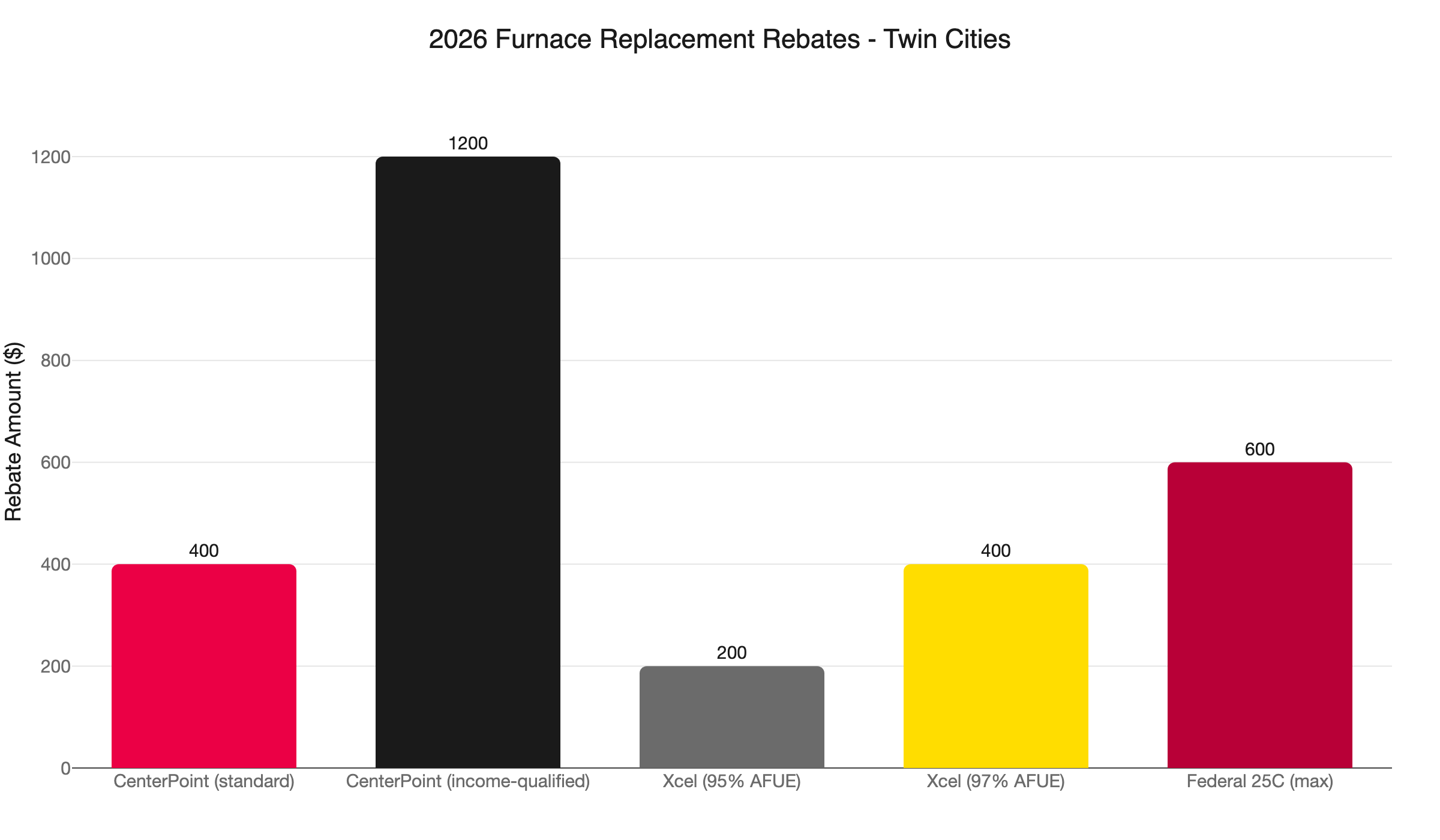
If the diagnosis points to a cracked heat exchanger or a major blower failure on an aging system, replacement deserves a serious look. A new 95%+ AFUE furnace qualifies for meaningful rebates in 2026.
What is available in the Twin Cities:
- CenterPoint Energy: up to $400 for a 95%+ AFUE gas furnace; up to $1,200 for income-qualified households
- Xcel Energy: $200 for 95% AFUE; up to $400 for 97% AFUE
- Federal 25C tax credit: 30% of qualifying equipment cost, up to $600 for furnaces
Stacking two or three of those programs can bring the out-of-pocket cost down considerably.
One more item to know: furnace replacement requires a mechanical permit in virtually all Minnesota jurisdictions under state law. Permits typically run $95 to $250 and are pulled by your licensed contractor. We handle that paperwork as part of every installation. You should not have to manage it.
For a full breakdown of costs and the repair-vs.-replace decision, see our post on furnace replacement cost in the Twin Cities. If the upfront cost is a concern, ask about financing when you call.
Get It Diagnosed Today
A furnace making banging noise is not something to wait out through the next cold snap. Some of these sounds mean your heating system is one cycle away from a much larger problem or a safety issue.
Northern One Hour is locally owned and operated in Ramsey, Minnesota. We serve the Twin Cities, including Minneapolis, St. Paul, Blaine, Maple Grove, Plymouth, Brooklyn Park, Woodbury, and Bloomington. Our team shows up when we say we will. “Always On Time… Or You Don’t Pay a Dime!(R)”
Call (763) 260-6662 or book your furnace repair online today.
Frequently Asked Questions
Why does my furnace make a loud banging noise when it starts? +
What furnace sound means I should turn it off immediately? +
Can furnace noises cause a carbon monoxide leak? +
Need a technician now?